
Outdoor plant
Monkey Puzzle
Araucaria araucana
Also known as Chile Pine, Pehuen
How to grow monkey puzzle, Araucaria araucana. A lone tree never cones, since each is either male or female, it takes a century to develop the bare-trunked umbrella shape, and the species is endangered in the wild yet common in gardens.
At a glance
- Difficulty
- Moderate
- Water
- Regularly for the first two or three years, then rarely
- Light
- Full sun
- Temperature
- Fully hardy once established; young trees dislike hard late frost
- Hardiness
- USDA 7-10, RHS H5, hardy to -15 C
- Type
- Evergreen conifer, extremely long lived
- Height
- 25-40 m
- Native to
- Chile, Argentina
Survives winters well below freezing once its root system is established, but a young tree still in its first few years can be checked by a hard late frost before the bark has thickened. The bigger limit is summer. It comes from a volcanic highland with cool, humid summers, and a long hot dry season leaves it scorched and slow rather than killed outright, which is why it thrives in Cornwall and coastal Pacific Northwest gardens and sulks through a continental summer.
Hardiness zones describe winter cold alone. Summer heat, humidity, rainfall and the length of the growing season decide as much, so treat the range as the outer limit rather than as a recommendation.
Not known to be toxic
Monkey puzzle is not listed by the RHS among potentially harmful garden plants and does not appear on the ASPCA's toxic plant index. The seeds, known as pinones, are a genuine food crop in southern Chile and Argentina, roasted or boiled and eaten much like a large pine nut, and they carry no recorded toxin. The real hazard is mechanical rather than chemical. Every leaf ends in a rigid point sharp enough to draw blood, packed along the branches in overlapping rows, so a fall into a mature tree or careless handling of a fallen branch is a wound risk for children, pets and gardeners alike, not a poisoning one.
Sources: RHS potentially harmful garden plants, ASPCA toxic and non-toxic plants
About
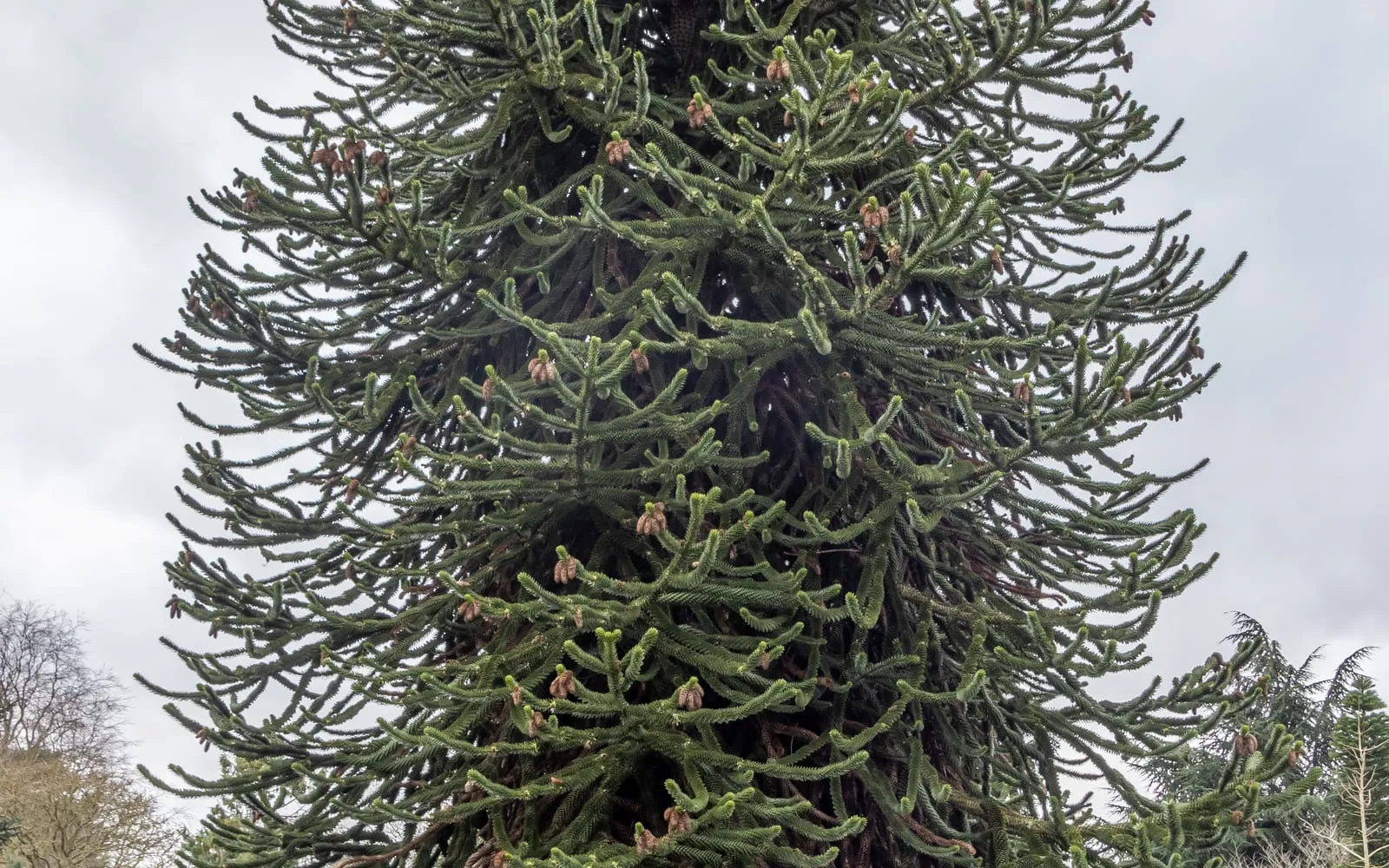
Monkey puzzle is one of the strangest trees any garden can hold, a conifer with none of the softness the word usually implies. Every branch is wrapped in stiff, triangular, dagger-tipped leaves rather than needles, arranged in tight spirals that give the whole tree a reptilian look closer to a fossil than to a pine.
A young specimen is a dense, symmetrical cone reaching almost to the ground. Over decades the lower branches drop away and the trunk clears, leaving a bare grey pole carrying a flat, spoked crown high overhead, the shape most people picture when they hear the name. That change takes the tree the better part of a century, which is a fair summary of how it grows.
It is a male or a female tree, never both, and only a female bears the huge cones that break apart on the ground into large edible seeds. A single specimen planted alone will never cone; two are needed, and even then coning starts only once the tree is mature.
Appearance and character
The leaves are the identification on their own. Thick, leathery, triangular and dark glossy green, each one tapering to a sharp point and overlapping the next like scales on a pangolin, they cover the young shoots, the older branches and even sections of trunk that have not yet shed them, since a monkey puzzle keeps its leaves for fifteen years or more before they finally drop.
Branches grow in whorls around the trunk, spaced by a season’s growth, so an old tree reads almost like a tiered candelabra when seen from below.
Female cones are rounded and spiky, growing to the size of a large grapefruit and taking about three years to mature before disintegrating on the tree and scattering seeds the size of a large almond. Male cones are smaller, narrow and cylindrical, releasing pollen that the wind carries between trees.
Bark on an old trunk is grey, thick and deeply patterned in a texture that has been compared to elephant hide, a defence that helped the species survive the volcanic fires and eruptions of its native mountains.
Where it is from
Araucaria araucana grows on the volcanic slopes of the southern Andes, straddling the border between Chile and Argentina at altitudes where summers stay cool and winters bring heavy snow. It shares that landscape with active volcanoes, and populations sit on lava flows and ash deposits where the bark’s thick, fire-resistant plates give it an advantage few other trees can match.
The Pehuenche people, whose name means “people of the pehuen”, have harvested the seeds as a staple food for centuries, and the tree remains central to their culture as well as to Chile’s, where it is a national monument protected by law.
Logging, volcanic disturbance and a warming, drying climate have pushed wild populations into decline, and the IUCN lists the species as endangered in the wild even though it is common in cultivation across cool, wet regions of Europe, New Zealand and the Pacific coast of North America.
How it grows
Plant in deep, moisture-retentive but free-draining soil, in full sun and with room to spare. A monkey puzzle grown in the open eventually needs a footprint measured in tens of metres, and a tree planted too close to a path or a boundary becomes a hazard as the lower branches harden and their tips reach shoulder height.
Water regularly through the first two or three growing seasons while the root system establishes, then step back. An established tree copes with periods of drought and needs no supplementary watering in a temperate climate with reasonable rainfall.
Growth is slow for the first several years and then picks up once the roots are established, adding perhaps 30 cm a year on a happy tree, still glacial compared with most garden conifers.
Avoid pruning beyond removing dead wood. The tiered branch structure is part of the tree’s character, and cutting a live branch leaves an awkward gap that decades of growth will not fill.
Site it well away from paths, seating areas and anywhere children play, since the leaf tips do not soften with age and even fallen branches litter the ground with sharp debris.
Through the seasons
Spring brings the main flush of new growth, soft green shoots extending from the branch tips before hardening into the characteristic rigid leaves over the following weeks.
Summer is quiet growth and, on a mature female tree with a male nearby, the slow swelling of the current year’s cones.
Autumn on a female tree of coning age can bring a heavy scatter of maturing cones breaking apart and releasing seed, worth collecting promptly if germination is the goal.
Winter is dormant and undemanding. An established tree stands through hard frost, wind and snow without protection, needing nothing from the gardener until spring.
Care difficulty
Moderate, weighted almost entirely towards patience and siting rather than ongoing labour. Once planted in a spot with room to grow, an established monkey puzzle needs very little. It needs no routine feeding, no pruning beyond dead wood, and no watering beyond the first couple of seasons.
The difficulty is upstream of planting day. Choosing a position that still works when the tree is ten times its current size matters more than anything done after it goes in the ground.
Watering
Water deeply and regularly through the first two or three growing seasons, allowing the top of the soil to dry slightly between waterings rather than keeping the ground constantly saturated.
Once established, an ordinary temperate climate supplies enough rainfall on its own, and good drainage matters more than watering discipline. Heavy, waterlogged winter ground is a more common cause of failure than any amount of summer drought.
Warning signs, diseases and pests
Scale insects sometimes colonise the older, woodier branches, appearing as small brown bumps along the bark that sap the plant’s vigour over time without a fast dramatic decline. A stiff brush or a horticultural oil treatment on accessible growth usually controls a light infestation.
Honey fungus can attack a stressed or waterlogged tree, showing as gradual dieback in the crown and, eventually, white fungal sheets visible under the bark near the base. There is no reliable cure once it takes hold.
Waterlogging is the most common cause of decline in cultivation. Heavy clay that holds winter water rots the roots regardless of how well the tree otherwise performs, and a site with poor drainage should be improved or avoided before planting rather than corrected afterwards.
Frost damage affects mainly young trees whose bark has not yet thickened, browning or killing new growth after a hard late frost. An established tree with mature bark takes far more cold without harm.
Growing environment
Full sun suits it best, and a monkey puzzle planted in shade grows thin, lopsided and slow to establish its characteristic form.
Deep, moisture-retentive soil with good drainage gives the strongest early growth, though an established tree tolerates poorer ground once rooted.
Shelter from the very hardest, driest summer heat helps it thrive rather than merely survive, which is why it performs best in a cool, humid climate close to a coastline and struggles through a long hot continental summer.
Allow generous space from the outset. A mature specimen needs a footprint of several metres in every direction, and the leaf-covered lower branches make it a poor choice within reach of a path, a driveway or anywhere people brush past regularly.
Feeding
Apply a general-purpose, slow-release feed in spring for the first few years while the tree establishes, following the product’s guidance rather than over-applying to a young root system.
An established tree in reasonable garden soil needs no routine feeding at all, and heavy fertiliser pushes soft growth that copes poorly with wind and cold. A yearly mulch of well-rotted organic matter around the root zone supports establishment better than repeated fertiliser.
Troubleshooting
How long before mine looks like a proper monkey puzzle? Decades. The bare-trunked, umbrella-crowned shape most people picture takes the better part of a century to develop, and a young tree spends its first years as a dense, symmetrical cone reaching nearly to the ground instead.
Why has my tree never produced any cones? Monkey puzzle is dioecious, meaning each tree is either male or female, and a lone specimen of either sex never cones on its own. You need a male and a female growing within range of each other, and even then coning starts only once both trees reach maturity.
Is it safe to plant near where children play? Handle the placement with care rather than avoiding the species outright. The leaves are not toxic, but every one ends in a properly sharp point, and a mature tree’s low branches and fallen leaf litter are a real scratch and puncture hazard, so keep it well back from paths, lawns and play areas.
My tree has stopped growing and looks unwell. Check the drainage first. Waterlogged winter ground is the most common cause of decline in cultivation, and a tree sitting in heavy wet clay rarely recovers without the underlying drainage being addressed.
Can I prune it to keep it smaller? Not successfully. A monkey puzzle does not regrow reliably from cuts into old wood, so removing a live branch leaves a permanent gap rather than a tidier shape. Only plant one where its eventual full size, tens of metres tall and wide, will fit.