
Outdoor plant
Cedar of Lebanon
Cedrus libani
How to grow cedar of Lebanon, Cedrus libani. Why a young tree looks nothing like the flat, tiered giants of legend, the patience its famously slow growth demands, and why its cones fall apart scale by scale rather than dropping whole.
At a glance
- Difficulty
- Moderate
- Water
- Regularly for the first few years, then rarely
- Light
- Full sun
- Temperature
- Fully hardy once established; young trees benefit from shelter
- Hardiness
- USDA 6-9, RHS H5, hardy to -20 C
- Type
- Evergreen conifer, extremely long lived
- Height
- 30-40 m
- Native to
- the eastern Mediterranean
Comes from mountain slopes at altitude in Lebanon, Syria and Turkey, where winter snow is routine and summers are hot and dry, so it takes a properly cold winter without trouble once its roots are established. The zone number leaves out how slow the early years are. A young tree can take a decade or more to look like anything more than a large shrub, and gardeners planting one are, by tradition and by necessity, planting for a landscape that will not fully arrive in their own lifetime.
Hardiness zones describe winter cold alone. Summer heat, humidity, rainfall and the length of the growing season decide as much, so treat the range as the outer limit rather than as a recommendation.
Not known to be toxic
Cedar of Lebanon is not listed by the RHS among potentially harmful garden plants and does not appear on the ASPCA's toxic plant index for cats, dogs or horses. No part of the tree is a recognised poisoning hazard, though as with any conifer the resinous sap can irritate skin on contact for some people, and fallen cone scales and needles are unpleasant rather than dangerous to walk on barefoot. Cedarwood oil, distilled commercially from the timber and used in some pet-repellent and cleaning products, is a concentrated and separate substance from the living tree and should be kept away from cats specifically, which are more sensitive to it than dogs.
Sources: RHS potentially harmful garden plants, ASPCA toxic and non-toxic plants
About
Cedar of Lebanon is one of the few trees whose silhouette is recognisable from a considerable distance and whose name appears throughout the Bible. Solomon’s Temple was built from its timber, floated down the coast from Lebanon on rafts, and the tree stands on Lebanon’s national flag today, an emblem drawn directly from groves that were already being logged in antiquity.
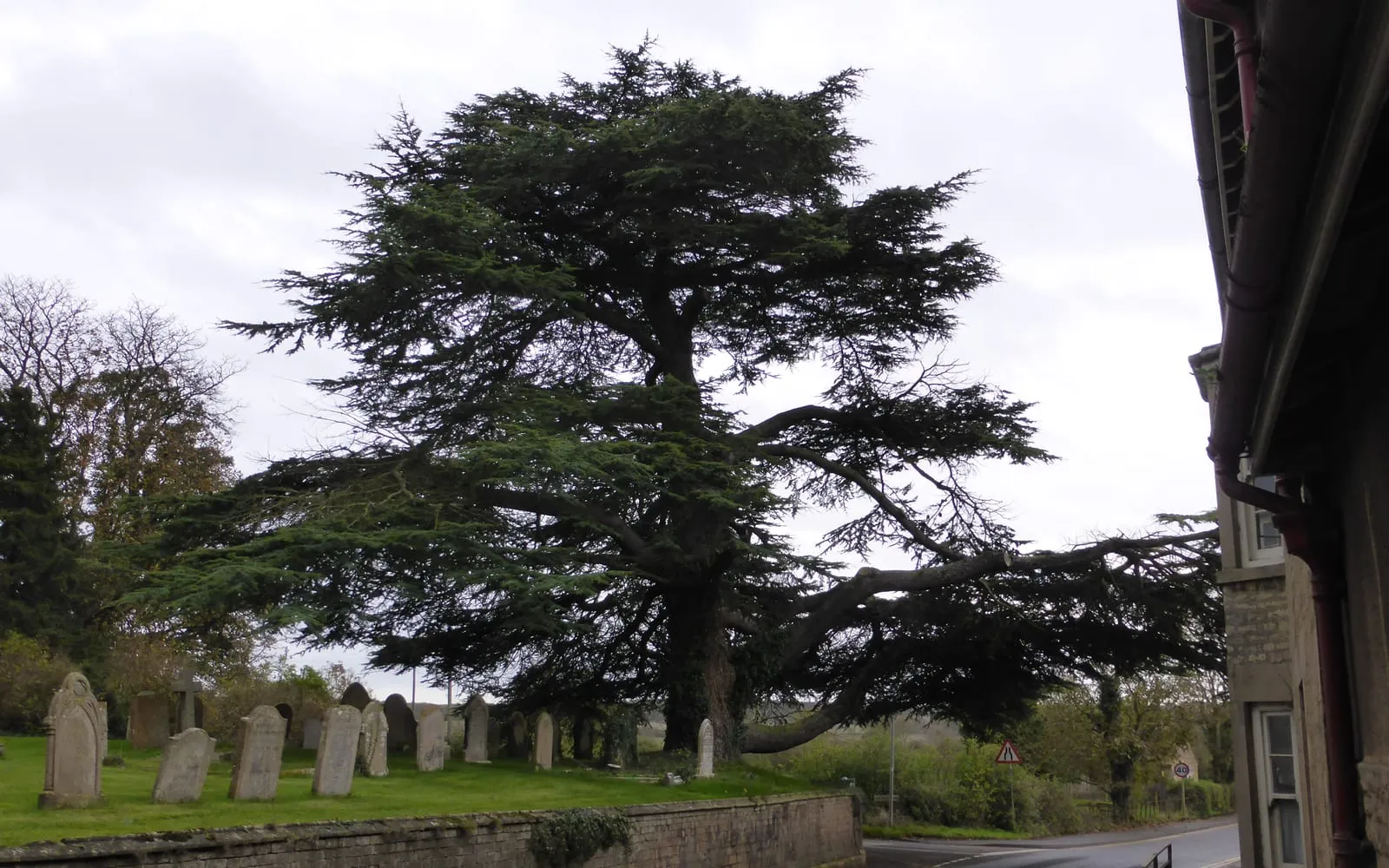
A mature specimen carries a crown unlike almost any other conifer, built from broad, level tiers of branches that flatten out with age into a shape closer to a table than a cone, so distinctive that a single old cedar on a skyline reads as itself rather than as a generic conifer shape.
Getting there takes patience measured in generations rather than years. Growth is slow, particularly in youth, and the tree that eventually dominates a landscape starts life as a modest, unremarkable pyramid that gives little hint of what several centuries will produce.
Appearance and character
Needles are dark green to grey-green, 2 to 3.5 cm long, borne in dense whorled rosettes on short spur shoots along the older branches and singly on new growth, giving the foliage a tufted, textured look up close.
Cones are barrel-shaped, 8 to 12 cm long, standing upright on the branches like small green or purple-tinged casks that ripen to brown over two years. Unlike a pine cone, a mature cedar cone does not fall intact; it disintegrates scale by scale on the tree, littering the ground beneath with individual scales rather than whole cones.
Bark on a young tree is smooth and grey, becoming deeply fissured and dark grey-brown with age, thickening considerably on an old trunk.
The crown changes shape dramatically over the tree’s lifetime. Young trees are broadly pyramidal with a single leading shoot; older trees lose that conical outline entirely, developing the wide, flat, tiered branches that give an ancient cedar its unmistakable table-topped profile, often with a girth that takes several people to encircle.
Where it is from
Cedrus libani grows wild at altitude across the mountains of Lebanon, western Syria and southern Turkey, typically between 1,000 and 2,000 metres, where it takes deep winter snow and a hot, dry Mediterranean summer in the same year.
The remaining old-growth groves, most famously the Cedars of God above Bsharri in Lebanon, hold some of the oldest living trees in the Mediterranean region, several reputed to be over a thousand years old, though millennia of logging for shipbuilding, temple construction and export have reduced the wild forest to a small fraction of its former extent. The species is protected in Lebanon today, and the surviving groves are a site of both ecological and national significance.
It reached Western European gardens in the seventeenth century and became a favourite of large estate and parkland planting from the eighteenth century onward, prized then as now for the scale and gravitas a mature specimen brings to a landscape.
How it grows
Plant in deep, well-drained soil, in full sun and with a great deal of room to spare. This is a tree for a large garden, a park or an estate rather than an ordinary plot, and a specimen planted too close to a building or boundary becomes a serious problem within a few decades as the crown and root system both expand.
Water regularly through the first several years while the tree establishes a deep root system, then reduce watering considerably. Once rooted, cedar of Lebanon copes well with dry summer conditions and needs little supplementary watering in a temperate climate with reasonable rainfall.
Growth is slow in the early years, often under 30 cm annually for the first decade, before picking up somewhat once the root system is well established. Patience is unavoidable with this species.
Avoid pruning beyond removing dead or damaged wood. The tiered branch structure that gives an old cedar its character develops naturally over many decades, and heavy pruning in youth disrupts a form that cannot be recreated by cutting later.
Stake only where the site is very exposed, and remove the stake within a couple of years, since a trunk that moves naturally in the wind develops the strength to support the enormous crown it will eventually carry.
Through the seasons
Spring brings a flush of new growth at the branch tips, softer and brighter green than the older foliage before it hardens.
Summer ripens the current year’s cones and extends the season’s new shoots through a period the tree, coming from a hot dry Mediterranean climate, generally tolerates without difficulty.
Autumn sees the previous year’s cones, now two years old, finally mature and begin disintegrating on the tree, scattering their winged seeds and scales below.
Winter is dormant and, on an established tree, entirely undemanding. Snow settling on the tiered branches of a mature specimen is part of the tree’s appeal rather than a hazard to it.
Care difficulty
Moderate, weighted almost entirely towards patience and initial siting rather than ongoing labour. An established cedar of Lebanon needs no routine feeding, minimal pruning and little to no watering, making it one of the lowest-maintenance large trees available once past its early years.
The real difficulty lies in accepting a tree that gives comparatively little visual return for a long time. A cedar planted today is planted for a scale of landscape that will only be fully realised well beyond the planter’s own gardening years.
Watering
Water deeply and regularly through the first several growing seasons after planting, encouraging the root system to establish thoroughly before demands on it increase.
Once established, an ordinary temperate climate with reasonable annual rainfall supplies enough moisture on its own, and cedar of Lebanon tolerates a dry summer considerably better than most large conifers, reflecting its native Mediterranean mountain climate.
Good drainage matters more than watering discipline. Heavy, waterlogged ground is a far more common cause of decline than any amount of summer dryness.
Warning signs, diseases and pests
Aphids sometimes colonise the shoots, particularly in a warm spring, leaving sticky honeydew behind that can attract sooty mould on the foliage beneath. A light infestation rarely needs treatment on an otherwise healthy, established tree.
Scale insects occasionally appear on older branches as small brown bumps that sap the plant’s vigour gradually rather than causing a fast decline. A horticultural oil treatment on accessible growth usually controls a light infestation.
Honey fungus can attack a stressed or waterlogged tree, showing as gradual dieback in the crown and, eventually, white fungal sheets visible under the bark near the base. There is no reliable cure once it takes hold.
Waterlogging is the most common serious problem in cultivation. Roots sitting in heavy winter wet rot regardless of how well the tree otherwise performs, and a poorly drained site should be improved or avoided before planting rather than managed afterwards.
Growing environment
Full sun suits it best, reflecting the open mountain slopes it comes from, and a tree planted in shade grows thin and etiolated rather than developing the dense, tiered form the species is known for.
Deep, well-drained soil gives the strongest results, though an established tree tolerates a range of soil types, including chalk. Shelter from the coldest winds benefits a young tree; an established specimen stands through hard frost, wind and heavy snow unprotected.
Allow generous space in every direction. A mature specimen needs a footprint of many metres, and the low, spreading branches of an old tree, sometimes sweeping close to the ground, need room that a garden boundary or a path cannot easily provide.
Feeding
Apply a general-purpose feed in spring for the first few years while the tree establishes, following the product’s guidance rather than over-applying to a young root system.
An established tree in reasonable garden soil needs no routine feeding, and heavy fertiliser produces soft growth that copes poorly with wind and cold. A yearly mulch of well-rotted organic matter around the root zone supports establishment better than repeated fertiliser applications.
Troubleshooting
Why does my young tree not yet have the flat, tiered shape I’ve seen on older specimens? That table-topped crown develops only after several decades of growth. A young cedar of Lebanon is broadly pyramidal with a single leading shoot, and the wide, flat tiers that define a mature tree take a long time, often over a century, to fully form.
Why is my tree growing so slowly? This is normal, particularly in the first decade. Cedar of Lebanon is slow-growing in youth, picking up pace somewhat once the root system is well established, but it is never a fast tree by the standards of most garden conifers.
The cones seem to be falling apart on the tree rather than dropping whole. This is how cedar cones mature. Unlike a pine cone, a ripe cedar cone disintegrates scale by scale while still attached to the branch, rather than falling to the ground intact.
Is it safe to plant near where children play? Yes, it is not listed as harmful by the RHS or the ASPCA. Cedarwood oil products distilled from the timber are a separate, concentrated substance and should be kept away from cats specifically.
My tree has stopped growing and looks unwell. Check drainage first. Waterlogged winter ground is the most common cause of decline in cultivation, and a tree sitting in heavy wet clay rarely recovers without the underlying drainage problem being addressed.