
Outdoor plant
Eelgrass
Zostera marina
Also known as Common eelgrass, Grass wrack
What eelgrass, Zostera marina, needs to survive, why it cannot be grown in a garden pond, and what its decline means for coastal wildlife.
At a glance
- Difficulty
- Difficult
- Water
- Fully submerged in tidal or subtidal seawater
- Light
- Clear, shallow seawater with strong light penetration
- Hardiness
- USDA 4-11, RHS H7, hardy to -2 C
- Type
- Marine perennial
- Height
- Leaves reach 30 cm to over 1 m, depending on water depth
- Native to
- Coastal waters of the Northern Hemisphere
USDA and RHS zones are built for terrestrial air temperature and describe this marine species only loosely, since seawater rarely reaches the extremes open air does; treat the range here as a rough equivalent rather than a precise rating. It is tolerant of the near-freezing seawater temperatures found around northern coasts in winter, and equally tolerant of warm summer shallows, provided the water stays clear enough for light to reach the seabed. Its limiting factor is almost never temperature; it is water clarity and the availability of a sheltered, gently sloping seabed of sand or mud.
Hardiness zones describe winter cold alone. Summer heat, humidity, rainfall and the length of the growing season decide as much, so treat the range as the outer limit rather than as a recommendation.
Not known to be toxic
Eelgrass has no toxicity listing and none is expected; it is a foundation food source for waterfowl such as brent geese and wigeon, which migrate specifically to graze on eelgrass beds, as well as habitat for countless fish and invertebrates. There is no meaningful care or safety consideration here in the way there is for a garden plant, since this species is not something anyone keeps in a home aquarium or pond.
Source: RHS
About
Eelgrass is a true flowering plant, not an algae or a seaweed, that lives entirely submerged in shallow coastal seawater and forms dense underwater meadows along sheltered shores across much of the Northern Hemisphere. It appears in this collection for what it explains rather than for anything a gardener does with it: it is not sold as an aquarium or pond plant and cannot be cultivated outside a specialist marine setting, but it is one of the most ecologically important plants in the coastal environments it occupies.
Eelgrass meadows rank among the most efficient carbon-storing habitats on the planet per unit area, alongside mangroves and salt marsh, and their decline across much of Europe and North America over the last century is one of the more significant, least visible losses in coastal conservation.
Appearance and character
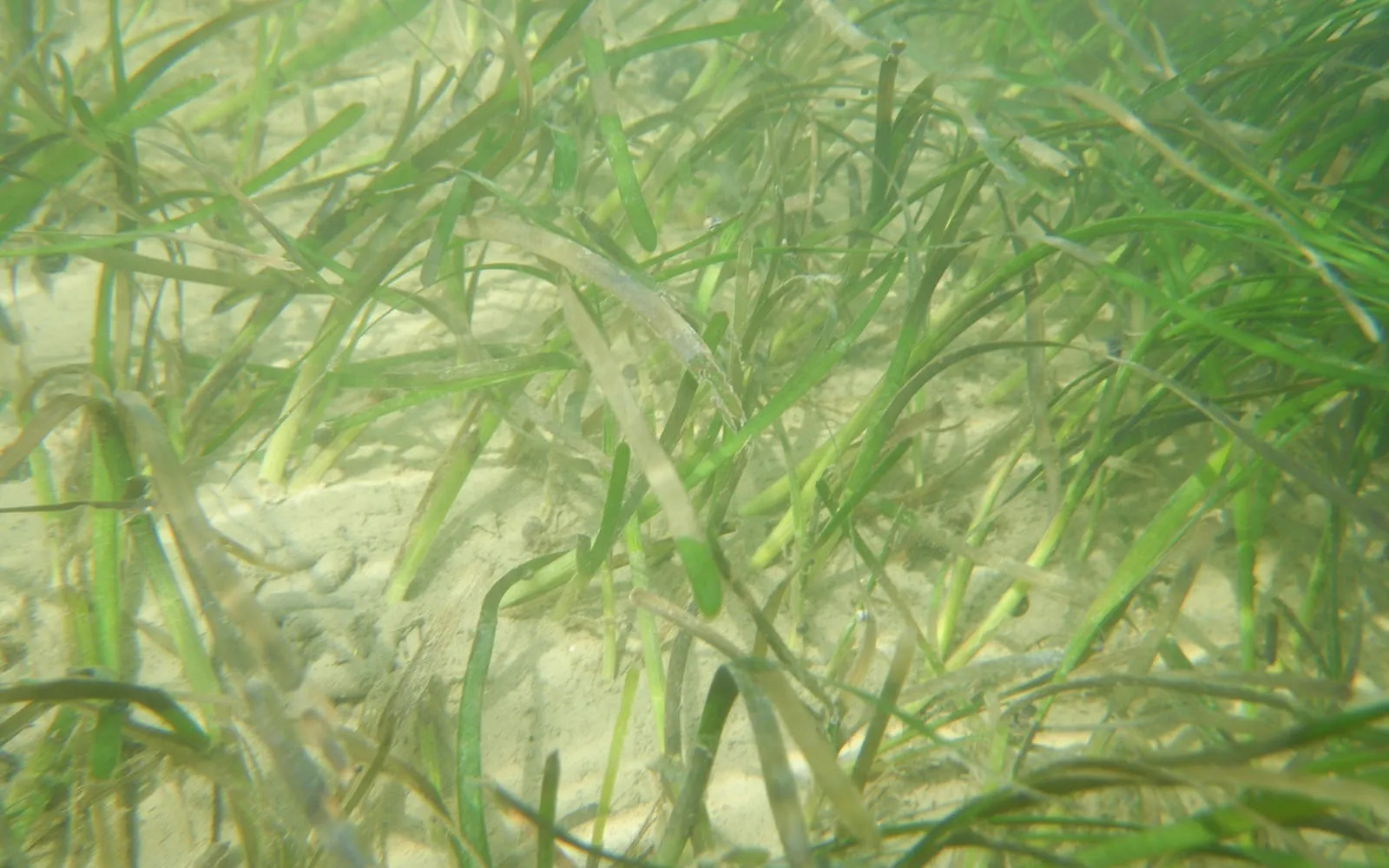
Long, flat, ribbon-like leaves grow in tufts from a creeping rhizome buried in sand or mud, swaying with the current in dense underwater meadows that can extend for hundreds of metres along a sheltered coastline. Leaves range from about 30 cm in exposed, shallow water to well over a metre in deeper, calmer conditions.
Flowers are minute and entirely submerged, pollinated by water currents holding pollen between plants rather than by any insect or wind, an unusual adaptation shared by only a small number of marine flowering plants worldwide. Seeds that follow are small and can remain viable in sediment for extended periods, allowing a bed to recover from disturbance given enough time and the right conditions.
Where it is from
Sheltered, shallow coastal waters across the temperate Northern Hemisphere, from northern Europe and the Mediterranean through to the Pacific and Atlantic coasts of North America, typically on soft sand or mud where wave energy is low enough for the rhizome to establish and the water clear enough for light to reach the seabed.
Clarity is the critical factor. Coastal development, dredging and nutrient runoff that cloud seawater with sediment or algae have driven the loss of a significant proportion of historic eelgrass beds across Europe and North America over the past century, since the plant cannot photosynthesise enough to survive once light penetration drops below a fairly narrow threshold.
How it grows
A marine perennial spreading by a creeping rhizome buried a few centimetres into soft sediment, sending up new leaf shoots at intervals and gradually expanding a bed outward over years. A healthy, undisturbed meadow can persist and slowly expand for decades, while a damaged one, once reduced below a certain density, often struggles to recover unaided because the dense root and rhizome mat that normally stabilises the sediment and attenuates wave energy is what has been lost.
Historic outbreaks of a wasting disease caused by the slime mould Labyrinthula zosterae, most especially in the 1930s, wiped out the vast majority of eelgrass across the North Atlantic within a few years, illustrating how quickly a widespread and apparently stable meadow can collapse under the right pathogen pressure.
Through the seasons
Spring growth resumes as light levels and water temperature both increase, with new leaf shoots extending from the rhizome.
Summer is the peak growing season, with the densest leaf cover and, in many populations, submerged flowering.
Autumn growth slows as light levels drop with shorter days and often increasing water turbidity from storms.
Winter the plant persists through cold seawater with little visible growth, relying on rhizome reserves built up over the previous growing season.
Care difficulty
Difficult in the sense that this is not a species anyone cultivates in a garden pond or aquarium; it belongs to open coastal seawater and specialist marine restoration projects rather than to horticulture. The difficulty rating here reflects that reality rather than any set of instructions a gardener could follow, and the entry exists to explain what the plant is and why it matters rather than to describe how to grow it at home.
Watering
Not applicable in the way it is for a garden or pond plant. Eelgrass lives permanently submerged in tidal or shallow subtidal seawater and depends entirely on natural coastal processes: tides, currents and water clarity, none of which a home aquarium or garden pond can replicate at meaningful scale.
Warning signs, diseases and pests
The most significant threat this species faces is the wasting disease caused by Labyrinthula zosterae, a slime mould that spreads through leaf tissue and caused the near-total collapse of North Atlantic eelgrass populations in the 1930s, an event still referenced in coastal ecology as one of the starkest examples of a single pathogen reshaping an entire coastline’s ecology within a few seasons.
More broadly, declining water clarity from nutrient pollution, sediment runoff and coastal development is the dominant modern pressure on eelgrass beds, reducing the light reaching the seabed below what the plant needs to photosynthesise and persist.
Growing environment
Clear, shallow, sheltered seawater over soft sand or mud is the specific combination this species needs, and none of the three elements substitutes for the others: turbid water blocks light even over suitable sediment, exposed wave-battered coastline prevents the rhizome establishing even in clear water, and unsuitable hard or shifting substrate offers nowhere for the rhizome to anchor even where light and shelter are both good.
Feeding
Not applicable. Eelgrass draws what it needs directly from seawater and seabed sediment, and there is no cultivated context in which feeding it would be relevant.
Troubleshooting
There is no home troubleshooting guide for this species in the way there is for a garden or pond plant, since it is not grown domestically. The questions that matter for eelgrass are ecological rather than horticultural.
Why is a local eelgrass meadow disappearing? Investigate water clarity first, since reduced light from sediment or nutrient pollution is the most common modern cause, followed by physical disturbance from boat anchors, moorings or dredging, and, historically, wasting disease.
Can a lost eelgrass bed recover? Sometimes, given improved water quality and reduced physical disturbance, since the plant can recolonise from surviving fragments or seed in sediment, but recovery is typically slow, often taking many years, and active replanting projects exist in several countries to speed the process along.
Why does an eelgrass meadow matter to a garden or coastal property owner? Beyond its conservation value, eelgrass beds stabilise sediment, reduce coastal erosion, and support the fish nurseries that many local fisheries depend on, so their health is directly tied to the wider health of a coastline.