
Houseplant
Norfolk Island Pine
Araucaria heterophylla
Also known as Norfolk Pine
How to grow Norfolk Island pine, Araucaria heterophylla. Why turning the pot regularly keeps its tiers even, why cutting the leading shoot ruins the shape for good, and telling normal lower-branch dieback from the early signs of root rot.
At a glance
- Difficulty
- Moderate
- Water
- When the top inch of compost has dried, roughly weekly in summer
- Light
- Bright light, some direct sun; turn regularly for even growth
- Temperature
- Above 7 deg C indoors
- Humidity
- Moderate; benefits from extra humidity in dry, heated rooms
- Hardiness
- USDA 10-11, RHS H2, hardy to -2 C
- Type
- Evergreen conifer
- Height
- Up to 50 m outdoors in the tropics; 1-2 m as a houseplant for many years
- Native to
- Norfolk Island
A subtropical island conifer used to mild, humid, maritime conditions without frost. It survives outdoors year round only where winters stay close to frost-free, such as coastal California and Florida, and is grown as a container or houseplant everywhere else, brought indoors or under cover for winter wherever a real frost is likely.
Hardiness zones describe winter cold alone. Summer heat, humidity, rainfall and the length of the growing season decide as much, so treat the range as the outer limit rather than as a recommendation.
Harmful to cats and dogs if eaten
- Do not eat
- The needles and stems
- Harm from
- Eating it
- Affects
- Cats and dogs
The ASPCA lists Norfolk Island pine as toxic to cats and dogs, though the mechanism is not fully identified and the effect is generally mild: vomiting, lethargy and, less commonly, some loss of coordination in an animal that has eaten a real quantity of the soft needles. It is not associated with serious or life-threatening poisoning in the way some houseplants are, and most cases resolve without treatment once the animal stops eating it. It is not reported as toxic to people. A young plant sold for a table or a Christmas display sits at exactly the height a cat finds easiest to chew, which is the more common trigger for a case than any older, larger specimen out of reach.
Sources: ASPCA (Norfolk Island Pine), RHS potentially harmful garden plants
About
Norfolk Island pine grows in regular tiers of horizontal branches. Indoors, that shape only stays even if the plant gets light from all sides or is turned regularly. If one side faces away from the light for too long, it becomes sparse and lopsided.
It is often sold small as a Christmas table plant, but it is not a short-term novelty plant. In frost-free climates it grows into a large tree. As a houseplant it stays much smaller for many years, provided it has bright light, steady watering and moderate humidity.
Appearance and character
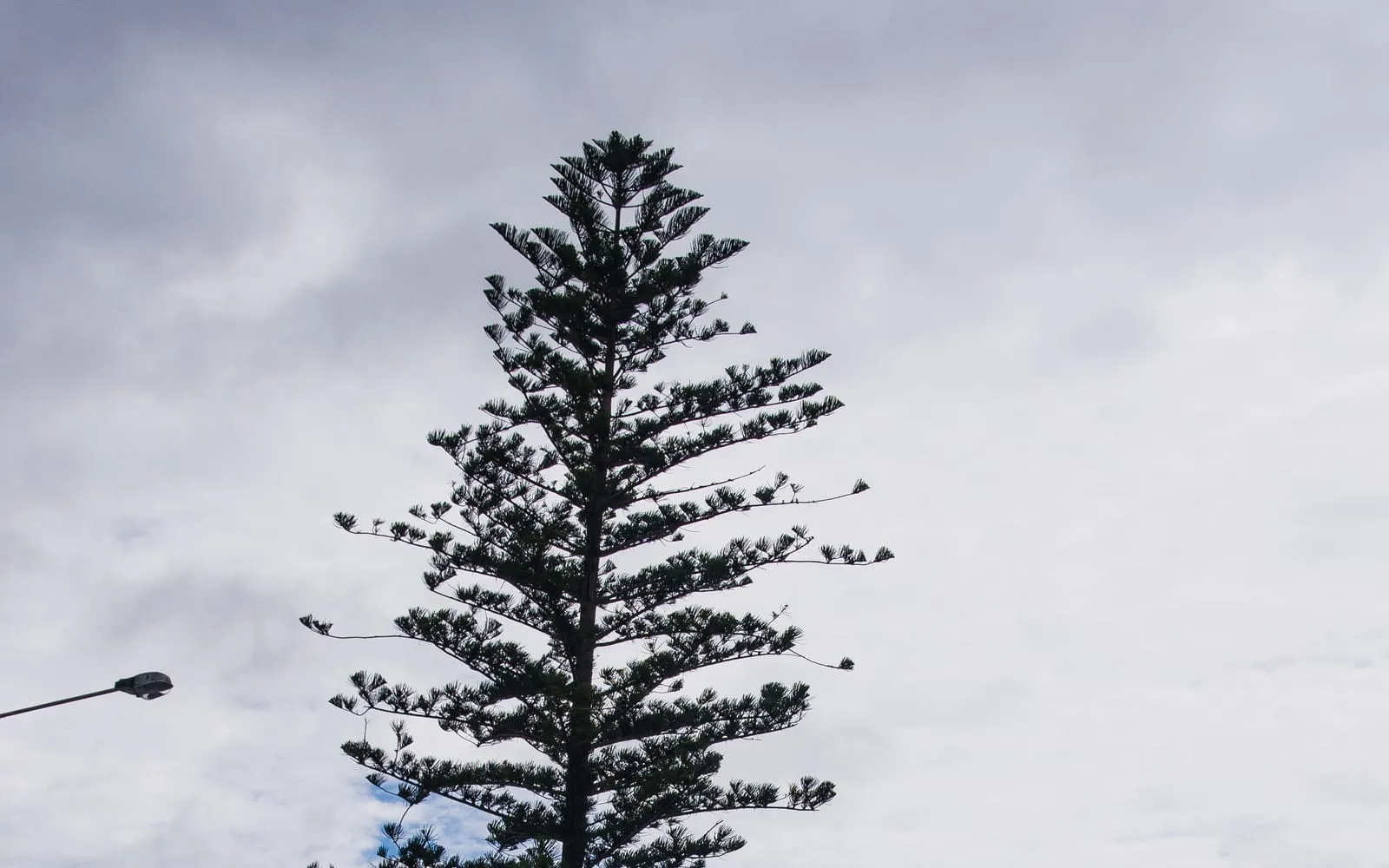
The habit is the identifying feature: a single straight trunk with branches arranged in horizontal, evenly spaced tiers, each tier a whorl of four to seven branches radiating from the same point, giving the whole plant a formal, almost architectural symmetry that few other houseplants share.
Needles are soft and awl-shaped on young growth, 1 cm or so, incurved and brush-like along each branchlet, a fresh, light green that is notably brighter than most other Araucaria species. Older, outdoor-grown trees develop stiffer, more scale-like foliage on their upper growth as they mature.
Bark is grey-brown, thin, and peels away in fine horizontal strips on older wood, a detail rarely seen on a young houseplant but characteristic of mature trees.
Where it is from
Araucaria heterophylla is native to Norfolk Island, a small, isolated volcanic island in the South Pacific between New Zealand and New Caledonia, where it grows in a mild, humid, maritime climate with rainfall spread through the year and no frost.
That narrow native range, and the constancy of the conditions on it, explain why the species has so little tolerance for either real cold or prolonged drought. It has never needed to adapt to either, and both stress it quickly compared with conifers from more variable climates.
How it grows
Pot it in a free-draining, slightly acidic compost, and choose a pot only a little larger than the rootball, since it dislikes being overpotted into compost that stays wet around roots the plant is not yet using.
Turn the pot a quarter turn every week or two so all sides get even light, which is the single most effective thing you can do to keep the tiered growth symmetrical. A plant left facing one direction for months develops noticeably longer branches on the light side.
Repot every two to three years in spring, moving up only one pot size, as it is a slow grower that does not need frequent repotting.
It does not respond well to hard pruning or having its leading shoot cut out, since removing the growing tip disrupts the tiered growth pattern permanently rather than encouraging new branching the way it would on many other plants. Leave the main stem alone and only trim damaged or dead lower branches.
Through the seasons
Spring is the best time to repot if needed, as growth resumes after a slower winter.
Summer is the main growing season. Water and feed on the regular schedule and keep the pot turning for even growth.
Autumn slows growth gradually as light and temperature drop.
Winter is a rest indoors. Water less often, since the compost stays damp for longer, and keep the plant well away from cold windows and draughts, both of which it feels quickly for a plant with no frost tolerance.
Care difficulty
Moderate. The plant itself needs little beyond steady warmth, reasonable light and a compost that is not left soggy. Keeping its tiered symmetry intact is the harder, ongoing part. It needs regular turning, protection from one-sided draughts, and a settled position it is not moved from too often, since it dislikes frequent relocation and responds with dropped needles.
Watering
Water when the top inch or so of compost has dried out, typically weekly in summer and considerably less often in winter. Water thoroughly until it drains from the pot, then let it drain fully and never leave it standing in water.
It dislikes both extremes: compost that dries out completely causes browning and needle drop on the lower branches, while compost kept constantly wet leads to root rot, which for a plant this slow-growing can take a long time to recover from, if it recovers at all.
Warning signs, diseases and pests
Spider mite is the most common problem in the dry, heated air of a typical home in winter, showing as fine speckling on the needles and faint webbing between branchlets in bad cases. Raising humidity and occasionally misting the foliage helps prevent it.
Scale insects appear as small, immobile brown bumps along the branches, sapping the plant and leaving a sticky residue. Wipe them off or treat with horticultural soap.
Root rot follows compost kept too wet, showing as browning that starts at the branch tips and works inward, along with an unhappy plant despite damp compost. Unpot it, check the roots, and repot into fresh, drier compost if any are soft or discoloured.
Browning and dropping of the lowest tier of branches with age is normal rather than disease, the plant’s way of shedding branches that have become shaded as it grows taller, and is only a concern if it happens high up the plant or spreads faster than new growth appears at the top.
Growing environment
Bright light with some hours of direct sun keeps growth dense and even; too little light causes sparse, elongated branches reaching for the window.
Keep it above 7 deg C indoors as a reasonable minimum, and well above that for the best growth; it has no frost tolerance and even a brief cold snap on a draughty windowsill can brown the needles.
Moderate humidity suits it, and it benefits from extra humidity where indoor heating dries the air, since dry air is a common trigger for spider mite as well as for needle browning.
Keep it away from heating vents and cold draughts alike, both of which cause needle drop on the branches nearest the source.
Feeding
Feed with a balanced liquid houseplant fertiliser at half the strength on the label, once a month through spring and summer.
Stop feeding in autumn and winter, when growth slows close to a standstill and unused fertiliser accumulates as salts in the compost rather than being taken up.
Troubleshooting
One side of the plant has grown longer branches than the other. Uneven light. Turn the pot regularly from now on; the existing asymmetry will not correct itself, but it becomes less noticeable as new, evenly-lit tiers form above it.
The lowest branches have browned and dropped. Often nothing more than age and shading as the plant grows, and not a cause for concern unless it is happening well up the plant or faster than new growth replaces it.
A whole branch tier looks sparse and stretched. Not enough light during that period of growth. Move the plant somewhere brighter; that particular tier will not fill back in, but future growth should be denser.
Can I cut the top out to keep it shorter? It is best avoided. Removing the leading shoot disrupts the tiered growth pattern for good rather than encouraging a bushier plant, so choose a spot with enough headroom for the size you eventually want instead.
Will my small tabletop plant grow into a giant tree? Only outdoors in a mild climate with no frost at all, and only over many decades. Indoors in a pot, growth is slow enough that a Norfolk Island pine can furnish a room for many years before it becomes too large for the space.
Norfolk Island Pine problem guides
Not sure what is wrong? See the common houseplant pests guide.