
Houseplant
Chinese Money Plant
Pilea peperomioides
Also known as Pancake plant, Missionary plant, UFO plant, Pilea
How to grow Pilea peperomioides. Light, watering, why the leaves curl, and how to take the offsets that carried this plant across Europe before any nursery sold it.
At a glance
- Difficulty
- Easy
- Water
- When the top 2-3 cm of compost is dry, roughly weekly in summer
- Light
- Bright indirect light. An east window, or a metre back from a south one
- Temperature
- 15-25 deg C. Not frost hardy, and unhappy below 10 deg C
- Humidity
- Ordinary room air suits it. No misting needed
- Hardiness
- USDA 10-12, RHS H1c, hardy to 10 C
- Type
- Evergreen perennial
- Height
- 25-30 cm
- Native to
- Yunnan and Sichuan, southwestern China
- Best month
- March in the Northern Hemisphere, September in the Southern Hemisphere
Yunnan in south-west China, where it was collected once by a Norwegian missionary in 1946 and spread through Europe entirely by cuttings passed between gardeners before commercial nurseries caught up. Outdoors year round in USDA 10 and warmer.
Hardiness zones describe winter cold alone. Summer heat, humidity, rainfall and the length of the growing season decide as much, so treat the range as the outer limit rather than as a recommendation.
Every month named in this guide is for the temperate Northern Hemisphere. If you garden in the Southern Hemisphere, shift each one by six months, so March becomes September. Closer to the equator the wet and dry seasons matter more than the calendar, and the shift stops being a useful guide.
Not known to be toxic
Non-toxic. NC State Extension describes Pilea peperomioides as safe for pets and children, and the ASPCA lists a sibling species, the aluminium plant Pilea cadierei, as non-toxic to dogs, cats and horses. Neither the RHS list of potentially harmful garden plants nor the ASPCA database carries any Pilea as toxic. A cat that chews a leaf may still be sick, because a mouthful of any plant can do that, but there is no toxin here to worry about. Of the houseplants in these guides this is one of the few you can put anywhere without checking who lives in the house.
Sources: NC State Extension, Pilea peperomioides, ASPCA (Aluminum plant, Pilea cadierei)
About
For about forty years this plant travelled around Europe entirely by hand. A Norwegian missionary, Agnar Espegren, collected it in Yunnan in 1946, carried cuttings home, and gave offsets to friends. They gave offsets to their friends. By the 1970s it sat on windowsills across Scandinavia while remaining almost unknown to British botany, and in 1983 Kew ran an appeal in a gardening magazine asking readers to help identify the mystery plant people kept posting in.
The distribution method tells you how it grows. A healthy pilea throws up offsets constantly, from the base of the stem and from the compost around it, and each one lifts away with roots already attached.
It is also one of the easiest houseplants sold, provided you get two things right. Give it bright light out of direct sun, and let the compost dry down before you water again.
Appearance and character
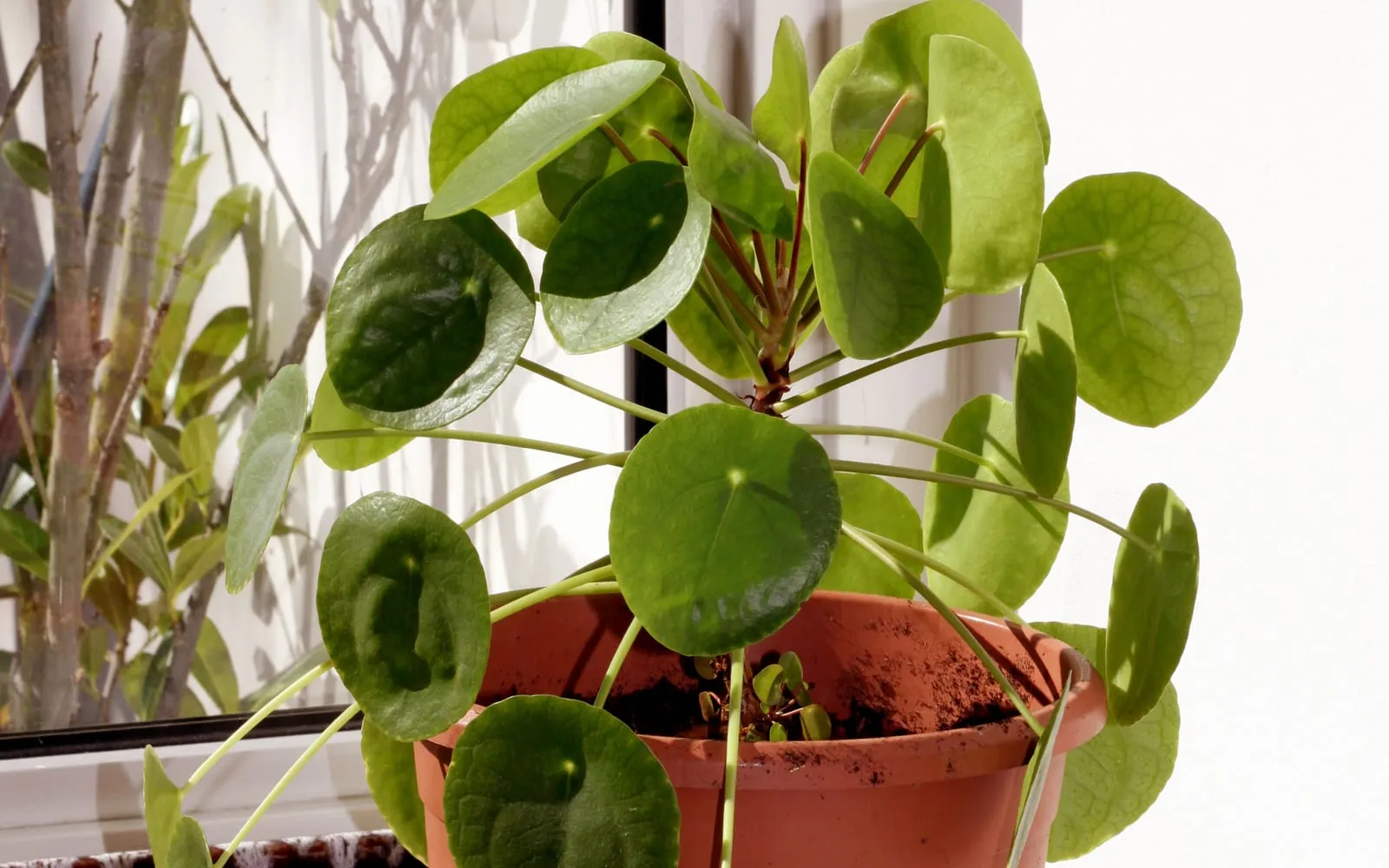
Round, flat, slightly glossy leaves up to about 10 cm across, held well clear of the pot on long upright stalks. Mature plants develop a single thickening stem that goes slightly woody at the base and can carry the leaves 25 cm up.
The leaf attachment is the detail to look at. The stalk joins the leaf in the middle of its underside rather than at the edge, so each leaf sits on its stem like a parasol. Botanists call this peltate, and few houseplants show it as clearly.
It belongs to Urticaceae, the nettle family, which surprises people who know nettles only by the sting. Stinging hairs are a feature of a few genera in that family rather than a family trait, and a pilea has none of them.
Flowers appear on older plants as small greenish-white clusters on pink stems. They are easy to miss and add nothing to the plant, so most growers cut them off.
Where it is from
Yunnan and Sichuan in southwestern China, on shaded rocky slopes and cliff bases in the Cangshan range, mostly between 1500 and 3000 m.
Those conditions explain the two care rules. Shade at that altitude is bright, so the plant wants plenty of light without the sun ever hitting it directly. Rock and thin leaf litter drain fast, so the roots expect to dry between soakings.
The wild population is small and restricted, which makes the plant a curiosity of conservation: it is rare where it comes from and abundant in cultivation across the world.
How it grows
An evergreen perennial that grows from a single stem and reproduces by offsets. Some appear from the base of the main stem, others push up through the compost a few centimetres away, sent up on short underground rhizomes.
The main stem lengthens with age and drops its lower leaves as it goes, producing a small palm-like plant on a bare trunk. Some people prize this and some dislike it. If you want a bushy pot, leave two or three offsets in place rather than removing them all.
Propagation needs no equipment. Wait until an offset is 5 to 7 cm tall, cut it away below compost level with a clean blade so it keeps a root or two, and pot it into damp compost. Rooting takes two or three weeks.
Growth runs from March to September and stops almost completely in winter.
Through the seasons
Spring restarts everything. Repot now if roots are circling the pot, take offsets, and begin feeding from April.
Summer is the main growth period. Water more often and turn the pot a quarter turn each week, or the plant leans hard towards the light and stays crooked.
Autumn slows down. Stop feeding around the end of September and let the compost dry more between waterings.
Winter is a rest. Central heating dries the compost faster than the plant uses water, so check with a finger rather than a calendar, and keep it away from a hot radiator and a cold pane alike.
Care difficulty
Easy, and it fails in only two ways.
Overwatering kills it. The roots are fine and the stem base rots quickly once it stays wet, so the plant collapses at compost level with the leaves still looking healthy.
Poor light makes it ugly rather than dead. Stems stretch, leaves shrink and sit further apart, and the plant leans towards the window at an increasing angle.
Watering
Water when the top 2 to 3 cm of compost is dry. In a warm room in July that is roughly weekly; in January it may be every three weeks.
Water thoroughly when you do, until it runs out of the drainage holes, then empty the saucer. Standing water at the base is what rots the stem.
Tap water is fine. This is one of the houseplants in these guides with no fluoride sensitivity, so filtered water buys you nothing.
Drooping leaves mean either extreme, so check the compost before reaching for the watering can. Dry compost and a limp plant means water. Wet compost and a limp plant means the roots have already gone.
Warning signs, diseases and pests
Root and stem rot is the main killer, and it follows overwatering or a pot without drainage. The first sign is usually a soft, darkened stem at compost level. Once that has happened the parent is beyond saving, so take any healthy offsets straight away and start again from those.
Fungus gnats breed in permanently damp compost. They do little direct harm but they signal that the surface never dries, which is the same condition that causes rot. Let the top layer dry properly and they go.
Spider mites turn up in hot dry rooms, stippling the leaves with pale dots and leaving fine webbing where the stalk meets the leaf. Rinse the plant under a tepid shower and improve the air movement around it.
Curling leaves are the commonest complaint and have several causes, which the troubleshooting section below separates out.
White crusting on the compost surface is usually mineral salts from feed and hard water rather than disease. Scrape it off and flush the pot through.
Growing environment
Bright indirect light. An east-facing windowsill is close to perfect, and so is a spot a metre back from a south-facing window. Direct summer sun bleaches the leaves to a pale washed-out green and scorches brown patches into them.
Warmth of 15 to 25 deg C suits it. It survives briefly down to about 10 deg C but sulks below that, and frost kills it outright, so it stays indoors all year colder than USDA 10.
Ordinary room humidity is fine. This plant gets grouped with tropicals it has nothing in common with, and neither misting nor a pebble tray improves it.
Compost must drain. A peat-free houseplant compost with a third perlite or grit mixed through it works well. Pot size should be modest, since a large pot holds water the small root system cannot use.
Feeding
A balanced liquid houseplant feed at half the label strength, monthly from April to September.
Stop entirely from October to March. Feeding a plant that is not growing builds salts in the compost and burns the root tips.
Underfeeding shows as small pale new leaves. Overfeeding shows as brown leaf margins and a white crust on the compost.
Troubleshooting
Leaves curling inward, like a cup. Usually underwatering or too much heat. Check the compost and move it away from a radiator.
Leaves curling outward or downward. Usually too much light. Move it back from the window.
Plant leaning hard towards the window. Normal phototropism. Rotate the pot a quarter turn weekly and it straightens over a few months.
Lower leaves yellowing and dropping. A few at the bottom is ageing. Many at once, with damp compost, is overwatering.
Tall bare stem with a tuft of leaves on top. Age, low light, or both. Cut the top off and root it in water, and the stump usually sprouts again.
No offsets. The plant is young, underfed, or short of light. Give it a brighter position and feed through the growing season.
White spots on the leaf undersides. Cystoliths, which are natural calcium carbonate deposits found throughout the nettle family. They are part of the plant rather than a pest.
Chinese Money Plant problem guides
Not sure what is wrong? See the common houseplant pests guide.