
Edible
Ajwain
Trachyspermum ammi
Also known as Carom seeds, Bishop's weed, Ajowan
How to grow ajwain, Trachyspermum ammi. The carom seed that tastes of thyme, why it needs a greenhouse here, and its place in Indian cooking and home remedies.
At a glance
- Difficulty
- Difficult
- Water
- Weekly while growing, then reduced as the seed fills
- Light
- Full sun, preferably under glass where summers are cool
- Temperature
- Needs a long warm season. Killed by frost
- Hardiness
- USDA 9-11, RHS H2, hardy to 0 C
- Type
- Half-hardy annual
- Height
- 30-90 cm
- Native to
- South Asia
- Best month
- April and September in the Northern Hemisphere, October and March in the Southern Hemisphere
It wants the same long dry warm season as cumin and, like cumin, gives leaf and no seed where the summer is short. Thymol is the dominant oil, which is why the seed tastes of thyme rather than of the carrot family it belongs to. Sow direct, since the taproot dislikes moving.
Hardiness zones describe winter cold alone. Summer heat, humidity, rainfall and the length of the growing season decide as much, so treat the range as the outer limit rather than as a recommendation.
Every month named in this guide is for the temperate Northern Hemisphere. If you garden in the Southern Hemisphere, shift each one by six months, so April becomes October. Closer to the equator the wet and dry seasons matter more than the calendar, and the shift stops being a useful guide.
Not known to be toxic
- Safe to eat
- Seeds and leaves
Non-toxic in food use. Ajwain seed is eaten across south Asia in large quantities and it appears on neither the RHS list of potentially harmful garden plants nor the ASPCA list. The seed is also used as a home remedy for indigestion, and standard herbal references advise moderation in pregnancy for medicinal doses, which describes concentrated preparations rather than seed in a flatbread. Ajwain oil is very high in thymol, the same compound that makes thyme oil a strong antiseptic, and it should be treated as a concentrated product rather than a strong version of the spice. As with every umbellifer here, identification matters: the family contains hemlock and hemlock water-dropwort, and the checks are in those guides.
Sources: RHS potentially harmful garden plants, ASPCA toxic and non-toxic plants
About
Ajwain tastes of thyme, and for a good reason. The seed is loaded with thymol, the same compound that gives thyme its scent and its antiseptic reputation, and a pinch of ajwain in a pan smells like a handful of thyme.
It is used across northern India and Pakistan in flatbreads, in savoury pastry, in lentils and in fried snacks, and it is also the standard household remedy for indigestion, taken as seed chewed raw or as a water infusion.
Growing it in a cool climate runs into the same wall as cumin. Ajwain wants a long warm season, and in a cool one the plant grows while the seed rarely fills. A greenhouse or polytunnel changes that, and a good crop is possible under cover.
Appearance and character
An upright branching annual, 30 to 90 cm, feathery and rather soft.
Leaves are divided into fine thread-like segments, mid green, more generous than cumin’s sparse foliage.
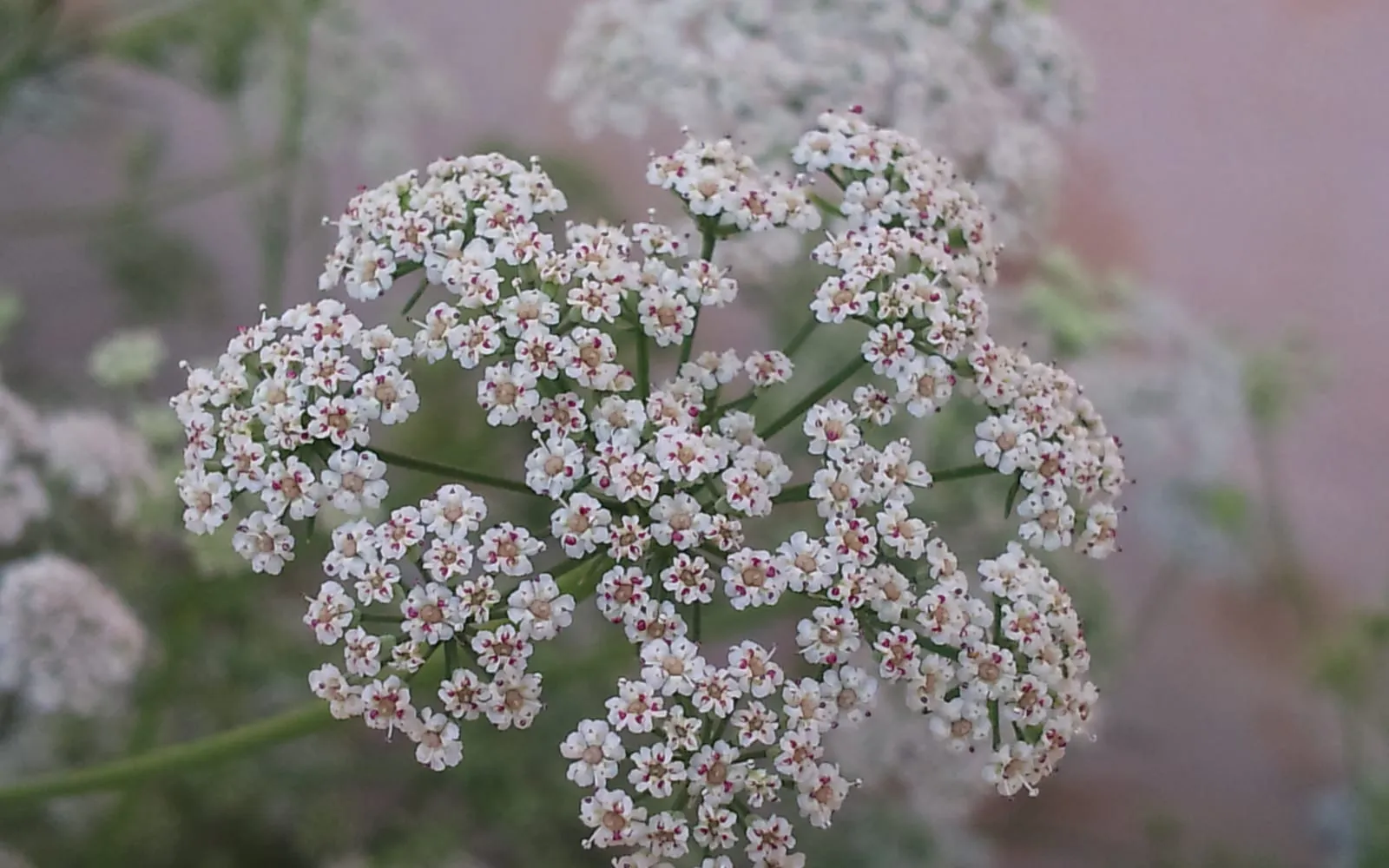
Flowers are small and white, in compound umbels 2 to 4 cm across, opening from July under glass.
Seeds are small, oval, ridged, grey-brown and about 2 mm long, resembling a miniature caraway and easily mistaken for celery seed by eye.
The scent settles the identification immediately. Crushed ajwain smells strongly of thyme, which nothing else in this family does.
The whole plant is aromatic and the leaves can be used, though the seed carries almost all of the flavour.
Where it is from
Ajwain is thought to have originated in the eastern Mediterranean, possibly Egypt, and it moved east early enough that its cultivation and its culinary identity are now entirely south Asian.
India grows the great majority of the crop, mostly in Rajasthan and Gujarat, with Iran the other significant producer.
Its use in Indian cooking is specific and consistent. Ajwain goes into paratha and other flatbreads, into the batter for pakora, into lentil dishes and into pickles, usually fried briefly in fat first to release the thymol.
The digestive use is as old as the culinary one. Ajwain water, made by steeping the seeds, is a standard household remedy for stomach upset across the subcontinent, and the seed is chewed after meals.
Thymol was extracted commercially from ajwain before synthetic production took over, and the seed remains one of the richest natural sources of it.
How it grows
Sow in April under glass at 20 deg C. A cold sowing fails, and an outdoor sowing in a cool climate rarely produces ripe seed.
Sow into deep modules or direct into a greenhouse border. The taproot dislikes disturbance, so avoid moving established plants.
Germination takes one to two weeks in warmth.
Space at 25 to 30 cm. The plant branches more than cumin and needs the room.
Grow it warm and bright, in a polytunnel, greenhouse or conservatory. Outdoors in a cool summer the plant will grow and flower and usually fails to ripen.
Water regularly while growing, then reduce as the seed sets.
Ventilate well. Still humid air brings mildew and aphids.
Harvest in September when the seed heads turn brown, cutting the whole plant before the seed shatters. Dry the stems head-down in paper bags and thresh.
Store the seed airtight. The thymol is volatile and an open jar loses its strength within months.
Through the seasons
Winter there is nothing. Ajwain is a tender annual.
Spring is sowing, in April, under glass in warmth.
Early summer is steady growth. The plant fills out through June if it is warm enough.
Midsummer brings flowering, from July, and the umbels are worked by hoverflies even under cover if the vents are open.
Late summer is when the seed fills, and warmth through August decides the crop.
Autumn is harvest, in September. Cut as the heads brown and dry them under cover.
Care difficulty
Difficult outdoors in a cool climate and manageable under glass.
The requirement is a long warm season. Ajwain flowers late and needs weeks of warmth afterwards to fill its seed, which a cool summer outdoors rarely provides.
Under cover it is straightforward. Sow in April, keep it warm, ventilate, and harvest in September.
Transplanting checks the plant because of the taproot, so sow into deep modules or direct.
Greenhouse pests are the practical nuisance. Aphids and mildew both take hold on a soft plant in still warm air, so ventilation does more good than anything else.
Harvest timing needs attention, since the seed shatters once fully ripe.
Yields per plant are modest, so grow more plants than seems necessary.
Watering
Water regularly through growth, keeping the soil evenly damp.
Water at the base in the morning. Wet foliage under glass encourages mildew on a feathery plant.
Reduce watering as the seed begins to fill, since dry conditions at ripening give better seed.
A container needs watering every two or three days in a warm greenhouse. Use a deep pot for the taproot.
Do not let it dry out completely while growing. A check costs weeks that a short season cannot spare.
Stop watering a week before harvest.
Warning signs, diseases and pests
Seed that stays green and shrivels means the season ran out of warmth. Grow under glass and sow in April.
Damping off kills seedlings in cold wet compost. Use fresh compost, sow thinly and water carefully.
Aphids build up quickly under glass on the soft growing tips. Rub them off or use a biological control on a food crop.
Powdery mildew whitens the foliage in still humid conditions. Ventilate.
Seed lost on the greenhouse floor means the heads were left too long. Cut as soon as they brown.
Plants that stayed small were sown cold or transplanted.
Seed that smells of nothing has been stored open. Keep it airtight, since thymol is volatile.
Growing environment
Under glass where summers are cool. A greenhouse, polytunnel or conservatory gives the warmth the plant needs to fill seed.
Full sun and warmth throughout. Twenty degrees and above suits it.
Free-draining soil of moderate fertility, or good multipurpose compost in a deep pot.
Neutral to slightly alkaline, around pH 6.5 to 7.5.
Ventilation is as important as heat. A closed humid greenhouse produces mildew and aphids faster than it produces seed.
Outdoors in a hot southern garden the plant will grow and flower, and ripe seed is unlikely. Grow it outside for the foliage and under cover for the crop.
Feeding
Nothing is needed in decent compost or greenhouse soil.
Avoid nitrogen. It delays flowering, and a plant that flowers late in a short season does not ripen at all.
A weak balanced feed every three weeks suits a container plant.
Refresh greenhouse border soil or use fresh compost each year rather than feeding harder.
Lean growing gives stronger flavoured seed, which is true across the spice crops in this wave.
Troubleshooting
The seed never ripened. Not enough warmth or not enough season. Sow in April under glass and keep the greenhouse warm through August and September.
Why does it taste like thyme? Because it is full of thymol, the compound responsible for thyme’s scent. Ajwain is one of the richest natural sources of it.
Is it the same as caraway or celery seed? No, though it looks like both. Crush a seed and smell it. Ajwain smells of thyme and nothing else in the family does.
The plants are covered in greenfly. Common under glass. Ventilate more, rub them off, and use a biological control rather than spraying a food crop.
The seed lost its flavour. Thymol is volatile. Store seed airtight in a dark cupboard and grind it only when needed.
Can I use the leaves? Yes, and they carry a milder version of the same flavour. The seed is what the plant is grown for.
How is it used in cooking? Fried briefly in oil or ghee at the start of a dish, or worked into flatbread dough. Heat releases the thymol and takes the raw edge off it.