
Outdoor plant
Deadly nightshade
Atropa belladonna
Also known as Belladonna, Dwale, Devil's cherries
How to recognise Atropa belladonna, telling its berries from the harmless lookalikes, what to do if a child eats one, and why it is still grown as a crop.
At a glance
- Difficulty
- Moderate
- Water
- Never plant it deliberately in a family garden
- Light
- Partial shade, and it dislikes full exposure
- Temperature
- Fully hardy, and the top growth dies at the first frost
- Hardiness
- USDA 5-9, RHS H6, hardy to -20 C
- Type
- Herbaceous perennial from a thick rootstock, long-lived
- Height
- 1-2 m
- Native to
- Europe, North Africa and western Asia, including native Britain
- Best month
- September in the Northern Hemisphere, March in the Southern Hemisphere
Chalky woodland edge in part shade is where it grows naturally, and it wants the same in a garden. Cold does not trouble it. The whole plant is lethal and two or three of the sweet black berries can kill a child, so anyone growing it should keep it away from paths, children and livestock.
Hardiness zones describe winter cold alone. Summer heat, humidity, rainfall and the length of the growing season decide as much, so treat the range as the outer limit rather than as a recommendation.
Every month named in this guide is for the temperate Northern Hemisphere. If you garden in the Southern Hemisphere, shift each one by six months, so September becomes March. Closer to the equator the wet and dry seasons matter more than the calendar, and the shift stops being a useful guide.
Poisonous if eaten
- Do not eat
- Every part, and the berries and roots most of all
- Harm from
- Eating it, handling it and sap in the eyes
- Affects
- People, cats, dogs and horses
Deadly nightshade is one of the most poisonous plants in Britain and the berries are the danger, because they are sweet, glossy, black and about the size of a small cherry. Two to five berries can kill a child and ten to twenty an adult, and a single leaf contains a potentially fatal dose. Every part contains tropane alkaloids, chiefly atropine, hyoscyamine and scopolamine, which block the parasympathetic nervous system. Poisoning produces a characteristic sequence taught to medical students as dry as a bone, red as a beet, blind as a bat, mad as a hatter and hot as a hare. Expect a dry mouth, flushed dry skin, widely dilated pupils and blurred vision, confusion and hallucination, fever, a racing heart, then seizures and respiratory failure. Symptoms begin within a few hours. Any suspected ingestion is a medical emergency. Get the person to emergency care immediately, take a piece of the plant with you, and do not wait for symptoms. There is an antidote, physostigmine, and supportive care is effective when treatment starts early. The alkaloids are also absorbed through the skin and through the eye, so wear gloves when handling the plant, wash afterwards, and never rub your eyes. The name belladonna, beautiful woman, comes from the Renaissance practice of using drops of it to dilate the pupils cosmetically. Atropine is still an essential medicine, used in anaesthesia, in cardiac emergencies and by ophthalmologists, and the plant is grown commercially for it.
Sources: RHS potentially harmful garden plants, ASPCA toxic and non-toxic plants
About
This is the plant everyone has heard of and almost nobody can identify, which is an unhelpful combination. Deadly nightshade is native to Britain, it is lethal, and it is far less common than the number of scares suggests. Most reported sightings are woody nightshade, black nightshade or one of several harmless black-berried shrubs.
The berry is the reason it matters. Every other poisonous plant in Britain tastes foul, which is what stops children eating a second mouthful. Belladonna berries are sweet. A child who eats one will happily eat several, and two to five is enough to kill.
September is when they ripen, which is also when families are out picking blackberries, and that overlap is the single most important thing in this guide.
Appearance and character
A branching herbaceous perennial, 1 to 2 m tall, growing each year from a thick fleshy rootstock and dying back at the first frost.
Stems are green, sometimes purple-flushed, softly hairy, and become slightly woody at the base.
Leaves are oval and pointed, 10 to 20 cm long, dull mid-green, softly downy and untoothed. They are carried alternately, and characteristically in unequal pairs, one large leaf and one much smaller beside it.
Flowers open from June to September, drooping bells 2.5 to 3 cm long, dull purple on the outside shading to greenish-brown, and easy to walk past. They hang singly in the leaf axils.
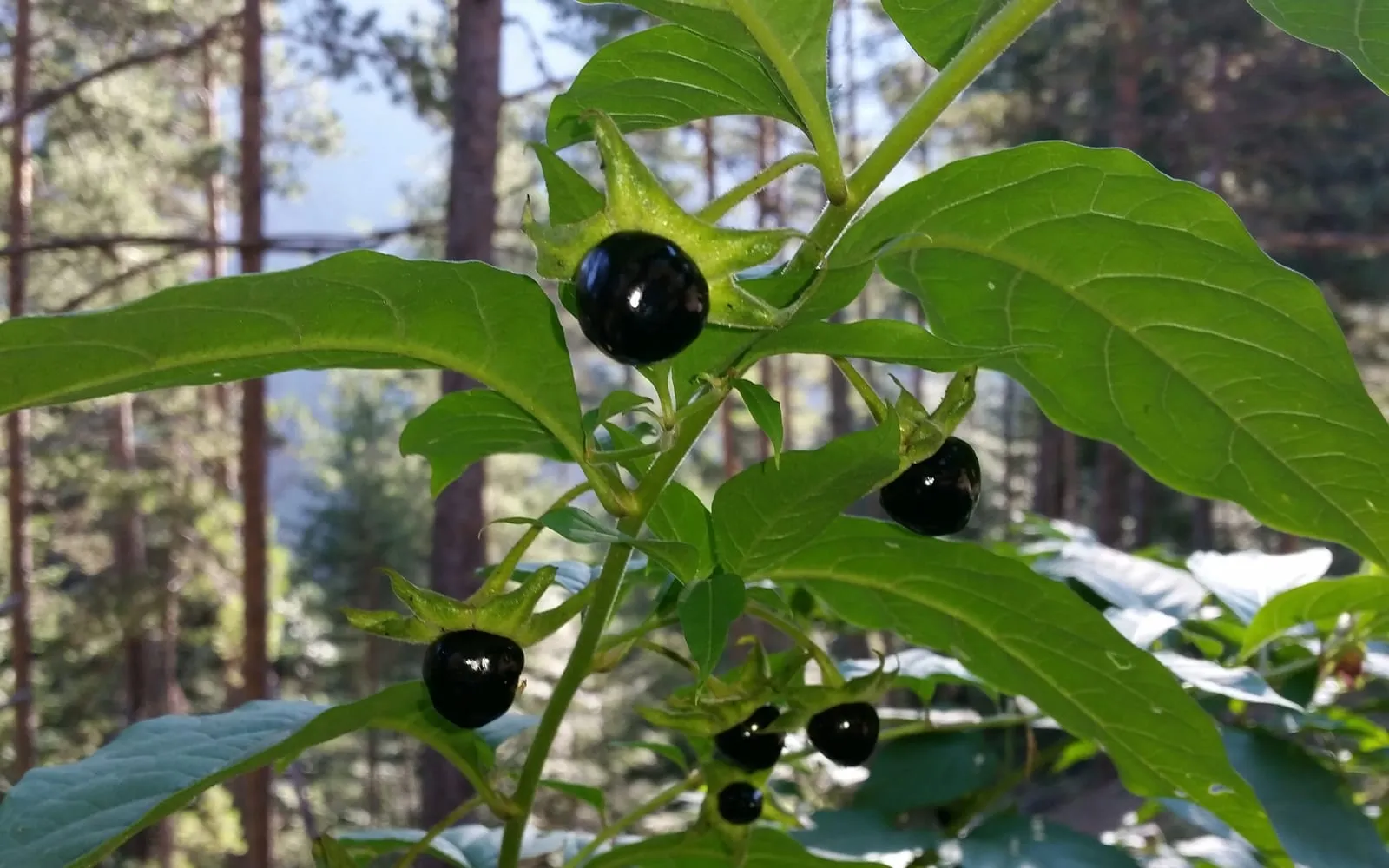
Berries ripen from late August into October. Each is glossy, jet black, 1.5 to 2 cm across, about the size of a small cherry, and sits in a persistent green calyx whose five points spread out behind it like a star.
That star-shaped green collar behind a single glossy black berry is the most reliable field mark this plant has.
The whole plant has a faintly unpleasant smell when bruised.
Telling it from the lookalikes is the useful skill. Woody nightshade, also called bittersweet, is a scrambling climber with purple flowers with a yellow central cone, and its berries are red and carried in bunches. Black nightshade is a low annual with white starry flowers and small dull black berries in clusters, and it is far commoner in gardens. Elder and privet both carry black berries in flat or branched clusters on woody shrubs. Belladonna berries hang singly on a soft-stemmed plant, each in its green star, and nothing else does that.
Where it is from
Europe, North Africa and western Asia, and native to southern England, where it grows on chalk and limestone in scrub, woodland clearings, quarries, old walls and disturbed ground.
It favours chalky, nitrogen-rich, disturbed soil, which is why it turns up around ruins, old monastery sites, quarries and railway cuttings rather than in the open countryside.
It is a local plant. Belladonna is common in a few chalk districts of southern England and absent from most of a cool climate, and it is scarce in Scotland and Ireland.
Its history is long and dark. The Latin Atropa comes from Atropos, the Fate who cut the thread of life, and the plant appears in accounts of poisonings from Rome onward. Dwale, its old English name, may come from a Scandinavian word for stupefaction.
It was used as a surgical anaesthetic in medieval Europe, in a mixture of dubious reliability, and by the Renaissance women used dilute drops to dilate their pupils because it was considered attractive.
Atropine remains on the World Health Organization list of essential medicines, and Atropa belladonna is grown as a field crop for it in eastern Europe and India.
How it grows
This entry describes the plant so you can recognise it, and the sensible course with a plant this dangerous in a garden is removal rather than cultivation.
Seed germinates in spring, often after ground has been disturbed, and seedlings grow slowly in their first year.
The plant flowers from its second year, from June onward, and sets berries from late August.
The rootstock is thick, fleshy and deep, and it stores enough to regrow the whole plant after the top has been cut off. Cutting the stems achieves nothing lasting.
Birds eat the berries without harm and spread the seed, which is how new plants appear well away from any parent.
To remove it, dig out the entire rootstock. Wear waterproof gloves, use a fork, and follow the root down, since a fragment left behind regrows.
Do this before the berries ripen if you can, in early summer, so no seed is added to the soil.
Cut off and bag any berries first if the plant is already fruiting, to stop them scattering while you work.
Wash hands, tools and gloves afterwards, and do not rub your eyes while working.
Dispose of the plant through green waste rather than a home compost heap, and never leave it lying where an animal or child could reach the berries.
Expect seedlings for a few years afterwards and remove them while small.
Anyone who wants to grow it deliberately, and there are botanic gardens and medicinal collections that do, should site it well away from paths and children and label it clearly.
Through the seasons
Winter is dormancy. The top growth has died away completely and only the rootstock remains, so the plant is invisible.
Spring brings the shoots through from April. This is a good time to dig plants out, since they are identifiable and not yet flowering.
Summer is flowering, from June. The dull purple bells are inconspicuous and the plant is now full-sized.
Autumn is the dangerous season. Berries ripen glossy black from late August into October, exactly when families are out picking blackberries.
Care difficulty
Moderate, and the difficulty is in identification and in safe removal rather than in anything horticultural.
Recognising it reliably is the first hurdle, and most people who think they have found it have found something else.
The deep rootstock makes removal a digging job rather than a cutting one.
Handling requires gloves, because the alkaloids cross skin and are very serious in the eye.
The plant itself is untroubled by pests and diseases and grows without any attention at all, which is part of why it persists.
Watering
Nothing here needs watering.
The plant favours moist, chalky, nitrogen-rich disturbed ground in partial shade.
It grows in woodland clearings, scrub, quarries, hedge banks and around old buildings.
It does not persist in acid soil, in dense shade or in closely grazed grassland.
Warning signs, diseases and pests
Berries in a garden used by children is the situation that matters. The fruit is sweet, glossy and cherry-sized, and nothing about eating one warns a child off. Remove the plant, and in the meantime cut off and bag every berry.
If someone has eaten a berry, treat it as an emergency. Get the person to emergency care immediately, take a sample of the plant, and do not wait for symptoms to develop. Do not try to make the person sick. Early treatment works well and delayed treatment is far more dangerous.
Widely dilated pupils, a dry flushed face, confusion and a racing heart in someone who has been in the garden or the countryside is the combination that should prompt a call.
Regrowth after cutting means the rootstock is still there. Dig it out completely.
Seedlings appearing for several years after removal are normal, since birds spread the seed and it persists in soil.
Misidentification runs both ways. People panic over black nightshade, which is a common garden annual, and they occasionally fail to recognise the real thing. Check for single berries each in a green star, on a soft-stemmed plant with dull purple bell flowers.
Livestock generally avoid it, and horses and cattle have been poisoned where it grows in a hedge and grazing is short.
Growing environment
Knowing where it grows helps you look in the right places.
Chalk and limestone districts of southern England are its stronghold, and it is scarce or absent elsewhere.
Woodland clearings, scrub, hedge banks, quarries, railway cuttings, old walls and the sites of ruined buildings are typical.
It wants partial shade and dislikes full exposure.
Disturbed, nitrogen-rich ground suits it, which is why it follows human activity so faithfully.
Check hedge banks and scrub edges on chalky ground in September if you are unsure whether it is present, since the berries are the easiest stage to spot.
It will not be found on acid heath, on peat or in dense closed woodland.
Feeding
Nothing here needs feeding.
The relevant point is that this plant thrives on rich disturbed ground, so a neglected corner behind a shed on chalky soil is exactly where it appears.
Restoring dense cover after removal helps suppress the seedlings that follow.
Troubleshooting
How do I know it is deadly nightshade? A single glossy black berry the size of a cherry, each sitting in a green five-pointed star, on a soft-stemmed plant 1 to 2 m tall with dull purple drooping bell flowers and large untoothed leaves.
My child has eaten a black berry from the garden. Treat it as an emergency. Get emergency care now, take a piece of the plant with you, and do not wait for symptoms.
What are the symptoms? A dry mouth, flushed dry skin, very dilated pupils, blurred vision, confusion, fever and a racing heart, starting within a few hours.
Is it the same as the black berries on the weed in my vegetable bed? Almost certainly not. Black nightshade is a low annual with small white starry flowers and clusters of small dull berries, and it is very much commoner.
How do I get rid of it? Dig out the whole rootstock wearing waterproof gloves, after cutting off and bagging any berries. A fragment of root left behind regrows.
Can I just cut it down? No. The rootstock is deep and fleshy and regrows the whole plant.
Is it native to Britain? Yes, on chalk and limestone in southern England, and it is local rather than widespread.
Why is it still grown as a crop? For atropine, which remains an essential medicine in anaesthesia, cardiac emergencies and ophthalmology.