
Edible
Chebulic Myrobalan
Terminalia chebula
Also known as Haritaki, Harde, Black Myrobalan
How to grow chebulic myrobalan, Terminalia chebula. Why its astringent fruit is one of the three in Triphala, the tannins that stain skin and fabric and made it a dye and tanning agent, and the decade or more it can take to first flower.
At a glance
- Difficulty
- Moderate
- Water
- Regularly through the wet season; sparingly once dormant
- Light
- Full sun
- Temperature
- Frost-tender when young; established trees take an occasional light chill
- Hardiness
- USDA 10-12, RHS H2, hardy to 0 C
- Type
- Deciduous tree, slow to reach full size
- Height
- 20-30 m
- Native to
- South Asia, Southeast Asia
A monsoon-forest tree from foothill and plains habitats across South and Southeast Asia, timing its growth to a wet season and coasting through a long dry one on stored reserves. It needs real seasonal warmth rather than year-round heat, and established specimens at higher elevation within its native range take an occasional light chill that would damage a young tree outright.
Hardiness zones describe winter cold alone. Summer heat, humidity, rainfall and the length of the growing season decide as much, so treat the range as the outer limit rather than as a recommendation.
Edible, with limits
- Safe to eat
- Ripe fruit pulp, used fresh, dried or powdered
- Do not eat
- Large quantities of the fruit or its extract
- Harm from
- Eating it
- Affects
- People
Chebulic myrobalan is one of the three fruits in Triphala, a long-established Ayurvedic preparation, and its dried fruit is eaten or brewed in measured doses rather than as a food in the ordinary sense. The fruit is strongly astringent and has a marked laxative effect, which is exactly why it is used medicinally, and eating a large quantity of it, whether fresh or as a concentrated extract, commonly causes diarrhoea and stomach cramping rather than any more serious harm. The RHS harmful garden plants index and the ASPCA toxic plant index do not list Terminalia chebula, since neither covers South Asian medicinal trees in any detail, so this assessment rests on its long traditional use rather than on a structured toxicology entry.
Sources: RHS potentially harmful garden plants, ASPCA toxic and non-toxic plants
About
Chebulic myrobalan is a large deciduous tree grown across South and Southeast Asia for its astringent, tannin-rich fruit, used medicinally, for dyeing and for tanning leather in roughly equal measure. It is one of the three fruits combined in Triphala, a preparation with centuries of use in Ayurvedic medicine, and its dried fruit still turns up in markets from India to Myanmar for exactly that purpose.
Outside its native range it is grown mainly by specialist and botanical collections rather than as an ordinary garden tree, since it needs real tropical warmth and eventually reaches a considerable size. Within its native range it is a familiar roadside and village tree, valued as much for shade and timber as for the fruit that gives it its reputation.
Appearance and character
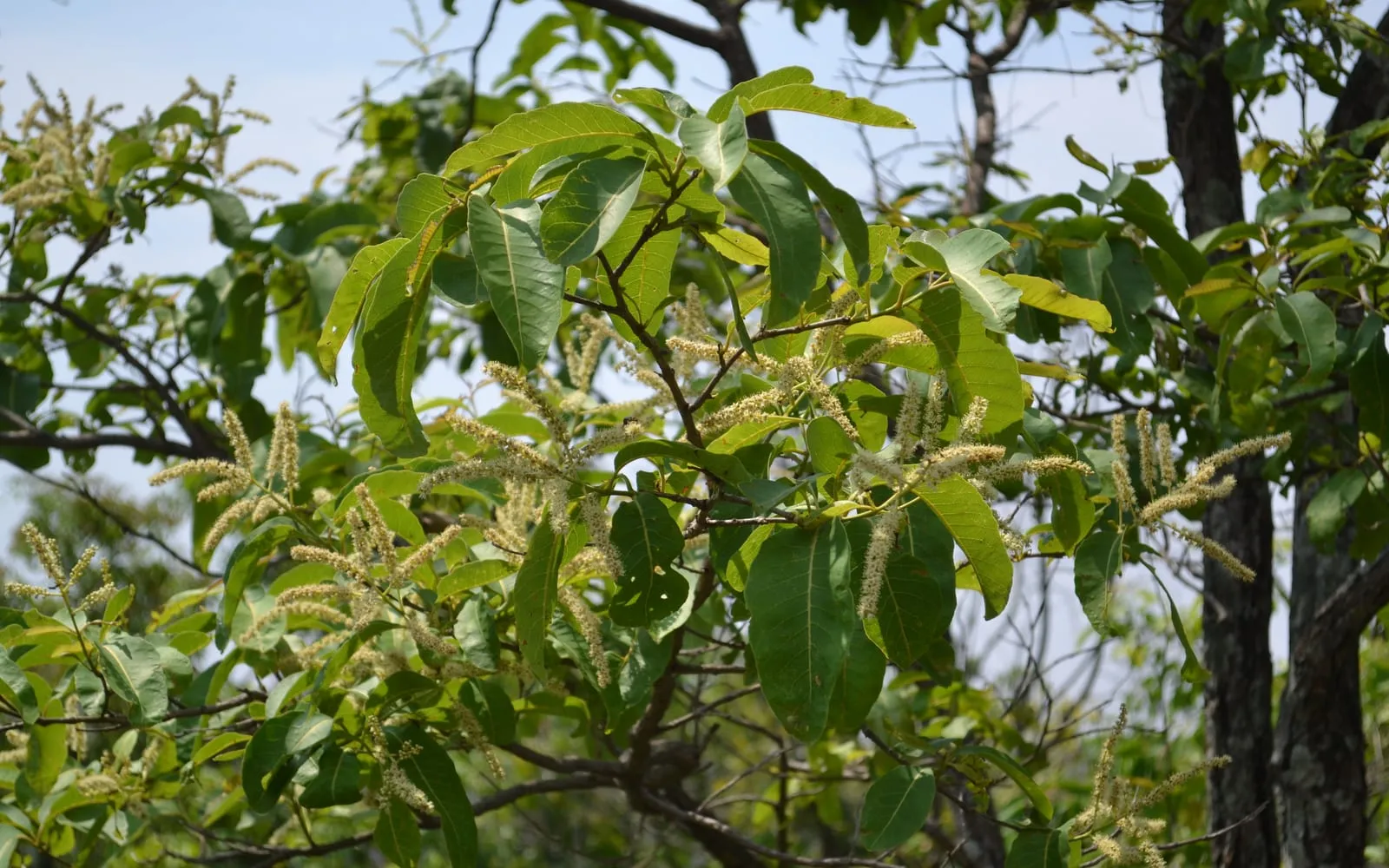
The tree develops a broad, rounded canopy on a single trunk, with grey-brown bark that fissures and darkens with age on an old specimen. Leaves are oval, glossy and leathery, arranged alternately along the branches and dropping over a dry season in a way that varies with local rainfall rather than following a fixed calendar.
Small, pale yellow flowers open in dense spikes and carry a strong, somewhat unpleasant odour, more noticeable up close than from any distance, which is enough to make a flowering tree obvious to anyone passing beneath it. Bees work them anyway, and the flowers set into hard, ridged, olive-shaped fruit that ripens from green through yellow to a dull orange-brown.
Gardeners grow it for the ripe fruit. It is intensely astringent when fresh and is usually dried, at which point it darkens, wrinkles and concentrates its tannins for storage, powdering or extraction.
Where it is from
Terminalia chebula grows wild across the Indian subcontinent, Nepal, Sri Lanka, Myanmar, Thailand and into southern China, generally in deciduous forest at low to moderate elevation rather than in true lowland rainforest. Its native range experiences a pronounced monsoon rhythm, a wet season that drives a burst of growth and flowering and a dry season the tree coasts through on stored reserves, dropping leaves as conditions demand rather than on a fixed schedule.
That rhythm explains why the species tolerates real drought once established, since a tree adapted to survive months without rain in its native forest carries the same resilience into cultivation. A young tree lacks that deep root system, so it needs far more consistent watering than an adult tree.
How it grows
Plant in full sun in well-drained soil, since chebulic myrobalan tolerates poor, rocky or lateritic ground far better than it tolerates roots sitting wet. A young tree benefits from generous watering through its first two or three growing seasons while it develops the deep taproot that eventually carries it through dry periods unaided.
Give it plenty of room from the outset. A mature tree spreads a wide canopy and this is not a species that responds well to hard pruning or confinement, so plant it where its eventual size, both above and below ground, will not conflict with buildings or other trees.
Propagate from seed, which benefits from soaking or nicking the hard seed coat before sowing to improve germination, or from semi-hardwood cuttings taken from healthy young growth. Growth is moderate rather than fast in the early years, and a tree grown from seed can take a decade or more to flower and fruit for the first time.
Through the seasons
The wet season drives the main flush of new leaf growth, followed by the strongly scented flower spikes and, on an established tree, the start of fruit development.
The dry season slows growth noticeably and can trigger partial or complete leaf drop, depending on how pronounced the local dry period is that year.
Fruit ripening generally follows several months after flowering, turning from green to yellow-brown as it dries on the tree, and is typically harvested once fully coloured rather than picked green.
A cool spell, where the climate allows one, brings growth almost to a standstill until temperatures rise again, though this pause is brief compared with the tree’s long dry-season dormancy.
Care difficulty
Moderate. The tree is not fussy about soil and, once established, needs little routine attention, but it demands real warmth year round and a substantial amount of space, which rules it out for most gardens outside the tropics and subtropics.
Young trees need more consistent watering and protection from cold than their eventual toughness suggests, and the gap between a struggling young specimen and a resilient mature one is the period where most losses happen.
Watering
Water young trees regularly through their first two or three growing seasons, particularly during the wet season when the surrounding forest this species evolved in would be delivering frequent rain.
Once established, rely on seasonal rainfall in a tropical or monsoon climate, watering only during an unusually prolonged dry spell. In cultivation outside that climate, where rainfall is more evenly spread through the year, a mature tree still benefits from occasional deep watering during any extended dry period.
Warning signs, diseases and pests
Leaf spot appears as small brown or black lesions on the foliage in humid, still conditions with poor airflow around the canopy. It rarely threatens a mature tree and is best managed by improving air circulation and removing badly affected leaves.
Scale insects colonise the bark and the undersides of leaves, appearing as small, immobile brown or grey bumps that sap the plant’s vigour over time. Horticultural oil applied to the affected areas is the standard treatment.
Sooty mould follows an infestation of scale or other sap-sucking insects, growing as a black, powdery coating on the honeydew they excrete. Treat the insect causing it rather than the mould itself, which clears once the underlying pest is controlled.
Root rot develops in ground that stays waterlogged after heavy monsoon rain rather than draining freely between downpours. Good drainage at planting time, on a slight mound if the site is at all prone to standing water, is the main prevention.
Growing environment
Full sun suits it best throughout the year, and a tree grown in shade develops a thinner canopy and fruits far less reliably than one in open ground.
Soil matters less than drainage. Chebulic myrobalan grows in poor, rocky or lateritic ground as readily as in fertile loam, provided water does not stand around the roots after rain.
Warmth year round is the one condition it cannot do without. Growth stops below around 10 deg C, and a young tree exposed to a real frost is likely to be killed outright, though older, larger specimens within parts of its native range take an occasional light chill without lasting harm.
Feeding
Feed a young tree with a balanced fertiliser or well-rotted manure twice a year while it establishes, supporting the vigorous early growth that builds its eventual root system and canopy.
Once mature, feeding is rarely necessary. A large, established tree draws on a deep root system and generally finds enough nutrition in ordinary ground without further intervention, particularly where fallen leaves are left to break down around the base rather than being cleared away.
Troubleshooting
My young tree dropped most of its leaves after a dry spell. Likely a normal dry-season response rather than a sign of trouble, particularly if new growth follows once regular watering or rain resumes. A young tree without an established root system drops leaves more readily than a mature one facing the same conditions.
It has not flowered after several years. Chebulic myrobalan is slow to reach flowering size, often taking a decade or more from seed. Warmth, full sun and an unrestricted root run all speed the process along, but patience is the main requirement.
The fruit never seems to ripen fully. Ripening depends on sustained warmth over several months after flowering, so a tree grown at the cooler edge of its tolerance may produce fruit that colours slowly or incompletely compared with one grown in a consistently tropical climate.
Can I eat the fresh fruit straight off the tree? In small quantity, yes, though most traditional use dries the fruit first, which concentrates both the flavour and the effect. Eating a large amount of either the fresh or dried fruit is likely to cause the same laxative effect it is valued for medicinally, in a dose nobody intended.
Why does the bark stain everything it touches? The high tannin content that makes the fruit useful for tanning and dyeing runs through the whole tree, and bark, leaves and fruit can all leave a brown stain on skin, fabric or paving that has been in prolonged contact with them.