
Houseplant
Zebra haworthia
Haworthiopsis fasciata
Also known as Zebra plant, Haworthia fasciata, Zebra cactus
How to care for Haworthiopsis fasciata. The succulent that tolerates a shaded windowsill, watering it correctly, removing offsets, and telling it from Haworthiopsis attenuata.
At a glance
- Difficulty
- Easy
- Water
- When the compost is completely dry, and far less in winter
- Light
- Bright indirect light, with a little direct morning sun
- Temperature
- 15-24 deg C. Never below 5 deg C
- Humidity
- Low. It wants dry air and good ventilation
- Hardiness
- USDA 10-11, RHS H1c, hardy to 7 C
- Type
- Evergreen succulent perennial, long-lived and slow-growing
- Height
- 10-15 cm
- Native to
- The Eastern Cape of South Africa
- Best month
- January in the Northern Hemisphere, July in the Southern Hemisphere
Eastern Cape of South Africa, growing among rocks and low scrub rather than in the open. It wants bright shade rather than full sun, which scorches it, and it is one of the few succulents that suits a windowsill without direct light. Outdoors year round in USDA 10 and 11.
Hardiness zones describe winter cold alone. Summer heat, humidity, rainfall and the length of the growing season decide as much, so treat the range as the outer limit rather than as a recommendation.
Every month named in this guide is for the temperate Northern Hemisphere. If you garden in the Southern Hemisphere, shift each one by six months, so January becomes July. Closer to the equator the wet and dry seasons matter more than the calendar, and the shift stops being a useful guide.
Not known to be toxic
Non-toxic. The ASPCA lists Haworthia among plants that are not harmful to cats, dogs or horses, and the RHS does not include it in its list of potentially harmful garden plants. This makes the zebra haworthia one of the best succulents for a household with animals, which matters because so many popular succulents are not. Aloe, jade plant, string of pearls, kalanchoe and euphorbia are all toxic to cats and dogs to some degree, and a haworthia looks enough like a small aloe to be a sensible substitute. The leaves contain no irritant sap and nothing that causes vomiting beyond the fibre itself. The main issue is confusion rather than danger. Aloe vera and zebra haworthia are superficially similar, both being stiff pointed rosettes, and aloe is toxic to cats and dogs. Haworthia leaves are hard, dark and covered in raised white bumps, while aloe leaves are thicker, softer, grey-green and full of gel that oozes when cut. If you cut a leaf and it bleeds gel, it is an aloe.
Sources: ASPCA (Haworthia), RHS potentially harmful garden plants
About
Most succulents demand a south-facing windowsill and sulk anywhere else. The zebra haworthia does not. It grows under rocks and shrubs in the wild rather than in open sun, so it tolerates the bright but indirect light of an ordinary room better than almost any other succulent, and it will not stretch and go pale the way an echeveria does.
It is also small, slow, long-lived and non-toxic, which is a rare combination. Where a household has cats and someone wants a succulent, this is the one to suggest, since aloe, jade plant and string of pearls are all toxic and this looks much like the first of them.
The only way to kill it is water. Everything in this guide comes back to that.
Appearance and character
A small evergreen succulent forming a tight rosette 10 to 15 cm across, offsetting at the base into a clump over time.
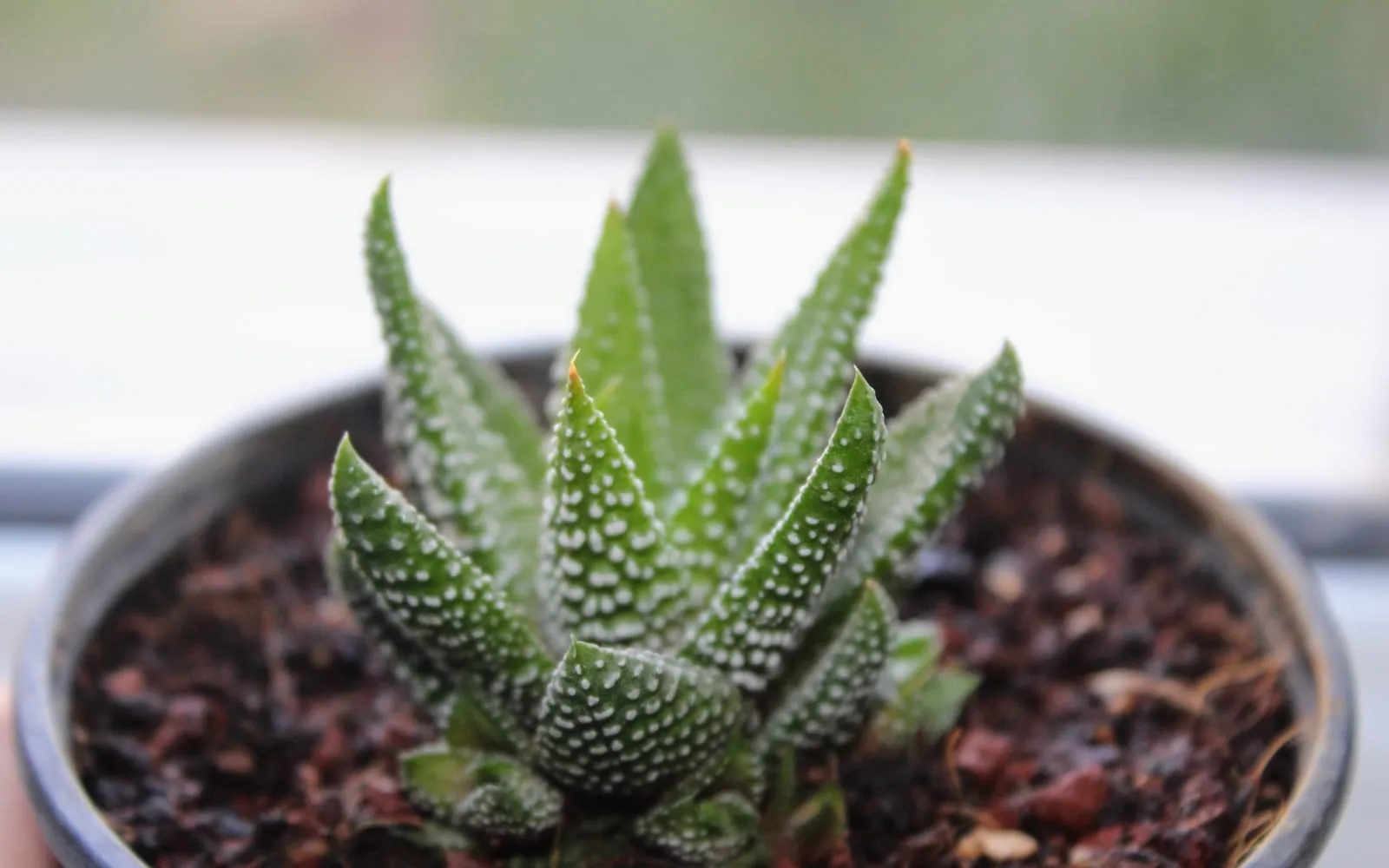
Leaves are stiff, thick and sharply pointed, dark green, and arranged in a spiral rosette.
The banding is the identifying feature. Raised white tubercles cover the underside of each leaf in horizontal bands, giving the zebra effect, while the upper surface is smooth and unmarked.
That distinction matters for identification. Haworthiopsis fasciata has smooth upper leaf surfaces and bumps only underneath. The far commoner Haworthiopsis attenuata has bumps on both surfaces, and most plants sold as fasciata are attenuata. They are grown identically.
Leaves are hard and fibrous rather than soft and juicy, which is what distinguishes the genus from aloe.
Offsets appear around the base and are how the plant is propagated.
Flowers are produced on a surprisingly long thin stem, up to 40 cm, carrying small tubular white flowers with brownish stripes. They are unremarkable and the stem is usually removed.
Growth is very slow. A plant may add one or two leaves a year.
Where it is from
The Eastern Cape of South Africa, where it grows in dry scrub and grassland, usually sheltered under rocks, in leaf litter or in the shade of larger shrubs.
That sheltered habit is what sets the genus apart from most succulents and explains the tolerance of lower light. A haworthia in full South African sun would burn.
Many species are partly buried in habitat, with only the leaf tips showing, which protects them from heat and grazing.
The climate is dry with unreliable rainfall, so the plant stores water in its leaves and expects long periods with none at all.
The genus was split from Haworthia in 2013, and the hard-leaved species with tubercles were moved into Haworthiopsis. Older books, labels and most shops still say Haworthia.
Many wild populations are threatened by illegal collecting, and nursery-propagated plants are both cheap and plentiful, so there is no reason to buy wild-collected stock.
How it grows
Position it in bright indirect light with perhaps an hour of direct morning sun. An east-facing windowsill is close to ideal.
Avoid harsh direct midday sun, which turns the leaves red-brown.
Keep it between 15 and 24 deg C in growth. It tolerates a cool winter down to about 5 deg C and is happier around 10 to 15 deg C then.
Use gritty free-draining cactus compost, or ordinary compost with half added grit and perlite.
Use a shallow pot with drainage holes, only slightly wider than the rosette. The roots are thick and fleshy and do not want depth or space.
Water only when the compost is completely dry all the way through, which in summer means every two to three weeks.
Water at the base and never into the centre of the rosette. Water sitting between the leaves is the classic cause of rot.
Reduce watering sharply in winter, to perhaps once every six weeks, and keep the plant cool.
Feed every six to eight weeks in the growing season with a dilute cactus feed, and not at all in winter.
Remove offsets in spring to make new plants. Twist or cut them from the parent with a few roots attached, let the cut surface dry for a day, and pot them into gritty compost.
Repot every two or three years in spring, which is mostly an opportunity to check the roots for mealybug.
Cut off the flower stem at the base if you do not want it, since flowering takes energy from a slow plant.
Through the seasons
Winter is the rest and the riskiest season for watering. Keep it cool and bright, water perhaps every six weeks, and stop feeding entirely.
Spring is the restart. Increase watering, resume feeding, repot if needed, and remove offsets.
Summer is the growing season, such as it is. Water when the compost dries fully, feed occasionally, and shade from harsh midday sun.
Autumn is the wind-down. Reduce watering from October and move it somewhere cooler and bright.
Care difficulty
Easy, and among the most forgiving succulents for indoor conditions.
Overwatering is the only meaningful risk, and it is the reason nearly every dead haworthia died.
Light is unusually flexible for a succulent, which is the plant’s main practical advantage.
Slow growth frustrates people expecting visible change. A haworthia looks much the same from one year to the next.
Mealybug in the roots is the pest to check for at repotting.
Watering
Water only when the compost is completely dry all the way through. Push a finger or a chopstick right to the bottom, since the surface dries long before the base.
In summer that usually means every two to three weeks, and in winter every six weeks or less.
Water at the base, never into the rosette. Water trapped between the leaves rots the crown.
Water thoroughly when you do, until it runs from the drainage holes, then drain fully and empty the saucer.
Wrinkled, slightly deflated leaves mean thirst, and the plant plumps up within a day or two of watering.
Yellowing translucent mushy leaves at the base mean overwatering, and by that stage the roots are usually already lost.
Warning signs, diseases and pests
Soft yellowing translucent leaves at the base of the rosette mean rot from overwatering. Unpot the plant, cut away every soft part, let the remainder dry for several days, and repot into dry gritty compost. Recovery is possible if the growing point is firm.
Water sitting in the centre of the rosette is the specific cause of crown rot. Tip the plant to drain it if it happens, and water at the base in future.
Leaves turning red, brown or purple mean too much direct sun. It is a stress response rather than a disease, and the plant recovers in gentler light.
Pale stretched growth with the rosette opening out and the leaves reaching upward means too little light.
Wrinkled leaves mean thirst, which is the easy problem.
Mealybug hides at the leaf bases and, more damagingly, among the roots, where it shows as white cottony deposits when the plant is unpotted. Check at every repotting.
Brown dried leaf tips are usually old damage and are cosmetic.
No visible growth for a year is normal for this plant.
Growing environment
Bright indirect light with a little direct morning sun. An east-facing windowsill suits it, and it tolerates a north-facing one better than most succulents.
Avoid harsh direct midday sun in summer.
Warmth of 15 to 24 deg C in growth, and a cool bright winter at 10 to 15 deg C which improves the plant.
Low humidity and good ventilation. A steamy bathroom is the wrong place.
Gritty free-draining cactus compost in a shallow pot with drainage holes.
A windowsill, a shelf or a desk. The plant is small enough to go almost anywhere with reasonable light.
A good choice for a home with cats, being non-toxic and looking much like the aloe that is not.
Feeding
Feed every six to eight weeks from April to September with a dilute cactus or succulent fertiliser at half the stated strength.
Stop feeding entirely from October to March.
Repot every two or three years into fresh gritty compost, which supplies more than a feed does.
Avoid rich or high-nitrogen fertiliser, which produces soft growth that rots.
A slow-growing plant needs very little, and overfeeding does more harm than underfeeding.
Troubleshooting
The bottom leaves have gone soft and see-through. Overwatering. Unpot it, cut away every soft part, let it dry for several days, and repot into dry gritty compost.
How often should I water it? Only when the compost is completely dry to the bottom, roughly every two to three weeks in summer and every six weeks in winter.
The leaves have turned reddish-brown. Too much direct sun. It is a stress response rather than damage, and the colour fades in gentler light.
It has gone pale and stretched upward. Too little light. Move it somewhere brighter, though it needs less than most succulents.
Is it an aloe? No, though they look similar. Haworthia leaves are hard, dark and covered in raised white bumps. Aloe leaves are thicker, softer and full of gel. Aloe is toxic to cats and dogs, and haworthia is not.
Mine has bumps on both sides of the leaves. Then it is almost certainly Haworthiopsis attenuata rather than fasciata, which is what most plants sold under either name turn out to be. Grow it identically.
How do I get more plants? Remove the offsets around the base in spring with a few roots attached, let the cut dry for a day, and pot them into gritty compost.
It has not grown at all this year. Normal. Haworthias are very slow and may add only one or two leaves in a season.
Zebra haworthia problem guides
Not sure what is wrong? See the common houseplant pests guide.