
Houseplant
Plush Plant
Echeveria pulvinata
Also known as Ruby blush, Chenille plant
How to grow plush plant as a houseplant. Its velvety, red-tipped leaves, why touching them dulls the surface, and its shrubby, upright habit.
At a glance
- Difficulty
- Easy
- Water
- Water when the compost has dried out completely
- Light
- Bright light, several hours of direct sun
- Temperature
- 10-27 deg C, avoid below 5 deg C
- Hardiness
- USDA 9-11, RHS H1c, hardy to 5 C
- Type
- Evergreen perennial succulent
- Height
- 15-30 cm
- Native to
- Mexico
Tender to frost and grown as a houseplant across almost the entire temperate world. Strong light and, ideally, a cooler night temperature in autumn bring out the red colouring at the leaf tips that gives this species much of its appeal, and a plant kept warm and shaded year round tends to stay a plainer green throughout.
Hardiness zones describe winter cold alone. Summer heat, humidity, rainfall and the length of the growing season decide as much, so treat the range as the outer limit rather than as a recommendation.
Not known to be toxic
Plush plant has no toxicity listing from the RHS or the ASPCA and is considered safe around pets and children. There is no documented history of poisoning associated with this species.
Source: RHS
About
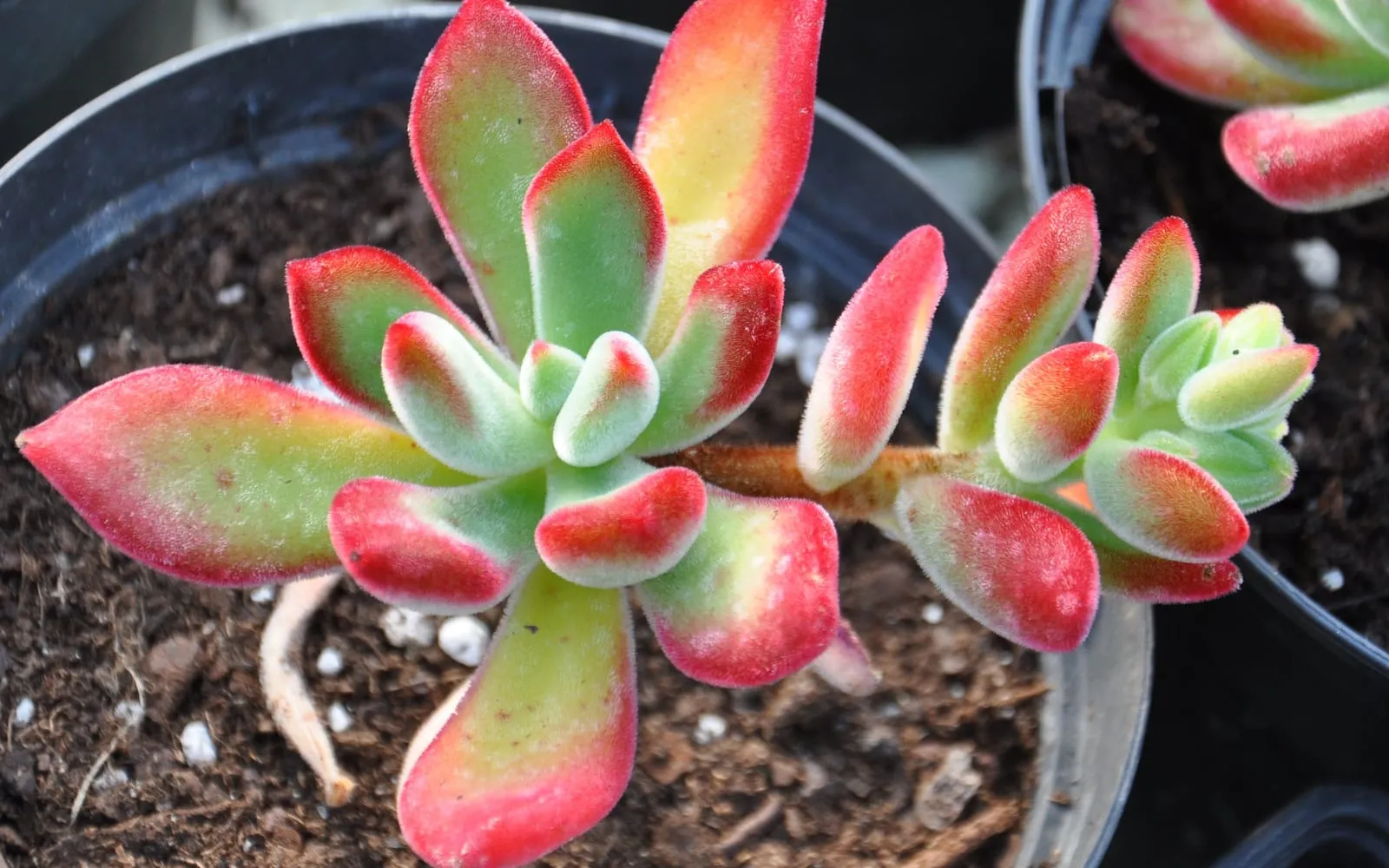
Plush plant is grown for the dense covering of fine, velvety hairs on its thick, fleshy leaves, a texture unusual among Echeveria species, most of which have smooth, glossy leaf surfaces instead. In good light the leaf tips and margins flush a deep red, standing out sharply against the soft, pale green of the rest of the leaf, and the combination of that colour and the leaves’ furry texture has earned it the alternative names ruby blush and chenille plant.
Unlike many Echeveria species, which stay as a single low, flat rosette, this one grows into a shrubbier, branching plant with multiple upright stems, each tipped with its own rosette, giving a mature specimen more height and structure than the low, ground-hugging habit typical of the genus.
Appearance and character
Thick, fleshy leaves, covered in a fine coat of short hairs that gives the whole surface a soft, velvety texture, arrange in loose rosettes at the tips of upright, branching stems. In strong light, particularly with some cooler nights, the leaf margins and tips deepen to a rich red, fading back toward green at the base of each leaf and creating a noticeable two-tone effect across the rosette.
Small, bell-shaped, orange-red flowers appear on tall, arching stalks in winter or early spring on a well-grown plant, a welcome splash of colour during a season when few other houseplants are flowering, though the foliage remains the plant’s main draw through the rest of the year.
Where it is from
Rocky, semi-arid hillsides in Mexico, in strong sun with generally sharp drainage and a real difference between warm days and cooler nights, particularly outside the hottest part of summer.
That day-to-night temperature swing is directly connected to the red colouring this species is grown for; a plant grown in a stable, warm indoor environment with little temperature variation, even in bright light, often shows less intense colour than one that experiences cooler nights as part of its normal cycle.
How it grows
Branching stems extend from the base, each one eventually forming its own rosette at the tip, and older stems can become somewhat woody at the base as the plant matures into a shrubbier form than most other Echeveria species. New branches often arise where an older stem has been damaged or pruned, which is one reason growers sometimes pinch out a leggy stem deliberately to encourage a fuller, more branched shape.
Because it branches so readily, this species is also easy to propagate from stem cuttings as well as from individual leaves, the two most common Echeveria propagation methods, and cuttings generally root and establish faster than single leaves do.
Through the seasons
Spring growth resumes as light and, in many climates, temperature both increase.
Summer is the main growing season, with steady stem extension and new leaf growth. Water when the compost has dried out fully and feed once or twice through this period.
Autumn cooler nights, where available, often bring out stronger red colouring in the leaves.
Winter flowering may occur on a mature, well-grown plant. Reduce watering and keep the plant in the brightest available spot.
Care difficulty
Easy. This is a tolerant, adaptable succulent that grows well under typical bright houseplant conditions, needing only sharp drainage and careful watering, the same basics that suit most other succulents.
Watering
Water only once the compost has dried out completely, soaking thoroughly and letting all excess drain away rather than leaving the pot standing in water. As with most succulents, err toward underwatering rather than overwatering, particularly since the velvety leaf surface can trap and hold moisture if watered from above, encouraging spotting or rot on the leaves themselves.
Warning signs, diseases and pests
Mealybug can settle in the crevices between leaves at the centre of a rosette, and is treated with careful manual removal or a horticultural soap for persistent infestations. Root rot from overwatering is the more serious risk, showing as a soft, discoloured base or lower leaves that yellow and drop.
Watering directly onto the leaves, rather than the compost, can leave water trapped in the fine surface hairs, sometimes leading to spotting or localised rot on the leaf surface; watering at the base and avoiding wetting the foliage avoids this.
Pale, less colourful growth despite apparently bright conditions often reflects a lack of temperature variation between day and night, since this species colours up more strongly with a real seasonal or daily temperature contrast than under constant warmth alone.
Growing environment
Bright light with several hours of direct sun brings out the best leaf colour and keeps growth compact; in lower light the plant stretches and loses much of its characteristic red colouring. Sharply free-draining succulent or cactus compost is essential, and a spot with some cooler night temperatures, such as a windowsill in an unheated or lightly heated room, supports stronger colour than a uniformly warm position.
Feeding
A low-nitrogen cactus or succulent fertiliser, applied once or twice during the growing season, supports steady growth without producing the soft, weak stems that heavier feeding can cause. This species does not need a particularly rich feeding regime to perform well.
Troubleshooting
Leaf colour looks plain green rather than red-tipped. Usually too little light, or too little temperature variation between day and night. Move the plant to a brighter spot and, where practical, a position that experiences some cooler night temperatures.
Spotting or soft patches have appeared on the leaf surface. Check whether water has been getting trapped in the fine leaf hairs from overhead watering. Water at the base of the plant in future and avoid wetting the foliage.
Stems have become tall and leggy with sparse leaves. Usually insufficient light. Move the plant to a brighter spot, and consider pinching out a leggy stem to encourage bushier, more branched regrowth from lower down.
You want to propagate new plants from this species. Both leaf cuttings and stem cuttings work, though stem cuttings generally root and establish faster; let any cutting callus for a few days before setting it on the surface of barely moist, free-draining compost.
Plush Plant problem guides
Not sure what is wrong? See the common houseplant pests guide.