
Houseplant
Lady's Slipper Orchid
Paphiopedilum insigne
Also known as Paph, Slipper Orchid
Practical guidance for growing lady's slipper orchid, Paphiopedilum insigne, including the pouched flower, no pseudobulbs, constant light moisture, cool growing conditions, and handling care.
At a glance
- Difficulty
- Moderate
- Water
- Kept lightly and evenly moist year round, never fully dried out
- Light
- Medium indirect light; no direct sun
- Temperature
- 10 to 24 deg C, cooler than most houseplant orchids
- Humidity
- 50-70 percent
- Hardiness
- USDA 9-11, RHS H1c, hardy to 7 C
- Type
- Evergreen terrestrial orchid, growing in a low fan with no pseudobulbs
- Height
- 20-30 cm in flower
- Native to
- the Himalaya
Native to the Khasi Hills and neighbouring foothills of the eastern Himalaya, at a moderate elevation with a monsoon-influenced climate and properly cool winters. Grow it as a cool orchid, with nights noticeably cooler than a typical warm, tropical houseplant orchid tolerates. It struggles in the sustained heat that suits a Phalaenopsis or Vanda. It has no frost tolerance but copes with a cool room that would stall most other orchids grown indoors.
Hardiness zones describe winter cold alone. Summer heat, humidity, rainfall and the length of the growing season decide as much, so treat the range as the outer limit rather than as a recommendation.
Skin irritant
- Do not eat
- Fine glandular hairs on the leaves and flower stem
- Harm from
- Handling it
- Affects
- People
Paphiopedilum, along with its close temperate relative the lady's slipper orchids in the genus Cypripedium, carries fine glandular hairs on the leaves and flower stalk that can cause a contact rash, known among growers and florists as orchid dermatitis, in people sensitive to the compound involved. It shows as redness and itching where bare skin has brushed against the plant repeatedly, usually during repotting or handling rather than from a single light touch. Wearing gloves when repotting or dividing a plant avoids the issue for anyone prone to skin reactions. It is not listed by the ASPCA as toxic to cats or dogs, and there is no record of it causing harm if eaten by a pet.
Sources: RHS potentially harmful garden plants, ASPCA toxic and non-toxic plants
About
Lady’s slipper orchid takes its name from the flower’s pouch, a swollen, slipper-shaped lip that traps visiting insects briefly and forces them past the flower’s reproductive parts on the way back out, a mechanism unique among the orchids commonly grown as houseplants. Paphiopedilum insigne was one of the first tropical slipper orchids introduced to Western cultivation and remains one of the easier species in the genus.
Unlike most orchids on this site, it has no pseudobulbs and no dry storage organ of any kind, which is the single fact that shapes almost everything else about growing it. It needs consistently moist roots and comes from cooler hill country than a typical tropical orchid, wanting a noticeably cooler spot than a Phalaenopsis or a Vanda would tolerate.
Appearance and character
Growth forms a low, fanned rosette of strap-shaped, leathery leaves, plain mid-green in this species, arising in a tight cluster with no pseudobulb or storage stem behind them. New fans emerge from the base of older ones, gradually building a multi-growth clump over years.
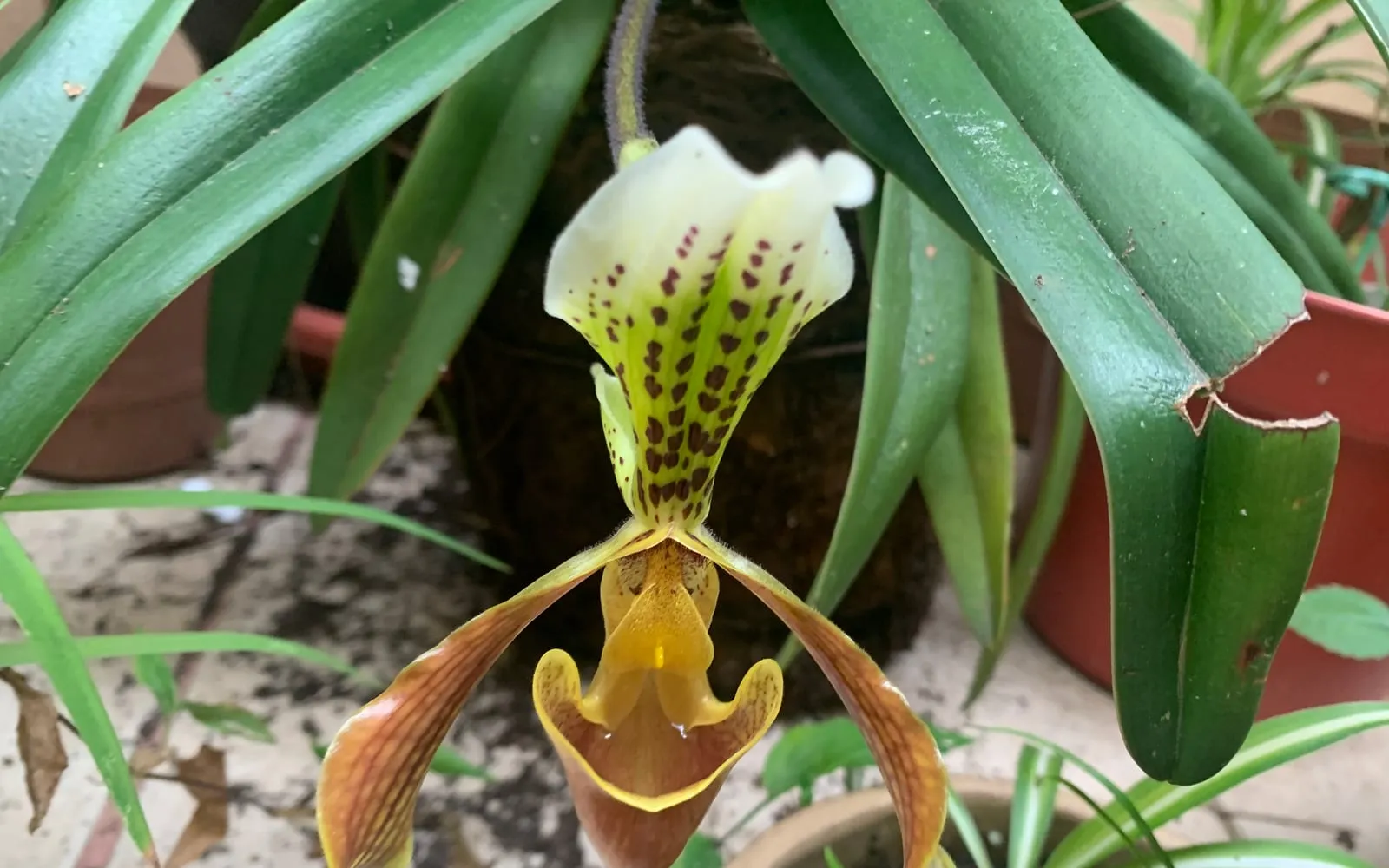
The flower is the plant’s defining feature: a single bloom, occasionally two, carried on a hairy stem above the foliage, with a large, pouched lip in warm coppery brown to maroon, an upper dorsal sepal striped in green and white or pale yellow, and twisted, tapering side petals in a similar coppery tone. Flowers are long-lasting, often remaining fresh for six weeks or more, and typically appear in autumn or winter.
The whole plant stays compact, rarely spreading much beyond a dense clump of fans even after years of good growth, which suits it well to a windowsill or a shelf where space is limited.
Where it is from
Paphiopedilum insigne grows in the Khasi Hills and neighbouring foothill ranges of the eastern Himalaya, at a moderate elevation shaped by the monsoon, rooting into leaf litter and moss on shaded, humus-rich slopes rather than climbing into the canopy as an epiphyte. Rainfall is heavy through summer, and winters at that elevation turn properly cool, often with nights close to freezing at altitude, though the plant itself grows in the milder microclimate of the forest floor rather than fully exposed.
That elevation sets it apart from most orchids sold as houseplants, which mostly come from warm lowland tropics. A cool winter and constant leaf litter moisture describe its wild ground far better than a warm, occasionally-dry regime does, which is why it is grouped among the small number of orchids described as cool growing rather than warm or intermediate.
How it grows
Pot it in a fine, moisture-retentive orchid mix combining small bark grade, perlite and a portion of sphagnum moss, denser and more water- retentive than the coarse bark suited to an epiphytic orchid with thick storage roots. This species has fine roots with no reserve to fall back on if the mix dries out for long.
Give it medium indirect light with no direct sun, which scorches the leaves quickly. A north- or east-facing spot, or a position a little back from a brighter window, generally suits it well.
Keep it noticeably cooler than a typical houseplant orchid, especially at night. A room that runs warm year round, as many centrally heated homes do, works against this species more than almost any other factor, and a cooler spare room, porch or unheated hallway in winter can improve flowering markedly.
Repot every one to two years once the mix begins to break down, since a compacted, ageing mix holds too much stale moisture around the fine roots and is a common cause of decline in an otherwise well-cared-for plant.
Through the seasons
Spring brings new fan growth from the base of the clump. Resume regular light feeding as new growth becomes visible.
Summer is the main growing season, needing consistent moisture and protection from strong direct sun, which is more intense than at any other time of year.
Autumn brings the flower spike on a mature fan, along with cooling temperatures that this species takes comfortably in its stride.
Winter brings the flowers themselves, often lasting into the new year. Keep the plant properly cool, reduce feeding, and maintain steady, light moisture throughout.
Care difficulty
Moderate. The plant has no pseudobulb to buffer a missed watering the way most other orchids do, so a mix that dries out fully causes stress within days rather than weeks. Temperature catches people out too. A warm room that suits a Phalaenopsis perfectly well can leave this species growing weakly without ever flowering, because it needs cooler conditions than most houseplant orchids tolerate.
Watering
Keep the mix lightly and evenly moist at all times, watering again once the surface has just begun to dry rather than waiting for the whole pot to dry out the way most orchid advice recommends.
Never let the pot sit in standing water, since even a moisture-loving orchid like this one needs air reaching the roots between waterings, and a saucer left full invites rot just as readily as an extended dry spell invites stress.
Warning signs, diseases and pests
Mealybug hides between the tightly overlapping bases of the leaf fan, showing as small white, cottony tufts that are easy to miss without a close look. Dab visible clusters with a cotton bud dipped in isopropyl alcohol.
Scale insects appear as small, flat brown bumps on the underside of the leaves, sapping the plant’s strength gradually. Scrape them off and treat with horticultural soap.
Root rot follows a mix that has become airless and compacted as well as wet, showing as fans that pull away easily from the base and roots that are brown and mushy rather than firm. Repot into fresh mix promptly, trimming away any dead roots.
Spider mite becomes more likely in warm, dry indoor air, showing as fine speckling on the leaves. Raising humidity slightly and wiping the leaves down periodically both help keep it in check.
Growing environment
Medium indirect light suits it best, with no direct sun at any time of year, since the leaves scorch readily and show permanent damage rather than recovering.
Cool conditions matter more for this species than for most orchids commonly grown indoors. Aim for something closer to 10 to 24 deg C, with a genuine drop at night, rather than the warmer, steadier range that suits a typical tropical houseplant orchid.
Moderate to high humidity, around 50 to 70 percent, supports healthy growth, though this species tolerates average room humidity reasonably well provided the mix itself never dries out.
Feeding
Feed at low strength with most waterings through the growing season, using a dilute, balanced orchid fertiliser or one formulated specifically for terrestrial orchids, which have different nutrient needs from an epiphyte growing in bark.
Reduce feeding through the cooler winter months, when growth has slowed, though this species never stops taking up water and small amounts of nutrient the way a dormant epiphytic orchid does.
Troubleshooting
The leaves have developed brown, scorched patches. Too much direct sun, almost always. Move the plant further from the window or add a sheer curtain between it and the glass, and expect new leaves to grow in undamaged.
A fan pulled away easily and the roots underneath look brown. Root rot, usually from a compacted or overly wet mix. Repot promptly into fresh mix, removing dead roots, and check that the pot is never left standing in water.
It flowered once and has not flowered since. Check the growing temperature first. A room that has run warmer than this species prefers, particularly at night, is the most common reason an otherwise healthy plant stops flowering.
The leaves look fine but the plant seems to be shrinking. Likely a slow decline in the root system rather than anything visible above soil level. Unpot and check the roots; a mix broken down and stale for too long is the usual underlying cause and calls for a fresh repot.
Do I need to give it a dry rest like other orchids? No. Unlike many orchids with pseudobulbs, this species has no storage organ and should never be allowed to dry out fully at any point in the year.
Lady's Slipper Orchid problem guides
Not sure what is wrong? See the common houseplant pests guide.