
Houseplant
Slender Lady Palm
Rhapis humilis
Also known as Reed rhapis, Slender lady's palm
How to grow slender lady palm, Rhapis humilis, as a houseplant. Its tolerance of low light, clumping habit, and how it differs from the broader lady palm.
At a glance
- Difficulty
- Easy
- Water
- Water when the top few centimetres of compost have dried
- Light
- Bright indirect light to partial shade; tolerates low light well
- Temperature
- 15-27 deg C, avoid below 5 deg C
- Humidity
- Ordinary room humidity is fine
- Hardiness
- USDA 9-11, RHS H2, hardy to 2 C
- Type
- Evergreen perennial palm
- Height
- 1.5-3.5 m indoors
- Native to
- Southern China
Frost-tender and grown as a houseplant across almost its entire range outside the mildest, most humid subtropical gardens. Outdoors it survives only where winters stay reliably frost-free, and everywhere colder it needs to be grown in a container that can be brought inside before the first cold night of autumn.
Hardiness zones describe winter cold alone. Summer heat, humidity, rainfall and the length of the growing season decide as much, so treat the range as the outer limit rather than as a recommendation.
Not known to be toxic
Slender lady palm has no toxicity listing from the RHS or the ASPCA and is considered one of the safer palms to keep around cats and dogs, alongside its close relative the broadleaf lady palm. It has no documented history of causing poisoning in pets or people.
Source: ASPCA
About
The slender lady palm is a graceful, clumping houseplant grown for its narrow, fine-textured fronds and its unusual tolerance of the low light levels found in many homes and offices, a rare combination among palms, most of which demand strong light to look their best. It forms multiple slim, cane-like stems from the base rather than a single trunk, gradually building into a dense, bamboo-like clump over years.
It is closely related to and often confused with the broadleaf lady palm, Rhapis excelsa, the more commonly sold species; the two are distinguished mainly by leaf width and the number of segments per frond, with this species holding narrower, more numerous, more finely divided leaflets that give it a noticeably softer, more feathery overall texture.
Appearance and character
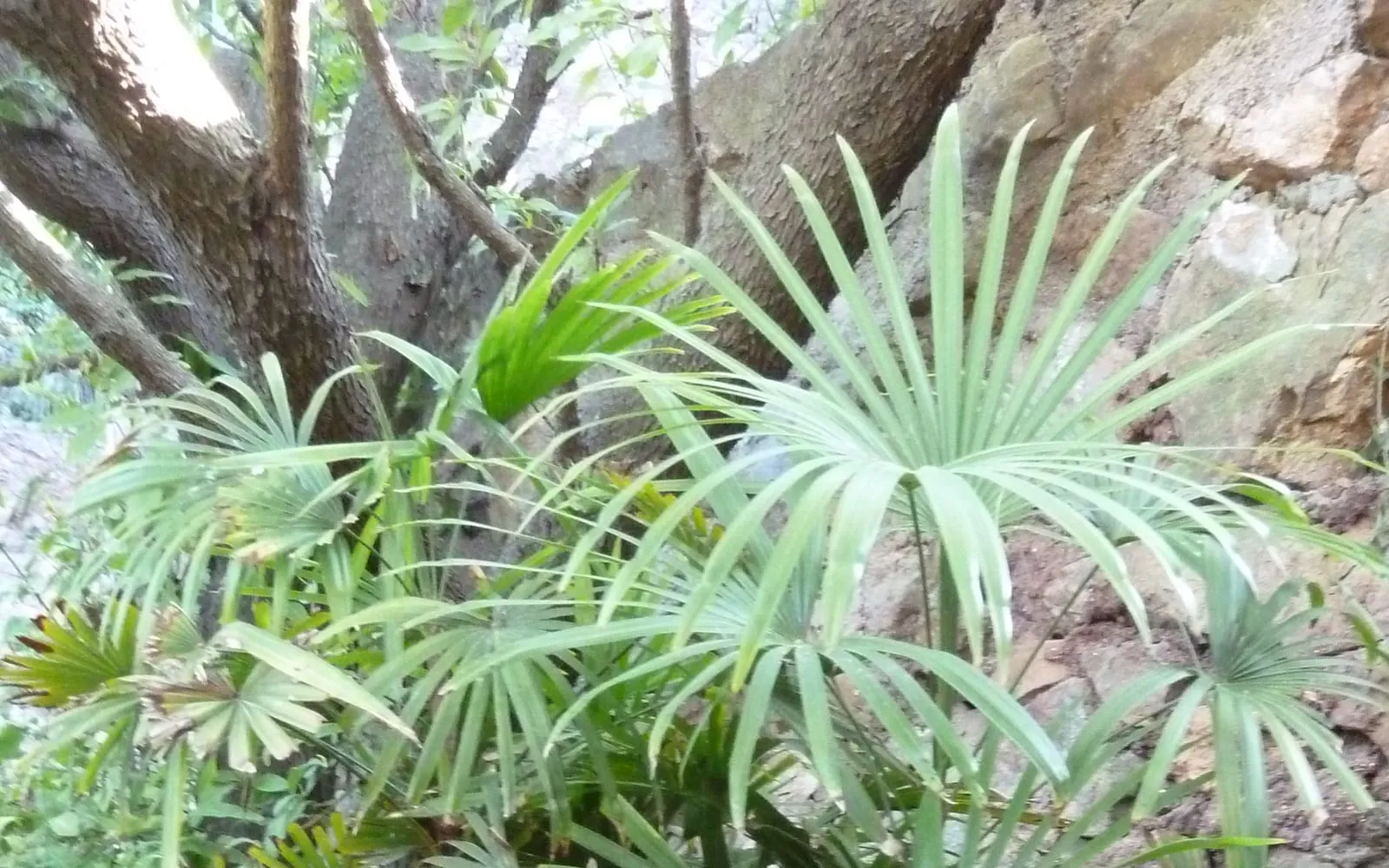
Slender, upright, cane-like stems, wrapped in a coarse brown fibre at the base, carry narrow, deeply divided, fan-shaped fronds arranged along their length, with each frond split into ten or more narrow, pointed segments that give the whole plant a fine, almost bamboo-like texture. New stems emerge continuously from the base, gradually thickening an established clump into a dense, multi-stemmed feature.
Flowers are small, pale and largely hidden among the foliage, rarely a feature of note on an indoor specimen, and this palm is grown overwhelmingly for its foliage texture and reliable indoor performance rather than for any floral display.
Where it is from
The understorey of subtropical forests in southern China, where it grows in the dappled, often quite low light beneath a taller canopy, in humid, humus-rich soil.
That forest understorey origin is the direct explanation for its unusual tolerance of low indoor light, a trait shared with few other commonly grown palms and one of the main reasons it has remained a popular houseplant for well over a century, particularly in Victorian-era conservatories where gas lighting and coal smoke made strong natural light scarce indoors.
How it grows
An evergreen, clumping palm that spreads by producing new stems from an expanding underground rhizome rather than growing as a single trunk. Each stem grows slowly but steadily, and a container-grown clump thickens gradually over years as new canes emerge from the base, eventually filling a substantial pot.
Growth indoors is generally slow and steady rather than fast, which suits its role as a long-term, low-maintenance houseplant that changes little from year to year rather than needing frequent repotting or drastic pruning.
Through the seasons
Spring growth picks up as light levels increase, with new stems and fronds emerging from the base. Resume regular feeding.
Summer is the main growing period, with steady new stem and frond production.
Autumn growth slows as light levels drop; reduce feeding as this happens.
Winter growth is minimal. Water less frequently, letting the compost dry a little further between waterings than in the growing season, while never letting it dry out completely.
Care difficulty
Easy. This is one of the more forgiving palms available for indoor growing, tolerating a wide range of light conditions, ordinary room humidity, and some inconsistency in watering far better than most other palms sold as houseplants.
Watering
Water thoroughly when the top few centimetres of compost have dried, allowing any excess to drain away completely rather than letting the pot sit in standing water. This palm is more forgiving of occasional underwatering than of consistently soggy compost, which can lead to root problems over time.
Warning signs, diseases and pests
Spider mites can appear in warm, dry indoor air, showing as fine speckling on the fronds and, in heavier infestations, fine webbing between leaflets; raising humidity and wiping fronds down periodically helps prevent this. Scale insects and mealybug both occasionally colonise the stems and frond undersides, appearing as small stationary bumps or cottony white clusters, and respond well to careful removal with a cloth or cotton bud dipped in diluted alcohol for light infestations.
Brown, dry leaflet tips are usually a sign of low humidity or a build-up of mineral salts from tap water rather than a pest problem, and are addressed by occasional flushing of the compost with plenty of water to wash excess salts through, along with trimming the affected tips for appearance.
Yellowing across whole fronds, rather than just the tips, more often indicates overwatering and poor drainage, and checking the roots for rot is worthwhile if this occurs alongside a generally unhealthy appearance.
Growing environment
Bright indirect light gives the fullest, most compact growth, though this species tolerates much lower light than most other palms without serious decline, making it a reliably useful choice for a dimmer corner of a room. Ordinary household humidity is adequate, and it does not need the misting or humidity trays some more delicate houseplants require.
Feeding
A balanced liquid feed at half strength, applied monthly through spring and summer, supports steady growth without encouraging the soft, weak growth that heavier feeding can cause in a palm adapted to a naturally low-nutrient forest floor. Stop feeding through autumn and winter while growth is minimal.
Troubleshooting
Leaflet tips are brown and dry. Usually low humidity or a build-up of mineral salts from tap water. Flush the compost thoroughly with water occasionally and trim the affected tips.
Whole fronds are yellowing. Check for overwatering and poor drainage first, since this is more often the cause than underwatering in this species.
Fine speckling or webbing appears on fronds. Check for spider mites, particularly in warm, dry indoor conditions, and raise humidity around the plant to discourage them.
The clump has become dense and pot-bound. This palm tolerates being somewhat pot-bound better than many houseplants, but very congested growth benefits from division or a move to a larger pot in spring, when new roots establish most readily.
You want to divide a clump to create new plants. Divide in spring, separating a section that includes several stems and a healthy portion of root, and pot it into fresh, free-draining compost. Keep newly divided sections a little more consistently moist than usual while they re-establish their root systems.
New stems are emerging noticeably thinner than established growth. This can indicate the plant is short of light or nutrients. Check that it is getting reasonably bright indirect light and resume regular feeding if it has been missed for some time.
Slender Lady Palm problem guides
Not sure what is wrong? See the common houseplant pests guide.