
Houseplant
Pride of Table Mountain
Disa uniflora
Also known as Red disa
How to grow Disa uniflora as a houseplant. Its need for cool, moving, mineral-free water at the roots, and why it rejects ordinary orchid bark.
At a glance
- Difficulty
- Difficult
- Water
- Constantly wet at the roots, ideally with some water movement
- Light
- Bright indirect light, no direct hot sun
- Temperature
- 10-22 deg C; struggles above 25 deg C
- Humidity
- High, 70 percent or more
- Hardiness
- USDA 9-10, RHS H2, hardy to 5 C
- Type
- Evergreen terrestrial orchid
- Height
- 30-60 cm in flower
- Native to
- South Africa
Adapted to cool, wet, mountain streamsides with roots that sit in constantly moving, mineral-poor water even in summer, so it dislikes both hard frost and real heat in roughly equal measure. It is grown as a container specimen in a cool, humid spot everywhere outside its narrow native climate band, and standard houseplant orchid conditions, aimed at tropical epiphytes, will not keep it alive for long.
Hardiness zones describe winter cold alone. Summer heat, humidity, rainfall and the length of the growing season decide as much, so treat the range as the outer limit rather than as a recommendation.
Not known to be toxic
Pride of Table Mountain has no toxicity listing from the RHS or the ASPCA and is considered safe around pets and children. It has no documented history of poisoning.
Source: RHS
About
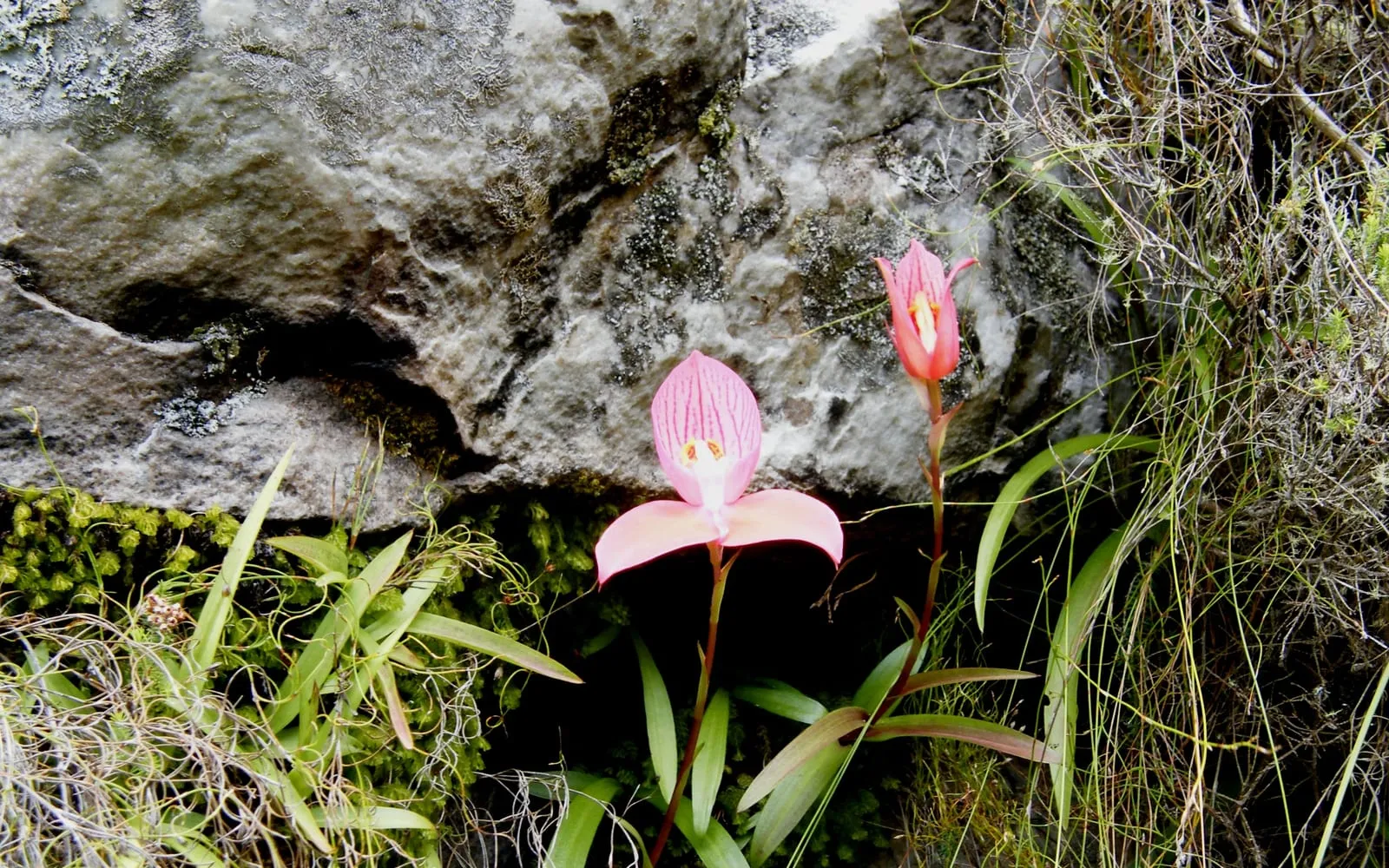
The pride of Table Mountain has one of the largest and most brilliantly coloured flowers of any orchid found growing wild at high elevation, a single vivid scarlet-red bloom, sometimes more than one on a strong plant, held atop a tall, upright stem above a low rosette of leaves. It grows naturally beside cold mountain streams on Table Mountain and neighbouring peaks in South Africa’s Western Cape, a habitat that explains almost everything difficult about growing it well away from that mountain.
Unlike the tropical epiphytic orchids most houseplant growers are familiar with, this is a terrestrial species with roots that expect to sit in cool, constantly moving, mineral-poor water, closer to a streamside bog plant in its needs than to a typical orchid grown in bark.
Appearance and character
A low rosette of strap-shaped leaves sits close to the growing medium, from which a single tall, upright flower stem rises, holding one to a few of the species’ large, glossy scarlet flowers, each marked with darker veining. The scale and intensity of colour on a well-grown flower can be startling next to the more muted tones of many other orchid species.
The plant persists as a rosette between flowering periods rather than losing all its leaves, though older rosettes typically decline after flowering as new offset rosettes develop alongside them to carry the plant forward.
Where it is from
Perennially wet rock faces and streamsides in the mountains of South Africa’s Western Cape, most famously Table Mountain itself, where roots sit in cold, fast-moving, mineral-poor water fed by mountain seepage even through the region’s dry summer.
That specific combination, cool temperatures, constant moisture movement and very low mineral content, is almost impossible to replicate by accident, and cultivation success with this species depends on deliberately engineering conditions closer to a cold mountain stream than to a typical potted houseplant.
How it grows
Each flowering rosette is generally replaced after blooming by one or more new offset rosettes that develop alongside it, so the plant effectively renews itself through a cycle of flowering and offsetting rather than the same rosette flowering indefinitely year after year. This is a normal part of the plant’s life cycle and not a sign that anything has gone wrong when an older rosette declines after flowering.
Roots are fine and easily damaged by stagnant conditions, rotting quickly in warm, mineral-laden or poorly oxygenated water, which is why growers experienced with this species often favour a growing medium that allows water to pass through and be refreshed regularly rather than sitting static around the roots.
Through the seasons
Spring new offset rosettes typically develop as the plant comes into active growth.
Summer is the main flowering period for many growers, though timing varies with how closely conditions match the plant’s native mountain climate. Keep roots constantly wet and cool even in warm weather.
Autumn flowering finishes and the plant focuses on establishing its offset rosettes for the following year.
Winter growth continues at a slower pace; keep the plant frost-free but still cool and constantly moist rather than allowing it to dry out.
Care difficulty
Difficult, and specifically difficult in a way that catches out growers experienced with more typical tropical orchids. The core challenge is providing cool temperatures, constant root moisture with real water movement, and mineral-free water simultaneously, a combination few ordinary houseplant setups achieve without deliberate adaptation.
Watering
Keep the growing medium constantly wet, ideally with some water movement past the roots rather than static moisture, using only rainwater or distilled water. Hard tap water, with its dissolved minerals, is one of the most common causes of failure with this species, causing a gradual decline that is easy to misattribute to other causes.
Warning signs, diseases and pests
Aphids occasionally colonise flower stems and are usually removed easily with a gentle spray of water. Root rot from stagnant, warm or mineral-laden water is by far the more serious and common problem, showing as a rosette that yellows and collapses despite what appears to be adequate watering, precisely because the watering, while frequent enough, has not been of the right quality or freshness.
A plant that grows leaves steadily but never flowers, or produces fewer and weaker flowers over successive years, often reflects temperatures that are too warm, particularly in summer, rather than any deficiency in water or feeding.
Growing environment
Bright, indirect light suits it well, avoiding hot, direct sun, which this cool-climate species tolerates poorly. Cool temperatures matter more for this species than for almost any other commonly grown orchid, and high humidity supports healthy growth alongside the constant root moisture it needs.
Feeding
A very dilute balanced fertiliser, well below the strength used for most other orchids, applied every second or third watering during active growth, is sufficient. This species is adapted to naturally low-nutrient mountain water, and heavier feeding is more likely to cause harm than to improve growth.
Troubleshooting
A rosette has yellowed and collapsed despite regular watering. Check water quality rather than quantity first; hard tap water or stagnant, warm water are common causes of root rot in this species even when watering frequency seems adequate.
The plant has never flowered despite healthy leaf growth. Suspect temperatures that are too warm, particularly through summer. This species needs sustained cool conditions to flower reliably.
An older rosette has declined after flowering. This is normal. Check for new offset rosettes developing alongside it, which will carry the plant forward for future seasons.
You are setting up a growing system for this species for the first time. Consider a wick or drip-tray arrangement using only rainwater or distilled water, refreshed regularly rather than left to stand and warm up, to better replicate the constantly moving, cool, mineral-free water this orchid depends on in the wild.
You want to compare this species with other Disa hybrids sold by specialist nurseries. Many Disa hybrids bred for slightly easier cultivation trade some of the intense scarlet colour of the wild species for improved tolerance of ordinary growing conditions, so a hybrid may suit a grower without a dedicated cool, humid setup better than the straight species does.
Pride of Table Mountain problem guides
Not sure what is wrong? See the common houseplant pests guide.