
Houseplant
Heuffel's Houseleek
Sempervivum heuffelii
Also known as Sempervivum heuffelii, Jovibarba heuffelii
How to grow Sempervivum heuffelii, Heuffel's houseleek, an easy, fully hardy alpine mat-former with tight colourful rosettes that divide by splitting.
At a glance
- Difficulty
- Easy
- Water
- When the soil dries; drought-tolerant
- Light
- Full sun to bright light
- Temperature
- Fully hardy; tolerates hard frost
- Humidity
- Low to average
- Hardiness
- USDA 4-9, RHS H7, hardy to -30 C
- Type
- Evergreen mat-forming rosette succulent, monocarpic rosettes
- Height
- Rosettes 4 to 10 cm; mats spreading
- Native to
- Southeastern Europe
A fully hardy alpine houseleek from the mountains of south-eastern Europe, growing in rock crevices and thin soil and surviving hard frost and snow well below minus 20 deg C. It needs full sun and very sharp drainage, tolerates drought and cold, and rots only where it sits wet, especially in winter. It needs no protection outdoors.
Hardiness zones describe winter cold alone. Summer heat, humidity, rainfall and the length of the growing season decide as much, so treat the range as the outer limit rather than as a recommendation.
Not known to be toxic
Sempervivum, the houseleeks, are not listed as toxic by the ASPCA or the RHS, and are safe to grow around pets and children. Houseleeks have a long folk history of use on the skin. A pet or child that bit a rosette would get a watery, astringent mouthful and at worst a mild stomach upset, so it can grow in a trough or rockery within easy reach.
Sources: ASPCA toxic and non-toxic plants, RHS potentially harmful garden plants
About
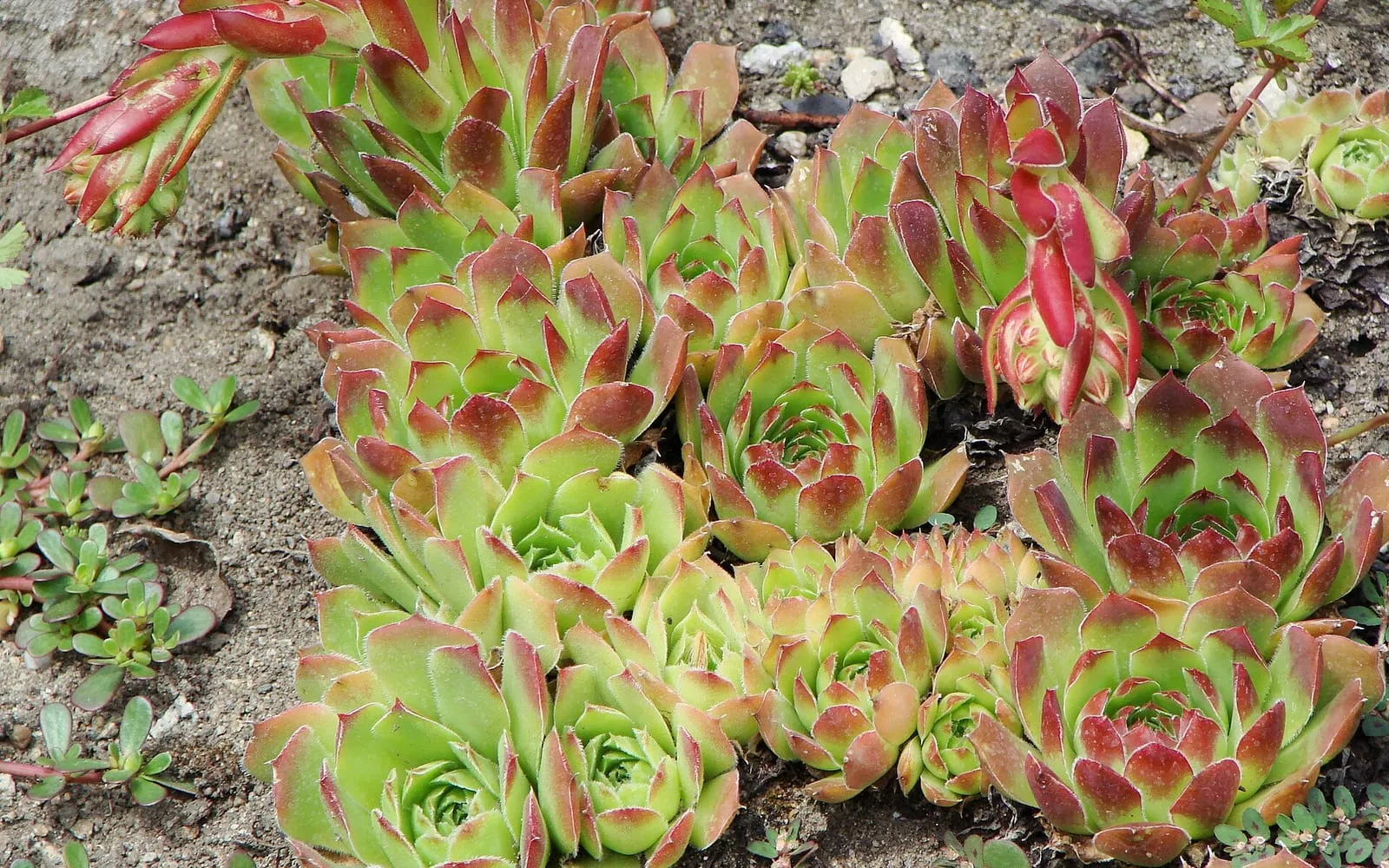
Heuffel’s houseleek makes tight, geometric rosettes of pointed leaves, often flushed in bronze, red, purple or gold, that pack together into low mats. It is a fully hardy mountain plant, and it grows in rock crevices and gravel, with rosettes that colour strongly in sun and cold and change through the year. Among the houseleeks it is distinctive for how it multiplies.
Most houseleeks throw out little offsets, the familiar hens and chicks, on runners. This one does not. Instead each rosette divides from within, splitting into two or more where it sits, so a plant builds a dense, tight mat instead of a loose colony of chicks. That habit produces neat, packed cushions.
It is one of the easiest and hardiest succulents, needing only full sun and sharp drainage, and no winter protection. Grown in a trough, rockery, wall or gritty pot, it tolerates frost, snow and drought. Its main weakness is sitting wet, especially in winter, which rots the crown.
Appearance
The rosettes are tight and geometric, four to ten centimetres across, of pointed, fleshy leaves, richly coloured in bronze, red, purple, gold or green depending on the form, sun and season.
Unlike other houseleeks it makes no offsets on runners; each rosette divides in place, splitting into two or more, so the plant forms a dense, packed mat instead of a scatter of chicks.
The colours shift through the year and are often deepest in the cold and strong sun of winter and spring.
Like all houseleeks it is monocarpic, so a rosette that flowers, sending up a stout stalk of bell-shaped blooms, dies afterwards. The dividing mat usually fills the gap.
Where it is from
Sempervivum heuffelii grows in the mountains of south-eastern Europe, in rock crevices, screes and thin soil, in full sun and cold, snowy winters. It is a true alpine, adapted to hard frost, drought and lean ground.
Give it full sun and very sharp drainage. It tolerates hard frost, snow and drought, and needs no winter protection. Its only weakness is sitting wet, especially in the cold, which rots the crown.
How it grows
It grows through spring and summer, the rosettes colouring and dividing, and stays evergreen and hardy through winter, often at its most colourful then. It spreads slowly into a dense mat by rosette division instead of by running offsets.
Grow it in a very free-draining, gritty, lean mix in a trough, rockery, wall crevice or gritty pot, in full sun. Water new plants until established, after which it is drought-tolerant and needs watering only in long dry spells or, in a pot, when the soil dries.
It needs no feeding and little care beyond removing a spent flowered rosette and any dead leaves. Divide the mat to propagate, teasing apart the split rosettes with roots.
Propagation is by division of the splitting rosettes, since it makes no chicks, or from seed.
Through the seasons
Spring brings fresh growth and often the richest colour. Divide the mat to propagate, and tidy dead leaves.
Summer is when the rosettes grow and divide. Water only in drought, and feed little or not at all.
Autumn growth slows and colours deepen. Little care is needed.
Winter leaves the mat fully hardy and often at its most colourful, needing no protection, though it should not sit wet.
Care difficulty
Easy, and one of the toughest succulents. Given full sun and sharp drainage it colours well, divides into a neat mat and returns each year with little help. It goes wrong mainly where it sits wet, especially in winter, which rots the crown. Keep it lean, sunny and sharply drained and it needs little attention.
Watering
Water a newly planted rosette until it establishes, then leave it mostly to the weather, since it is drought-tolerant and stores water in its leaves. In the ground it needs watering only in prolonged dry spells.
In a pot or trough, water when the soil dries and let it drain, easing off in winter. Sitting wet, especially in the cold, is the main thing that rots it, so sharp drainage matters most.
Warning signs, diseases and pests
Wet, airless conditions rot the roots and crown, the commonest cause of trouble, shown by soft, discoloured tissue at the rosette centre. Improve drainage and air movement, and keep it drier, especially in winter.
In pots, vine weevil grubs can eat the roots, so check the compost of a plant that fades for no clear reason. Otherwise pests are rarely a problem.
Rosettes that stretch, green and loosen mean too little light. Move the plant into full sun to tighten the rosettes and bring back the colour.
Growing environment
Full sun gives the tightest rosettes and the richest colour. In shade the rosettes stretch, green and loosen. It needs an open, sunny position.
It is fully hardy and needs no winter protection outdoors, tolerating hard frost and snow, though it should not sit wet. Low to average humidity suits it.
Grow it in a very free-draining, gritty, lean mix in a trough, rockery, wall or gritty pot in full sun. It is better outdoors than as a permanent indoor plant, since it needs the cold and the sun.
Feeding
Feed little or not at all. Lean soil gives the tightest, most colourful rosettes, and feeding produces soft, green growth. At most, give a single light feed in spring.
A trough benefits from fresh gritty compost every few years instead of feeding. Nothing is needed in autumn or winter.
Troubleshooting
The rosette centre has gone soft and discoloured. Crown rot from wet, airless conditions. Improve drainage and air movement, and keep it drier, especially in winter.
The rosettes have stretched and lost colour. Too little light. Move it into full sun to tighten them and bring the colour back.
Why doesn’t it make chicks like other houseleeks? It divides differently, splitting each rosette in place instead of sending out offsets on runners, so it forms a dense mat. Propagate it by dividing the split rosettes.
A rosette flowered and died. Normal, since houseleeks are monocarpic. The dividing mat fills the gap.
Is it safe around pets? Yes. Houseleeks are not listed as toxic, so it is safe with cats, dogs and children.
Heuffel's Houseleek problem guides
Not sure what is wrong? See the common houseplant pests guide.