
Outdoor plant
Katsura Tree
Cercidiphyllum japonicum
How to grow katsura tree, Cercidiphyllum japonicum. Its autumn leaves smell of burnt sugar and caramel, dry soil scorches the leaf margins no matter how mild the winter was, and nurseries let you choose a single trunk or a multi-stemmed form.
At a glance
- Difficulty
- Moderate
- Water
- Regularly through the growing season, never allowed to dry out for long
- Light
- Full sun to light shade, with some shade welcome in a hot climate
- Temperature
- Fully hardy; new spring growth can be caught by a late frost
- Hardiness
- USDA 4-8, RHS H6, hardy to -25 C
- Type
- Deciduous tree, often multi-stemmed
- Height
- 15-25 m
- Native to
- Japan, China
Takes a cold winter without damage once established, but the zone number says nothing about the condition that determines whether a katsura thrives. It comes from moist valley woodland in Japan and central China, and a garden with dry summer soil or a windy, exposed site scorches the leaf margins by midsummer regardless of how mild the winter was. Consistent soil moisture through the growing season matters more here than the cold tolerance the zone range describes.
Hardiness zones describe winter cold alone. Summer heat, humidity, rainfall and the length of the growing season decide as much, so treat the range as the outer limit rather than as a recommendation.
Not known to be toxic
Katsura is not listed by the RHS among potentially harmful garden plants and does not appear on the ASPCA's toxic plant index for cats, dogs or horses. Nothing about the leaves, bark or seed is a recognised poisoning hazard, and it is planted close to paths and seating areas in parks and gardens without any safety caveat attached to it. The only thing a curious dog or child gets from a fallen autumn leaf is the caramel scent the species is known for, which is the compound maltol rather than anything harmful.
Sources: RHS potentially harmful garden plants, ASPCA toxic and non-toxic plants
About
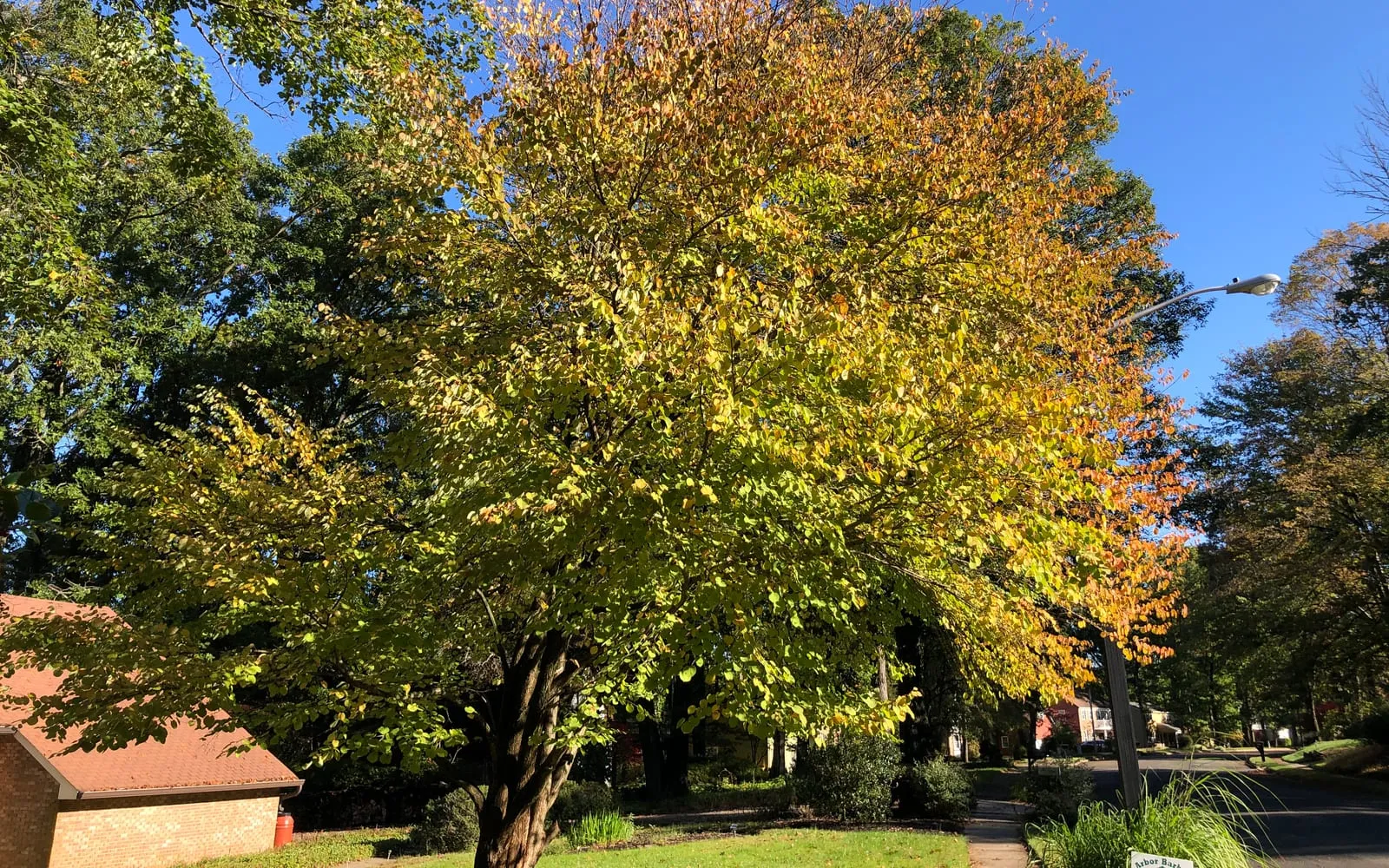
Katsura earns its place in a garden through two very different seasons. In summer it is an elegant, quietly handsome tree with soft blue-green heart-shaped leaves, easily overlooked next to something more showy. In autumn it turns, and as the leaves colour through apricot, pink and gold, they begin releasing a scent of burnt sugar and toffee into the air around the tree.
That scent comes from a compound called maltol, released as the leaves’ sugars break down before they fall, and on a still autumn day it can be smelled from several metres away, one of the few trees grown as much for how it smells as for how it looks.
It is often sold and grown with several trunks rising from a single base rather than one central leader, giving mature specimens a broad, spreading, almost sculptural outline that a single-stemmed tree of the same height rarely achieves.
Appearance and character
Leaves are heart-shaped to nearly round, 4 to 8 cm across, arranged in opposite pairs along the stem, opening reddish-purple in spring before settling into a soft blue-green through summer.
Autumn colour is the tree’s headline feature, the whole canopy turning through shades of apricot, pink, gold and soft red over a few weeks, usually more even and reliable than the autumn display of many showier trees.
Bark on an older trunk is grey-brown and shallowly furrowed, peeling in narrow curling strips with age, a texture that adds interest through the bare winter months once the leaves are down.
Flowers are small, red and inconspicuous, opening before the leaves in early spring on a tree that is either male or female. Neither sex produces a display worth growing the tree for, and most gardens value it for foliage and form rather than bloom.
A multi-stemmed specimen develops a wide, rounded crown with a soft, layered outline, while a single-trunked tree grows more upright and narrow, and nurseries usually let a buyer choose between the two forms.
Where it is from
Cercidiphyllum japonicum grows wild in the mountain valleys of Japan and central China, typically along streams and on moist slopes in mixed deciduous woodland where the soil stays reliably damp through the growing season.
That valley-floor origin explains why a katsura planted in an ordinary dry garden border underperforms compared with one given a moist, sheltered spot closer to what it evolved in. Wild populations sit in the shelter of a valley rather than exposed on a ridge, and the species carries that preference for still air and consistent moisture into cultivation wherever it is grown.
It has been cultivated in Japanese gardens for centuries and reached Western collections in the nineteenth century, valued from the start for the combination of elegant form, reliable autumn colour and the scent that no other common garden tree quite matches.
How it grows
Plant in moist, fertile, well-drained soil, in a position sheltered from strong wind and from the harshest afternoon sun in a hot climate. A spot with some protection from wind matters more for katsura than for most garden trees, since exposed, drying conditions scorch the leaf margins well before any real drought sets in.
Water regularly and deeply through the first several growing seasons, and continue watering an established tree during any extended dry spell, since this is not a species that tolerates drought the way many mature trees do.
Mulch generously around the root zone with well-rotted organic matter, which helps hold the soil moisture a katsura depends on and moderates soil temperature through summer.
Choose between a single-stemmed or multi-stemmed young tree at planting time, since the two forms grow into noticeably different shapes and a multi-stemmed tree is not easily converted to a single trunk later without losing the character it was chosen for.
Prune only to remove dead, damaged or crossing branches, ideally in late summer or early autumn, since major pruning in spring while sap is rising can bleed heavily from cut wounds.
Through the seasons
Spring brings small red flowers on bare branches, followed shortly by reddish-purple new leaves that soften to blue-green as they expand.
Summer is quiet, steady growth. Watch soil moisture closely through any dry spell, since this is when leaf scorch develops if the roots run short of water.
Autumn delivers the tree’s main display, foliage turning through apricot, pink and gold while releasing its characteristic caramel scent as the leaves fall.
Winter shows the bark and branch structure clearly once the leaves are down, particularly striking on a multi-stemmed specimen.
Care difficulty
Moderate, and the difficulty is concentrated almost entirely in siting and watering rather than in ongoing maintenance. A katsura planted in a sheltered spot with reliably moist soil more or less looks after itself, colouring reliably every autumn with minimal pruning.
The same tree planted in an exposed, dry border struggles from its first summer onward, with scorched leaf margins by midsummer and a duller, patchier autumn colour. Getting the site right at planting time matters more here than any amount of care afterwards.
Watering
Water deeply and regularly through the growing season, checking the soil rather than working to a fixed schedule, since a katsura in dry soil shows distress through leaf scorch well before it shows any more serious decline.
Newly planted and young trees need the closest attention, watering through any dry spell in their first several seasons. This is not a drought-tolerant species, and even a mature specimen benefits from watering during a prolonged dry summer.
Warning signs, diseases and pests
Leaf scorch shows as browning and crisping along the leaf margins, usually starting in the upper or outer canopy where exposure to sun and wind is greatest, and is almost always a sign of insufficient soil moisture or an exposed, windy site rather than disease. Improving watering and, where possible, shelter is the only real fix.
Verticillium wilt causes sudden wilting and dieback in one branch or section of the crown, sometimes with a streak of discoloured wood visible under the bark of an affected limb. There is no cure once a tree is infected; prune out affected wood promptly and keep the tree as unstressed as possible, since the fungus exploits weakened trees more readily than vigorous ones.
Honey fungus occasionally attacks a stressed or poorly sited tree, showing as gradual dieback and, eventually, fungal growth visible at the base near soil level. Removal is usually the only practical response.
Frost damage to the soft, newly opened spring growth blackens young leaves after a late frost, cosmetic rather than lasting on an established tree, though a young tree in an exposed frost pocket can be set back for a season.
Growing environment
A sheltered position out of strong wind suits it best, since exposure dries the leaf margins and spoils both the summer appearance and the autumn colour.
Full sun brings out the best autumn colour in a cool climate, while light shade, particularly from the hottest part of the afternoon in a warm climate, helps prevent scorch.
Moist, fertile, well-drained soil is essential. It tolerates neither prolonged drought nor waterlogged ground, and either extreme shows up quickly as browning or dropping leaves.
Give it room to develop its natural form, especially a multi-stemmed specimen, which spreads wider at the base than a single-trunked tree of similar height.
Feeding
Apply a general-purpose balanced feed in spring for the first several years while a young tree establishes, following the product’s guidance for a young ornamental tree.
An established katsura in reasonably fertile soil rarely needs supplementary feeding, and a yearly mulch of well-rotted organic matter around the root zone supplies most of what it needs beyond that, while also helping retain soil moisture.
Avoid heavy nitrogen feeding, which encourages soft, fast growth more prone to wind damage and more vulnerable to the leaf scorch that already troubles this species in a dry or exposed site.
Troubleshooting
Why do the leaves smell like caramel in autumn? A compound called maltol, released as the leaves’ sugars break down before they colour and fall. It is one of the tree’s most distinctive features rather than a sign of anything wrong.
The leaf edges are browning and curling in midsummer. Leaf scorch, almost always caused by dry soil or an exposed, windy site rather than disease. Increase watering, particularly during any dry spell, and consider whether the site offers enough shelter for a species that evolved in sheltered valley woodland.
One branch has suddenly wilted while the rest of the tree looks fine. Possibly verticillium wilt, which affects a single limb or section rather than the whole crown at once. Prune out the affected wood and keep the tree well watered and unstressed, since there is no chemical cure.
Should I choose a single-trunked or multi-stemmed tree? Either works, and it comes down to the shape you want. A multi-stemmed tree develops a broader, more spreading form and is the more traditional choice; a single-trunked tree grows more upright and takes up less ground space at the base.
Is it safe to plant near a patio where children play? Yes. It is not listed as harmful by the RHS or the ASPCA, and the caramel scent that draws people to stand under it in autumn comes from a harmless compound in the falling leaves.