
Houseplant
Jewel Orchid
Ludisia discolor
Also known as Black Jewel Orchid, Pink-Veined Orchid
Practical guidance for growing jewel orchid, Ludisia discolor, including its velvet patterned leaves, shaded position, moist soil rather than bark, low light tolerance, and modest flower spikes.
At a glance
- Difficulty
- Easy
- Water
- Kept lightly and evenly moist, never fully dried out and never waterlogged
- Light
- Low to medium indirect light; no direct sun
- Temperature
- 16 to 27 deg C
- Humidity
- 50-70 percent
- Hardiness
- USDA 10b-12, RHS H1b, hardy to 12 C
- Type
- Evergreen terrestrial orchid, spreading by creeping stems
- Height
- 15-20 cm tall, spreading indefinitely along the surface
- Native to
- Southeast Asia
Native to the shaded forest floor of Southeast Asia rather than the high canopy most orchids on this site come from, growing under a closed leaf litter layer that stays warm, damp and out of direct sun all year. Its habitat has no dry season or cold season, so it needs steady moisture rather than the wet-dry rhythm most orchid care assumes. It has no frost tolerance and dislikes any spell much below 12 deg C.
Hardiness zones describe winter cold alone. Summer heat, humidity, rainfall and the length of the growing season decide as much, so treat the range as the outer limit rather than as a recommendation.
Not known to be toxic
Ludisia carries no documented toxic compounds, consistent with the orchid family's generally clean safety record. Orchids are not among the plants the ASPCA flags as toxic to cats and dogs, and Ludisia discolor does not appear on the RHS list of potentially harmful garden plants. No part of the plant is a recognised poisoning risk, and the soft, fleshy leaves and stems are more likely to be chewed and damaged by a curious cat than to cause any harm to the cat itself. A pet that eats a mouthful may vomit from the texture alone rather than from any toxin involved.
Sources: ASPCA toxic and non-toxic plants, RHS potentially harmful garden plants
About
Jewel orchid is grown for its leaves rather than for any dramatic flower display, which sets it apart from almost every other orchid sold as a houseplant. Each leaf is a deep, velvety near-black or dark bronze-green, marked with fine, coppery-pink veins that catch the light and give the plant its name.
It also grows nothing like the orchids people picture when they hear the word. There are no pseudobulbs, no aerial roots and no bark mix. Ludisia discolor creeps along the ground on fleshy, jointed stems, rooting as it goes. Give it a shaded, evenly moist spot closer to what a fern or a peace lily needs than what a Phalaenopsis on a bright windowsill gets.
Appearance and character
Stems are thick, fleshy and reddish-brown, creeping and branching along the soil surface and rooting from the lower joints as they spread, more like a succulent groundcover than a typical orchid’s upright or hanging growth.
Leaves are the plant’s whole appeal: oval, velvety in texture, 5 to 8 cm long, in a deep chocolate to near-black green overlaid with fine, parallel veins in coppery pink to white that shift colour subtly depending on the light. New leaves emerge folded and open flat as the stem lengthens, carried in pairs along its length.
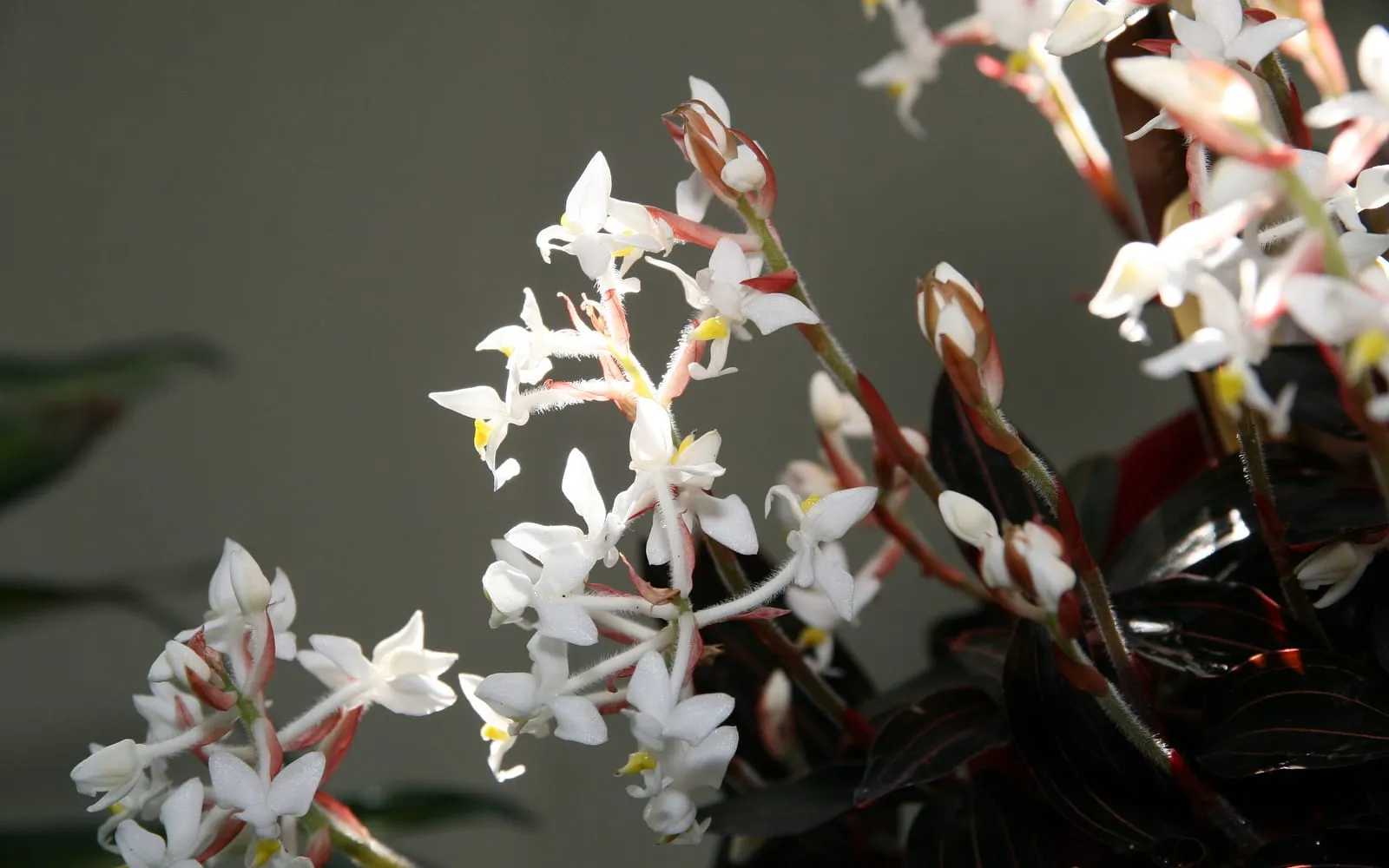
Flower spikes rise a short distance above the foliage in winter, carrying a series of small, white flowers with a yellow-marked lip. They are pretty at close range but modest compared with the leaves, and most growers treat flowering as a pleasant bonus rather than the point of keeping the plant.
Where it is from
Ludisia discolor grows on the shaded floor of tropical forest across Southeast Asia, from southern China down through Vietnam, Thailand and the Malay Peninsula, rooting into leaf litter and humus-rich soil rather than climbing into the tree canopy the way most orchid species do. Light at ground level under a closed forest canopy is dim and diffuse, filtered through several layers of leaves above.
That habitat explains why its care differs so sharply from an epiphytic orchid’s. There is no dry season at ground level the way there often is higher in the canopy, and no bark or open-air root system to manage, because the plant has never needed one. Steady warmth, steady shade and steady moisture describe its native ground, and reproducing exactly that is most of what keeping it well involves.
How it grows
Plant it in an ordinary, moisture-retentive potting mix enriched with leaf mould, compost or a little perlite for drainage, not the coarse bark mix that suits an epiphytic orchid. A mix that dries out within a day will leave this species chronically thirsty.
Give it low to medium indirect light and no direct sun at all, which scorches the delicate leaves quickly. A spot that would be considered too dark for most orchids, several feet back from a north- or east-facing window, suits jewel orchid well.
Because it spreads by creeping stems rooting as they go, it is easy to propagate: cut a length of stem with a couple of nodes, lay it on the surface of damp mix, and new roots form readily from the buried nodes within a few weeks.
Repot or divide a congested clump every couple of years, spreading the creeping stems out into a wider, shallow container rather than a deep one, since the root system stays close to the surface.
Through the seasons
Spring brings a return to active growth as new stems lengthen. Resume regular feeding and check whether the pot needs refreshing.
Summer is the main growing season, with warmth and consistent moisture supporting fast stem growth. Keep the mix evenly damp throughout.
Autumn slows growth gradually. Continue watering steadily, since this species has no dry dormancy to prepare for.
Winter brings the modest flower spikes on a well-grown plant, alongside slower growth. Reduce feeding and ease off watering only slightly, keeping the mix from ever drying out fully.
Care difficulty
Easy, and among the more forgiving orchids available, precisely because it does not need the specialised bark mix, aerial root management or dry resting period most orchids demand. The two things it does need consistently are shade, since it scorches quickly in bright light, and an evenly moist mix, since it has no pseudobulb or thick root reserve to fall back on during a dry spell the way most orchids do. A grower used to watering a fern or a peace lily will find this plant’s rhythm familiar.
Watering
Keep the mix lightly and evenly moist at all times, watering before it dries out completely rather than waiting for dryness the way most orchid care advises. This is one of the few orchids where the usual “let it dry between waterings” rule does not apply.
Avoid the other extreme too. A mix left sitting in standing water encourages the fleshy stems to rot at soil level just as readily as it would any other houseplant, so drainage still matters even though the mix should never fully dry out.
Warning signs, diseases and pests
Fungus gnats breed readily in a soil mix kept constantly wet, appearing as small flies hovering around the pot and larvae visible in the top layer of mix. Let the surface dry very slightly between waterings and consider a sticky trap or a mosquito bit application if numbers build.
Root rot follows soil that is properly waterlogged rather than lightly and evenly moist, showing as stems that blacken and soften at the base. Improve drainage, cut away affected stems, and repot into fresher mix.
Mealybug settles into the joints along the creeping stems, showing as small white, cottony tufts. Dab them with a cotton bud dipped in isopropyl alcohol.
Spider mite becomes a risk only if the air is allowed to run unusually dry, showing as fine speckling on the leaves. Raising humidity slightly and wiping the leaves down usually prevents it taking hold.
Growing environment
Low to medium indirect light suits it best, and direct sun should be avoided entirely, since it scorches the velvety leaves within hours rather than gradually. This makes jewel orchid a rare option for a shadier spot where most flowering houseplants would struggle.
Warm, steady temperatures suit it well, staying above 12 deg C at all times and ideally not swinging widely between day and night, unlike the seasonal contrast several other orchids on this site depend on.
Moderate to high humidity, around 50 to 70 percent, keeps the leaves looking their best, though this species tolerates average room humidity better than most true epiphytic orchids do.
Feeding
Feed monthly with a balanced liquid houseplant fertiliser, diluted to around half strength, through spring and summer.
Feed rarely if at all through the cooler, slower winter months, since growth has slowed and the plant takes up very little of what is applied.
Troubleshooting
The leaves have gone pale and lost their dark colouring. Too much light, more often than not. Move the plant further from the window into a more shaded position, and expect the deep colouring to return in new growth over the following weeks.
A leaf has developed a scorched, papery brown patch. Direct sun, almost certainly. Even a short spell of direct midday sun through a window can mark the leaves within a single afternoon, so check the plant is kept clear of any direct beam through the day.
The stems have gone soft and black at the base. Root rot from waterlogged soil. Cut away the affected stems back to firm, healthy tissue, improve the pot’s drainage, and repot into fresh, humus-rich mix.
It has never flowered. Most jewel orchids flower reliably in winter once mature, so a young or recently divided plant may need only another year or two of growth. Steady warmth and consistent moisture matter more here than strong light, which this species does not need to flower.
Can I grow it in a terrarium or bottle garden? Yes, very well. The warm, humid, shaded conditions inside a closed or part-closed terrarium suit its forest floor origins closely, often better than an open room does.
Jewel Orchid problem guides
Not sure what is wrong? See the common houseplant pests guide.