
Houseplant
Jelly Bean Plant
Sedum rubrotinctum
Also known as Pork and Beans, Sedum Stonecrop
Practical guidance for growing jelly bean plant, Sedum rubrotinctum, including bead-like leaves, sun colour, propagation from a dropped leaf, watering, and low pest pressure.
At a glance
- Difficulty
- Easy
- Water
- Only once the mix is fully dry, roughly every two to three weeks in summer
- Light
- Full sun to bright light, with several hours of direct sun for best colour
- Temperature
- Above 5 deg C; enjoys a warm, dry summer
- Humidity
- Low; average room humidity is more than enough
- Hardiness
- USDA 9b-11, RHS H2, hardy to -3 C
- Type
- Evergreen succulent perennial, trailing with age
- Height
- 15-20 cm, spreading wider than tall
- Native to
- Mexico
From the dry highlands of central Mexico, where the growing pattern is set by rainfall rather than by cold. It tolerates a short, dry cold snap close to freezing but cannot take a wet winter outdoors, since saturated roots rot long before the leaves show frost damage. Full sun and a hot, dry summer bring out the deepest red in the leaf tips; kept shaded and cool, the same plant stays plain green.
Hardiness zones describe winter cold alone. Summer heat, humidity, rainfall and the length of the growing season decide as much, so treat the range as the outer limit rather than as a recommendation.
Not known to be toxic
Sedum rubrotinctum has very low toxicity and is widely treated as safe, though the genus is not uniformly harmless, since biting stonecrop, Sedum acre, contains piperidine alkaloids that irritate the skin and gut. The ASPCA's toxic and non-toxic plant database lists related Sedum species, such as donkey's tail, as non-toxic to cats and dogs, and jelly bean plant carries the same reputation among growers who keep it around pets without concern. It is not named on the RHS index of potentially harmful garden plants either. The leaves are firm and a little bitter, which discourages most animals from eating more than an experimental nibble, and even a mouthful is not expected to cause more than mild, short-lived stomach upset from the fibre involved.
Sources: ASPCA toxic and non-toxic plants, RHS potentially harmful garden plants
About
Jelly bean plant gets its name honestly. The leaves are small, plump and rounded, packed along trailing stems in clusters that look like a handful of jelly beans tipped into a dish. Each leaf stores water the way any succulent does, which is what gives the plant its low, sprawling habit and its tolerance of an owner who forgets to water for a week or two.
Strong light, a gritty mix that drains fast, and long stretches left alone between waterings are all it needs to colour up deep red at the leaf tips and grow well with almost no other care. The main way it fails is the opposite of neglect, a well-meaning owner who waters on a schedule rather than by feel.
Appearance and character
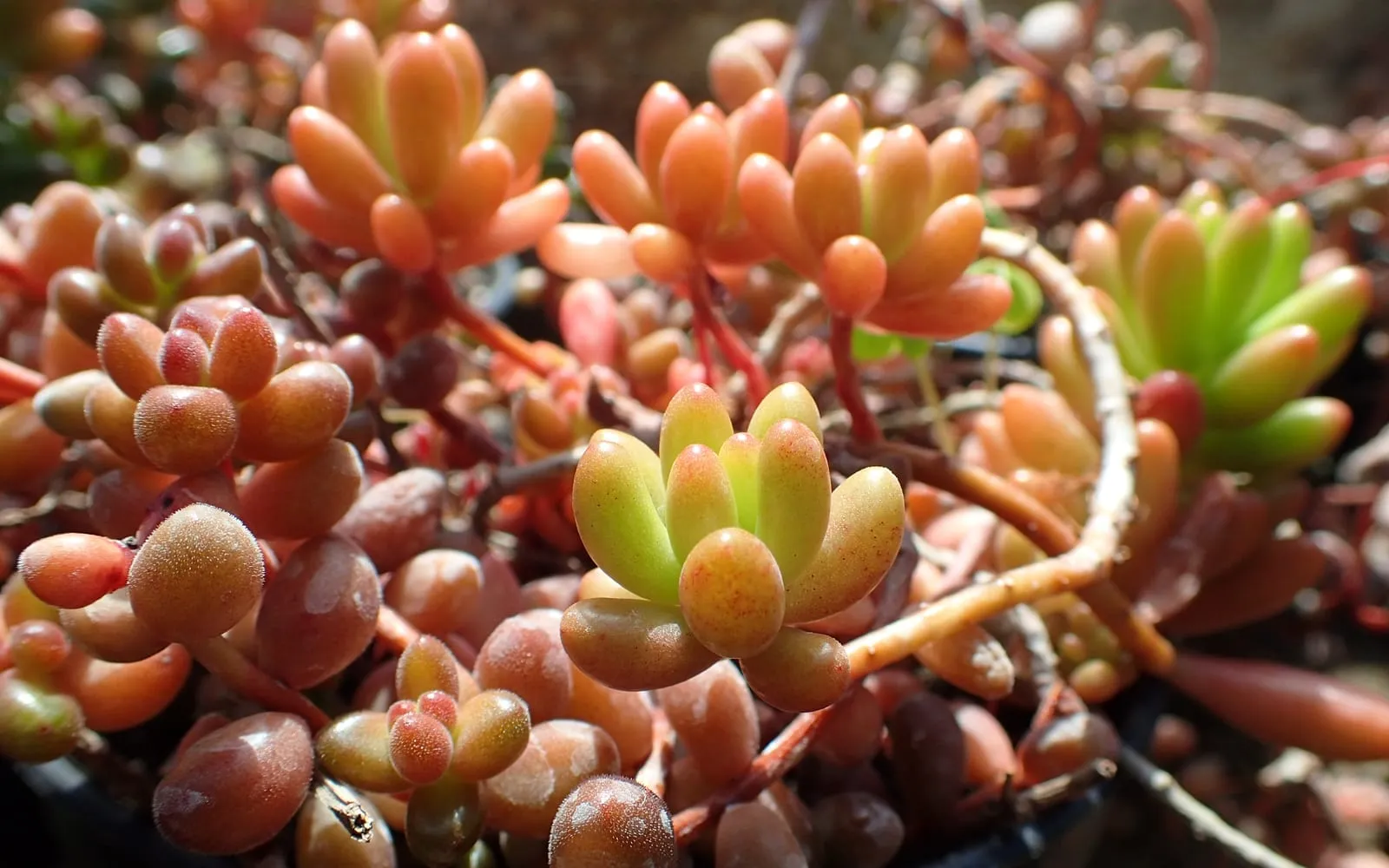
The leaves are the whole story here, cylindrical and slightly flattened, 2 to 3 cm long, packed tightly along stems that start upright and flop over as they lengthen. In strong light the tips flush a deep coral red over a base of pale jade green, giving a two-tone bean-like effect that fades to plain green in lower light.
Stems are brittle and snap cleanly at the leaf joints, which sounds like a flaw and is instead how the plant spreads in the wild. A dropped leaf roots readily wherever it lands. Established clumps sprawl over the pot rim and trail attractively from a shelf or hanging basket rather than growing upright.
Small star-shaped yellow flowers appear on older growth in spring, held above the foliage on short stalks, though the plant is grown for its leaves rather than for any great floral display.
Where it is from
Sedum rubrotinctum comes from the dry highlands of central Mexico, growing on rocky outcrops and thin, mineral soils where rain falls in a distinct wet season and the rest of the year is dry. Little organic matter builds up on ground like that, which is why a succulent mix that drains within seconds suits it far better than any ordinary potting compost.
That native ground also explains its colour response. Strong equatorial sun and wide day-to-night temperature swings push the red pigment in the leaf tips, a stress response the plant carries into cultivation. Grown in a dim corner it survives perfectly well but never shows the colour it would in full sun.
How it grows
Plant it in a gritty cactus or succulent mix, ideally with added perlite or pumice, in a pot with drainage holes. Ordinary potting compost holds far too much water around the fine roots of a plant built for scree and rock crevice.
Give it as much direct sun as the space allows. An east- or south-facing windowsill suits it well indoors, and it does even better spending summer outdoors in a bright spot once night temperatures stay reliably above 5 deg C.
Propagation could hardly be easier. A leaf that drops naturally, or is gently twisted free with its base intact, will root and form a tiny new plant within a few weeks if laid on the surface of dry succulent mix and left undisturbed until roots appear.
Repot only when the clump has outgrown its pot, since the shallow, wiry roots are easily damaged and the plant recovers slowly from disturbance compared with how quickly it grows on otherwise.
Through the seasons
Spring brings the start of active growth and the small yellow flowers on older stems. Resume feeding once new growth is clearly under way.
Summer is the main growing season, and the best time for colour if the plant gets several hours of direct sun a day. Water when the mix is completely dry, more often in hot weather.
Autumn slows growth as light and temperature drop. Cut back watering and stop feeding by the middle of the season.
Winter is a rest. Water only sparingly, perhaps once a month, and keep the plant somewhere it will not sit below 5 deg C or in prolonged damp.
Care difficulty
Easy, and one of the more forgiving succulents an indoor grower can choose. It copes with missed waterings, needs no humidity adjustment, and needs nothing beyond bright light and a well-drained pot. The single mistake worth guarding against is overwatering, since the plump leaves give little early warning of a soggy root system and by the time top growth looks unwell, rot has often already set in below the surface.
Watering
Water thoroughly, until it runs from the drainage holes, then leave the mix completely dry before watering again. In a bright, warm room through summer that may mean every two to three weeks; in winter it can stretch to once a month or less.
Check the mix with a finger before watering rather than working from a calendar, since light, temperature and pot size all shift how quickly it dries. A leaf that goes soft and translucent rather than merely wrinkled is usually a sign of too much water rather than too little.
Warning signs, diseases and pests
Mealybug hides in the tight clusters where leaves meet the stem, showing as small tufts of white, cottony wax that are easy to miss until a colony has built up. Dab them with a cotton bud dipped in isopropyl alcohol or treat with horticultural soap.
Root rot follows overwatering or a mix that never fully dries, and shows as leaves that turn yellow, then translucent and mushy, often dropping at the lightest touch. Unpot the plant, cut away any soft, dark roots, let the remainder dry out fully, and repot into fresh, gritty mix.
Etiolation, thin and stretched growth reaching towards a light source, is the commonest cosmetic problem rather than a disease. It signals too little light and is corrected only by moving the plant somewhere brighter; the already-stretched growth will not shorten back down.
Slugs and snails will graze the leaves of a plant kept outdoors over summer, leaving ragged holes and slime trails, usually overnight. Beer traps, hand picking after dark, and a dry mulch of grit around the base all help.
Growing environment
Full sun to bright light suits it best, and several hours of direct sun each day is what produces the strongest red colouring in the leaf tips. A south- or west-facing windowsill is ideal indoors.
Average room warmth is fine year round. It is more cold-hardy than most houseplant succulents, tolerating a brief dip close to freezing if the mix is dry, but a damp, cold winter outdoors will rot it regardless of the temperature reading.
No particular humidity is needed. This is a plant built for dry, open ground, and normal indoor air suits it without any adjustment.
Feeding
Feed with a weak, balanced liquid fertiliser or a cactus and succulent feed, diluted to around half strength, once a month through spring and summer.
Stop feeding entirely from autumn to spring, when growth has slowed or stopped and unused fertiliser only accumulates as salts in a mix that is already drying out between the occasional winter watering.
Troubleshooting
The leaves have stayed green and never turned red. Not enough direct sun. Move the plant to the brightest spot available, ideally with several hours of unfiltered sun a day, and the next flush of leaves should colour up within a few weeks.
Leaves keep falling off when I brush past the plant. Normal. The stems and leaf joints are naturally brittle, and a dropped leaf is how the plant spreads in habitat rather than a sign of ill health. Leave fallen leaves on the surface of a spare pot of dry mix and most will root.
The stems have gone thin and stretched with leaves spaced far apart. Etiolation from too little light. Move it somewhere brighter; the stretched growth will not correct itself, but healthy new growth from a brighter spot will look normal.
A leaf cluster has turned soft, yellow and translucent. Overwatering, almost always. Stop watering immediately, check the roots for rot, and let the mix dry out completely before resuming a more cautious watering routine.
Can I grow it outdoors year round? Only in a reliably dry, frost-free or near-frost-free climate. Where winters are wet as well as cold, grow it in a pot that can be moved under cover, since damp cold does far more damage than a low temperature reading on its own.
Jelly Bean Plant problem guides
Not sure what is wrong? See the common houseplant pests guide.