
Houseplant
Ghost Plant
Graptopetalum paraguayense
Also known as Mother of Pearl Plant, Sedum weinbergii
Practical guidance for growing ghost plant, Graptopetalum paraguayense, including pale rosettes, leaf propagation, drought tolerance, bright light, and non-toxic houseplant care.
At a glance
- Difficulty
- Easy
- Water
- Every one to two weeks in summer, monthly or less in winter
- Light
- Full sun to bright light; some direct sun for the best colour
- Temperature
- 5-30 deg C
- Humidity
- Dry air; avoid misting
- Hardiness
- USDA 9-11b, RHS H2, hardy to -4 C
- Type
- Evergreen succulent rosette-forming perennial
- Height
- Rosettes 10-15 cm across; trailing stems to 30 cm
- Native to
- Mexico
A rock-dwelling succulent from central and eastern Mexico, where it grows wedged into crevices with almost no soil around its roots. It takes a light frost outdoors when the compost is completely dry, and the zone range says less about how it will look than sunlight does, since colour and rosette form both track light intensity rather than winter minimums. Cold combined with wet compost kills it far faster than cold on its own.
Hardiness zones describe winter cold alone. Summer heat, humidity, rainfall and the length of the growing season decide as much, so treat the range as the outer limit rather than as a recommendation.
Not known to be toxic
Graptopetalum paraguayense does not appear on the RHS list of potentially harmful garden plants or the ASPCA's list of plants toxic to cats and dogs. It is not, however, safe to assume every succulent in its family is harmless purely by association. Jade plant, a member of the closely related genus Crassula, is listed as toxic, and echeveria, one of ghost plant's other close relatives, is confirmed non-toxic. The Crassulaceae family mixes both outcomes, so checking the specific botanical name rather than trusting a shelf label reading succulent remains the sensible habit. On the evidence available, ghost plant itself carries no documented toxicity, and a pet or child that chews a leaf gets nothing worse than a mouthful of gritty, waxy plant material.
Sources: RHS potentially harmful garden plants, ASPCA toxic and non-toxic plants
About
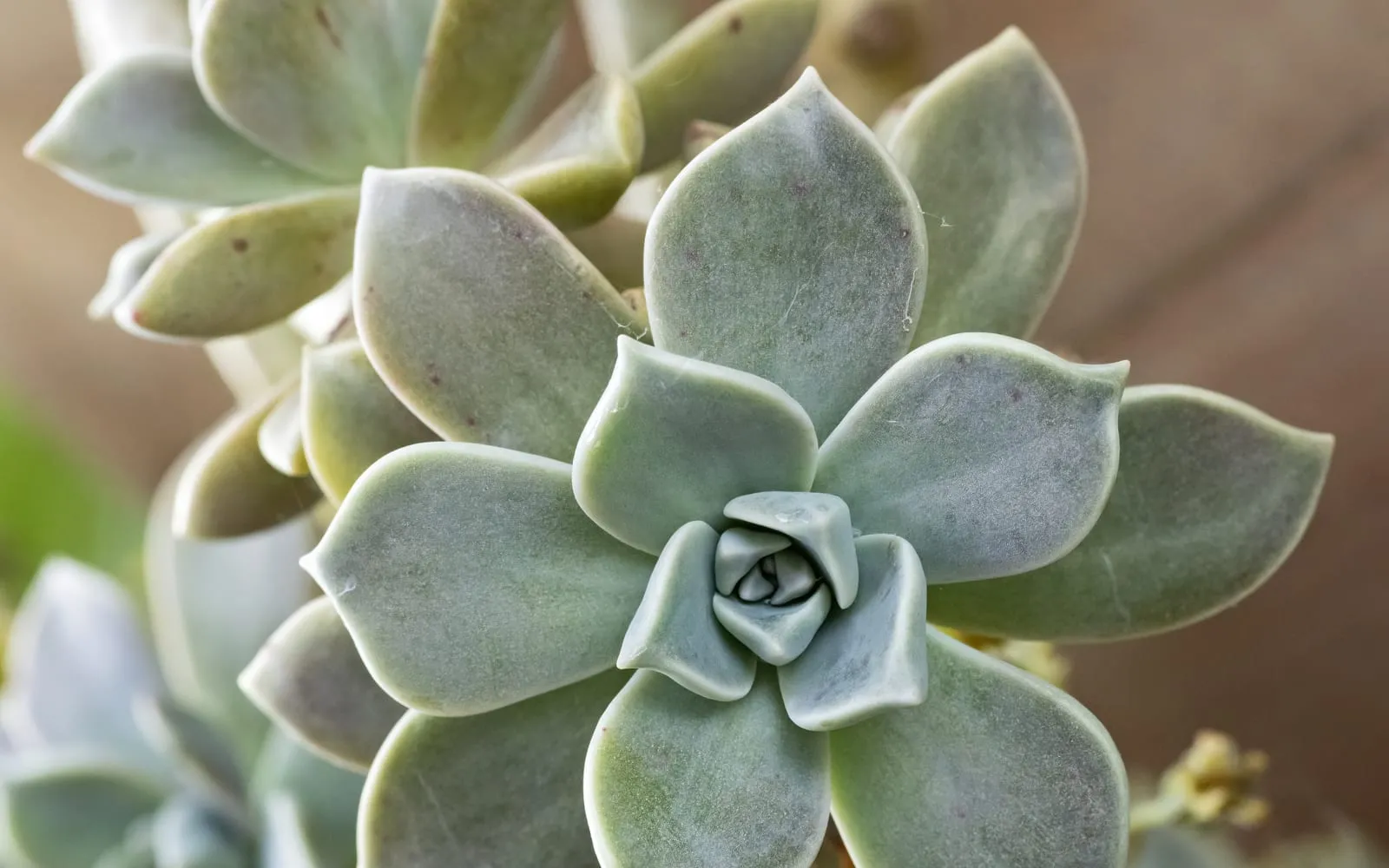
Ghost plant forms loose, open rosettes of thick, pale, dusty grey-lavender leaves at the tips of stems that trail and branch as they grow, gradually spreading into a low mat rather than staying as a single upright clump. The pale, almost translucent colouring, closer to stone than to typical leaf green, gives the plant both its common name and much of its appeal.
It is among the easiest succulents to propagate, rooting readily from a fallen leaf, a broken stem tip or almost any piece with a growing point still attached, which is part of why it turns up so often passed between gardeners rather than bought.
Appearance and character
Leaves are thick, plump and spoon-shaped, pale grey with a lavender to pinkish flush that deepens in strong light and cooler weather, coated in a fine powdery bloom that rubs off with handling.
Rosettes sit loosely rather than tightly packed, giving the plant a softer, more open look than a tight-rosetted echeveria, and they form at the tips of stems that lengthen and trail as the plant matures, eventually spreading into a low, spilling mat well suited to a hanging pot or a raised bed edge.
Small star-shaped, pale yellow to white flowers appear on slender stalks rising above the foliage in spring, generally on older, more established plants rather than young ones freshly propagated from a leaf.
Fallen leaves that land on the compost around the base root readily where they lie, so a mature pot often carries a scatter of small new plantlets around its edges without any deliberate propagation at all.
Where it is from
Graptopetalum paraguayense is native to rocky, semi-arid terrain in central and eastern Mexico, growing wedged into crevices and ledges with almost no soil, rather than rooted into open ground.
That rock-crevice habitat is the source of the plant’s exceptional drought tolerance and its intolerance of anything resembling standing water. Roots in a rock crack drain within moments of any rain, and the thick, water- storing leaves carry the plant through long dry spells between showers.
Strong, often unfiltered sunlight across most of its native range is also what produces the deepest lavender and pink tones in cultivation, while a plant grown in weaker light stays a plainer pale green and tends to grow with a looser, more elongated form.
How it grows
Almost any fragment of the plant roots. Twist a healthy leaf cleanly away from the stem, rest it on the surface of a dry, mineral-heavy mix, roughly two parts pumice or coarse sand to one part ordinary potting compost, and leave it alone rather than burying it or watering it in. A thread of roots and a tiny new rosette appear at the base of the leaf within a few weeks, drawing on the water already stored inside the leaf rather than on anything supplied from outside.
Light matters more to an established rosette than to a newly struck leaf. A cutting tolerates broken or filtered light while it roots, but a mature plant needs several hours of unobstructed sun a day to hold its shape and colour. Move a shade-grown plant into stronger light over a couple of weeks rather than all at once, since the jump alone can bleach leaves that are not used to it.
Hold off on watering until the mix has gone properly dry underneath the surface, judged with a finger rather than a fixed number of days, and read a wrinkled, slightly deflated leaf as a sign that the plant needs water.
As a stem lengthens and trails, the lower leaves often drop away cleanly, leaving bare stem below a rosette that has effectively climbed clear of its own base. Cut the rosette off with an inch or two of stem attached, let the cut end callus, and repot it; the bare stem left behind can be composted or, just as often, will throw new rosettes of its own from dormant points along its length.
Move a plant into a slightly larger pot only once the current one is visibly full of roots, using the same fast-draining mineral mix each time rather than anything richer.
Through the seasons
Spring restarts active growth. Increase watering gradually, take leaf or stem cuttings if more plants are wanted, and give the first feed of the season.
Summer is the main growing period. Water every one to two weeks, and give the plant as much direct sun as the space allows for the strongest colour of the year.
Autumn slows growth. Reduce watering as temperatures and light levels drop.
Winter is a dry rest. Water monthly at most, keep the plant in the brightest position available, and expect the colour to fade somewhat in low winter light before it returns the following spring.
Care difficulty
Rated easy chiefly because so little goes wrong with it. A plant left dry for a month shows nothing worse than slightly softer lower leaves, while the same month spent in wet compost puts the roots in real danger, so any uncertainty about watering is better resolved by waiting another few days than by going ahead.
Handle the plant by its pot or its stem rather than gripping a leaf. The pale coating that gives ghost plant its colour comes away wherever it is touched, leaving a darker green fingerprint that stays for the rest of that leaf’s life.
Watering
Soak the mix until water runs from the base of the pot, then leave it alone until it has dried out fully underneath the surface, which in a warm, bright spot in summer tends to mean somewhere around a week to ten days.
A leaf that has started to soften and lose some of its plumpness is ready for the next watering. A leaf that is still firm and full has reserves in hand and gains nothing from being watered early.
Cut back hard once autumn sets in. A cool, dim winter with the compost kept close to bone dry does the plant no harm at all, whereas the same winter with compost kept even lightly damp is when most losses to rot happen.
Warning signs, diseases and pests
Mealybug settles into the crevices between the loosely arranged rosette leaves, showing as small white, cottony tufts. Reach into the gaps with surgical spirit on a fine paintbrush rather than spraying the whole plant.
Root rot follows compost that never dries out, showing as translucent, mushy leaves and stems that collapse at a touch. Cut away all affected growth, take healthy cuttings as insurance, and start again in fresh, gritty compost.
Etiolation, a stretching stem with widely spaced, pale leaves reaching for light, points to too little sun. Move the plant somewhere brighter and trim back the stretched growth, since that section will not tighten up again on its own even once light improves.
Leaf scorch can follow a sudden move from indoor or shaded conditions into strong, unfiltered direct sun, showing as bleached or brown patches on leaves that were not gradually acclimatised. Increase sun exposure over one to two weeks rather than all at once when moving a plant outdoors for summer.
Growing environment
An unobstructed south or west-facing window, or several hours outdoors in direct sun over the warmer months, is what brings out the deepest lavender and pink in the leaves. A plant kept back from the glass, or in a room that only gets indirect light, settles for a flatter green and grows with more space between each leaf than it should.
Ordinary room temperature is fine for most of the year. Outdoors, an established plant tolerates a short, light frost provided its roots are dry when the cold arrives. Cold, wet compost does the damage.
Skip humidity altogether. This is a plant built for bare rock in open sun, and damp air around the foliage does nothing but raise the odds of rot where leaves overlap at the base of a rosette.
A wide, shallow pot filled with a mineral-heavy mix drains faster than any deep container will, which matters more here than the particular brand or recipe of compost chosen.
Feeding
Feeding is close to optional for this species. A half-strength cactus feed once as growth resumes in spring, and again at the height of summer, covers what the plant draws on; anything beyond that tends to sit unused as salt in a mix that is deliberately kept lean.
A leaf cutting still forming its first rosette, or a plant recently moved into fresh compost, needs no fertiliser at all for several months. The small reserve already in a mineral mix, together with what the leaf itself carries, is enough to get new growth established.
Troubleshooting
The stems have stretched with big gaps between the rosettes. Etiolation from too little light. Move the plant somewhere brighter and trim back the stretched section, propagating a fresh, tighter rosette from a leaf or a cutting taken from healthy growth.
Leaves have gone translucent, soft and are dropping. Overwatering, most likely leading into root rot. Stop watering, check the roots for rot, and take healthy leaf or stem cuttings as insurance.
Pale or scorched patches appeared after I moved the plant outdoors. Leaf scorch from a sudden jump in light intensity. Acclimatise a plant to stronger sun gradually over one to two weeks next time, moving it outdoors in stages rather than all at once.
Fallen leaves are rooting all over the pot. Normal for this species, which propagates readily from any leaf that lands on compost. Leave them to grow on, or pot the small plantlets up separately once they have a few roots of their own.
Can I grow it as ground cover outdoors? Yes, in a frost-free or nearly frost-free climate with sharply drained soil, where it spreads readily as a low, trailing mat over rock or gravel.
Ghost Plant problem guides
Not sure what is wrong? See the common houseplant pests guide.