
Pest
Box tree caterpillar
Cydalima perspectalis
Also called Box tree moth, Box moth, Buxus moth
Box tree caterpillar leaves webbing, bare brown patches and stripped hedges. Early checks, hand removal, Bacillus thuringiensis and pheromone traps work best before bark damage weakens the plant.
At a glance
- Type
- Pest
- Cause
- Insect
- Severity
- Destroys the crop or display
- Affects
- Garden plants
- Active
- March to October
- Established in
- Asia, Europe, North America and Africa
What you are seeing
- Fine white webbing binding shoots, leaves and droppings into a mat
- Leaves eaten back to a papery skeleton, or removed entirely from the twig
- Bare brown patches appearing inside the hedge and spreading outwards
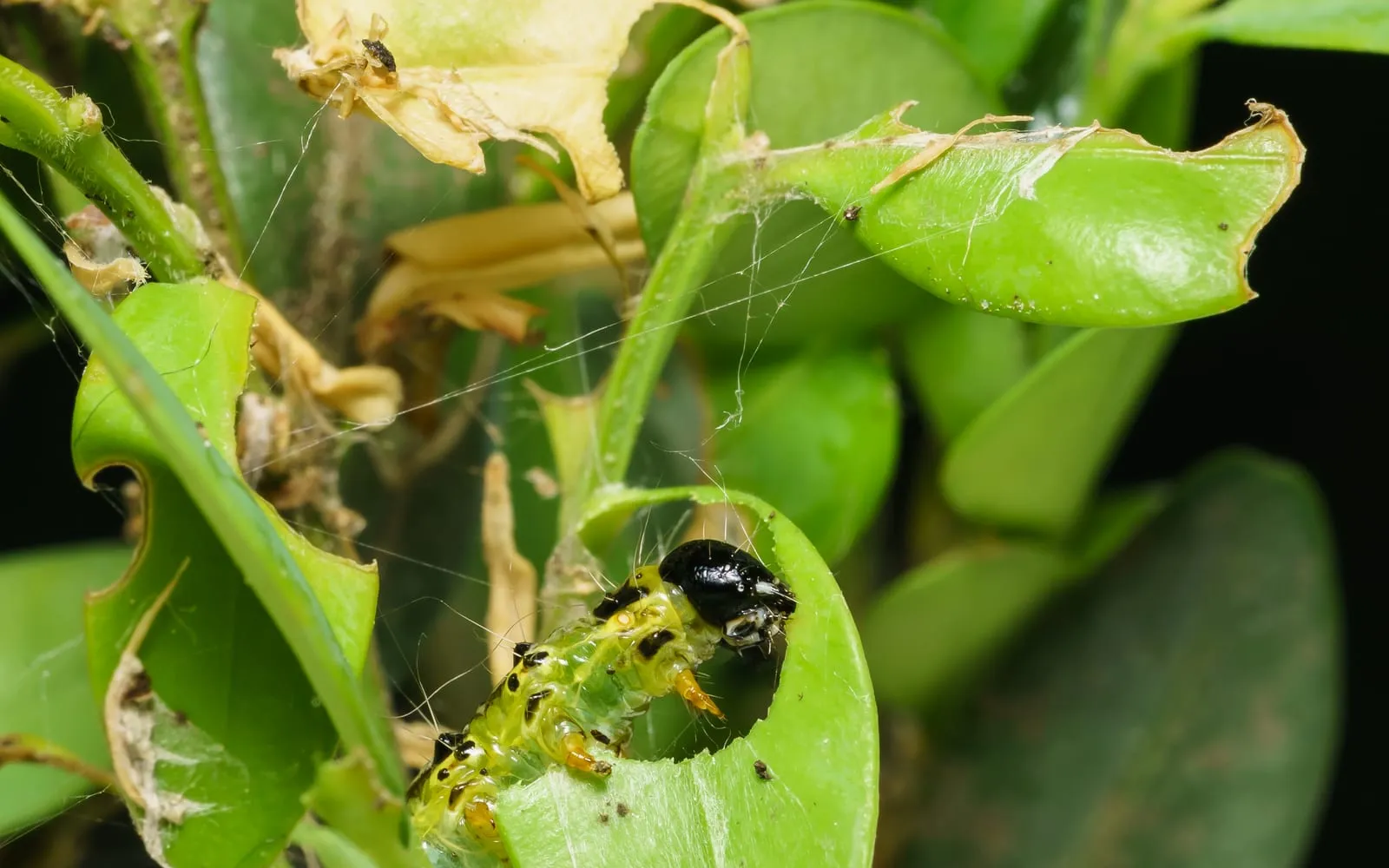
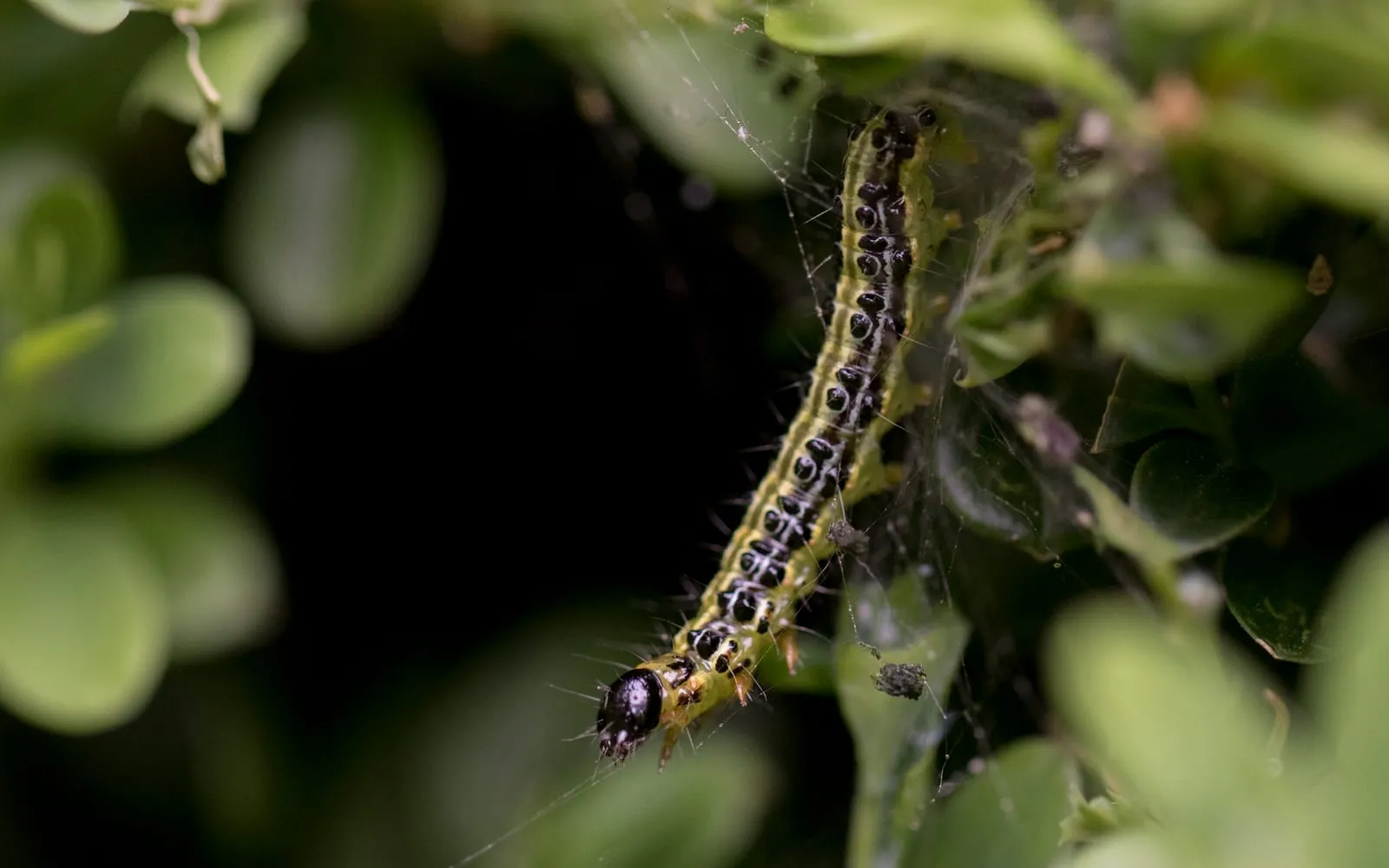
- Green caterpillars up to 4 cm long, striped black and white, with a glossy black head
- Green-black frass pellets caught in the webbing and scattered on the ground
- Bark grazed off green stems once the leaves have gone
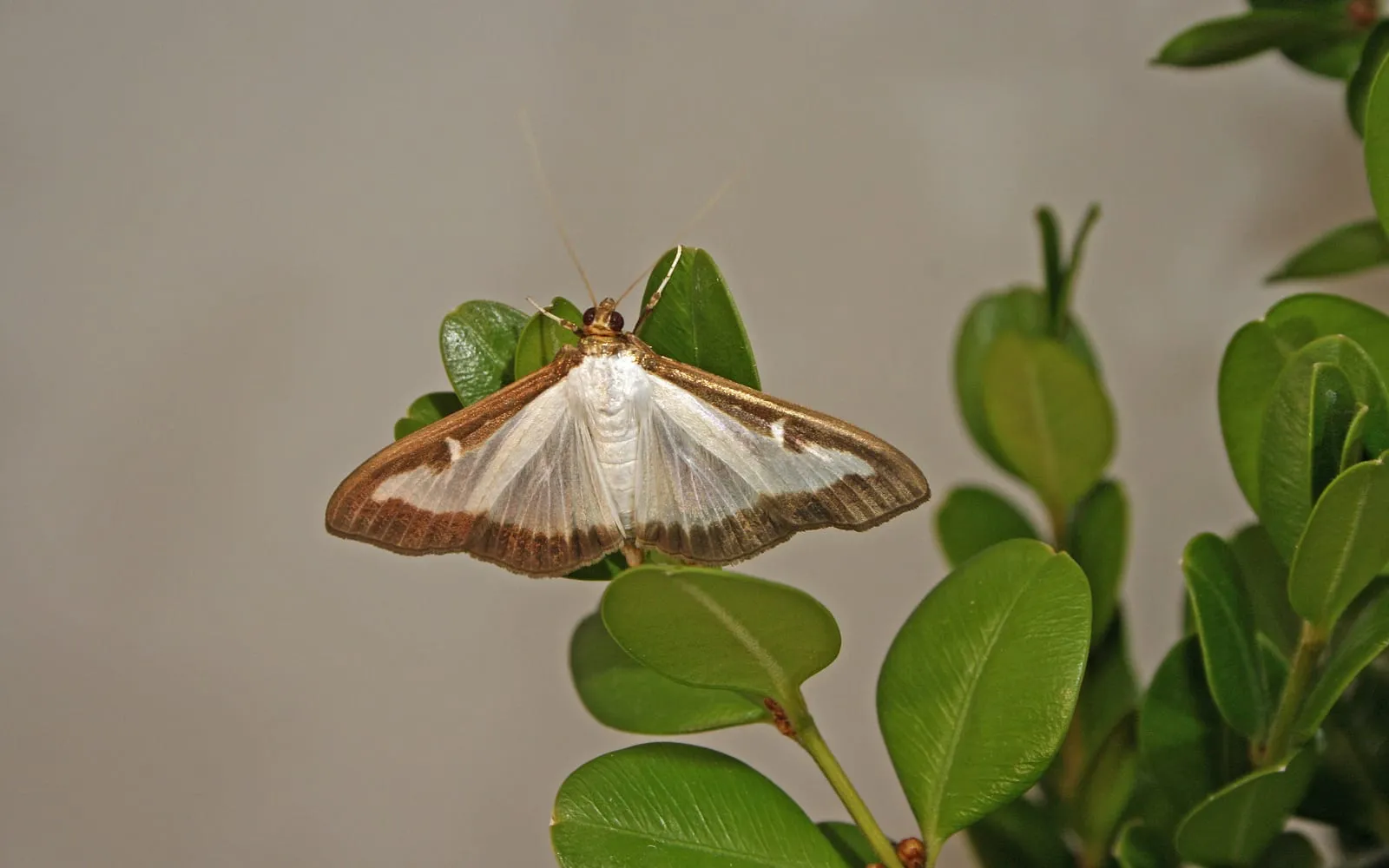
- Moths with white wings edged in a thick brown band, resting on the plant by day and flying at dusk
Before you treat anything
The caterpillars are harmless to handle. Bacillus thuringiensis kills the caterpillars of butterflies and moths generally, so confine it to the box and keep it off anything a butterfly lays on.
What you are looking at
Silk is the giveaway. Pull the foliage apart and the shoots inside are bound together with fine white threads, with dark green pellets caught in them and leaves chewed to a pale skeleton. The caterpillars are green, striped along each side in black and white, up to 4 cm long when fully grown, and they have a head that looks like a drop of black gloss paint.
Damage starts in the middle of the plant. A hedge can be hollow before anything shows from the path, which is why so many are found only when a brown patch opens up and the whole interior turns out to be bare twigs.
The moths are easier to see than the caterpillars. Most have white wings with a thick irregular brown border and a small white crescent on each forewing, about 4 cm across. A proportion of them are brown all over. Both are the same insect and both lay on box.
Bark is the damage that matters
Box takes defoliation well. Cut it to bare wood in June and it breaks again, which is what makes it the hedging plant it is. A stripped hedge fed and watered through the following season usually comes back.
What it does not survive is losing its bark. Once the leaves have gone the caterpillars graze the green skin off the young stems, and a stem ringed that way dies above the point where the bark was taken. Whole plants are lost this way in a late attack, after the leaves are gone and the caterpillars are still feeding.
Look at the stems rather than counting the leaves when deciding whether a plant is worth keeping. Green bark means it will come back. Brown, dry, scraped stems through the whole framework mean it will not.
Three generations, and the first one is invisible
Small caterpillars spend the winter inside a pocket of two leaves spun together with silk, tucked well down in the plant. They start feeding again as soon as March turns mild, weeks before anything is flying, and a gardener watching for moths will miss the entire first round.
Adults emerge from about April onwards and lay on the underside of box leaves. Britain gets two full generations and often a partial third, so an untreated plant faces waves of feeding from March to October rather than one attack. That is also why a single spray in June disappoints: it catches one cohort and the next arrives four weeks later.
The moth reached Britain in 2007, turned up as caterpillars in a private garden in 2011, and was the most reported garden pest in the country within a decade. Anyone who grew box for thirty years without meeting it is meeting it now.
What to do about it
Start looking in March, from the inside. Fortnightly checks through the season find an outbreak while it is a handful of caterpillars in one corner, and that is the difference between picking them off in ten minutes and losing the hedge.
Hand removal handles a single plant or a short run. On anything larger, Bacillus thuringiensis while the caterpillars are still small is the treatment with the best record, and it needs thorough coverage inside the plant plus a repeat after a week. Nematodes watered on after dark are the alternative where the weather is damp.
Hang a pheromone trap to know when a generation is flying. Buy it as a warning system rather than as a cure, because the males it catches are replaced from next door.
Trim in late July, between the generations, and bag the clippings.
Where box has already been lost twice, plant something else. Japanese holly clips to the same shape and the moth ignores it.
What it gets mistaken for
Box blight kills foliage without eating it. Leaves go brown and fall whole, black streaks run down the green stems, and there is no silk and no frass anywhere. A plant can carry both at once, since caterpillar wounds let blight in.
Box sucker distorts the spring shoot tips into a little cabbage of cupped leaves and leaves a waxy white deposit, and it does no lasting harm.
Winter bronzing turns exposed foliage orange-brown over cold months and greens up again in spring. The leaves stay whole and stay attached.
Ordinary garden caterpillars eat a wide range of plants. Damage confined to box, with the rest of the border untouched, is this species.
Not established in Australia and New Zealand
Do not prune, spray or otherwise treat a suspected case. Doing so risks spreading an organism the country has kept out, and it disturbs the evidence needed to identify it. Photograph what you can see, leave the plant alone, and contact your national or state plant health authority. The control advice further down this page is written for regions where this problem is already established.
Cydalima perspectalis came out of humid subtropical east Asia and reached England in 2007 in nursery stock. It crossed Europe within a decade and turned up in Ontario in 2018. EPPO now records it through six Canadian provinces and ten US states, so a North American gardener who has not met it yet probably will. Australia and New Zealand remain free of it and both watch imported box closely.
What to do, in order
The steps below apply where this problem is already established.
Start here
Prevention, and the changes that stop the problem returning. Most of these pages should end at this tier.
- Look inside the hedge from March, not at the outside of it
- The first generation feeds deep in the plant where the light does not reach, and a hedge can be hollowed out while the surface still looks green. Part the foliage with both hands once a fortnight from March and look at the stems near the centre. Almost every hedge lost to this pest was found too late from the outside.
- Feed and water a stripped plant rather than digging it up
- Box regrows from bare wood so long as the bark on the stems is intact. Water through the following summer, mulch, and give a balanced feed in spring. A plant that was stripped in August will often be furnished again by the next June.
- Cut the hedge in late July
- Trimming between the generations takes off eggs and the smallest caterpillars along with the growth, and it is the moment in the year when clipping does the most good. Bag the clippings or bury them in the middle of a hot heap rather than leaving them at the foot of the plant.
- Plant something else where box has already been lost twice
- Japanese holly gives the same small dark leaf and takes the same clipping. Euonymus japonicus, Lonicera nitida and Podocarpus all make a low hedge and none of them is eaten by this moth. Replanting box into ground where the moth is established invites the same result.
- Buy box carefully and inspect what arrives
- Much of the spread across southern England came through the nursery trade rather than on the wing. Open the plant up before it leaves the car, and check the centre of any topiary you are given.
Then reach for a barrier
Netting, hand removal and water. Nothing here harms anything except the target.
- Pick the caterpillars off by hand
- On a single plant or a short run of hedge this settles it. Work from the inside outwards, pull the webbing apart, and take the caterpillars into soapy water. Go back after a week, because the ones that were eggs the first time will have hatched.
- Hang a pheromone trap to time the checks
- The trap catches male moths and tells you a generation is on the wing, which is when to start looking for eggs on the underside of the leaves. It will not reduce the population, and a trap sold on that promise is being oversold. Treat it as a calendar rather than a control.
- Cut out and bag a heavily webbed section
- Where one part of the hedge is matted with silk, cutting that section back hard and bagging it removes hundreds of caterpillars in one go. Box breaks from old wood, so the gap fills.
Then bring in the predators
Encourage what already lives in the garden, and buy predators in where the problem is under glass and nothing will arrive on its own.
- Spray Bacillus thuringiensis while the caterpillars are small
- A bacterium that has to be eaten to work, so it kills caterpillars chewing treated leaves and leaves ladybirds, bees and hoverflies untouched. It works on young larvae rather than fully grown ones, so the timing from a pheromone trap matters. Sunlight breaks it down within a few days, which means covering the plant thoroughly and repeating after a week rather than expecting one pass to hold.Registered for amateur use in most countries, Australia and New Zealand included, though the approved strain and the products carrying it differ. Check the label names your target caterpillar before buying.
- Water on Steinernema carpocapsae nematodes in the evening
- Sold in a gel that keeps the nematodes alive on the foliage long enough to find a caterpillar. Apply after sunset on a mild damp evening, since the nematodes die in daylight and dry air, and drench the inside of the plant rather than the surface.Widely sold across Europe and North America. Australia and New Zealand permit far fewer species, because releasing an entomopathogenic nematode that is not already approved is prohibited there. Check what is registered locally rather than ordering from overseas.
- Take the help the birds give, and expect it to be small
- The caterpillars take up alkaloids from the box they eat, which makes them unpleasant to most birds. Blue tits and sparrows have learned to take them in some gardens after several seasons, and even there the birds arrive late in an outbreak. Nothing about the garden can be arranged to make this the answer.
Biological controls are live organisms and their sale and release are regulated country by country. An agent sold freely in one place may be unapproved in another, so buy from a licensed supplier where you live and never import or move one yourself.
In pictures
Plants affected
Guides that name it among the problems to watch for. The list is the plants it is characteristic of rather than everything it will feed on.