
Disease
Box blight
Calonectria pseudonaviculata
Also called Buxus blight, Boxwood blight, Cylindrocladium
Box blight causes falling brown leaves, black streaks on green stems and spreading bald patches. Reduce clipping, improve airflow and remove infected debris to keep a hedge going.
At a glance
- Type
- Disease
- Cause
- Fungus
- Severity
- Destroys the crop or display
- Affects
- Garden plants
- Active
- May to October
- Established in
- Europe, North America, Asia, New Zealand and Australia
What you are seeing
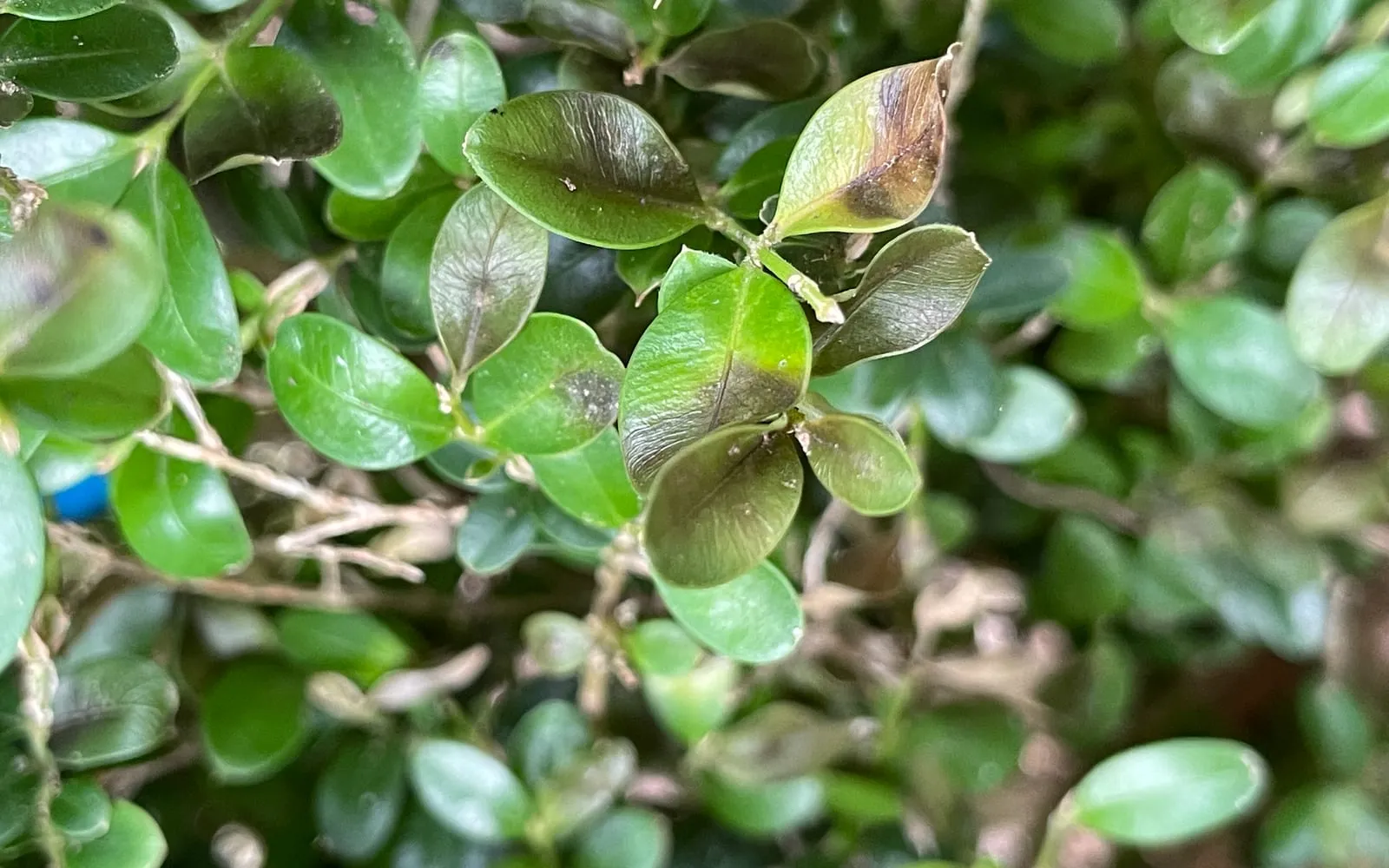
- Dark brown leaf spots, often with a darker ring, running together until the whole leaf browns
- Leaves falling while still whole, leaving bare twigs behind
- Narrow black streaks running lengthways down the young green stems
- Bald patches with a sharp edge, spreading outwards through the hedge
- A white bloom of spores on the underside of infected leaves in muggy weather
- Regrowth from the bare wood browning again within weeks
Before you treat anything
Nothing here is harmful to handle. Bag infected clippings rather than shredding them, since dry spore-laden dust is unpleasant to breathe.
What you are looking at
Dark brown spots appear on the leaves, sometimes ringed with a darker edge, and run together until the leaf is brown all over. Within days those leaves fall, still whole, leaving twigs that carry nothing. The patch has a defined edge rather than fading out, and it widens week by week.
Look at the young green stems next to the bare twigs. Narrow black streaks running lengthways along them are what confirms the diagnosis, and they belong to no other box problem.
In warm still weather after rain, turn a browning leaf over. A fine white bloom on the underside is the fungus sporing, and touching it moves it.
Why hedges get it and specimens often do not
Spores germinate when a leaf stays wet for several hours at around 20 degrees. Everything that makes a good clipped hedge works towards that. Tight annual shearing produces a dense outer shell of twiggy growth, the middle of the plant stops seeing moving air, and dew sits on the interior leaves until late morning. An open specimen dries by nine o’clock and is infected far less often.
The spores themselves are sticky and heavy. They travel a few metres in splashing rain and no further on their own, which is why blight arrives in a garden on a plant, a pair of shears or the sole of a boot rather than on the wind. A hedge trimmer taken between three gardens in a week is the commonest route of all.
Fallen leaves under the plant keep the fungus alive for five years or more. Clearing them changes what happens the following June more than anything done to the foliage above.
What no amateur product will do
No fungicide available to a gardener in Britain gives control of box blight. Professional growers use programmes that are not sold in garden centres, and even those are protective rather than curative. Anything on a shelf marketed for this will disappoint, and the money is better spent on a leaky pipe or on replacement plants.
That leaves cultural change carrying the whole page, which sounds thin and is not. A hedge watered at the base, clipped once in dry weather, thinned to let air through, and kept clear of its own fallen leaves can be held for years with blight present in the garden. The same hedge sheared twice a year and watered overhead will be bare in three summers.
What to do about it
Stop wetting the leaves today. That single change removes the condition the fungus needs.
Cut out the marked growth, going 15 cm past the last damaged leaf into clean wood, and bag it. Then rake up everything underneath, skim off the top centimetre of soil where the plant is badly affected, and mulch over the cleaned ground.
Wash and disinfect the shears before touching the next plant.
Drop to one clip a year and take it in a dry settled spell. Open the plant out rather than tightening it.
Where a hedge has already failed twice, replant with Japanese holly. It takes the same shaping, holds the same dark green, and this fungus does not touch it.
What it gets mistaken for
Volutella blight, the older and milder box disease, turns leaves straw-coloured to pink-bronze and leaves them hanging on the plant. Its spore pustules are pink or salmon rather than white, and it does not streak the stems black.
Box tree caterpillar leaves silk, green-black droppings and chewed leaf edges. Blight leaves whole leaves on the ground. A plant can have both, and caterpillar wounds make infection easier.
Winter bronzing is a cold and wind response on the exposed face of a hedge. The foliage turns orange-brown, stays attached, and greens up again in April.
Drought and root damage brown a whole plant or a whole branch at once, from the tip back. Blight works leaf by leaf from inside the plant outwards.
What to do, in order
Start here
Prevention, and the changes that stop the problem returning. Most of these pages should end at this tier.
- Water the ground and never the foliage
- The spores need several hours of liquid water on a leaf to germinate, so an overhead sprinkler or a hose played across the top of a hedge creates the conditions the fungus requires. Put the water on the soil. Where a hedge has to be irrigated, run a leaky pipe along the base of it.
- Clip less often, and only when the forecast is dry
- Every cut leaves a wound and drives the plant to make dense new growth that holds moisture at its centre. Tight annual clipping is what turns a healthy hedge into a humid one. Cut once a year rather than twice, take it in dry settled weather, and leave the surface slightly looser than a formal finish demands.
- Open the plant up and thin the growth
- Air moving through the foliage dries the leaves before the spores can germinate. Thin congested growth, lift the skirt off the ground, and leave a gap between a hedge and a wall rather than pressing it flat against one.
- Clear fallen leaves and mulch over the ground beneath
- Infected leaf litter carries the fungus for five years or more and is the reservoir that reinfects the plant every summer. Rake it up, take off the top centimetre of soil under a badly affected plant, and mulch the cleaned ground to stop rain splashing what is left back up.
- Go easy on the nitrogen
- A high-nitrogen feed produces soft sappy growth that infects readily. A balanced feed in spring is enough, and a hedge growing hard is more use than one growing fast.
- Choose a less susceptible box, or a different plant
- Buxus sempervirens 'Suffruticosa', the traditional dwarf edging box, is the worst affected of the lot. B. microphylla 'Faulkner' and B. sempervirens 'Handsworthiensis' hold up better. Where a hedge has already been lost, Japanese holly gives the same clipped line without the disease.
Then reach for a barrier
Netting, hand removal and water. Nothing here harms anything except the target.
- Cut out infected growth and take it well below the damage
- Cut into clean wood at least 15 cm beyond the last marked leaf, because the fungus runs ahead of the visible symptom in the stem. Bag what comes off. Do not compost it and do not shred it near the plant.
- Disinfect tools, boots and gloves between plants
- The spores are sticky rather than airborne, and most of the spread between gardens travels on shears, hands and clothing. Wash the blades and dip them in disinfectant before moving to the next plant, and think twice about lending a hedgetrimmer.
- Quarantine anything new for a month
- Nursery stock arrives infected without showing it, which is how the disease reached most of the gardens that now have it. Keep new box away from established plants for four weeks and look at it weekly before planting out.
In pictures
Plants affected
Guides that name it among the problems to watch for. The list is the plants it is characteristic of rather than everything it will feed on.