
Edible
Borage
Borago officinalis
Also known as Starflower, Bee bread, Cool tankard
How to grow borage, Borago officinalis. Sowing, self-seeding, bee-friendly blue flowers and cucumber-flavoured young leaves.
At a glance
- Difficulty
- Easy
- Water
- Rarely once established
- Light
- Full sun to light shade
- Temperature
- Hardy as a seedling. Autumn-sown plants overwinter
- Hardiness
- USDA 2-11, RHS H4, hardy to -5 C
- Type
- Hardy annual
- Height
- 30-60 cm, occasionally 90 cm
- Native to
- the Mediterranean
- Best month
- May and June in the Northern Hemisphere, November and December in the Southern Hemisphere
Fast enough from seed to flower in eight weeks, so it fits any climate with a short frost-free window and needs no particular season. It seeds itself hard, and one plant becomes a colony within a couple of years. Autumn sowings overwinter as small plants where frost stays light.
Hardiness zones describe winter cold alone. Summer heat, humidity, rainfall and the length of the growing season decide as much, so treat the range as the outer limit rather than as a recommendation.
Every month named in this guide is for the temperate Northern Hemisphere. If you garden in the Southern Hemisphere, shift each one by six months, so May becomes November. Closer to the equator the wet and dry seasons matter more than the calendar, and the shift stops being a useful guide.
Skin irritant
- Safe to eat
- Flowers, and young leaves in small quantities
- Do not eat
- The leaves in quantity, because of pyrrolizidine alkaloids
- Harm from
- Eating it and handling it
- Affects
- People
Borage flowers are eaten freely and the young leaves are used in salads and drinks, and neither is a hazard in the quantities a kitchen uses. The caution concerns quantity and it is a real one. Borage leaves contain small amounts of pyrrolizidine alkaloids, a group of compounds that damage the liver with repeated exposure, and the European Food Safety Authority has assessed these compounds as a genuine concern in foods where they occur. German authorities have advised against regular consumption of borage leaf for that reason. A few young leaves in a jug of Pimm's or a salad is not a problem; a daily habit of borage leaf tea is. Borage seed oil, sold as starflower oil, is refined and does not carry the alkaloids. The bristly hairs also irritate skin on a warm day, so wear sleeves when clearing a large stand.
Sources: RHS potentially harmful garden plants, EFSA scientific opinion on pyrrolizidine alkaloids in food and feed
About
Borage is the plant with the brilliant blue star flowers that everyone puts in a jug of Pimm’s. The flowers are edible, they taste faintly of cucumber, and they freeze into ice cubes beautifully, which is most of what the plant is grown for in gardens now.
For bees it is one of the best things a garden can hold. Borage refills its nectar within minutes of being emptied, which is unusual, and a stand of it in July is loud with bumblebees from morning to evening.
It seeds itself with real determination. One plant gives you dozens next year and hundreds the year after, appearing in paths, gravel and every vegetable bed within range. That is either a free supply or a nuisance depending on the garden.
Appearance and character
A bushy sprawling annual, 30 to 60 cm and occasionally taller, with thick hollow stems.
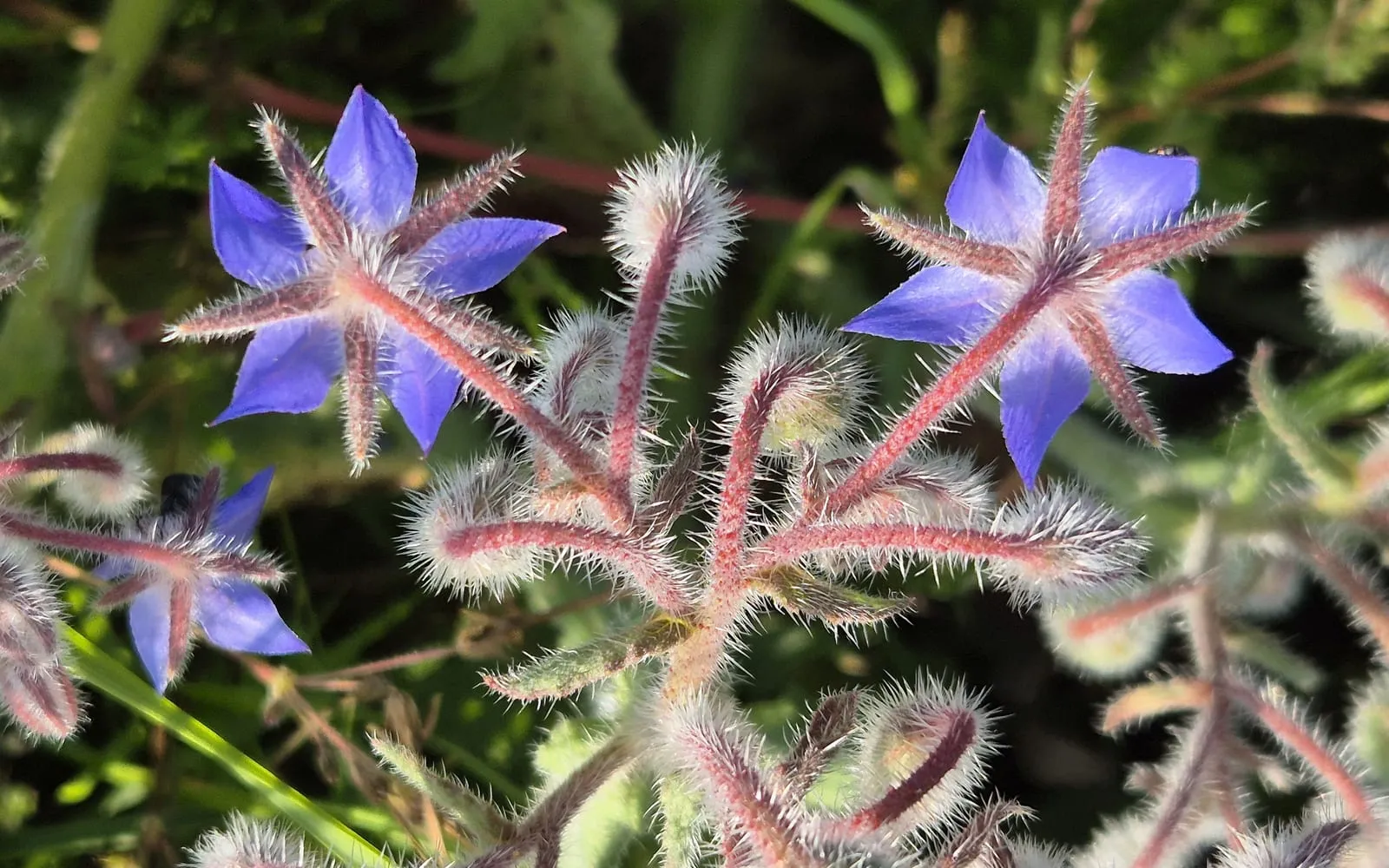
The whole plant is covered in stiff white bristles, which give it a grey cast from a distance and prickle unpleasantly on a hot day.
Leaves are large, oval, wrinkled and grey-green, and the biggest sit at the base in a rough rosette.
Flowers are the reason for it. Five-pointed blue stars, 2 cm across, with a cone of black anthers at the centre, hanging in nodding sprays. They open pink in bud and turn blue. A white form exists and is grown occasionally.
The scent is faint and the taste, in leaf and flower, is of cucumber.
The plant flops as it grows. That is normal and nothing is gained by staking it.
Where it is from
Borage is native to the Mediterranean, probably Syria and the eastern Mediterranean, and it has spread across Europe as a garden plant and an escape.
In Britain it is an ancient introduction, grown here since the medieval period and now naturalised on waste ground.
Its old reputation was as a plant for courage and cheerfulness. Pliny records the belief, John Gerard repeats it in the sixteenth century, and the phrase about borage bringing courage runs through English herbals for centuries.
The Pimm’s association is comparatively modern and specifically British. Borage is the traditional garnish for the drink, and cucumber substitutes for it because the flavour is close.
Commercially it is grown for the seed oil, sold as starflower oil, which is one of the richest plant sources of gamma-linolenic acid. Fields of it are grown in Britain, Canada and New Zealand for that trade.
How it grows
Sow direct where it is to grow, from April to June. Borage has a taproot and resents transplanting.
Sow at 2 cm deep and thin to 30 cm. Germination takes one to two weeks.
An autumn sowing in September also works. The plants overwinter as small rosettes and flower weeks earlier the following year.
Choose an open sunny position on poor or ordinary soil. Rich ground gives you a large soft plant that flops badly.
Water until the seedlings are established, then leave it entirely.
Deadhead if you want to limit self-seeding, though keeping ahead of it is difficult. Pulling the plant before the seed ripens is more effective.
Pick flowers as they open, taking them with a gentle pull so the black cone comes away with the petals.
Pick young leaves for the kitchen and use them sparingly, for the reason set out under toxicity.
Pull the plants in autumn. They die at the first hard frost.
Through the seasons
Winter shows small bristly rosettes from an autumn sowing and nothing from a spring one.
Spring brings the first sowing from April and rapid growth from overwintered plants.
Early summer is when flowering starts, in June, and it continues for months. Self-sown seedlings appear across the garden now.
Midsummer is the peak. The plants are large, flopping and covered in bees, and the flowers are at their best for picking.
Late summer brings mildew on the lower leaves and the first ripe seed. Pull plants you do not want seeding.
Autumn ends them at the first hard frost. Clear the stems, which rot quickly, and expect seedlings next spring regardless of what you do.
Care difficulty
Easy to the point of needing no care at all, and the difficulty is restraint.
It grows on poor ground, needs no feeding and no watering, and flowers for months without attention.
Self-seeding is the practical issue. A single plant produces a large quantity of seed that stays viable in the soil, and borage turns up in beds for years after the original plant has gone. Pull plants before the seed ripens if you want control.
Flopping is normal. The stems are hollow and the plant gets heavy, and staking is more trouble than it is worth.
The bristles irritate skin. Wear sleeves when clearing a large stand on a hot day.
Powdery mildew appears on the lower leaves every year from midsummer and does no real harm.
Watering
Water the seedlings until they are established and then stop.
An established borage needs no watering in a temperate climate, since the taproot goes deep and the plant is drought tolerant.
Water in an extended drought if the plants wilt by mid-morning, and soak them properly rather than sprinkling.
A container needs weekly watering in summer, and borage is a poor container plant because of its size and its taproot.
Water at the base if you water at all. Wet leaves accelerate the mildew that arrives anyway.
Stop worrying about it from August. The plants are finishing.
Warning signs, diseases and pests
Powdery mildew whitens the lower leaves from midsummer, every year, on every plant. It is disfiguring rather than damaging and it arrives as the plant is already at full size.
Blackfly build heavy colonies on the stems, and borage is often recommended as a sacrificial plant near beans for that reason. The ladybirds and hoverflies it attracts deal with most of them.
Slugs graze seedlings. Protect a new sowing.
Flopping stems mean the plant is doing what borage does, or that the ground is too rich.
Seedlings across the garden mean the seed ripened. Pull plants earlier next year.
Yellowing lower leaves in late summer are normal ageing.
A rash after handling it is the bristles rather than an allergy. Wear sleeves.
Growing environment
Full sun to light shade. It flowers best in sun and tolerates part shade without complaint.
Almost any soil that drains. Poor, stony and sandy ground all produce better plants than a rich border.
pH from 6 to 8. It is entirely unfussy.
A vegetable garden edge, a wild corner, a gravel patch or the front of a border all suit it, provided you accept the seedlings.
It is a traditional companion plant, particularly with strawberries, courgettes and beans, and the argument for it is the pollinators it brings rather than any direct effect on the neighbours.
For bees it is among the best plants in this collection, refilling nectar within minutes and flowering from June until the frosts.
Feeding
None. Fed borage grows enormous, flops flat and flowers no better.
Do not add compost or manure before sowing. Poor ground gives you a sturdier plant.
A container plant takes a weak balanced feed once, if at all.
If a plant looks starved, the cause is usually crowding or deep shade rather than nutrition.
Ground that grew borage needs nothing doing to it, and the plant is often recommended as a green manure for exactly that reason, since the deep taproot brings up nutrients and the soft growth breaks down fast.
Troubleshooting
It has seeded everywhere. That is borage. Pull the plants before the seed ripens, and hoe the seedlings while small. The seed stays viable in the soil for years, so expect a few regardless.
White powder on the lower leaves. Powdery mildew, which arrives every midsummer and does no real harm. Pull the plant when it stops being useful.
The stems fell over. Normal, and worse on rich ground. Staking is not worth the effort.
I got a rash picking it. The stiff bristles. Wear long sleeves on a hot day.
Can I eat the leaves? In small quantities and occasionally. Borage leaf contains pyrrolizidine alkaloids that damage the liver with repeated exposure, so a few young leaves in a drink or salad is fine and a daily tea is not. The flowers carry far less and are eaten freely.
The flowers turned pink. They open pink and turn blue, and they can revert to pink again as they age or on alkaline soil. Both are normal.
Is it as good for bees as people say? It refills its nectar within minutes of being emptied, which few plants do, and a stand in July is worked constantly.