
Houseplant
Hairy Philodendron
Philodendron squamiferum
Also known as Philodendron squamiferum, Red Bristle Philodendron
How to grow Philodendron squamiferum, the hairy philodendron, with oak-leaf-shaped leaves on red bristly stalks. It climbs and needs warm, humid care.
At a glance
- Difficulty
- Easy
- Water
- When the top few centimetres of mix have dried
- Light
- Bright indirect light
- Temperature
- Warm, 18 to 29 deg C; keep above 15 deg C
- Humidity
- Moderate to high
- Hardiness
- USDA 10-12, RHS H1b, hardy to 15 C
- Type
- Evergreen climbing perennial
- Height
- 2 to 3 m with support
- Native to
- Northern South America
A tender climber from the warm forests of the Guianas and Brazil, grown for its lobed leaves and bristly red stalks. It has no frost tolerance and needs warmth above about 15 deg C, but of the climbing philodendrons it is among the more easygoing about ordinary room air. A cold, waterlogged pot is still its main enemy.
Hardiness zones describe winter cold alone. Summer heat, humidity, rainfall and the length of the growing season decide as much, so treat the range as the outer limit rather than as a recommendation.
Toxic if eaten
- Do not eat
- All parts, which contain calcium oxalate crystals
- Harm from
- Eating it and handling it
- Affects
- People, cats and dogs
This philodendron holds the family's calcium oxalate crystals throughout its tissue. Chewing it can cause sudden burning and swelling of the mouth and throat, drooling and, in pets, vomiting; the sap can leave a rash on skin and sting the eyes. The ASPCA counts Philodendron among the plants toxic to cats and dogs. A serious dose is unlikely, because the first painful taste stops most attempts, but keep it well away from pets and small children and rinse off any sap.
Sources: ASPCA toxic and non-toxic plants, RHS potentially harmful garden plants
About
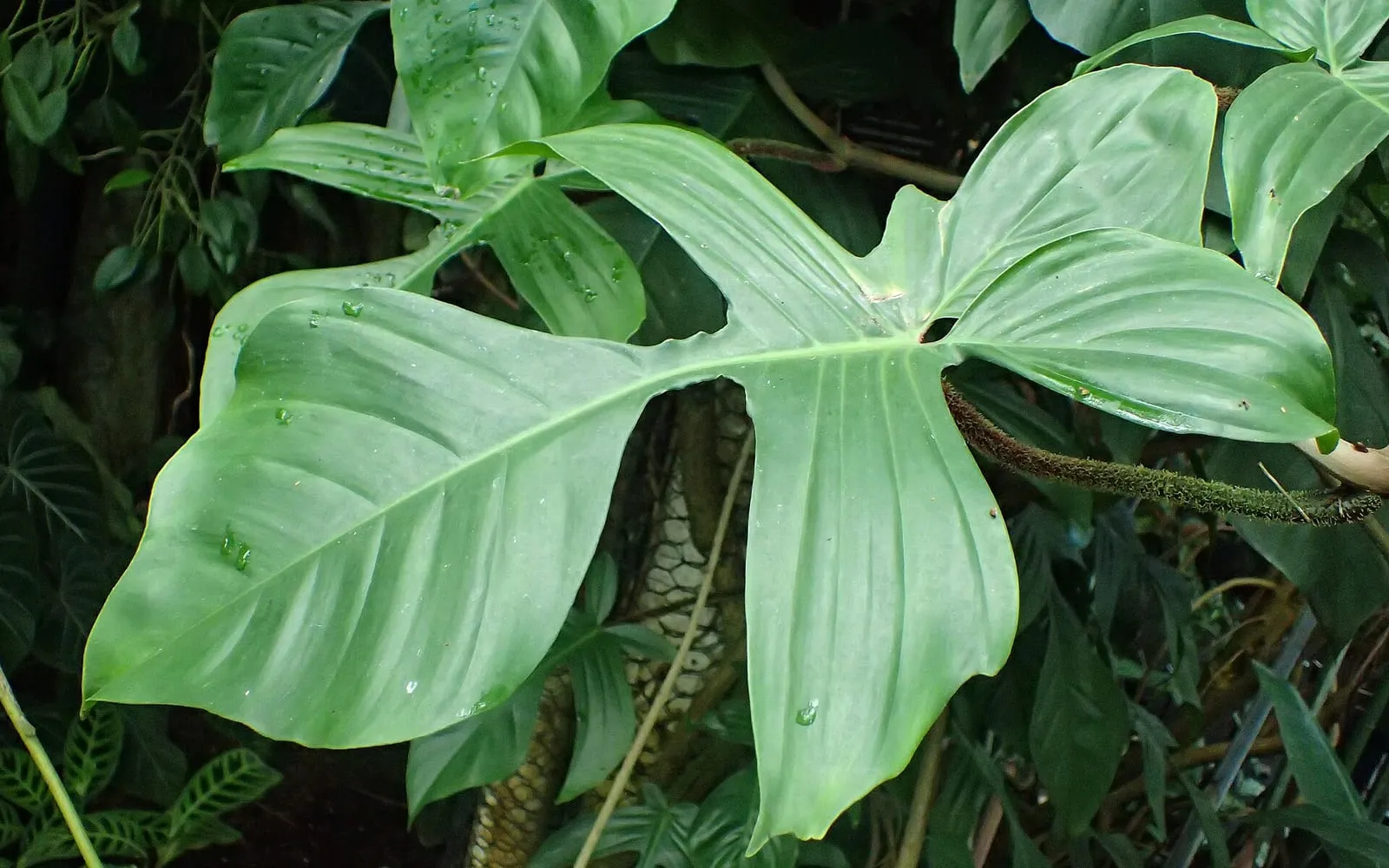
Hairy philodendron differs from its smooth-stemmed cousins in two clear ways. Its mature leaves are broad and deeply five-lobed, more like a giant oak or fiddle leaf than the usual heart, and its leaf stalks are covered in soft, warm-red bristles you can feel between finger and thumb. Those fuzzy red stalks make it a collector’s pick among the climbing philodendrons.
The leaf shape changes as the plant matures. A young plant carries simpler, barely lobed leaves, and the deep, wavy lobes only develop as the plant climbs and matures, so a small specimen and a tall, supported one look like different plants.
It comes from the warm forests of northern South America and climbs by aerial roots. Of the climbing philodendrons it is one of the toughest and most forgiving, tolerating ordinary room air better than the velvet-leaved kinds and asking mainly for warmth and a pole.
Appearance and character
Mature leaves are broad and cut into five deep lobes, oak-leaf or fiddle-shaped, glossy mid-green, growing larger and more strongly lobed the higher the plant climbs.
The leaf stalks identify the plant, sheathed in soft, hair-like red bristles quite unlike the bare stalks of other philodendrons.
It is a climber, gripping a support with aerial roots and rising two to three metres, with its best leaves produced once it has some height.
The flower is the plain green hood of the arum family and is seldom seen indoors; the plant is grown for its lobed leaves and those distinctive stalks.
Where it is from
Philodendron squamiferum grows through the warm, humid forests of northern South America, including the Guianas and Brazil, climbing tree trunks in dappled light. It is used to warmth, humidity and a trunk to climb.
Give it warmth, reasonable humidity, filtered light and a pole to root into, and it copes with average room air better than its fussier relatives. Cold, soggy roots still cause problems.
How it grows
It climbs through the warmer months, with aerial roots attaching to a pole and the leaves growing more deeply lobed as it rises, then slows over winter. A pole and a warm spot keep it developing.
Grow it in a coarse, open aroid mix and set a mossy pole in the pot, keeping the pole damp for the climbing roots. Water the compost once its top few centimetres feel dry, and let it drain.
Keep the room above about 15 deg C, the light bright but off direct sun, and the air reasonably humid, though it tolerates dry rooms more than most. Guide the stem onto the pole so the mature, lobed leaves develop.
Propagate from stem cuttings, each with a node and, ideally, an aerial root, rooted in an airy medium in warmth.
Through the seasons
Spring starts stronger growth as light returns. Repot if needed, freshen the pole, and begin feeding.
Summer brings the best-lobed leaves. Keep it warm, reasonably humid and lightly but steadily watered, and feed monthly.
Autumn slows the climb as the days shorten. Ease off feeding and let the mix dry a little more between drinks.
Winter is a rest in lower light. Keep it warm and only lightly watered, clear of cold draughts.
Care difficulty
Easy, and one of the most forgiving climbing philodendrons. Given warmth, a support and reasonable humidity it climbs steadily and develops its lobed leaves. Cold, wet compost, dry air and lack of a pole cause most problems. Without support, the leaves stay juvenile. Give it something to climb in a warm spot and it does well.
Watering
When the top few centimetres of the open mix have dried, water so the whole root ball is moistened and let the surplus run off. The coarse mix should not stay wet, since roots kept cold and sodden in poor light rot.
Keep the pole damp so the aerial roots can feed, and cut watering back in winter as growth slows. Empty the saucer after each watering.
Warning signs, diseases and pests
Warm, dry air can still bring spider mites, which mark the lobed leaves and web the undersides. Lift the humidity, wipe the leaves down, and treat at the first sign.
Cold, wet compost rots the roots, the leaves yellowing and flopping over a soft base. Repot into a chunkier aroid mix, water less, and keep it warm.
Leaves that stay small and unlobed usually mean the plant has no pole to climb, or too little light. Give it a damp support and brighter indirect light, and the mature lobes appear as it rises.
Growing environment
Bright, indirect light suits it, matching the broken light of the forest. Direct sun scorches the leaves, and deep shade keeps them small and juvenile.
Warmth and humidity suit it, above about 15 deg C, though it tolerates average room air better than the velvet philodendrons. Add a little humidity in a dry room and keep it out of cold draughts.
Set it in a chunky aroid mix with a damp moss pole, somewhere warm and well lit. Without the pole to climb, it keeps its juvenile leaves instead of producing the deep oak-leaf lobes.
Feeding
Feed monthly through spring and summer with a diluted balanced liquid at half strength, enough to support climbing growth and the widening lobes. Reduce feeding in autumn and stop over winter.
The half dose keeps the roots from scorching, and a plain-water flush now and then washes out salts. A freshly potted plant has enough nutrients in the new mix for its first few weeks.
Troubleshooting
The leaves aren’t lobed like the photos. The plant is still young or has nothing to climb. Give it a damp pole and good light, and as it climbs and matures the deep oak-leaf lobes develop.
Why are the leaf stalks red and fuzzy? That is normal and is the feature the plant is named for. The soft red bristles on the stalks are natural and a handy point of identification.
The leaves look dull and speckled. Spider mites, which appear when the air is warm and dry. Raise the humidity, wipe the leaves over, and treat at the first webbing.
The base is soft and the leaves are yellow. Root rot from cold, wet compost. Shift it to a chunkier, faster mix, water less, keep it warm, and re-root a firm tip if the base has gone.
Is it safe with pets and children? No. Like every philodendron it contains calcium oxalate, and a chewed leaf or bristly stalk can irritate the mouth quickly, so keep it out of reach and wash off the sap.
Hairy Philodendron problem guides
Not sure what is wrong? See the common houseplant pests guide.