
Outdoor plant
English Yew
Taxus baccata
Also known as Common yew, European yew, Churchyard yew
How to grow Taxus baccata. The one conifer that regrows from bare wood, why clippings kill horses, what the red berries are, and how it reaches two thousand years.
At a glance
- Difficulty
- Easy
- Water
- Weekly through the first two summers, rarely afterwards
- Light
- Anything from full sun to deep shade
- Temperature
- Fully hardy, to about -20 deg C
- Hardiness
- USDA 5-7, RHS H6, hardy to -20 C
- Type
- Evergreen coniferous tree, extremely long-lived
- Height
- 10-20 m as a tree, any height you choose as a hedge
- Native to
- Woodland and limestone slopes across Europe, north-west Africa and western Asia
- Best month
- August in the Northern Hemisphere, February in the Southern Hemisphere
Drainage matters more than cold, and yew is one of the few conifers that will not take a waterlogged root. It clips harder than any other conifer and regrows from old bare wood, which no spruce or cypress will do. Hot humid summers suit it poorly, so through the eastern United States the hedging yews are Taxus cuspidata and the hybrid Taxus x media, which take both the cold and the heat better.
Hardiness zones describe winter cold alone. Summer heat, humidity, rainfall and the length of the growing season decide as much, so treat the range as the outer limit rather than as a recommendation.
Every month named in this guide is for the temperate Northern Hemisphere. If you garden in the Southern Hemisphere, shift each one by six months, so August becomes February. Closer to the equator the wet and dry seasons matter more than the calendar, and the shift stops being a useful guide.
Poisonous if eaten
- Safe to eat
- The red flesh of the aril alone, though the seed inside it is deadly
- Do not eat
- Every part except the red flesh of the aril, and the seed most of all
- Harm from
- Eating it
- Affects
- People, cats, dogs and horses
Yew is among the most poisonous plants growing in Europe. The foliage, bark, wood and seeds all contain taxine alkaloids, which block the heart's electrical conduction and can stop it. Symptoms may be minimal until collapse, there is no specific antidote, and death can follow within hours. The RHS lists Taxus baccata as toxic if eaten, and the ASPCA lists it as toxic to dogs, cats and horses. Horses and cattle are the usual victims. A horse can be killed by a few hundred grams of foliage, and the classic circumstance is a well-meaning person throwing hedge clippings over a fence into a paddock. Dried clippings stay lethal, so never dispose of yew prunings anywhere livestock can reach and never compost them onto grazing land. There is one genuine exception, which needs stating carefully because half-remembering it is dangerous. The fleshy red aril surrounding the seed is not toxic, and birds eat it freely. The hard green seed inside that red cup is intensely poisonous, and swallowing seeds is what poisons children. Treat the whole fruit as dangerous around anyone who might not separate the two. Yew is entirely safe to plant, to clip and to live beside, and the caution applies to eating it and to where the clippings go.
Sources: RHS potentially harmful garden plants, ASPCA (Yew, Taxus spp)
About
Cut a leylandii back to bare wood and you have a brown wall for ever. Cut a yew back to bare wood and it breaks into new shoots the following spring. Among conifers that ability is close to unique, and it is the reason yew has been the hedging plant of choice in temperate gardens for five centuries.
The other reason is longevity. The Fortingall Yew in Perthshire is credibly estimated at two thousand years and possibly a good deal more. Yews hollow out as they age, so the usual ring count is impossible and the oldest specimens defeat dating altogether.
Its reputation for being slow is overstated. A well-fed yew hedge on decent soil puts on 20 to 30 cm a year, which is half the speed of a leylandii and lasts twenty times as long.
Appearance and character
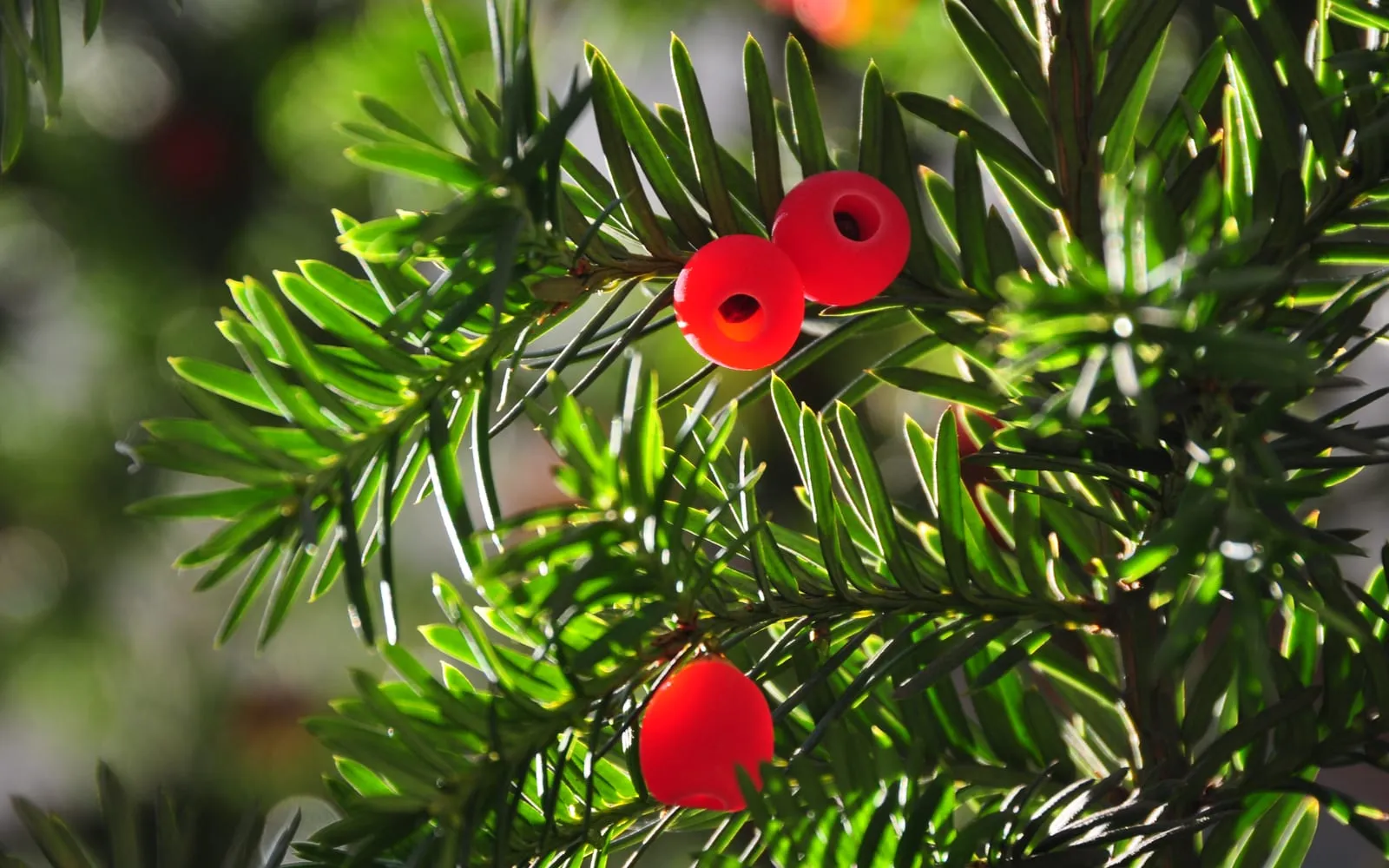
Flat needles, 1 to 3 cm long, dark glossy green above and paler beneath, ranged in two rows either side of the shoot so the spray looks flattened.
The bark is reddish-brown, thin and flaking in plates, and on old trees the trunk becomes fluted and knotted as separate stems fuse together.
Yew is dioecious, meaning male and female flowers grow on different plants. Only female trees bear the red fruit, and only if a male grows near enough to pollinate them.
Those fruits are arils rather than berries. Each is a fleshy scarlet cup, open at the tip, with a single hard green seed sitting inside. Yews are conifers, so they produce no true berries at all.
Left alone a yew makes a broad dense tree of 10 to 20 metres. Clipped, it holds any shape you cut, with a surface finer and darker than any other hedging plant.
‘Fastigiata’, the Irish yew, is a narrow upright column, and every plant in cultivation descends from two seedlings found in Fermanagh around 1780.
Where it is from
Woodland and limestone slopes across Europe, north-west Africa and western Asia, and native throughout Britain.
In the wild it grows as an understorey tree in beech and ash woods, which is why it is one of the very few conifers that thrives in deep shade. Sun and shade both suit it, and that flexibility is rare.
It grows on chalk and limestone as happily as on acid sand, and the yew woods of the South Downs sit on almost pure chalk.
Drainage is the one thing it insists on. Yew tolerates drought, cold, salt wind, clipping and shade, and it will not tolerate waterlogged ground, where Phytophthora root rot kills it.
The churchyard association predates the churches in many cases. A number of British churchyard yews are older than the buildings beside them, suggesting the churches were sited at existing sacred trees.
How it grows
An evergreen conifer growing from buds along the whole length of its stems, including old bare wood. That is the botanical basis for its tolerance of hard pruning.
Growth is steady rather than dramatic. Expect 20 to 30 cm a year on a young hedge in good soil, less in poor dry conditions.
Roots are fibrous, dense and comparatively shallow, so yew transplants well even at a fair size and competes strongly with anything planted beneath it.
Ageing yews hollow as the heartwood decays while the outer sapwood carries on, and a hollow yew is a healthy yew. Branches sometimes root where they touch the ground, so a single tree can spread into a ring of apparently separate trunks.
Propagation is by cuttings taken in late summer with a heel of old wood. Seed germinates slowly and erratically, often taking two winters.
Through the seasons
Spring brings new growth in a paler fresh green against the older foliage. Male trees release clouds of pollen in March. Feed hedges now.
Summer is the season for the main clip, once the new growth has hardened. Late July into August is the traditional timing.
Autumn is when the arils ripen on female trees and birds strip them. It is also the best planting season, since the soil is warm and the rains have started.
Winter asks nothing. Yew holds its colour through frost. Brush snow off the top of a formal hedge before its weight splays the sides.
Care difficulty
Easy. Yew is among the most tolerant of all garden plants, and almost every failure traces to wet feet.
Waterlogged soil kills it, and it kills it slowly enough that the cause is often missed. Foliage goes yellow-brown in patches, whole branches die back, and the roots are found to be black and brittle. Plant on a slight mound in heavy clay, and never plant a yew where water stands in winter.
The second difficulty is patience during establishment. A yew hedge does almost nothing visible in its first two years while it builds roots, then accelerates. Gardeners who feed and water hard through those two years get a hedge years sooner.
Clipping is straightforward and forgiving. There is no wrong cut you cannot recover from.
Watering
Water new plants weekly through their first two summers, and more often in a drought. This is the period that decides whether a hedge establishes quickly or sulks.
Give a deep soak at the base rather than a light sprinkle. Twenty litres once a week beats two litres daily.
Established yews need no watering. The root system is dense and efficient, and mature trees are notably drought-tolerant.
Container-grown yews need regular water and should never be allowed to dry out completely, since a yew in a pot cannot forage.
Mulch after planting with bark or compost, keeping it clear of the stems, to hold moisture through the first summers.
Warning signs, diseases and pests
Yellowing and browning foliage, often on one side or in patches, with dieback spreading through the plant, is usually Phytophthora root rot from wet soil. Check the roots for blackening. There is no cure, so improve drainage and replant.
Whole branches browning suddenly after a wet winter point the same way.
Brown patches inside a hedge after clipping are ordinary. Yew regrows into them within a season or two, unlike other conifers.
Yew scale shows as small brown blisters on stems and shoots with sooty mould below. Established hedges tolerate it.
Yew gall midge produces tight artichoke-like rosettes at shoot tips. It looks alarming and does no real harm.
Vine weevil grubs eat the roots of young container plants, causing sudden wilting in a plant that lifts out of its pot with no roots left.
Deer and rabbits browse young yew despite the toxicity, so protect new plants.
Growing environment
Full sun to deep shade, and it performs well in both. Few plants give you that freedom, and it is why yew is used for hedging on the shaded north side of a garden where everything else thins out.
Any reasonable soil, including chalk, clay and sand, provided it drains. Yew is the standard answer for a hedge on chalk.
Fully hardy to about -20 deg C, and tolerant of exposure and coastal salt wind.
Plant hedging at 50 to 60 cm apart in a single row. Closer spacing costs more and gains little.
Autumn is the best planting time, with spring an acceptable second. Prepare the whole trench rather than individual holes, and work in compost.
Avoid planting where water stands in winter, and avoid a hollow at the bottom of a slope where cold wet air settles.
Site a hedge with the paddock question in mind. Yew growing where horses or cattle can reach over a fence is a genuine risk.
Feeding
Feed clipped hedges once a year in spring with a balanced granular fertiliser, which is what keeps growth at the upper end of the range. A hedge is being repeatedly defoliated, and it needs replacing what you cut off.
Established trees need nothing.
Mulch annually with garden compost or well-rotted manure, keeping it away from the stems. This does more good over time than fertiliser.
Newly planted hedging benefits from bonemeal or mycorrhizal fungi at planting, and a spring feed in each of the first three years.
Avoid heavy nitrogen feeds late in the season, which push soft growth that catches frost.
Troubleshooting
Can I cut it back hard into bare wood? Yes. This is yew’s defining characteristic among conifers. Cut one face of an overgrown hedge back to the main stems in spring, let it recover for a year or two, then do the other. It will reshoot from the old wood.
When should I clip a yew hedge? Late July into August, once the year’s growth has hardened. One cut a year keeps a hedge tight. A second light trim in autumn gives a crisper finish for winter.
Brown patches after clipping. Normal. Yew fills them in.
Whole branches have gone brown and the plant looks to be dying. Check drainage first. Phytophthora root rot from wet soil is the most common cause of death in garden yew.
My yew has no red fruit. It is probably male. Yews carry male and female flowers on separate plants, and only females fruit, and only when a male is within pollinating distance.
Are the red berries poisonous? The red flesh itself is not, and birds eat it constantly. The hard seed inside it is intensely poisonous, and swallowing seeds is how children are harmed. Treat the whole fruit as dangerous for anyone who will not reliably spit the seed.
What do I do with the clippings? Bag them and take them to a green waste facility, or compost them well away from any grazing. Never tip yew prunings over a fence into a field. Dried yew stays lethal, and it kills horses somewhere most years.
How fast does it grow? Around 20 to 30 cm a year on decent soil with feeding and water. The reputation for extreme slowness comes from neglected hedges on poor ground.