
Houseplant
Dragon's Blood Tree
Dracaena cinnabari
Also known as Dracaena cinnabari, Socotra Dragon Tree
How to grow Dracaena cinnabari, the dragon's blood tree of Socotra, a rare succulent tree with an umbrella crown, red resin and extremely slow growth.
At a glance
- Difficulty
- Moderate
- Water
- When the mix has dried well; drought-hardy
- Light
- Full sun to bright light
- Temperature
- Warm to cool; keep above about 7 deg C
- Humidity
- Low
- Hardiness
- USDA 10-11, RHS H2, hardy to 5 C
- Type
- Evergreen succulent tree
- Height
- Up to 10 m in the wild; tiny and slow in a pot
- Native to
- Socotra
A rare succulent tree from the mist-fed mountains of Socotra, growing on dry, rocky slopes that catch cloud and monsoon mist instead of much rain. It needs full sun, very sharp drainage and a dry-side regime, has little frost tolerance, and is safest above about 7 deg C. It grows with famous slowness and rots in wet, airless conditions.
Hardiness zones describe winter cold alone. Summer heat, humidity, rainfall and the length of the growing season decide as much, so treat the range as the outer limit rather than as a recommendation.
Harmful to cats and dogs if eaten
- Do not eat
- Leaves, stems and bark; saponins occur throughout the genus
- Harm from
- Eating it
- Affects
- Cats and dogs
The ASPCA lists the genus Dracaena as toxic to cats and dogs because of its saponins, and it has no separate entry for Dracaena cinnabari. No species-specific toxicity data exists for the Socotra dragon tree, so it is rated here as the genus is. Chewing the leaves can cause vomiting, sometimes with blood, drooling and lethargy, and cats may show dilated pupils. The effect is mild and rarely serious, but keep it away from pets that chew. The red resin has a long history of use as a dye and medicine, and no harm to people is recorded from handling the plant.
Sources: ASPCA Dracaena, RHS potentially harmful garden plants
About
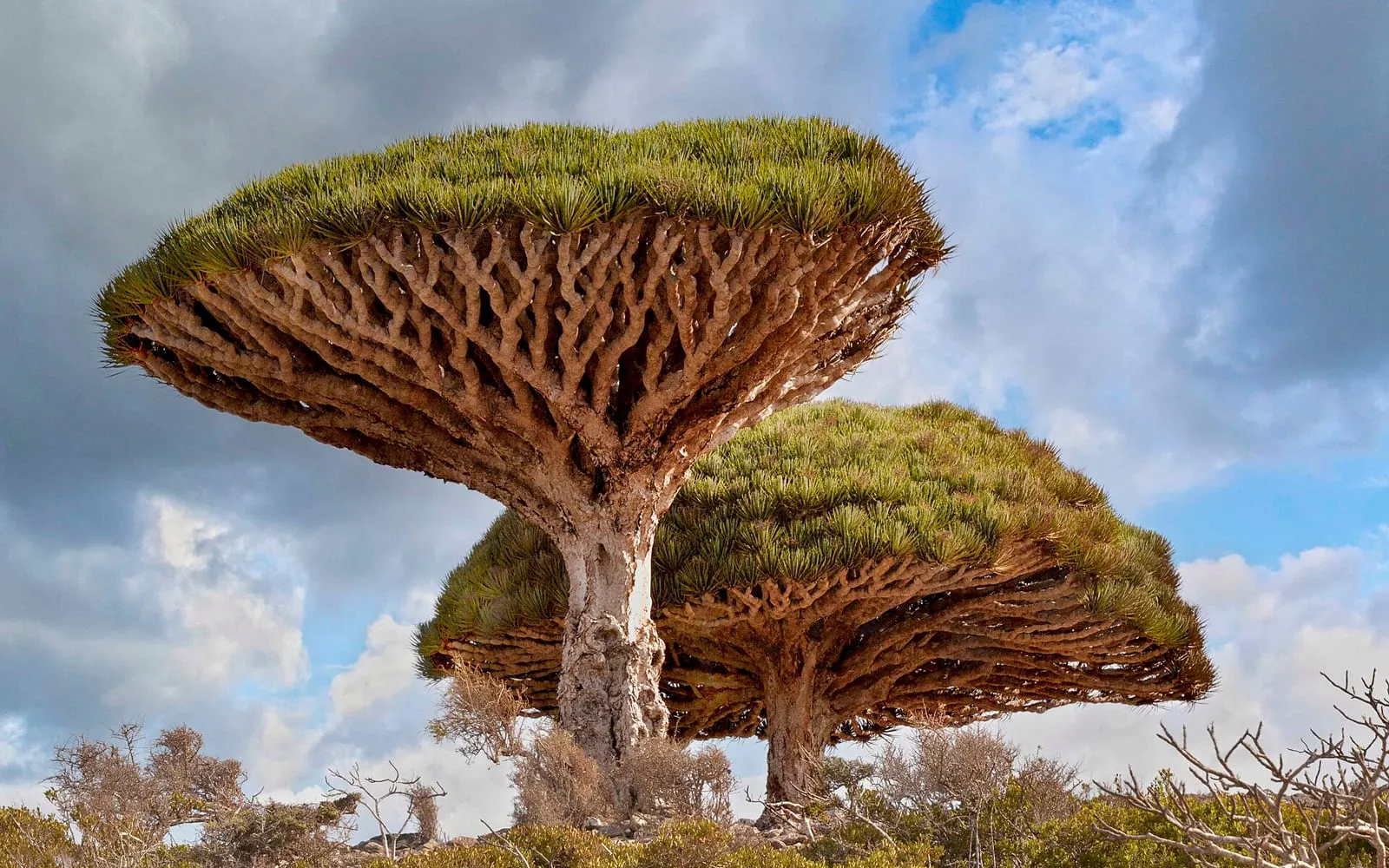
Dragon’s blood tree is one of the most distinctive trees in cultivation, and a plant few growers ever raise to size. In the wild, on the island of Socotra, it forms a dense, upturned umbrella of stiff, sword-like leaves on a thick trunk that branches repeatedly into a broad dome. Cut the bark and it releases a deep red resin, the dragon’s blood that has been prized for dye and medicine since antiquity.
It grows on the misty mountains of Socotra, on dry, rocky slopes fed more by cloud and monsoon mist than by rain, so it is a drought-adapted succulent tree that needs full sun, very sharp drainage and a dry-side regime. It has none of the toughness of a hardy tree and cannot take frost, but it endures long drought and lean, stony ground.
Its main quirk is slowness. It grows so slowly that a potted plant stays a small, single rosette of leaves for many years before it begins to branch, so it is grown as a rare, sculptural plant for the patient. Given full sun, sharp drainage and careful, sparing watering, it is a striking plant, with an umbrella form and red resin unlike most other houseplants.
Appearance and character
The leaves are stiff, sword-shaped and blue-green, held in a dense rosette at the branch tips, so a young plant is a single spiky tuft and an old one a domed umbrella of many tufts.
The trunk is thick and, with great age, branches repeatedly into the upturned umbrella crown that gives the tree its recognisable shape.
Cut or wounded, the bark and trunk release a deep red resin, the dragon’s blood, long harvested as a dye, varnish and folk medicine.
It grows very slowly, adding little each year and taking many years even to begin branching, so a potted plant remains small and simple for a long time.
Where it is from
Dracaena cinnabari is found only on the island of Socotra, off the Horn of Africa, growing on dry, rocky mountain slopes fed by cloud and monsoon mist instead of by much rain. It is adapted to drought, mist, strong sun and lean, stony ground.
Give it full sun, very sharp drainage and a dry-side regime. It can take long drought but not frost. Its dense umbrella crown is thought to funnel mist to its roots, and it rots in wet, cold or airless conditions.
How it grows
It grows extremely slowly through the warm months and rests in winter, adding little each year. Full sun and sharp drainage keep it firm; wet, cold or airless conditions rot it. It takes years to gain size, even when grown well.
Grow it in a very free-draining, gritty, lean mix in a deep pot, and water only when the mix has dried well, keeping it drier than a leafy plant. Repot rarely, since it grows so slowly and dislikes root disturbance.
Give it full sun and good air movement, and keep it warm above about 7 deg C, drier in winter. Never cut the growing points at the leaf rosettes unless you want to force branching, which is slow and uncertain.
Propagation is from seed, which is very slow, or occasionally from cuttings of a branched plant.
Through the seasons
Spring brings slow growth as warmth returns, and is the best time to repot if needed and to resume feeding.
Summer is the main growing season. Water when the mix dries well, feed lightly, and give full sun.
Autumn slows growth. Reduce watering ahead of winter.
Winter is a drier rest. Keep it bright, warm above about 7 deg C, and sparingly watered, since wet, cold conditions rot it.
Care difficulty
Moderate, mainly because it grows slowly and dislikes damp. Given full sun, sharp drainage, warmth and air movement it is tough and long-lived, taking long drought. It rots in wet, cold or airless conditions, and it grows so slowly that a potted plant stays small for years. Do not expect quick results.
Watering
Water when the gritty mix has dried well, keeping it drier than a leafy plant, since it is drought-adapted. Let it drain fully and do not let it stand wet.
Water sparingly over winter, when wet, cold conditions rot it. When in doubt, leave it dry, since overwatering is more dangerous than drought.
Warning signs, diseases and pests
Wet, cold or airless conditions rot the roots, the commonest way to lose it, shown by a soft, collapsing base or crown. Improve drainage and air movement, keep it drier, and grow it in full sun.
Scale insects and mealybugs settle on the leaves and can be wiped off with dilute alcohol or treated with horticultural oil. Extremely slow growth is normal for the species and no cause for concern.
Browning of the oldest lower leaves as they age is natural; new leaves come from the rosette tips.
Growing environment
Full sun gives the firmest, healthiest growth. In shade it weakens and grows soft. It needs as much direct light as you can give it.
Warmth above about 7 deg C, good air movement and dry conditions suit it, matching its misty but well-drained mountain home. It cannot take frost and dislikes damp, airless rooms.
Grow it in a very free-draining, gritty, lean mix in a deep pot in full sun, with good air movement, and keep it drier in winter.
Feeding
Feed once or twice over the growing season with a dilute, low-nitrogen feed. It needs very little, given how slowly it grows, and rich feeding does it no good.
Give nothing over winter. Fresh gritty mix supports a plant for a long time, since it grows so slowly.
Troubleshooting
The base or crown has gone soft. Rot from wet, cold or airless conditions. Improve drainage and air movement, keep it drier, especially in winter, and grow it in full sun.
It has barely grown in years. This is normal. The dragon’s blood tree is famously slow, and a potted plant stays a small, simple rosette for many years before branching.
Why does red resin appear when it is cut? That deep red resin is the dragon’s blood the tree is named for, long used as a dye, varnish and folk medicine. A wounded plant seals the cut with it.
When will it form its umbrella crown? Only after many years, since it branches slowly and late. A young plant is a single rosette of leaves for a long time.
Is it safe around pets? Dracaena is listed by the ASPCA as toxic to cats and dogs, causing mild upset if chewed, so keep it away from pets that chew.
Dragon's Blood Tree problem guides
Not sure what is wrong? See the common houseplant pests guide.