
Houseplant
Gardenia
Gardenia jasminoides
Also known as Cape jasmine, Common gardenia
How to care for Gardenia jasminoides. Why the buds drop, the ericaceous compost and rainwater it insists on, and the steady conditions that decide whether it flowers.
At a glance
- Difficulty
- Difficult
- Water
- When the top 2 cm has dried, keeping it evenly moist
- Light
- Bright indirect light, with a little direct morning sun
- Temperature
- 18-24 deg C by day and 15-17 deg C at night
- Humidity
- High. Dry air is the commonest cause of bud drop
- Hardiness
- USDA 8-11, RHS H2, hardy to 2 C
- Type
- Evergreen shrub, long-lived in the right conditions
- Height
- 45-120 cm indoors
- Native to
- Southern China, Taiwan, Japan and Vietnam
- Best month
- December in the Northern Hemisphere, June in the Southern Hemisphere
Subtropical southern China and Japan. It is fussier about root conditions than temperature, demanding acid soil, soft water and steady humidity, and the yellow leaves that follow hard water are iron lock-out rather than overwatering. Outdoors year round in USDA 8 and warmer.
Hardiness zones describe winter cold alone. Summer heat, humidity, rainfall and the length of the growing season decide as much, so treat the range as the outer limit rather than as a recommendation.
Every month named in this guide is for the temperate Northern Hemisphere. If you garden in the Southern Hemisphere, shift each one by six months, so December becomes June. Closer to the equator the wet and dry seasons matter more than the calendar, and the shift stops being a useful guide.
Not known to be toxic
Non-toxic. The ASPCA lists Gardenia jasminoides among plants that are not harmful to cats, dogs or horses, and the RHS does not include it in its list of potentially harmful garden plants. Neither the flowers nor the leaves present a poisoning risk, and a pet that chews a leaf may be sick from the fibre in the way it would after eating grass. The fruit has a long history of use in Chinese medicine and as a natural yellow food dye, and gardenia yellow is still used commercially to colour foods across east Asia, including the pickled daikon in Japanese cooking. That fruit is rarely produced on an indoor plant. Two small points are worth adding. The flowers are very strongly scented, and a large plant in full bloom in a small closed room is enough to give some people a headache, which is a matter of ventilation rather than toxicity. And gardenias are usually treated with growth regulators and fed hard by commercial growers, so a newly bought plant will behave differently from one you have grown on for a year. Neither affects the plant's safety in a household.
Sources: ASPCA (Gardenia, Gardenia jasminoides), RHS potentially harmful garden plants
About
The gardenia is the hardest plant in this collection and the one with the best scent, and those two facts keep it in the shops despite everything.
Almost every gardenia sold arrives covered in fat buds, drops every one of them within a fortnight, and is thrown out by February. That is not bad luck. A gardenia sets buds under greenhouse conditions of steady warmth, high humidity, acid compost and soft water, and then meets a centrally heated living room in December, which supplies none of those.
The plant is asking for four things at once, and none of them is optional. Acid compost, rainwater, humidity, and a night temperature five or six degrees below the day. Supply them and it is a superb plant. Supply three of the four and it drops its buds.
Appearance and character
An evergreen shrub, bushy and rounded, reaching 45 cm to 1.2 m indoors and rather more in a conservatory.
Leaves are thick, glossy and deep green, oval with a pointed tip, 5 to 10 cm long, carried in opposite pairs or whorls of three. Healthy foliage is lacquered enough to look artificial.
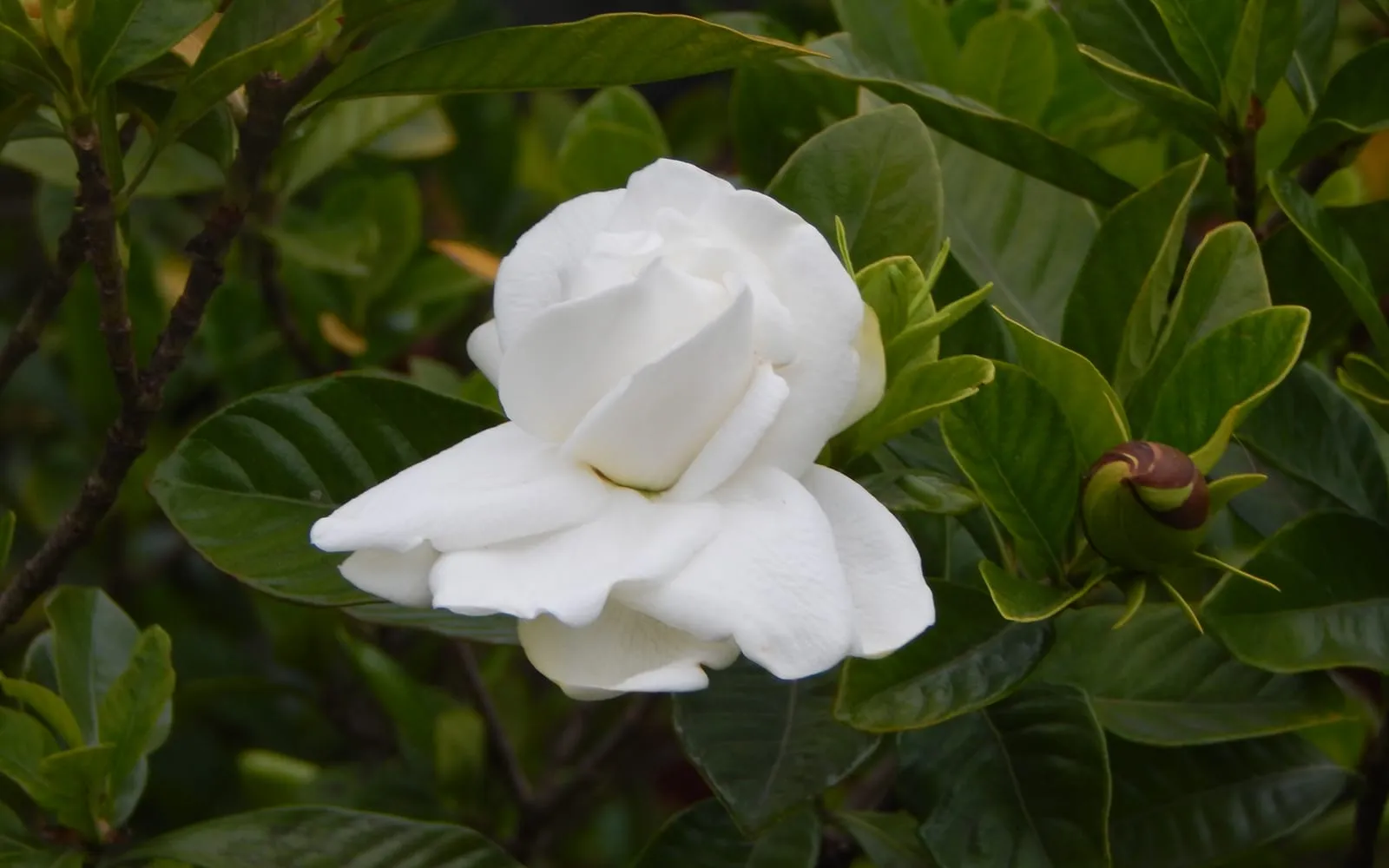
Flowers are the reason to grow it. Waxy, thick-petalled and pure white, 5 to 10 cm across, opening from a tight spiralled bud and ageing to cream and then buttery yellow.
Most cultivated forms are fully double, packed with overlapping petals like a formal camellia. Single forms with a boss of stamens exist and are less common.
The scent is heavy, sweet and carrying, and one open flower perfumes a room.
Buds are conspicuous long before they open, tightly furled and slightly angular, and they sit on the plant for weeks.
Fruit is an orange-red berry with prominent ridges, rare indoors and the source of the traditional yellow dye.
Where it is from
Southern China, Taiwan, Japan and Vietnam, where it grows as an understorey shrub in warm humid forest on acid soil.
It has been cultivated in China for over a thousand years, both as an ornamental and for the dye and medicine made from its fruit.
The genus honours Alexander Garden, a Scottish-born physician and naturalist who worked in Charleston in the eighteenth century and corresponded with Linnaeus.
Its forest understorey origin explains the light requirement, which is bright but filtered rather than direct.
The acid soil of its native range is why ericaceous compost and soft water are non-negotiable. Gardenia is as intolerant of lime as a camellia or a blueberry, and for the same reason, since alkalinity locks up the iron it needs.
The night temperature requirement is the least known and the most decisive. Gardenias initiate and hold their buds when nights are meaningfully cooler than days, which is what a forest provides and a thermostatically heated house does not.
How it grows
Position it in bright indirect light with an hour of direct morning sun, and leave it there. Moving a budded gardenia is one of the surest ways to lose the flowers.
Get the temperature right, and particularly the night drop. Aim for 18 to 24 deg C by day and 15 to 17 deg C at night. A room that stays at 21 deg C all night will cost you the buds.
Use ericaceous compost with added perlite for drainage. Ordinary compost will yellow the plant within a season.
Water with rainwater. Tap water in a hard water area raises the pH of the compost and causes the chlorosis that follows almost every gardenia around. Filtered water is second best.
Keep the compost evenly moist, watering when the top 2 cm has dried. Neither dry nor sodden.
Raise the humidity substantially. A humidifier is the reliable answer, and a large pebble tray, grouping plants or a well-lit bathroom all help. Misting the leaves marks the flowers and does little.
Feed fortnightly from April to September with an ericaceous liquid fertiliser, and apply sequestered iron if the leaves yellow.
Prune lightly after flowering to shape the plant, cutting back to just above a leaf pair.
Repot every two years in spring into fresh ericaceous compost, one pot size up.
Stand the plant outdoors in a sheltered shaded spot through the summer if you can, which suits it well, and bring it in before the nights drop below 15 deg C.
Take semi-ripe cuttings in summer, which root in a warm humid propagator.
Through the seasons
Winter is when most gardenias are bought and lost. Keep it bright and humid, away from radiators, water with rainwater, and accept that a plant bought in bud will probably drop them.
Spring is the recovery and the pruning. Repot, prune lightly, resume feeding, and increase watering as growth restarts.
Summer is the growing season and the main flowering period for an established plant. Feed fortnightly, keep the humidity up, and consider standing it outside in shade.
Autumn is the wind-down. Bring outdoor plants back in before the nights get cold, reduce feeding, and settle it in its winter position early.
Care difficulty
Difficult, and it is the hardest plant in this collection by a clear margin.
Bud drop is the defining problem, and it has half a dozen possible causes acting at once, which is what makes it so frustrating to diagnose.
The four requirements are all interlinked. Acid compost, soft water, high humidity and a cool night are needed together rather than individually.
Chlorosis follows within one season of watering with hard tap water.
Red spider mite arrives in the dry conditions that also stress the plant.
Anyone who can supply a conservatory, a humidifier or a cool bright bathroom will find it far easier than someone with a warm dry living room.
Watering
Keep the compost evenly moist, watering when the top 2 cm has dried.
Use rainwater. In a hard water area, tap water raises the compost pH within a season and yellows the plant, and this is the single most common avoidable mistake.
Water thoroughly and let it drain completely. Never leave the pot standing in water.
Use tepid water. Cold water on the roots contributes to bud drop.
Reduce watering in winter without letting the compost dry out, since the plant is evergreen and still transpiring.
Yellowing leaves with green veins mean the water or compost is too alkaline rather than that the plant needs more water.
Warning signs, diseases and pests
Bud drop is what people ask about, and the list of causes is long because the plant is sensitive to all of them. Work through it in order. Dry air is the commonest. Then a night temperature that stays too high. Then being moved or turned while in bud. Then irregular watering, either too much or too little. Then a draught. Then alkaline water. A newly bought plant covered in buds will usually drop most of them regardless, because greenhouse conditions cannot be matched at home, and the plant will flower properly the following year if kept well.
Yellow leaves with green veins are lime-induced chlorosis. Switch to rainwater, repot into fresh ericaceous compost, and apply sequestered iron for a quick correction.
Red spider mite produces fine pale stippling and webbing in dry heated air. Raise the humidity and treat promptly.
Mealybug gathers in the leaf axils as white cottony masses.
Sooty mould on the leaves follows scale or mealybug above.
Brown flower buds that never open, along with brown leaf tips, usually means the air is too dry.
Sudden leaf drop with a soft stem base is root rot from cold wet compost.
Flowers browning as they open is normal ageing, and they always yellow before they fall.
Growing environment
Bright indirect light with an hour of direct morning sun. An east-facing window is close to ideal.
Day temperatures of 18 to 24 deg C with a night drop to 15 to 17 deg C. The night drop matters and is the requirement most often missed.
High humidity, supplied properly. A humidifier, a large pebble tray or a well-lit bathroom, rather than occasional misting.
Ericaceous compost with added perlite, in a pot with drainage holes.
Rainwater or filtered water, always.
Away from radiators, draughts, external doors and cold glass, all of which cause bud drop.
A cool bright bathroom, a conservatory that is not too hot, or an unheated but frost-free porch with good light all suit it better than a warm living room.
Outdoors in shade through the summer, brought in before the nights turn cold.
Feeding
Feed fortnightly from April to September with an ericaceous liquid fertiliser.
Stop feeding from October to March.
Apply sequestered iron at the first sign of yellowing between the veins, and fix the underlying water and compost at the same time.
Avoid ordinary houseplant fertiliser, bone meal and anything containing lime.
Repot every two years into fresh ericaceous compost, which does as much as feeding does.
Troubleshooting
All the buds fell off. The commonest question about this plant. Work through the causes in order. Dry air, a night temperature that never drops, being moved while in bud, irregular watering, a draught, or alkaline water. A newly bought plant in full bud will usually drop them whatever you do, and should flower properly the following year.
The leaves have gone yellow with green veins. Lime-induced chlorosis from hard tap water or ordinary compost. Switch to rainwater, repot into ericaceous compost, and apply sequestered iron.
Do I need rainwater? In a hard water area, yes. Tap water raises the compost pH within a season and the plant yellows and stops.
What is this about night temperature? Gardenias hold their buds when nights are five or six degrees cooler than days. A house heated to a constant temperature is one of the main reasons buds drop.
Is misting enough for humidity? No. It lasts minutes and marks the flowers. Use a humidifier or a large pebble tray.
Can I put it outside? In a sheltered shaded spot through the summer, yes, and it does well there. Bring it in before the nights fall below 15 deg C.
When should I prune it? Lightly after flowering, cutting back to just above a leaf pair.
Is it safe with pets? Yes. Gardenia is listed as non-toxic to cats, dogs and horses, which is unusual among the more demanding flowering houseplants.
Gardenia problem guides
Not sure what is wrong? See the common houseplant pests guide.