
Edible
Angelica
Angelica archangelica
Also known as Garden angelica, Holy ghost, Wild celery
How to grow angelica, Angelica archangelica. The two-metre biennial for candied stems, sowing the seed fresh, and stopping it flowering to keep the plant another year.
At a glance
- Difficulty
- Moderate
- Water
- Regularly. It will not tolerate a dry root
- Light
- Part shade to full sun, with shade preferred in the south
- Temperature
- Fully hardy, to about -25 deg C
- Hardiness
- USDA 4-9, RHS H6, hardy to -25 C
- Type
- Hardy biennial, or short-lived perennial if stopped from flowering
- Height
- 100-250 cm
- Native to
- northern Europe, Asia
- Best month
- May and June in the Northern Hemisphere, November and December in the Southern Hemisphere
It dies after flowering, so the way to keep a plant going is to cut the flower stem out before it opens. Seed is the other catch. Angelica seed loses viability within a few months, so it wants sowing fresh in autumn and it needs a winter outdoors before it will germinate.
Hardiness zones describe winter cold alone. Summer heat, humidity, rainfall and the length of the growing season decide as much, so treat the range as the outer limit rather than as a recommendation.
Every month named in this guide is for the temperate Northern Hemisphere. If you garden in the Southern Hemisphere, shift each one by six months, so May becomes November. Closer to the equator the wet and dry seasons matter more than the calendar, and the shift stops being a useful guide.
Skin irritant
- Safe to eat
- Stems, leaf stalks, roots and seeds
- Do not eat
- The sap on skin in strong sunlight
- Harm from
- Handling it
- Affects
- People
Angelica is a culinary and confectionery plant and its stems have been candied for centuries. It is not on the RHS list of potentially harmful garden plants and the ASPCA holds no entry for it. The real caution is phototoxicity. The sap is rich in furanocoumarins, the same class of compound that makes giant hogweed dangerous, and skin contact followed by sunlight can raise a blistering rash. Cutting down a two-metre angelica on a sunny day without gloves and sleeves is how people find that out. The second caution is identification. Angelica is an Apiaceae, the family that holds hemlock and hemlock water-dropwort, and a large white-flowered umbellifer growing wild should never be harvested on a guess. Read the hemlock and hemlock water-dropwort guides before picking any of them.
Sources: RHS potentially harmful garden plants, ASPCA toxic and non-toxic plants
About
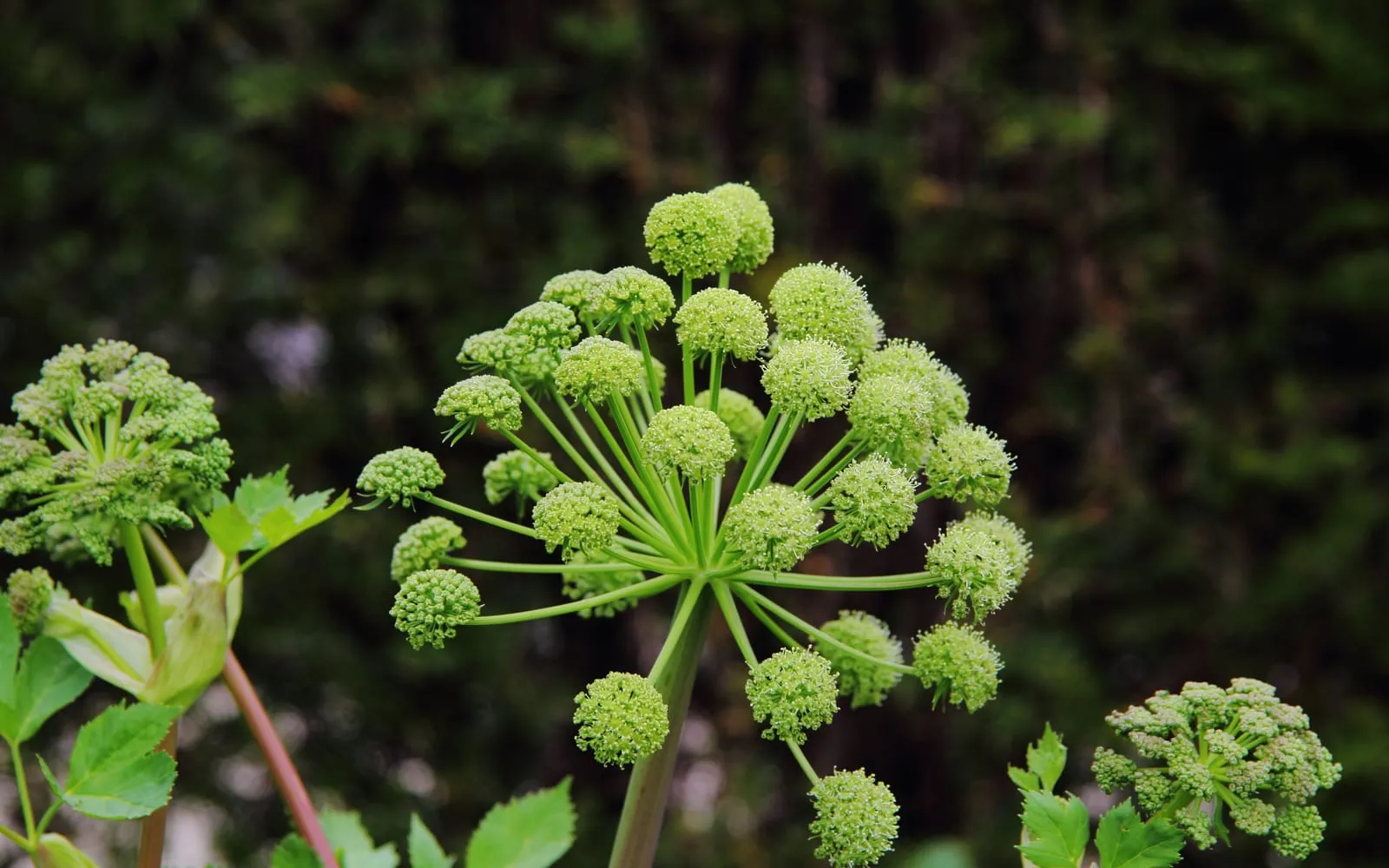
Angelica is the largest herb most gardens will ever hold. A second-year plant throws up a hollow stem thicker than a broom handle and taller than the gardener, topped with a dome of green-white flowers the size of a football.
Its kitchen use is narrow and specific. The young stems and leaf stalks are boiled in syrup and candied, producing the bright green pieces that decorate cakes and trifles, and the roots and seeds flavour gin, vermouth and Chartreuse. Nothing else in a temperate garden does that job.
It is a biennial, so a plant that flowers dies. Cutting the flower stem out before it opens keeps a plant going for several more years, which is worth doing if you want the stems rather than the spectacle.
Appearance and character
In its first year, a large mound of bright green divided leaves, 1 m across and nearly as tall, on stout hollow stalks.
In its second year, a thick hollow ribbed flowering stem 2 m or more, purple- flushed at the base, holding leaves that clasp the stem in inflated sheaths.
Flowers are small and greenish-white, packed into a great rounded umbel 20 cm across, opening in June and July. The umbel is domed rather than flat, which separates angelica from most of the family at a glance.
Seeds are large, pale, ribbed and strongly aromatic, ripening in August.
The scent is warm, sweet and musky, closer to juniper than to celery, and it is the reason the roots go into gin.
The whole plant is imposing and it holds attention in a border in a way no other herb here does.
Where it is from
Angelica is native to northern and eastern Europe and to Russia, growing on riverbanks, damp meadows and mountain pastures, and it reaches well into the Arctic.
Scandinavia and Iceland used it as a vegetable long before the rest of Europe took an interest. Angelica stems were eaten and traded in Norway and Iceland from the medieval period, and Icelandic law protected angelica patches as property.
The Sami and other northern peoples used the stems as food and the roots for smoking and medicine, in a landscape where few other plants offered either.
Its European reputation is medieval and medicinal. The name archangelica comes from the story that the Archangel Michael revealed the plant as a remedy for plague, and it was carried and chewed during outbreaks.
Candying is the use that survived, and the liqueur trade is what keeps it grown commercially. Angelica root is one of the standard botanicals in gin and appears in Chartreuse and Benedictine.
How it grows
Sow fresh seed. Angelica seed loses viability within a few months, and a packet bought in spring often produces nothing. Collect your own in August and sow it straight away.
Sow on the surface and press it in without covering, since it needs light. Autumn sowing outdoors gives the cold period the seed wants.
Sow where it is to grow if you can. It makes a deep taproot and dislikes being moved once it is past the seedling stage.
Space at 90 cm to 1 m. This is a very large plant and crowding it produces mildew and weak growth.
Choose damp, rich ground in part shade. Angelica grows beside rivers in the wild and a dry sunny border is the wrong environment for it.
In year one it makes leaves. In year two it flowers, sets seed and dies.
To keep a plant longer, cut the flowering stem out as soon as it appears and before any flower opens. Repeat each year and the plant will run for three or four seasons.
Harvest young stems and leaf stalks in late spring of the second year for candying, before the plant flowers. Dig roots in autumn of the first year.
Through the seasons
Winter is a low crown or bare ground. First-year plants keep some leaf in a mild winter.
Spring brings rapid growth from March. Mulch now, and watch for slugs, which take young plants readily.
Late spring is when second-year stems are cut for candying, before flowering starts.
Early summer is flowering, in June and July, and the plant is at full height. The umbels carry an extraordinary number of hoverflies and small wasps.
Late summer ripens the seed. Collect it in August and sow it immediately, or cut the heads off if you do not want a hundred seedlings.
Autumn ends a flowered plant. Cut it down and compost it. Dig roots from first-year plants now if you want them.
Care difficulty
Moderate, and there are three things to get right.
Seed viability is the first and the one that stops most people. Angelica seed is short-lived, so sow it fresh in autumn rather than buying a packet in March.
Size is the second. A mature plant is a metre across and two metres tall, it shades whatever is behind it, and it cannot be moved once established.
Moisture is the third. It grows on riverbanks and it will not tolerate a dry root in a sunny border. Damp, rich, part-shaded ground is what it wants.
The biennial habit surprises people who expected a perennial. It is manageable once understood, and cutting the flower stem out extends the plant’s life.
Beyond that it has few pests, needs no staking despite its height, and is entirely hardy.
Watering
Water it well and often. Angelica is a plant of damp ground and it is one of the thirstiest things in this collection.
Water new plants two or three times a week through their first summer.
Water an established plant deeply in any dry spell. Large leaves lose a great deal of water and a plant that dries out checks badly.
Mulch thickly in spring with compost or manure over the root spread, which holds moisture better than watering does.
A container is a poor choice. If you must, use the largest pot you can find and expect to water daily.
Water at the base rather than over the foliage.
Warning signs, diseases and pests
Aphids build enormous colonies on the flower heads in June. On a plant this size they are more a curiosity than a threat, and they bring in ladybirds and hoverflies.
Slugs take young plants and can destroy a first-year seedling entirely. Protect them for the first few months.
Leaf miner tunnels pale trails through the leaves. Cosmetic.
Crown rot in cold wet clay kills the plant over winter. Improve the drainage while keeping the moisture, which usually means adding organic matter rather than grit.
Wilting in July means the root has dried out. Soak it thoroughly.
Powdery mildew on crowded plants in a dry August is disfiguring rather than serious.
A plant that flowered and then died has completed its cycle.
Growing environment
Part shade is ideal, particularly in southern England. Full sun works in Scotland and the north, where the ground stays damper.
Deep, moisture-retentive, fertile soil with plenty of organic matter. This is a riverbank plant.
pH from 5.5 to 7. It grows on neutral and slightly acid ground and is not fussy.
Give it a metre of space in every direction. The back of a large border, a damp corner or a woodland edge all suit it.
It is fully hardy anywhere in its range and needs no shelter, though a two-metre flower stem in an exposed site may want a stake.
For pollinators it is one of the best plants here. The umbels attract hoverflies, solitary bees and parasitic wasps in quantity, and letting one plant flower feeds a great deal of garden wildlife.
Feeding
Feed it. Angelica is a large hungry plant and it grows better on rich ground than poor.
Mulch each spring with well-rotted manure or compost, spread over the root spread and kept off the crown.
A balanced liquid feed monthly through the first summer helps a young plant build the crown it needs to flower well.
Avoid heavy nitrogen on its own, which produces soft growth and heavy aphid colonies.
Feed a container plant fortnightly through summer, since a pot cannot supply what this plant wants.
Ground that grew a flowered angelica is worth mulching before anything else goes in, because the plant will have taken a great deal out of it.
Troubleshooting
None of the seed germinated. Angelica seed is short-lived. Collect fresh seed in August and sow it immediately, on the surface, outdoors.
It flowered and died. That is a biennial. Cut the flower stem out as it appears if you want to keep the plant longer.
Seedlings everywhere. One flowering plant produces thousands of seeds. Cut the heads off before they ripen.
I got a blistering rash after cutting it down. Phototoxic sap plus sunlight. Wear gloves and long sleeves, and cut it on a dull day or in the evening.
It wilted in July. Dry roots. This plant wants damp ground and a thick mulch.
Can I candy the stems? Yes, and that is its classic use. Cut young hollow stems in late spring of the second year, before flowering, then blanch and simmer them in syrup over several days.
Is it the same as wild angelica? No. Wild angelica, Angelica sylvestris, is a smaller native with pink-tinged flowers. Garden angelica is the taller green-white one, and neither should be confused with hemlock, which is a different and lethal plant.