
Outdoor plant
Meadow Saffron
Colchicum autumnale
Also known as Autumn crocus, Naked ladies, Colchicum
How to grow autumn crocus, Colchicum autumnale. The leafless autumn flowers, why it is not saffron, the colchicine that makes it lethal and how it differs from a true crocus.
At a glance
- Difficulty
- Easy
- Water
- None needed in open ground
- Light
- Full sun to partial shade
- Temperature
- Fully hardy, to about -30 deg C
- Hardiness
- USDA 4-9, RHS H6, hardy to -30 C
- Type
- Perennial corm, flowering in autumn and leafing in spring
- Height
- 15 cm in flower, and 30-40 cm in leaf
- Native to
- Europe, in damp meadows and woodland clearings, and native to Britain
- Best month
- September in the Northern Hemisphere, March in the Southern Hemisphere
Leaves and flowers arrive at opposite ends of the year, so the broad strappy foliage comes up in spring, dies away by midsummer, and the naked flowers push up from bare ground in autumn. Feeding the leaves through spring is what pays for the autumn flowers. Every part contains colchicine, and dried plants in hay stay lethal, which makes it a serious livestock poison across European meadows and a reason never to compost the foliage where stock graze.
Hardiness zones describe winter cold alone. Summer heat, humidity, rainfall and the length of the growing season decide as much, so treat the range as the outer limit rather than as a recommendation.
Every month named in this guide is for the temperate Northern Hemisphere. If you garden in the Southern Hemisphere, shift each one by six months, so September becomes March. Closer to the equator the wet and dry seasons matter more than the calendar, and the shift stops being a useful guide.
Poisonous if eaten
- Do not eat
- Every part, and the corm and seed most of all
- Harm from
- Eating it
- Affects
- People, cats, dogs and horses
Colchicum autumnale contains colchicine, and it is one of the most dangerous plants that can be bought in a garden centre. Colchicine stops cell division, so poisoning attacks the tissues that divide fastest, which are the gut lining and the bone marrow. The clinical course is characteristic and treacherous. Burning in the mouth and throat, then severe vomiting and profuse diarrhoea beginning two to twelve hours after eating, then an apparent recovery, then multi-organ failure and bone marrow collapse over the following days. There is no antidote. Deaths have occurred from as little as a few grams of corm, and the delayed onset means people have eaten a fatal dose without any immediate warning. Two confusions account for most human cases. The corm has been mistaken for a wild onion, and the spring leaves for wild garlic or ramsons, which grow in similar damp ground. The flowers have also been mistaken for saffron crocus, which is a completely different plant. Treat any ingestion as a medical emergency, and say colchicine when you get help, because that changes the management. It is equally lethal to dogs, cats, horses and cattle, and livestock are poisoned by it in hay from damp meadows where drying does not destroy the toxin.
Sources: RHS potentially harmful garden plants, ASPCA toxic and non-toxic plants
About
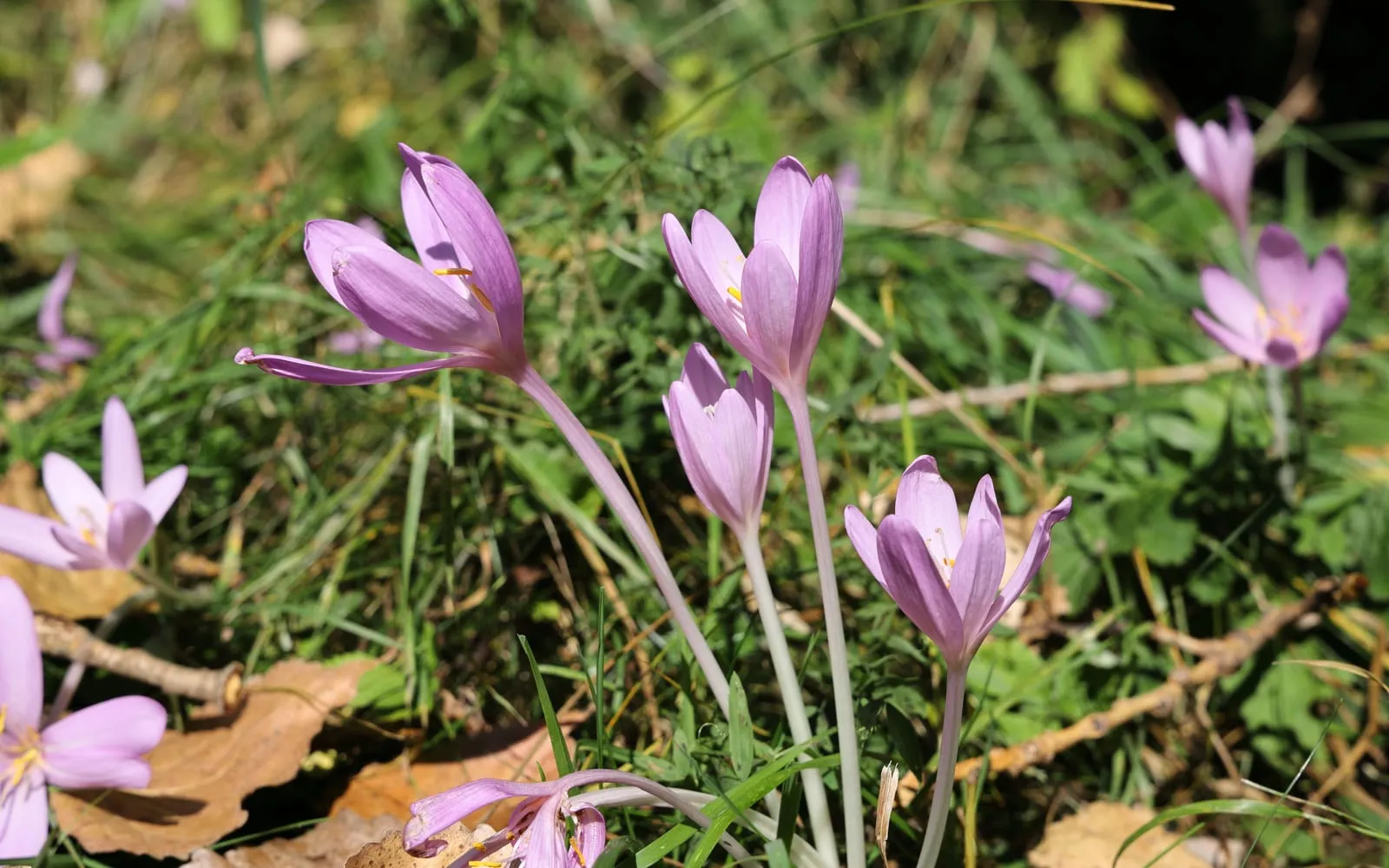
Autumn crocus flowers out of a bare lawn in September with no leaves anywhere near it, which is the origin of the name naked ladies and the reason it stops people in their tracks.
It is a beautiful and useful garden plant for late colour, and it is one of the most poisonous things you can buy at a garden centre.
Two pieces of naming cause real harm and are worth settling immediately.
It is not a crocus. True crocuses are in the iris family and have three stamens. Colchicum is in a different family entirely and has six. The distinction is not academic, because the second confusion depends on it.
It is not saffron. Saffron comes from Crocus sativus, an autumn-flowering true crocus with red stigmas. Meadow saffron looks similar at a glance and contains colchicine. People have died after mistaking one for the other.
The plant is also medically important. Colchicine extracted from it is a real and widely used drug for gout, which tells you something about how narrow the margin between dose and poison is.
Appearance and character
A perennial growing from a large corm, with a life cycle that runs backwards compared with most bulbs.
Flowers appear from late August to October, rising straight out of bare ground with no leaves at all. Each is a goblet 10 to 15 cm tall, pale lilac to rosy pink, occasionally white, with six tepals and a long pale tube running down into the ground.
Count the stamens to be certain. Colchicum has six. A true crocus has three.
Leaves appear the following spring, in March and April, and are quite unlike the flowers. They are broad, strap-shaped, glossy dark green, 20 to 40 cm long, and coarse enough to swamp small neighbours.
The leaves die back untidily in June, leaving a yellowing mess, and then the ground is bare until the flowers return.
Seed capsules push up among the spring leaves, which is another oddity, since they were fertilised the previous autumn and overwintered underground.
The corm is large, brown-skinned and irregular, and is the part most often eaten by mistake.
Where it is from
Europe, and native to Britain though now rare in the wild, where it grows in damp meadows and open woodland, mostly in the south-west of England.
It has declined sharply as damp hay meadows have been drained and improved, and it is a species of conservation concern in Britain despite being sold widely as a garden plant.
That decline has an agricultural side. Farmers removed it deliberately because it poisons cattle and horses, and it survives in hay in a form animals will eat.
The name refers to Colchis on the Black Sea, the land of Medea in Greek myth, which was associated with poisons.
Garden colchicums include the species and a number of larger hybrids such as ‘Waterlily’ and Colchicum speciosum, all of which are equally toxic.
How it grows
Plant corms in July or August, which is earlier than most bulbs, because they flower within weeks of going in.
Set them 10 to 15 cm deep and about 15 cm apart, in sun or partial shade.
Choose the position with the spring leaves in mind rather than the autumn flowers. The leaves are large and coarse for three months and will smother anything small planted around them.
Rough grass, an orchard, the edge of a shrub border or under deciduous trees all suit it. A neat lawn does not, because the leaves cannot be mown until they have died down in June.
Leave the foliage to die back naturally. Cutting it early starves the corm and the following autumn’s flowers suffer.
Lift and divide congested clumps in summer while dormant, wearing gloves.
It seeds and increases steadily, and an established colony in grass will spread.
Wear gloves whenever handling corms, and wash your hands afterwards. Do not store corms anywhere they could be confused with onions or other edible bulbs, which is a real and recurring cause of poisoning.
Through the seasons
Winter is bare ground with nothing showing.
Spring brings the broad glossy leaves in March, which persist until June, along with the seed capsules from the previous autumn’s flowers.
Summer is when the leaves yellow and die back, and the corms are dormant. This is the window for lifting, dividing and planting.
Autumn is the flowering, from late August through October, straight out of bare ground.
Care difficulty
Easy to grow and requiring real care in siting and handling.
The plant asks for almost nothing. It is fully hardy, needs no watering or feeding, and increases on its own.
The difficulty is in placing it. People plant it for the autumn flowers and are caught out by three months of coarse leaves in spring, which is the commonest reason it gets dug up again.
The other difficulty is safety, which is a matter of knowing what you have and keeping the corms away from anything edible.
Watering
None needed in open ground.
It prefers moisture-retentive soil that does not waterlog in winter, which reflects its natural damp meadow habitat.
Corms rot in soil that stays saturated, so improve drainage on heavy clay.
Warning signs, diseases and pests
The plant has few pests. Slugs sometimes graze the autumn flowers, which is cosmetic.
The warnings that matter are about poisoning.
If anyone has eaten any part of this plant, treat it as a medical emergency and say colchicine. Do not wait for symptoms and do not be reassured by a period of feeling well. The classic course is burning in the mouth, then severe vomiting and diarrhoea after two to twelve hours, then an apparent recovery, then organ failure over the following days. There is no antidote and early intensive treatment is what decides the outcome.
A dog or cat has eaten it. Go to a vet immediately. It is lethal to both, and delayed presentation is common.
Livestock. Colchicum in hay from a damp meadow retains its toxicity after drying and has killed cattle and horses. Check hay meadows before cutting.
The two confusions to guard against are the spring leaves against wild garlic, which grow in the same damp shady ground, and the corms against onions. Wild garlic smells strongly of garlic when crushed and colchicum has no smell.
Growing environment
Full sun to partial shade, on moisture-retentive but free-draining soil.
The best positions are rough grass, orchards, the edges of borders and beneath deciduous shrubs and trees, where the spring leaves can be tolerated and left to die down.
Avoid a fine lawn, since the mowing regime and the foliage are incompatible.
Avoid planting it among small delicate perennials, which the spring leaves will swamp.
Think carefully before planting it in a garden used by small children, or in a vegetable garden where corms could be confused with edible bulbs.
Keep it out of grazed paddocks and hay meadows entirely.
Combine it with low ground cover such as hardy geraniums or ivy, which hides the bare soil in summer and gives the autumn flowers something to rise through.
Feeding
Very little is needed. A mulch of compost in spring while the plant is in leaf supports the corm as it builds up for the following autumn.
Avoid feeding in autumn, which does nothing useful.
Poor flowering is usually caused by cutting the leaves down too early, by congestion in an old clump, or by shade, rather than by lack of nutrients.
Troubleshooting
Is this saffron? No, and this confusion has killed people. Saffron comes from Crocus sativus, an autumn-flowering true crocus with three stamens and red thread- like stigmas. Meadow saffron has six stamens, no red stigmas, and contains colchicine. Never harvest saffron from a plant you have not bought as Crocus sativus.
Is it a crocus? No. True crocuses have three stamens and grass-like leaves that appear with the flowers. Colchicum has six stamens and broad leaves that appear months later in spring.
Someone has eaten it. Get medical help now and say colchicine. Do not wait for symptoms and do not be reassured if they seem to improve after the initial illness.
My dog dug up and chewed a corm. Emergency vet, immediately. This is lethal to dogs.
When do the leaves appear? In March, months after the flowers, and they are broad and coarse and last until June. Plant it where that is acceptable.
Can I cut the leaves down early? No. Cutting them before they yellow starves the corm and reduces the next autumn’s flowering.
Is this wild garlic? Check the smell. Wild garlic leaves smell strongly of garlic when crushed, colchicum leaves have no smell. They grow in similar damp shady ground and this confusion has caused fatal poisonings.
It has stopped flowering well. Usually congestion. Lift and divide the clump in summer while dormant, wearing gloves.