
Outdoor plant
Round-Leaved Sundew
Drosera rotundifolia
Also known as Common Sundew
How to grow Drosera rotundifolia in a bog garden. The hibernaculum that gets it through a frozen winter, and why it rarely survives long as a houseplant.
At a glance
- Difficulty
- Difficult
- Water
- Keep the sphagnum permanently saturated with rainwater year-round
- Light
- Full sun
- Temperature
- Grows best 10-25 deg C in summer; needs a genuine winter freeze
- Humidity
- Ordinary outdoor humidity; sits directly in living sphagnum moss
- Hardiness
- USDA 2-8, RHS H7, hardy to -20 C
- Type
- Hardy herbaceous perennial
- Height
- 5-10 cm; flower stalks to 15-25 cm
- Native to
- Europe, North America, Asia
One of the most widely distributed carnivorous plants on Earth, found right across the cool bogs of the northern hemisphere from Scandinavia to Siberia to Canada. It does not merely tolerate a hard freeze, it needs one: the plant dies back completely above ground each autumn and survives winter as a tight bud at soil level, insulated by the sphagnum and often by snow. A mild winter, or a warm indoor spot, denies it this rest and the plant typically declines and dies within a season or two.
Hardiness zones describe winter cold alone. Summer heat, humidity, rainfall and the length of the growing season decide as much, so treat the range as the outer limit rather than as a recommendation.
Not known to be toxic
Round-leaved sundew has no toxicity listing from the RHS or the ASPCA for people or pets. It has, in fact, a long history of use in traditional herbal medicine for coughs, though that is a matter of dosage and preparation for a specific purpose rather than evidence of any general safety concern with the growing plant.
Source: RHS
About
Round-leaved sundew grows native throughout Britain, in Sphagnum bogs and wet heaths from Cornwall to the far north of Scotland, and the same species turns up again in bogs across Scandinavia, Siberia, Japan and Canada. Few carnivorous plants have a range this wide, and almost none of them combine it with such a small, unassuming plant: the whole rosette rarely spans more than a few centimetres, and it is easy to walk past a colony of them without noticing.
Herbalists noticed it long before botanists took much interest in how it caught insects. Dried sundew has been used since mediaeval times as a remedy for coughs and chest complaints, and the plant contains plumbagin, a compound with genuine antibacterial activity that later research confirmed works against a range of pathogens, which is presumably why it kept turning up in cough remedies for so many centuries before anyone understood why.
It is also, unusually among sundews commonly sold to beginners, a plant that cannot be kept indoors long term. It needs a proper winter, and without one it fades over a season or two rather than adapting.
Appearance and character
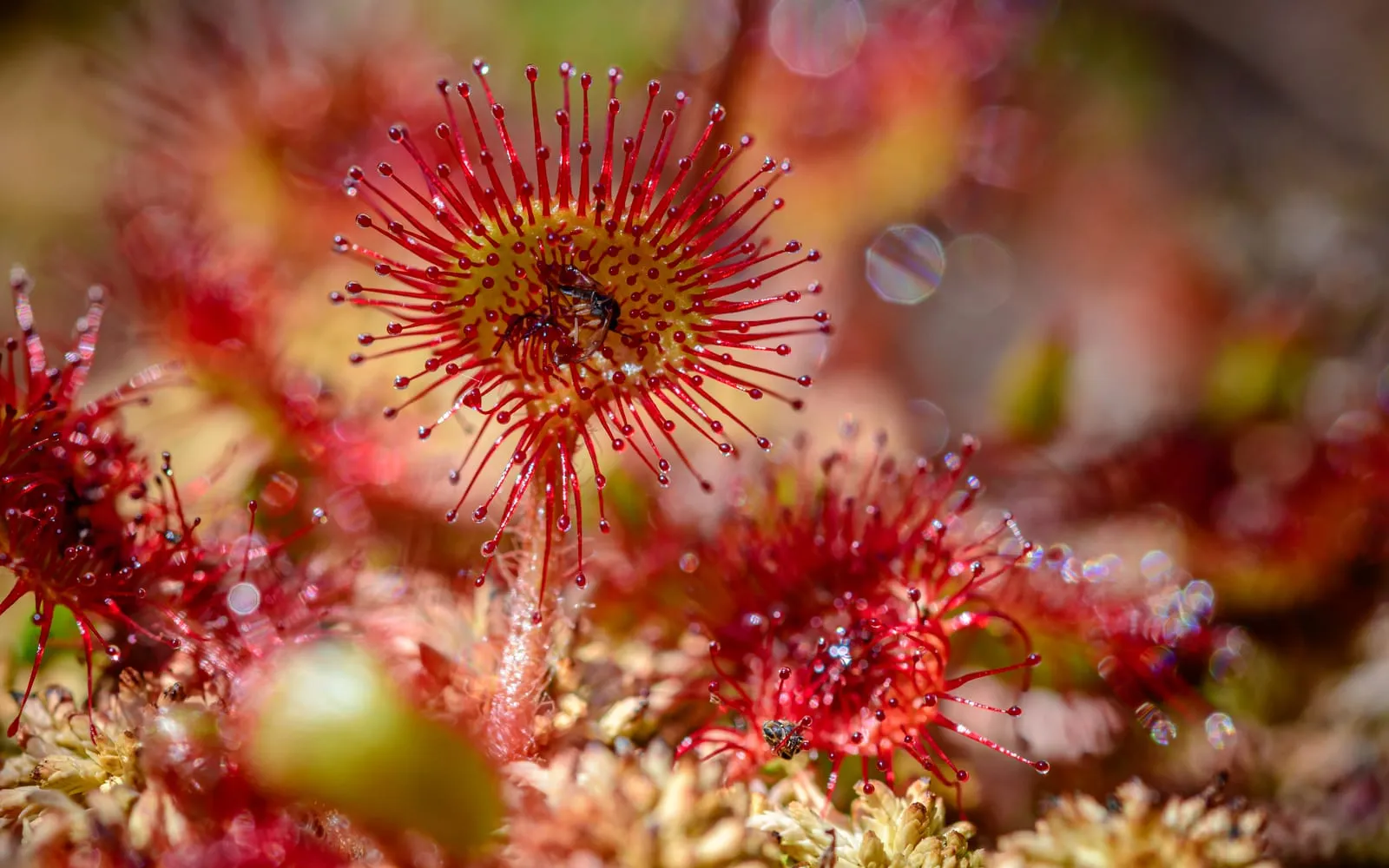
Leaves are small, round and flat, held horizontally at the end of long, slender, hairless stalks that radiate out from the centre in a rosette pressed close to the moss surface. Each leaf blade is covered in fine red tentacles tipped with glistening mucilage, giving the whole plant a sparkling, dew-covered look even on a dry day, which is the origin of its common name.
A midge or small fly that lands is held by the sticky tentacles, and the leaf slowly curls inward over several hours to bring more glands into contact with the prey, in the same manner as its larger relative the Cape sundew, though the smaller leaf and cooler climate mean the whole process runs noticeably more slowly here.
Small white, five-petalled flowers open on a thin stalk held well above the sticky foliage in summer, opening only briefly in sunshine and often only one at a time along the spike.
Where it is from
Acidic, nutrient-poor bogs and wet heaths across the cooler parts of the northern hemisphere, rooted directly into living sphagnum moss rather than soil. The moss keeps the surface constantly wet and strongly acidic, and it is this near-total absence of usable nitrogen in the peat, not the cold itself, that explains why the plant traps insects at all.
Because sphagnum keeps growing upward from below even as its lower layers die and compress into peat, a wild sundew is effectively riding a very slow conveyor belt, staying at the surface of a bog that has been accumulating for centuries.
How it grows
Growth begins in spring from the tight bud, called a hibernaculum, that carried the plant through winter, and new leaves unfurl steadily through the growing season as the rosette expands. Older leaves at the centre die back as new ones form at the margin, so an actively growing plant constantly replaces its own foliage rather than only adding to it.
By fully expanded summer, the rosette has usually caught enough insects to flower, sending up a single thin stalk. As autumn arrives, all the mature foliage dies back completely, leaving only the compact hibernaculum bud at soil level to see the plant through winter, which is a far more drastic seasonal collapse than most garden perennials undergo.
Propagation from seed is the most reliable method, sown on the surface of damp, living sphagnum and given a period of cold stratification, mimicking a winter, before it will germinate. Root cuttings taken in spring also work, though slowly.
Through the seasons
Spring brings the rosette back from its winter bud as temperatures rise, with new leaves unfurling over several weeks. This is when to check that last year’s dead growth has been left in place, since it protects the bud through the last of any late frosts.
Summer is the main growing and trapping season, and also when the plant flowers, sending a slender stalk of small white blooms above the sticky foliage. Keep the sphagnum permanently wet and in full sun throughout.
Autumn sees the whole rosette collapse and die back as temperatures fall, leaving only the tightly packed hibernaculum bud visible at soil level. This is entirely normal and not a sign of a failing plant.
Winter is spent as that dormant bud, ideally under a protective layer of snow or at least consistently cold, damp sphagnum. This is not a rest the plant can skip: without a real period of cold, it does not reliably resprout the following spring, and repeated mild winters weaken it over successive years until it fails entirely.
Care difficulty
Difficult, despite its unassuming size, because it depends on conditions a typical home cannot provide. It needs living sphagnum moss, permanently acidic, saturated, low-nutrient conditions, and a genuine winter freeze, none of which a houseplant setup delivers. It suits an outdoor bog garden or an unheated greenhouse far better than a windowsill.
Growers who succeed with it long term are almost always growing it outdoors year-round in a climate that already resembles its native bog, rather than trying to recreate winter artificially indoors.
Watering
Keep the sphagnum permanently saturated with rainwater at all times, summer and winter alike; this species has essentially no drought tolerance and a bog that dries out even briefly can kill an established colony. Standing a pot in a deep tray of rainwater, or planting directly into a lined bog bed, both work.
Only rainwater or distilled water is suitable. The naturally acidic, mineral-free chemistry of a sphagnum bog is central to how the plant lives, and tap water disrupts it quickly, first by encouraging algae and moss die- back and then by damaging the sundew’s own roots.
Warning signs, diseases and pests
Botrytis can appear on dying summer foliage in still, overly sheltered conditions, showing as a grey fuzz on collapsing leaves. This is often part of the plant’s normal autumn dieback rather than disease, but a heavy grey mould spreading onto the hibernaculum bud itself is worth addressing by improving airflow around the planting.
Algae competing with the sphagnum is the more common problem in cultivation, usually a sign that the water being used carries too many dissolved minerals or that the site gets too little direct sun. Green, slimy moss that is losing its usual structure should prompt a switch to purer water and, if possible, more light.
A rosette that fails to reappear in spring after an unusually mild winter is the clearest sign this species was denied the cold rest it needs, rather than evidence of a pest or disease.
Growing environment
Full sun is essential; this is an open bog and wet heath plant with no tolerance for shade, and a shaded planting produces small, pale, poorly trapping rosettes. Outdoors it belongs in a bog garden, a pond margin lined to hold water, or a large container of living sphagnum kept permanently wet.
It tolerates the cold well, as described under hardiness, and needs that cold rather than merely surviving it. Ordinary outdoor humidity is fine, and it should never be brought indoors to a heated room for any extended period, since the warmth prevents the dormancy it depends on.
Grow it directly in living sphagnum moss over acidic peat rather than any compost mix, replicating a bog surface as closely as possible.
Feeding
None applied to the growing medium. Midges, small flies and other tiny insects caught on the sticky leaves supply all the nitrogen the plant needs, and an outdoor bog planting rarely requires supplementary feeding of any kind.
Troubleshooting
The whole plant has disappeared in autumn. Normal, not a failure. It dies back to a small dormant bud each winter and regrows from it in spring.
It never reappeared the following spring. Usually means the winter was too mild, or the plant was kept somewhere too warm, denying it the cold rest it needs. This species does not adapt to a frost-free existence.
Green slime is spreading across the sphagnum. Algae, usually from mineral-bearing water or too little direct sun. Switch to rainwater only and move the planting somewhere brighter.
The rosette stayed tiny and never flowered. Often a light issue; this species needs full sun to build up enough reserve to flower. Check nothing is shading it for part of the day.
I tried it as a houseplant and it died within a year. A common outcome. This species needs a genuine winter dormancy that an indoor environment cannot provide, and it is far better suited to an outdoor bog garden or unheated greenhouse.
Leaves have gone grey and mushy in late summer. Likely botrytis on foliage that was already starting its natural autumn dieback. Improve airflow, and expect the bud beneath to survive regardless.
Can I collect it from the wild instead of buying one? No. It is uncommon and slow-growing in many areas, and taking it from a bog disturbs a sensitive habitat for very little benefit, since nursery-raised plants establish more reliably anyway.