
Outdoor plant
Paper Flower Bougainvillea
Bougainvillea glabra
Also known as Lesser Bougainvillea, Sanderiana
How to grow paper flower bougainvillea, Bougainvillea glabra. Why it flowers steadily for months rather than in flushes, why a slightly cramped pot produces more bracts than a roomy one, and the near-thornless stems that suit it to a bonsai or a hanging basket.
At a glance
- Difficulty
- Moderate
- Water
- Moderate and fairly steady for a container plant; drier spells suit an established plant in open ground
- Light
- Full sun, at least five or six hours of direct light a day
- Temperature
- Warm; foliage suffers below about 5 deg C and a hard frost kills the top growth
- Hardiness
- USDA 9b-11, RHS H1c, hardy to -1 C
- Type
- Woody evergreen to semi-evergreen climber, deciduous only under real cold or drought stress
- Height
- 3-6 m trained on a support; 0.5-1 m as a hanging basket or bonsai specimen
- Native to
- Brazil
This species flowers so readily that it can carry colour through most of the year wherever the winter stays frost-free, without needing the sharp dry season that some of its relatives depend on to trigger a display. A plant in a climate with year-round rainfall still flowers respectably here, which is not true of every bougainvillea. What the zone range does not cover is speed of recovery: a plant cut to the ground by frost regrows from surviving lower wood in a warm season but rarely reaches its previous size again before the following winter arrives.
Hardiness zones describe winter cold alone. Summer heat, humidity, rainfall and the length of the growing season decide as much, so treat the range as the outer limit rather than as a recommendation.
Skin irritant
- Do not eat
- Sap from cut stems and leaves; the few thorns present are a separate cutting hazard
- Harm from
- Handling it
- Affects
- People
The ASPCA lists bougainvillea as non-toxic to dogs, cats and horses, and there is no meaningful history of serious poisoning in people either. The sap can irritate skin on contact in sensitive individuals, causing redness or a mild rash similar to nettle stings, most often noticed by people who prune or repot the plant regularly rather than by someone brushing past it once. This species carries noticeably fewer and shorter thorns than its more common relative, great bougainvillea, which is part of why it is so often chosen for a hanging basket or a spot near seating, but a mature specimen still carries enough of them to catch unprotected skin during pruning, so wear gloves regardless of the reduced armament.
Sources: ASPCA (Bougainvillea), RHS potentially harmful garden plants
About
Paper flower bougainvillea is the species behind most of the bougainvillea grown as a compact pot plant, a hanging basket or a trained bonsai, rather than the sprawling wall-covering climber the genus is often pictured as. Its smooth, largely thornless stems and smaller flower bracts make it easier to handle at close quarters, and its habit of flowering steadily over many months rather than in a few intense flushes suits a plant kept somewhere it is seen every day.
The species name glabra means smooth, referring to the stems and leaves, which lack the coarse hairiness of great bougainvillea, Bougainvillea spectabilis, its larger and thornier relative. The cultivar ‘Sanderiana’, a form of this species with rich purple bracts, is one of the most widely sold bougainvillea in the world, grown from Mediterranean patios to Southeast Asian street plantings.
It is an easier plant to live with in a small garden or on a balcony than its bigger relative, without giving up much in the way of colour or vigour.
Appearance and character
A woody climber with smooth, slender, largely thornless stems, distinct from the coarse, hairy, heavily armed growth of great bougainvillea. Any thorns present are shorter, fewer and less rigid.
Leaves are smooth-edged, glossy and slightly smaller than those of its relative, giving the whole plant a neater, more refined texture that suits close viewing on a patio or balcony.
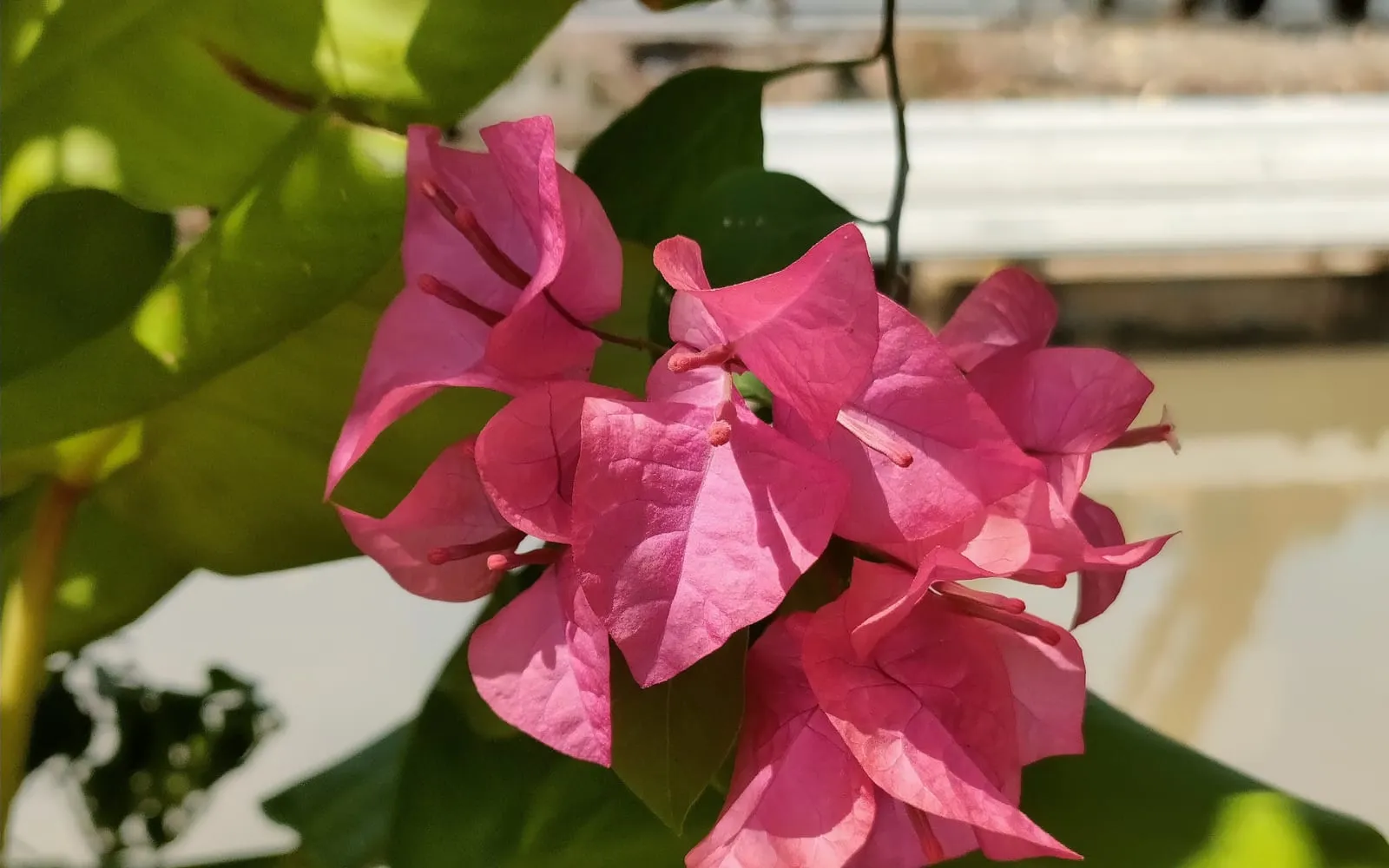
The true flowers are small, white and tubular, each surrounded by three papery bracts that carry the plant’s colour, most commonly a rich magenta-purple in the wild form and the widespread ‘Sanderiana’ cultivar, though white, pink and bicoloured forms are also grown. The bracts are noticeably smaller than those of great bougainvillea and are carried in slightly looser clusters.
Where great bougainvillea tends to flower in distinct flushes separated by quieter periods, this species blooms more continuously through the warmer months, particularly where light and warmth stay fairly constant through the year, making it the more reliable choice for near-constant colour in a container.
Where it is from
Bougainvillea glabra is native to Brazil, growing in scrubby, open, sun-exposed ground where competition from taller vegetation is limited and light is abundant for most of the year.
Its native range does not carry the same pronounced dry season that shapes the flowering rhythm of great bougainvillea further south in the continent, which helps explain why this species flowers more evenly across the growing season rather than concentrating its display around one seasonal dry spell.
It reached cultivation outside South America in the nineteenth century alongside its relatives and has since become, through selections like ‘Sanderiana’, one of the most widely planted bougainvillea worldwide, prized in particular for pot and container culture where its smaller, tidier growth is an advantage over larger-growing relatives.
How it grows
Plant in free-draining, unremarkable soil in open ground in a warm climate, or in a gritty, loam-based container compost where it will be grown in a pot or hanging basket, which is how most gardeners outside the tropics and subtropics keep this species.
Choose the sunniest position available. Flowering is directly tied to light levels, and a plant kept in shade produces mostly leaf with few of the papery bracts it is grown for.
Where grown in a container, keep the pot on the smaller side relative to the plant’s size, since a degree of root restriction encourages more reliable flowering than a large pot with room to spare.
Train young growth onto a small trellis, hoop or frame for a compact climbing shape, or leave it untrained in a hanging basket, where the stems arch and trail attractively over the container’s edge.
For a bonsai specimen, prune both roots and top growth regularly using standard bonsai technique, which this species tolerates well thanks to its naturally fine, near-thornless growth and its tolerance of hard, repeated cutting back.
Prune lightly and regularly through the growing season to maintain shape and to encourage the steady succession of new flowering growth this species is valued for, rather than saving all pruning for one annual session.
Through the seasons
Spring is the return to active growth after any winter rest, and the point to resume regular feeding as new shoots and flower buds appear.
Summer brings the heaviest and most continuous flowering in most climates this species is grown in, particularly with consistent warmth and light.
Autumn often continues the flowering display with little interruption in a mild climate, tapering only as light levels and temperature drop.
Winter is a period of reduced growth or dormancy wherever temperatures fall much below about 10 deg C. Move container plants under cover before the first frost and reduce watering until growth resumes.
Care difficulty
Moderate, and generally more forgiving in a small space than great bougainvillea, since its more compact size and near-continuous flowering suit container culture without the same need for a large structure to train against. The main requirements are consistent, strong light and restraint with water and rich soil, both of which push leafy growth at the expense of the flowers most gardeners are growing it for.
Watering
Water container-grown plants moderately and fairly steadily through the growing season, letting the top few centimetres of compost dry before watering again rather than keeping it constantly moist.
A plant in open ground in a warm climate tolerates and often flowers better through a drier spell once established, though this species does not depend on drought stress to flower the way some of its relatives do.
Reduce watering markedly over a cooler winter rest, whether the plant is in a container under cover or established outdoors in a climate with a cool season.
Warning signs, diseases and pests
Aphids can appear on soft new growth, particularly on a plant brought indoors or under cover for winter, distorting young shoots and leaving a sticky residue. A strong jet of water or an insecticidal soap controls a light infestation.
Mealybug tends to settle into leaf joints and around the base of the bracts, showing as small white, cottony tufts. Wipe accessible colonies away and treat the rest with horticultural soap.
Spider mite favours the dry air of a heated room over winter, showing as fine pale speckling on the leaves with faint webbing in a bad case. Raising humidity slightly around an overwintering plant helps prevent it.
Root rot follows overwatering or a container with poor drainage, showing as yellowing leaves and a softening base to the stems. Repot into fresh, gritty compost, trim away any soft roots, and water far more sparingly afterwards.
Growing environment
Full sun is essential for good flowering; a plant grown in shade produces leafy growth with little colour to show for it.
Free-draining soil or compost suits it better than anything rich or constantly damp, since overly generous conditions encourage leaf growth at the expense of the bracts.
A degree of root restriction in a modestly sized pot supports more reliable flowering than a large container with excess room to spare.
Shelter from hard frost is essential anywhere near the cold edge of its tolerance, whether that means a warm wall outdoors or bringing a container under cover for winter.
Feeding
Use a high-potassium bloom feed, of the kind formulated for tomatoes or other flowering plants, rather than a balanced or nitrogen-heavy fertiliser, since potassium supports bract production directly while nitrogen encourages competing leafy growth.
Feed every two to four weeks through the growing season, tapering off as growth slows in autumn and stopping entirely through a cooler winter rest.
A container specimen benefits from consistent light feeding through its long flowering period, since the compost’s nutrients are used up faster by such continuous bloom than by the shorter flushes some relatives produce.
Troubleshooting
How is this different from the bougainvillea most people picture? Paper flower bougainvillea has smooth, largely thornless stems and smaller flower bracts than great bougainvillea, its more common and more vigorous relative, and it tends to flower steadily over a long period rather than in a few intense flushes.
Mine has plenty of leaves but few flowers. Too little sun, soil that is too rich, or a pot that is too large for the plant are the usual causes. Move it to the sunniest spot available, hold back on watering and feeding, and consider a smaller pot.
Can I keep it as a small potted or bonsai plant? Yes, and this species suits that treatment better than most other bougainvillea, tolerating regular root and top pruning well thanks to its fine, near-thornless growth.
Do I need to let it dry out to get flowers, like other bougainvillea? Less so than great bougainvillea. This species flowers fairly continuously with warmth and light even without a pronounced dry spell, though avoiding constantly wet soil still helps.
Is it safe to grow somewhere children play? The ASPCA lists it as non-toxic to pets, and there is no record of serious poisoning in people. It carries fewer and shorter thorns than great bougainvillea, though a mature plant is still needs careful siting around a play area.