
Edible
Common Camas
Camassia quamash
Also known as Quamash
How to grow common camas, Camassia quamash. Why its leaves are almost identical to the seriously toxic death camas before either flowers, the rule of digging only in bloom, and the long, slow cooking its bulbs need to be edible.
At a glance
- Difficulty
- Easy
- Water
- Keep moist through autumn, winter and spring; withhold water once foliage dies down
- Light
- Full sun to light shade
- Temperature
- Fully hardy
- Hardiness
- USDA 3-9, RHS H6, hardy to -20 C
- Type
- Hardy perennial bulb, dormant through summer after spring flowering
- Height
- 30-70 cm
- Native to
- western North America
Comes from wet mountain and prairie meadows that flood or stay soggy through winter and spring, then dry out hard for summer, and it needs that dry season as much as it needs the winter cold. A garden spot that stays damp all year through summer, rather than drying out once flowering finishes, rots the dormant bulb even in a climate well within its cold-hardiness range.
Hardiness zones describe winter cold alone. Summer heat, humidity, rainfall and the length of the growing season decide as much, so treat the range as the outer limit rather than as a recommendation.
Edible, with limits
- Safe to eat
- Bulbs, only after long slow cooking or pit roasting
- Harm from
- Eating it
- Affects
- People
Camassia quamash bulbs were a staple food across the Pacific Northwest and interior Plateau for Indigenous peoples including the Nez Perce and Coast Salish, traditionally pit-roasted or steamed for a day or more, a process that converts the bulb's indigestible inulin into sweet, digestible sugars. Eaten raw or undercooked, the same inulin causes gas and digestive upset rather than a true poisoning, which is why slow cooking is part of the food tradition rather than an optional refinement. The serious risk with this plant is not the bulb itself but misidentification. Death camas, Toxicoscordion venenosum, an unrelated and seriously poisonous species, grows in the same meadows and produces near-identical grass-like leaves and bulbs before either plant flowers, and eating death camas has caused documented fatalities in people and livestock. Traditional harvesters dug camas only while the flowers were open, when the two species are easy to tell apart by colour, and the same rule remains the safest practical guard against confusing them today.
Sources: RHS potentially harmful garden plants, ASPCA toxic and non-toxic plants
About
Common camas is a hardy bulb from western North America’s wet mountain meadows and prairies, grown in gardens for its tall spikes of blue to purple star-shaped flowers in spring and historically significant across its native range as a staple food. It naturalises readily in soil that mimics its native habitat, wet for half the year and dry for the other half, and needs almost nothing once established in the right spot.
It has one identification hazard worth taking seriously. Death camas, an unrelated and seriously toxic species, shares its grass-like foliage and its habitat, and confusing the two before either plant flowers has caused real poisoning cases. A gardener growing common camas deliberately from a labelled bulb has little to worry about; anyone foraging bulbs from the wild needs to know the difference.
Appearance and character
The leaves are narrow, grass-like and basal, emerging in a loose clump in early spring well before the flowers appear, which is the point in its growth cycle when it most resembles other bulbs sharing its habitat.
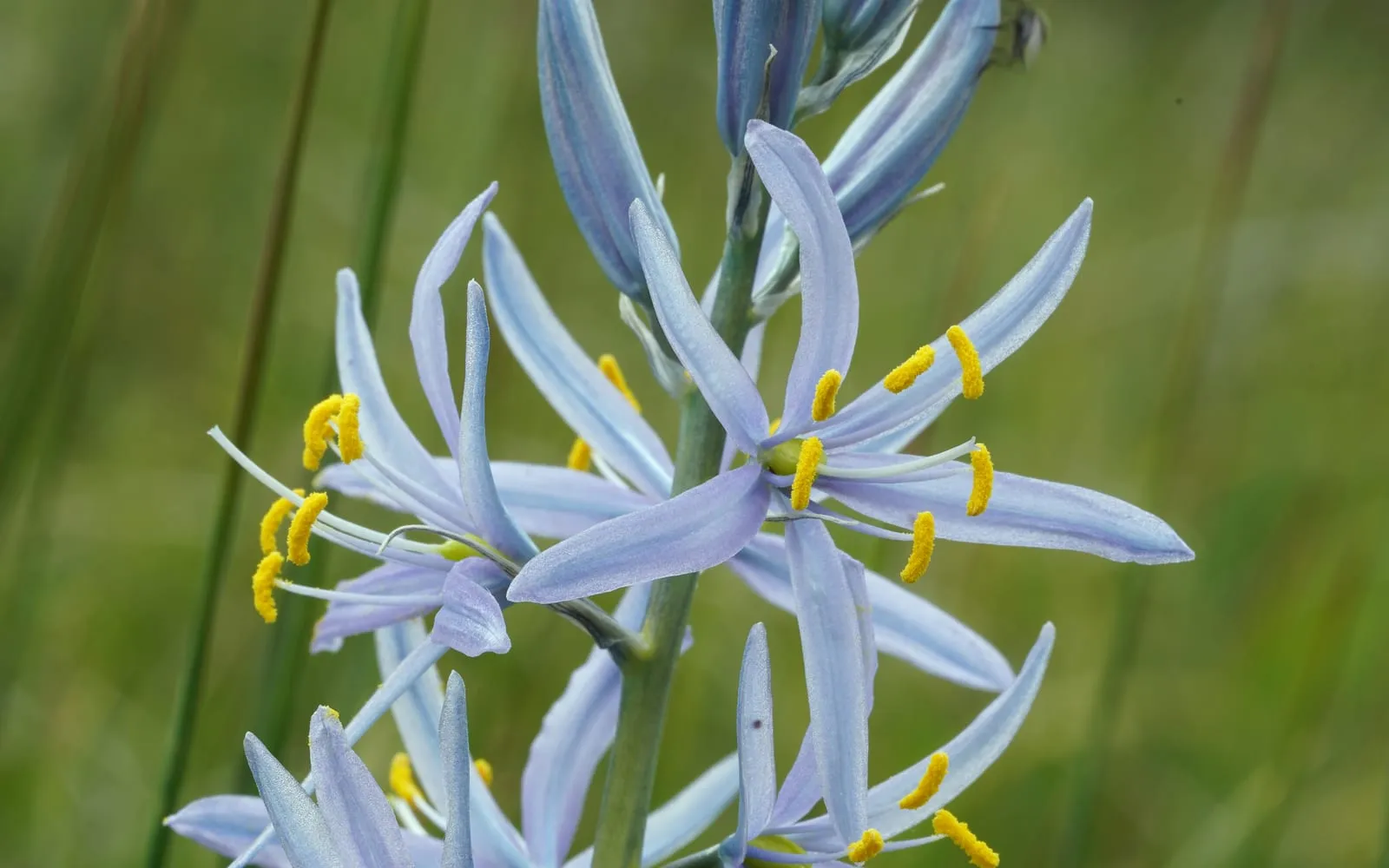
The flowering spike rises well above the foliage, carrying a loose raceme of star-shaped flowers in shades of blue to violet-purple, occasionally white, each with six narrow tepals. A useful diagnostic feature on close inspection is that the flowers are held slightly asymmetrically around the stem, one tepal set a little apart from the other five, unlike the more evenly arranged flowers of its larger relative, great camas.
After flowering, the foliage yellows and dies back as the plant enters summer dormancy, leaving no visible growth above ground until the following spring, a rhythm typical of bulbs from a climate with a wet season and a dry one rather than a single continuous growing season.
Where it is from
Camassia quamash is native to western North America, from British Columbia south through the Pacific Northwest into California and east into the Rocky Mountain states, growing in wet meadows, vernal seeps and prairies that flood in winter and spring and dry out completely by summer.
Those meadows, often called camas prairies, were actively managed by Indigenous peoples for generations, including through controlled burning that kept the ground open and favoured the bulb over competing woody growth. The bulbs were a major trade item and dietary staple across a wide region, harvested in enormous quantities at traditional sites and processed by long, slow cooking that made them both digestible and sweet.
How it grows
Plant bulbs in autumn, in soil that stays moist through winter and spring but dries out over summer, at a depth of around 10 cm. A spot that floods seasonally or sits at the base of a slope where water collects after rain suits it well, provided the same ground dries out reliably once the flowers have finished.
Full sun to light shade both work well, mirroring the open meadows and lightly wooded margins it grows in naturally.
Leave the foliage to die back naturally after flowering rather than cutting it while it is still green, since the bulb is drawing down reserves from the leaves for the following year’s growth during that period.
Established clumps need little attention and can be left undisturbed for years, gradually increasing by both bulb offsets and self-seeding into larger drifts where conditions suit them.
Through the seasons
Autumn is the main planting time for new bulbs, giving them a full wet season to establish roots before spring growth begins.
Winter brings little visible activity above ground in most climates, though roots continue developing in the moist, cool soil.
Spring is the main season of interest: grass-like leaves emerge first, followed by the flowering spike, which typically opens over several weeks from the base of the raceme upward.
Summer brings dormancy as the foliage yellows and dies back completely. The bulb needs the soil to dry out during this period and should not be watered artificially.
Care difficulty
Easy, provided the soil offers the wet-then-dry rhythm this bulb expects. Once planted in a suitable spot, it needs no routine feeding, no lifting, and no protection from cold, and it naturalises well in a meadow or damp border where it can be left undisturbed for years. The only real way to lose an established planting is to keep the ground consistently wet through summer, which rots the dormant bulb in a season it should be spending dry.
Watering
Water is rarely needed beyond natural rainfall in a climate with a wet autumn, winter and spring, since that is exactly the pattern the bulb evolved to expect. In an unusually dry spring, an occasional deep watering during active growth and flowering supports a fuller display.
Once the foliage dies back for summer, stop watering entirely. The dormant bulb needs dry conditions at that time of year, and continued watering through summer is one of the more common ways a planting is lost to rot.
Warning signs, diseases and pests
Slugs and snails graze on the soft young shoots as they emerge in early spring, sometimes significantly reducing a young planting before it gets established. Clearing debris where they shelter nearby helps limit the damage.
Vine weevil grubs feed on the bulb and roots below ground, weakening or killing affected bulbs without much warning above ground until the plant fails to emerge. Checking suspect bulbs for grubs when lifting and dividing a clump is the most practical way to catch an infestation.
Grey mould can affect flowers and foliage in a cool, wet spring, appearing as fuzzy grey growth on damaged or dying tissue. Removing affected material promptly limits its spread in damp conditions.
Waterlogging through the summer dormant season, rather than any pest, is the most common cause of a planting failing outright. Ground that drains poorly needs improving, or the bulbs moved to a spot that dries out properly, before the problem recurs.
Growing environment
Full sun to light shade both suit it, and a spot that mimics an open meadow, moist for half the year and dry for the other half, gives the strongest, most reliable flowering.
Soil that floods or stays wet through winter and spring suits this bulb, closer to its natural habitat than an ordinary well-drained border. What matters is that the same ground dries out through summer rather than staying damp year-round.
A naturalistic planting in grass or a damp meadow area suits its habit well, since it is adapted to competing with other meadow plants rather than growing as an isolated specimen in cultivated soil.
Feeding
Feeding needs are minimal. A light application of bonemeal or a bulb fertiliser worked into the soil at planting time in autumn is usually enough for the life of the planting on reasonable soil.
On very poor soil, a similar light feed every year or two in autumn supports stronger flowering, though an established clump in a naturally fertile meadow setting typically needs no supplemental feeding at all.
Troubleshooting
How do I tell it apart from death camas before it flowers? With real difficulty, which is the problem. Follow the traditional Indigenous harvesting rule: dig or gather bulbs only while the plants are in flower. Common camas has blue-to-purple, slightly asymmetric blooms, while death camas has small, cream to greenish-white flowers in a denser spike. Never dig an unflowered bulb from mixed wild meadow on the assumption it is camas.
The bulb I planted has not come up at all. Check that the soil dried out properly over the previous summer, since a bulb left in waterlogged ground through its dormant season commonly rots before the following spring. Lifting a sample bulb to check for firmness will confirm whether it has survived.
Foliage appeared but there was no flower spike. Usually a young bulb that has not yet reached flowering size, or a planting that is too shaded. Established clumps in reasonable sun flower reliably each spring once mature.
Can I eat camas bulbs from my garden? Only bulbs you are certain are Camassia quamash, grown from a labelled source, and only after long, slow cooking, since raw or undercooked bulbs cause digestive upset from their inulin content. Never eat a bulb dug from mixed wild ground unless you watched it flower and identified it with certainty first.
Does it need lifting and storing over summer like other bulbs? No. Unlike many summer-dormant bulbs grown in pots or borders that need lifting in hot, wet climates, common camas is best left in the ground year-round in a spot with the right seasonal drainage, where it will return reliably each spring.