
Outdoor plant
Japanese Painted Fern
Athyrium niponicum
Also known as Painted lady fern, Silver falls fern
How to grow Japanese painted fern, Athyrium niponicum. Metallic silver-grey and burgundy fronds, shade planting, and why some sun brings out the colour.
At a glance
- Difficulty
- Easy
- Water
- Water whenever the top few centimetres of soil feel dry
- Light
- Partial to full shade. A little morning sun deepens the colour
- Temperature
- Cool to mild. Dislikes prolonged summer heat above 30 deg C
- Humidity
- Ordinary garden air is fine outdoors. Avoid drying wind
- Hardiness
- USDA 4-9, RHS H7, hardy to -30 C
- Type
- Hardy deciduous perennial fern
- Height
- 30-45 cm
- Native to
- Woodlands of Japan, Korea, China and Taiwan
Fully hardy against cold. The zone number says nothing about the plant's main limit, which is a hot dry summer instead of a cold winter. In the warmer end of its range it needs steady soil moisture and shade from afternoon sun to avoid scorching, and it struggles anywhere the ground dries out for more than a day or two in leaf.
Hardiness zones describe winter cold alone. Summer heat, humidity, rainfall and the length of the growing season decide as much, so treat the range as the outer limit rather than as a recommendation.
Not known to be toxic
Non-toxic. The ASPCA lists Athyrium species as non-toxic to dogs and cats, and Japanese painted fern does not appear on the RHS list of potentially harmful garden plants. There is no irritant sap, and no part of the plant is reported to cause anything beyond mild stomach upset if a large quantity of frond were eaten, which is a generic response to unfamiliar plant matter instead of a specific toxin. It is a reasonable choice for a garden used by children or pets.
Sources: ASPCA toxic and non-toxic plants, RHS potentially harmful garden plants
About
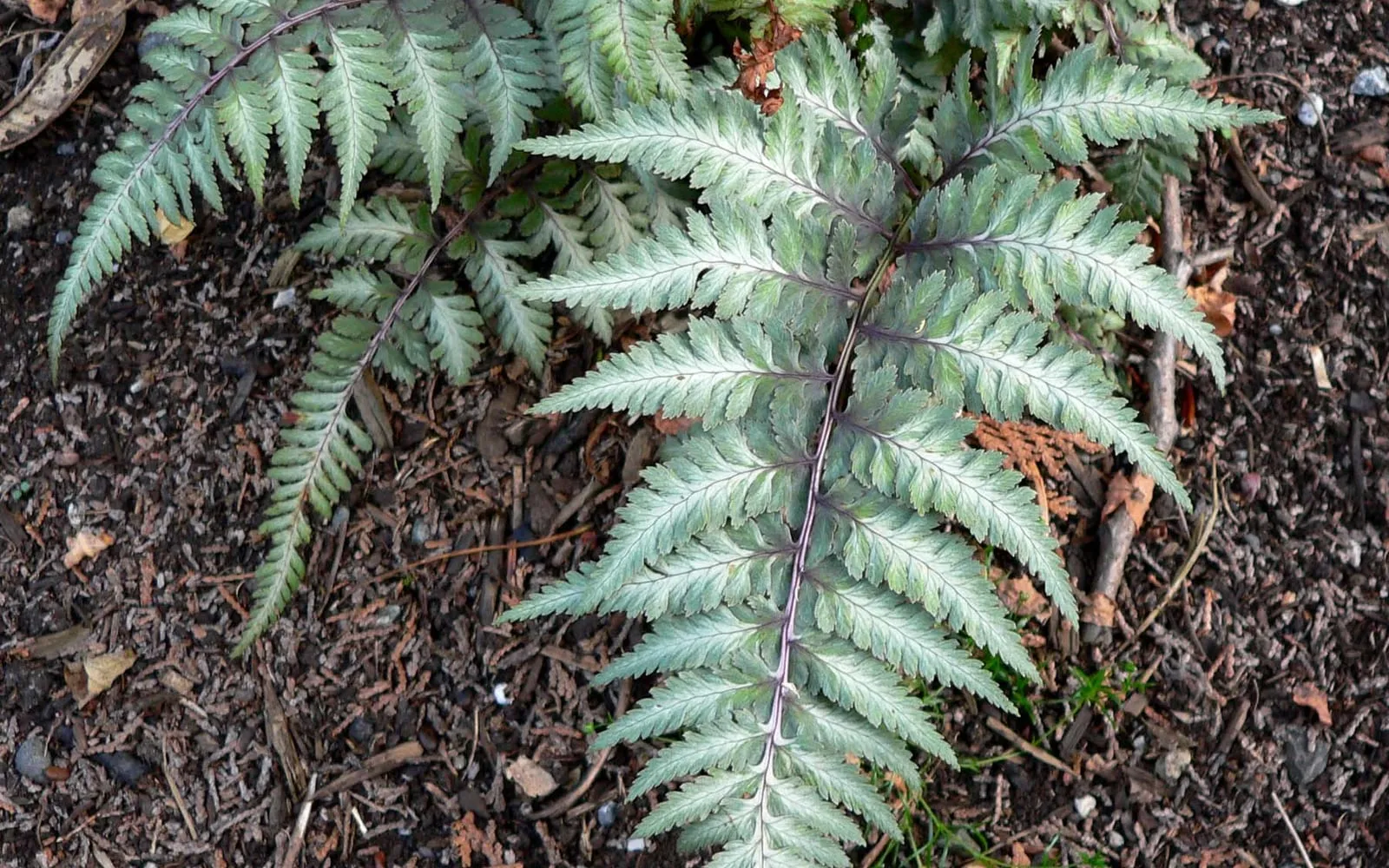
Most shade ferns are grown for form and texture, in greens that vary only slightly from one genus to the next. Japanese painted fern is grown for colour. Its fronds carry a metallic grey-silver wash over the outer part of each pinna, deepening toward the midrib into wine-red or burgundy, with the two shades bleeding into each other instead of sitting in a hard line. No other hardy fern sold in garden centres looks anything like it.
The named cultivar ‘Pictum’ is the plant almost everyone buys, and it won the Perennial Plant Association’s Perennial Plant of the Year award in 2004, an unusual award for a fern in a competition usually dominated by flowering perennials.
The colour is not fixed. A plant grown in deep shade stays closer to plain green with a faint grey cast; one given an hour or two of gentle morning sun develops the full silver and burgundy contrast. Too much sun bleaches the colour out and scorches the tissue, so the best light level is between deep shade and bright sun. It is worth testing a given spot by watching how the plant colours and whether the fronds scorch.
Appearance and character
A deciduous fern forming a slowly spreading clump 30 to 45 cm tall, wider than it is tall at maturity.
Fronds are triangular in outline, twice-divided, and arch outward from a short creeping rhizome instead of standing upright from a single crown. New growth unfurls a soft grey-green before the mature colouring develops over the following weeks.
The midrib and stalks of the fronds carry a deep maroon-red colour that persists all season and shows most clearly where the surrounding grey is palest.
Several selected forms extend the range further. ‘Burgundy Lace’ carries more red than silver through the whole frond, ‘Ghost’ is a hybrid with Athyrium filix-femina that grows taller and paler, and ‘Applecourt’ has more deeply cut, ruffled pinnae.
Like every true fern it reproduces by spores instead of flowers or seed, released from small brown sori on the underside of mature fronds in summer.
Where it is from
Temperate woodland in Japan, Korea, China and Taiwan, growing on shaded forest floor and among rocks at the base of slopes, often near streams.
That origin explains the two things the plant needs. It needs shade because canopy cover is constant in its native habitat and full sun there does not happen. It also needs steady soil moisture because forest floor litter holds water far more evenly than open garden ground does.
The species has been in Western cultivation since the nineteenth century, but it was slow to become common. Nurseries only began selecting and naming colour forms seriously from the 1980s onward, and it took the 2004 award to push it into mainstream garden centres.
It is not native to Britain or to North America, and it does not seed itself around aggressively where it is grown outside that range. Established clumps spread gradually by rhizome instead of by spore dispersal into open ground.
How it grows
Choose a shaded or partly shaded spot. Dappled shade under deciduous trees, the north side of a wall, or a woodland border all suit it. A little direct morning sun is fine and improves the colour; hot afternoon sun does not.
Improve the soil with leaf mould, garden compost or another form of organic matter before planting, since the natural habitat is a woodland floor rich in decayed leaf litter.
Water it in well after planting and keep the soil consistently moist through the first growing season while the roots establish.
Mulch every spring with garden compost or leaf mould. This feeds the plant lightly and holds moisture in the soil through summer, which matters more to this fern than any amount of liquid feed.
Divide an established clump in spring, just as new fiddleheads begin to show, by lifting the whole plant and cutting the rhizome into sections with roots and at least one growing point each. Replant immediately and keep the divisions damp until they establish.
Cut back the previous year’s dead fronds in late winter, before new growth starts, to tidy the clump and let the fresh fiddleheads through cleanly.
Through the seasons
Spring brings the new fiddleheads, grey-green at first and colouring up over several weeks. Divide the clump now if it needs it, and apply the season’s one dose of fertiliser or a fresh mulch layer.
Summer is when planting problems show up. Watch the soil in any dry spell and water deeply instead of little and often. A well-sited plant needs no more attention than this.
Autumn brings the fronds down gradually with the first hard frosts, turning tan and collapsing over the crown. Leave them in place over winter if you like the texture, or clear them for tidiness. Either is fine.
Winter the crown sits dormant below ground, fully hardy through temperatures that would kill many garden plants outright. No protection is needed in the open ground within its zone range.
Care difficulty
Easy, once it has the right spot, and getting that spot right is most of the work.
Shade with a little morning light gives the best colour and the least stress. Deep permanent shade is safe but produces a duller plant; strong afternoon sun scorches the fronds within a season, especially where the soil also dries out.
Consistent soil moisture is just as important. This is a woodland fern instead of a drought-tolerant one, and a dry summer without supplementary watering shows up quickly as browning and curled fronds.
Given shade and moisture, it needs little else. It does not need staking or routine spraying, and feeding should stay light.
Watering
Water new plants generously through their first year while the root system establishes, checking the soil every few days in dry weather.
Established clumps still want the soil kept reliably moist instead of allowed to dry out between waterings, particularly through summer.
A thick mulch does more for moisture retention here than frequent light watering does, since it slows evaporation from the soil surface between soakings.
Water at the base instead of over the foliage where practical, though overhead watering does no particular harm to this species the way it can to some silver-leaved plants.
A container-grown plant dries out faster than one in open ground and needs checking daily in hot weather.
Warning signs, diseases and pests
Bleached, brittle or brown patches on fronds exposed to direct sun mean too much light for the position. Move the plant to deeper shade or provide afternoon shading from a nearby shrub.
Curling, crisping fronds in summer mean the soil has dried out. Water deeply and mulch to prevent a repeat.
Ragged holes or entire fronds stripped overnight point to slugs and snails, which find the soft new growth attractive in spring. Torchlight checks after dark, beer traps, or a barrier of sharp grit around the crown all help.
Stunted growth with fronds that yellow and collapse for no obvious reason can mean vine weevil grubs feeding on the roots. Check the soil around the rootball; the C-shaped white grubs are the giveaway, and a biological nematode drench in late summer treats an active infestation.
Slow decline in heavy waterlogged soil suggests poor drainage instead of a pest. Improve drainage with grit and organic matter worked into the planting hole, or move the clump to a better-draining spot.
The plant is otherwise rarely troubled by disease for a garden perennial.
Growing environment
Partial to full shade, with a little gentle morning sun as the ideal rather than a requirement. Avoid any position with strong afternoon sun.
Cool to mild conditions suit it best. It tolerates cold well but does badly in extended heat above 30 deg C, especially where that heat coincides with dry soil.
Humus-rich soil that holds moisture without becoming waterlogged. Dig in leaf mould, garden compost or well-rotted manure before planting on poorer ground.
Shelter from strong wind helps, since the fronds are relatively soft and tear in exposed sites.
It combines well with hostas, heucheras and hardy geraniums in a shaded border, and the silver tones show up strongly against darker foliage planted nearby.
Container growing works well for a patio in shade, provided the pot is kept consistently watered and the compost is a moisture-retentive, peat-free mix.
Feeding
A single application of a balanced slow-release fertiliser in spring is usually enough for the whole season.
A yearly mulch of garden compost or leaf mould does more long-term good than repeated liquid feeding, since it improves the soil structure this species depends on as well as supplying nutrients gradually.
Avoid heavy or frequent feeding, which produces soft, floppy growth more prone to wind damage and slug attack than the naturally compact clump.
No feeding is needed over autumn and winter, when the plant is dormant or heading into dormancy.
Troubleshooting
The colour has faded to plain green. Too little light. Move the plant, or thin overhanging branches above it, to let in an hour or two of gentle morning sun.
The fronds have gone bleached and crisp at the edges. Too much direct sun, usually in the afternoon. Move the plant to deeper shade or provide shading from nearby planting.
Fronds are curling and browning in summer. The soil has dried out. Water deeply and add a mulch layer to hold moisture through future dry spells.
Something is eating the new growth. Slugs and snails, most active on soft young fiddleheads. Check after dark and remove them by hand, or use grit or wool pellets as a barrier.
Growth is stunted and fronds are collapsing without an obvious cause. Check for vine weevil grubs in the root zone. A nematode drench in late summer controls an active infestation.
Can it grow in full sun? Not reliably. Some morning sun improves the colour, but sustained direct sun through the afternoon scorches the fronds and fades the silver tones.
How do I make more plants? Divide the clump in spring as new growth starts, cutting the rhizome into sections that each carry roots and at least one growing point, and replant immediately into moist soil.