
Houseplant
Ox Tongue Plant
Gasteria bicolor
Also known as Cow tongue plant
How to grow the ox tongue plant as a houseplant. Its thick, tongue-shaped, white-spotted leaves, and why it tolerates lower light better than most succulents.
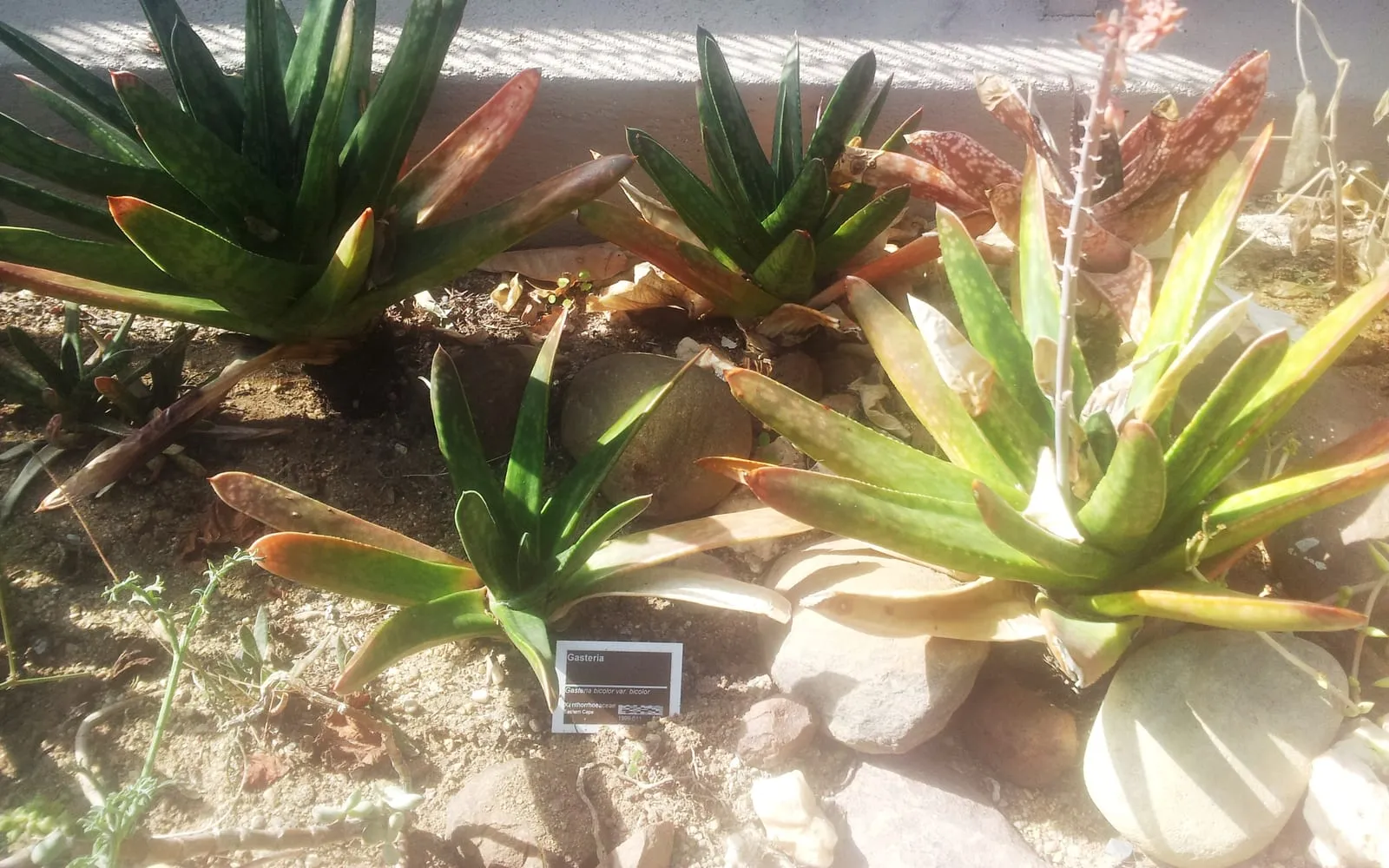
At a glance
- Difficulty
- Easy
- Water
- Water when the compost has dried out completely
- Light
- Bright indirect light; tolerates moderate shade better than most succulents
- Temperature
- 10-27 deg C, avoid below 5 deg C
- Hardiness
- USDA 9-11, RHS H1c, hardy to 5 C
- Type
- Evergreen perennial succulent
- Height
- 10-20 cm
- Native to
- South Africa
Tender to frost and grown as a houseplant across almost the entire temperate world. Unlike many succulents, it does not need harsh direct sun to thrive and tolerates a bright but shaded spot reasonably well, reflecting its origin in the dappled shelter of shrubs and rocks rather than fully open ground.
Hardiness zones describe winter cold alone. Summer heat, humidity, rainfall and the length of the growing season decide as much, so treat the range as the outer limit rather than as a recommendation.
Not known to be toxic
Ox tongue plant has no toxicity listing from the RHS or the ASPCA and is considered safe around pets and children. There is no documented history of poisoning associated with this species.
Source: RHS
About
The ox tongue plant takes its common name from its thick, rough-textured, tongue-shaped leaves, arranged in two opposite ranks rather than the spiralling rosette typical of many other succulents, and often marked with distinctive white or pale green spots and banding. It is one of the more shade-tolerant succulents commonly grown as a houseplant, making it a workable choice for a bright room that falls short of the intense, direct sun many other succulents demand.
Its low, architectural form and tolerance of less-than-perfect light have made it a long-standing favourite for a windowsill or shelf display, and its slow, undemanding growth means a well-chosen pot rarely needs changing for years at a time.
Appearance and character
Thick, firm, tongue-shaped leaves arise in two opposite ranks from a short central stem, giving young plants in particular a distinctly flattened, fan-like silhouette before maturing into a more rounded rosette shape. Leaf surfaces are rough to the touch and often patterned with pale green or white spots, bands or mottling, a decorative feature that varies widely between individual plants and named forms.
Tall, arching flower stalks rise well above the foliage, holding a loose spray of small, tubular, orange-pink flowers that dangle downward, a shape closely related to and resembling the flowers of the aloe genus, to which this plant is closely related.
Where it is from
Rocky outcrops and the dappled shelter of shrubs in South Africa, typically in partial shade rather than the fully open, intense sun many other South African succulents favour.
That habit of growing in the shelter of rocks and shrubs explains the plant’s comparative shade tolerance in cultivation, and it is one of the more reliable succulents for a bright but not south-facing window, where many other succulents would stretch and weaken.
How it grows
A slow-growing succulent that gradually produces offsets around the base of the main rosette, forming a small cluster over several years rather than growing quickly or spreading widely. Individual leaves are long-lived, and a mature plant changes little in general appearance from year to year beyond the slow addition of new leaves and occasional offsets.
Because offsets form readily at the base, this species is easy to propagate by division, separating a well-rooted offset from the parent plant and potting it separately, generally a more reliable method than leaf cuttings for this particular genus.
Through the seasons
Spring growth resumes gently as light levels increase.
Summer is the main growing period, with slow, steady leaf development. Water when the compost has dried out fully and feed once or twice through this period.
Autumn growth slows as light and temperature drop, and flower spikes may appear on a mature plant.
Winter water sparingly, allowing the compost to stay dry for longer between waterings.
Care difficulty
Easy. This is an unusually forgiving succulent, tolerating a wider range of light conditions than most, slow, undemanding growth, and few significant pest or disease problems, making it a reliable choice even for a grower without a bright, south-facing window.
Watering
Water only once the compost has dried out completely, soaking thoroughly and letting all excess drain away rather than leaving the pot standing in water. This species tolerates a slightly more relaxed watering schedule than some other succulents but still needs the compost to dry out fully between waterings to avoid rot.
Warning signs, diseases and pests
Mealybug can settle between the tightly packed leaves at the base of the rosette, and is treated with careful manual removal or a horticultural soap for persistent infestations. Root rot from overwatering is the more serious risk, showing as a soft, discoloured base or leaves that yellow and become mushy at their point of attachment to the stem.
Leaves that lose their distinctive spotting or banding and look uniformly pale can indicate too much direct, harsh sun rather than too little, since this species tolerates and often prefers somewhat gentler light than a full desert succulent; moving it out of the most intense midday sun can restore stronger, more typical markings.
Growing environment
Bright indirect light suits it well, and this species tolerates moderate shade better than most succulents, though it still benefits from some bright light to keep growth compact and markings distinct. Sharply free-draining succulent or cactus compost is essential, as with virtually all succulents.
Feeding
A low-nitrogen cactus or succulent fertiliser, applied once or twice during the growing season, supports slow, steady growth. This is not a heavy feeder, and established plants often do well with minimal supplemental feeding.
Troubleshooting
Leaf markings look pale and washed out. Check whether the plant is in unusually intense, direct sun, since this species often shows its best colour and pattern in bright but indirect light rather than harsh midday sun.
The base of the plant is soft with leaves turning mushy. Suspect root rot from overwatering. Cut back to healthy tissue, let it callus, and repot into fresh, sharply draining compost.
Small clusters are visible between the leaves near the base. Check for mealybug, and treat with careful manual removal or a horticultural soap.
You want to propagate new plants from an established rosette. Separate a well-rooted offset from the base of the parent plant and pot it separately in fresh, free-draining compost; this is generally more reliable for this species than propagating from individual leaf cuttings.
You are looking for a succulent to suit a north-facing or otherwise dimmer windowsill. This is one of the more realistic choices among common succulents for that spot, tolerating noticeably less direct sun than most of its relatives while still holding a reasonably compact, healthy shape rather than stretching badly, though it still benefits from being moved to a brighter position for at least part of the year if one becomes available, particularly through the darker winter months when indoor light levels drop overall and even a shade-tolerant plant can start to look noticeably thinner.
Ox Tongue Plant problem guides
Not sure what is wrong? See the common houseplant pests guide.