
Edible
Taro
Colocasia esculenta
Also known as Elephant ear, Dasheen, Eddoe, Kalo, Arbi, Cocoyam
How to grow taro, Colocasia esculenta. Why every part of it has to be cooked, how the same plant became the elephant ear in a garden centre, and the crop that fed the Pacific.
At a glance
- Difficulty
- Moderate
- Water
- Constantly. Taro is the one crop here that will not dry out
- Light
- Full sun to light shade
- Temperature
- 21-30 deg C, and growth stops below 15
- Humidity
- High
- Hardiness
- USDA 9-11, RHS H1b, hardy to 5 C
- Type
- Tender herbaceous perennial grown from corms
- Height
- 1-2 m
- Native to
- South East Asia, the eastern Himalaya
- Best month
- May in the Northern Hemisphere, November in the Southern Hemisphere
Standing water or permanently saturated soil is the requirement, and a wetland crop yields roughly twice what the same plant gives on dry ground. It needs 200 days or more above 21 deg C. Every part carries needle crystals of calcium oxalate, so nothing is eaten raw and long cooking is not optional.
Hardiness zones describe winter cold alone. Summer heat, humidity, rainfall and the length of the growing season decide as much, so treat the range as the outer limit rather than as a recommendation.
Every month named in this guide is for the temperate Northern Hemisphere. If you garden in the Southern Hemisphere, shift each one by six months, so May becomes November. Closer to the equator the wet and dry seasons matter more than the calendar, and the shift stops being a useful guide.
Toxic if eaten
- Safe to eat
- The corm, the leaves and the stalks, all only after thorough cooking
- Do not eat
- Every part when raw, because of calcium oxalate raphides
- Harm from
- Eating it and handling it
- Affects
- People, cats, dogs and horses
Raw taro is not food. Every part of the plant contains calcium oxalate in the form of raphides, microscopic needles bundled in specialised cells that fire on contact, and they produce immediate burning and swelling of the lips, mouth and throat. The mechanism is the same one behind dumb cane, peace lily and monstera, which are all in the same family, and taro differs from them by being edible once the raphides are destroyed. Thorough cooking does that. Boiling for at least twenty minutes, roasting, or the long steaming used across the Pacific all work, and undercooked taro leaves an itching in the throat that is the plant telling you it was not cooked enough. Handling raw corms and leaves causes itching on the hands, so peel them under water or wear gloves. The ASPCA lists Colocasia esculenta as toxic to cats, dogs and horses, and the RHS lists the genus as a skin and eye irritant that is harmful if eaten. If someone eats raw taro, rinse the mouth, give cold water or milk, and seek medical advice if swelling develops, since airway swelling is the serious outcome.
Sources: ASPCA entry for elephant ears, Colocasia esculenta, RHS potentially harmful garden plants, ASPCA toxic and non-toxic plants
About
Taro fed the Pacific. Polynesian voyagers carried corms in their canoes from South East Asia across thousands of miles of ocean, and the terraced irrigated pondfields they built for it in Hawaii, the loi kalo, are still farmed. In Hawaiian tradition kalo is the elder sibling of the human race.
The corm is a rough brown barrel with white, cream or purple-flecked flesh, sold as dasheen, eddoe or arbi. Cooked it is dry, floury and faintly nutty, and the purple-flecked kinds are the ones behind taro bubble tea and taro ice cream.
Every part of it is toxic raw. Calcium oxalate needles in the flesh and leaves burn the mouth and throat on contact, and the whole cuisine around taro is built on cooking them out. That is the same chemistry as the dumb cane and peace lily on a windowsill, which are close relatives.
Garden centres sell the same species as an ornamental elephant ear, sometimes in black-leaved cultivars, without mentioning that it is a staple food and without mentioning why nobody eats it raw.
Appearance and character
An upright herbaceous perennial forming a clump 1 to 2 m tall from a corm below ground.
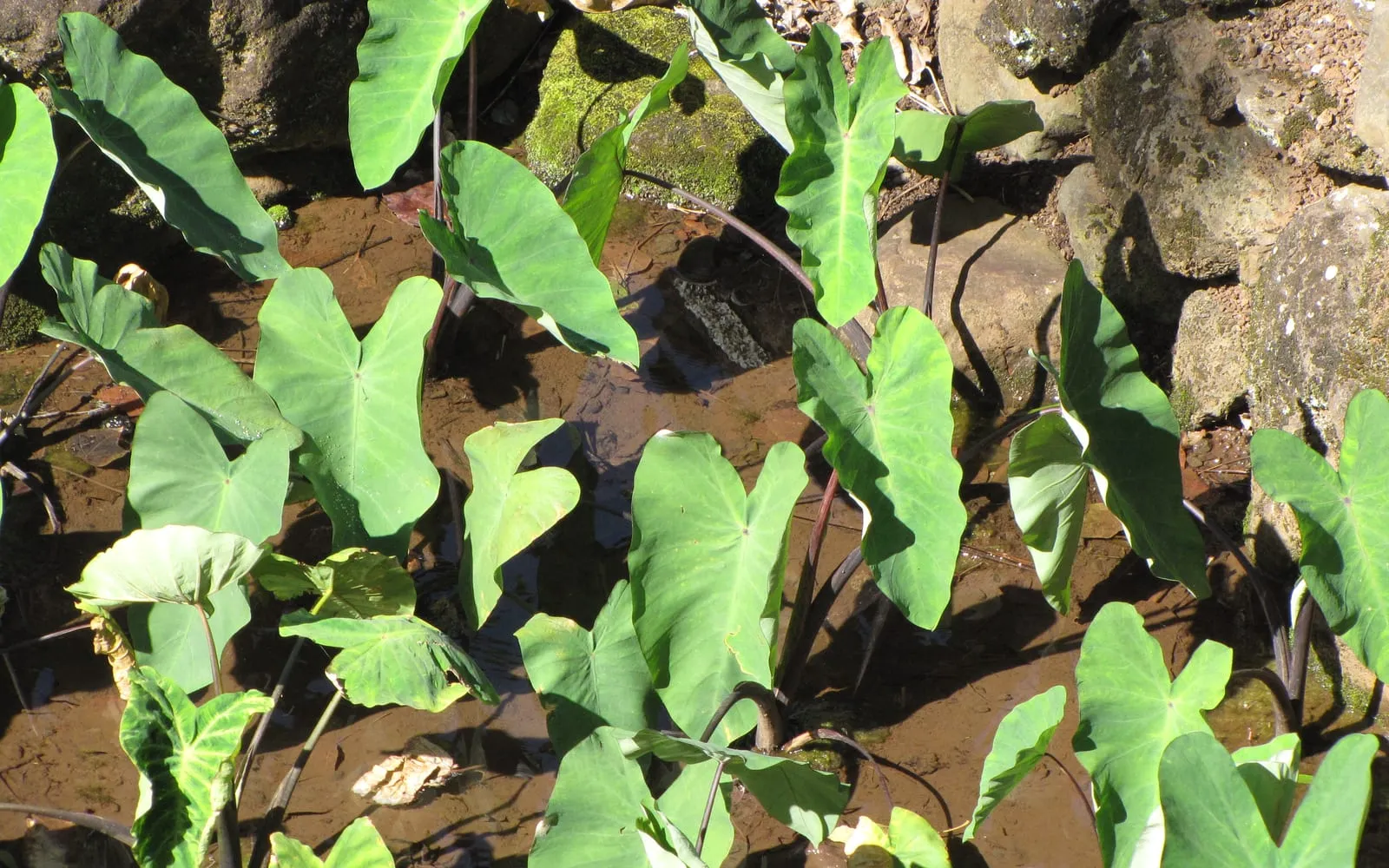
The leaves are the whole visual presence. Each is a broad heart or shield 30 to 60 cm long, held on a thick fleshy stalk that joins the blade some way in from the notch, which makes the leaf peltate.
Water beads and rolls off the leaf surface, since the waxy microstructure sheds it completely.
Leaf stalks are 60 cm to well over a metre, green, or flushed purple or almost black in the ornamental cultivars.
Flowers appear rarely in cultivation and are the typical aroid arrangement, a pale yellow spadix inside a yellowish green spathe.
The main corm is a rounded barrel 10 to 30 cm long with rough ringed brown skin, surrounded by smaller cormels. Dasheen types have one large corm; eddoe types have a small central corm and many usable cormels.
Cut flesh is white to cream, sometimes flecked with purple or pink, dry and firm.
Where it is from
Colocasia esculenta was domesticated in South East Asia and the eastern Himalaya, with wild populations from India through Myanmar into southern China and Indonesia.
It is among the oldest cultivated plants anywhere. Drainage ditches at Kuk Swamp in the highlands of Papua New Guinea, dated to around 7,000 BC, appear to be taro cultivation, which would make it one of the earliest crops in the world.
Austronesian voyagers carried it east across the Pacific and west to Madagascar, alongside yam, banana and breadfruit. Hawaii, Samoa, Fiji and Tonga all built food systems around it.
Africa took it up early through Egypt and the Arab trade, and it is now a staple in West and Central Africa under the name cocoyam, though the New World plant Xanthosoma shares that name and causes constant confusion.
Enslaved Africans and indentured Indian labourers carried it to the Caribbean, where dasheen and eddoe are everyday vegetables.
How it grows
Start from corms, which are sold in African, Caribbean and South Asian grocers. Choose a firm one with visible buds at the top.
Plant in May, 10 cm deep, in a large container or a greenhouse border, at 22 deg C or above.
Keep it wet. Taro is a wetland plant, and standing the pot in a tray or a bucket with 5 cm of water in it suits it better than any drainage regime.
Give it heat. Growth stops below 15 deg C and the plant sulks all summer if it is cold.
Full sun to light shade, and high humidity.
Feed fortnightly through the growing season.
Remove any flower that appears, which is rare and takes energy from the corm.
Expect six to nine months to a harvestable corm, so a crop in a cool climate means a May start and a November lift, with the plant held warm at the end.
Harvest when the leaves yellow and collapse. Lift the whole clump, cut the tops off, cure the corms for a few days somewhere warm and airy.
Store at 10 to 15 deg C, dry and dark, and keep a few cormels for next year.
Through the seasons
May is for planting corms in warmth, and for setting up whatever will keep the pot wet.
June brings the first leaves, which unfurl quickly once the plant starts.
July and August are the main leaf growth, and the plant is at its most impressive.
September is when the corm begins to bulk, well after the leaves have finished expanding.
October carries the bulking on, and the greenhouse heater has to stay on through it.
November brings yellowing collapse of the leaves, and harvest follows.
Winter is storage at 10 to 15 deg C, dry and dark, with a few cormels saved for spring.
Care difficulty
Moderate under glass and impossible outdoors in a cool climate except as a summer foliage plant.
Constant water is the requirement most gardeners find counter-intuitive, since this is the one plant here that likes wet feet.
Heat runs the whole show, and below 15 deg C the plant stops.
Six to nine months to a corm means starting in May and finishing in November.
Dry air browns the leaf edges and brings red spider mite.
As an ornamental it is easy and dramatic, which is how most temperate gardeners end up growing it.
Watering
Water constantly. Taro will not tolerate drying out at any point.
Stand the container in a tray, a bucket or a pond margin with several centimetres of water.
Use rainwater where the tap water is hard.
Keep humidity high, since dry air scorches the leaf edges.
Reduce watering only when the leaves start to yellow in autumn.
Keep stored corms dry, which is the one time the plant wants no moisture at all.
Warning signs, diseases and pests
Brown crisp leaf edges mean dry air rather than dry soil.
Fine stippling with webbing under the leaves is red spider mite, which arrives in dry glasshouse air and which taro suffers badly.
Yellow-brown water-soaked patches spreading fast across a leaf are taro leaf blight, the disease that destroyed Samoa’s crop in 1993.
Leaves that stop growing and pale in July mean the plant is too cold.
Sticky leaf stalks with black growth are aphids.
A corm that is soft at lifting was bruised or was left in cold wet soil after the leaves died.
Itching in the throat after eating means the taro was undercooked, and it needs longer next time.
Growing environment
A heated greenhouse, conservatory or a large container brought under cover.
Full sun to light shade.
Minimum 15 deg C, with 21 to 30 deg C for growth.
High humidity.
Rich heavy moisture-retentive soil, kept saturated or standing in water.
A large container, since the clump is substantial and the corm needs room.
A dry dark store at 10 to 15 deg C for the corms afterwards.
Feeding
Work rotted manure or rich compost into the planting medium.
Feed a balanced liquid feed fortnightly from the first leaf.
Keep nitrogen up through the leaf growth phase, which is unusual for a root crop and reflects how much leaf the plant makes.
Switch to a high-potash feed from September as the corm bulks.
Stop feeding as the leaves yellow.
Feed nothing to stored corms.
Troubleshooting
Can I eat it raw? No. Every part of the plant contains calcium oxalate needles that burn the mouth and throat. Boil for at least twenty minutes, roast, or steam it thoroughly.
My throat itched after eating it. It was undercooked. Cook it longer. Persistent burning or any swelling needs medical advice.
My hands itched after peeling. The same needles. Peel under running water or wear gloves.
Is this the elephant ear from the garden centre? Yes, the same species. The black-leaved ornamental cultivars are Colocasia esculenta as well, and the same warnings apply.
Can I eat the leaves? Yes, cooked thoroughly and for a long time. Callaloo in the Caribbean and laulau in Hawaii both use taro leaves, and they need more cooking than the corm rather than less.
What is the difference between dasheen and eddoe? Size and habit. Dasheen types make one large central corm; eddoe types make a small central corm and a cluster of smaller cormels around it. Both are the same species.
Why does water roll off the leaves? The leaf surface is covered in microscopic wax structures that stop water wetting it. Lotus does the same thing, and the effect is named after it.
How wet should I keep it? Wetter than feels right. Standing the pot in several centimetres of water suits it, and it is grown in flooded fields across Asia and the Pacific.
Is it safe to have around a cat or a dog? The ASPCA lists it as toxic to cats, dogs and horses. An animal chewing a leaf gets immediate burning and drooling. Keep it out of reach.
Can I grow it outdoors in a cool climate? As a summer foliage plant in a pot, yes. For a corm crop, no. It wants heat from May to November.