
Disease
Cassava mosaic disease
Cassava mosaic geminiviruses
Also called CMD
Leaves puckered and mottled yellow-green, roots stunted and yields cut by more than half, caused by whitefly-spread viruses found across Africa and South Asia. Cassava originated in the Americas and remains free of this disease there, one of the clearer examples on this site of a crop's homeland not being where its worst problem lives.
At a glance
- Type
- Disease
- Cause
- Virus
- Severity
- Destroys the crop or display
- Affects
- Herbs and edibles
- Active
- All year
- Established in
- Africa and Asia
What you are seeing
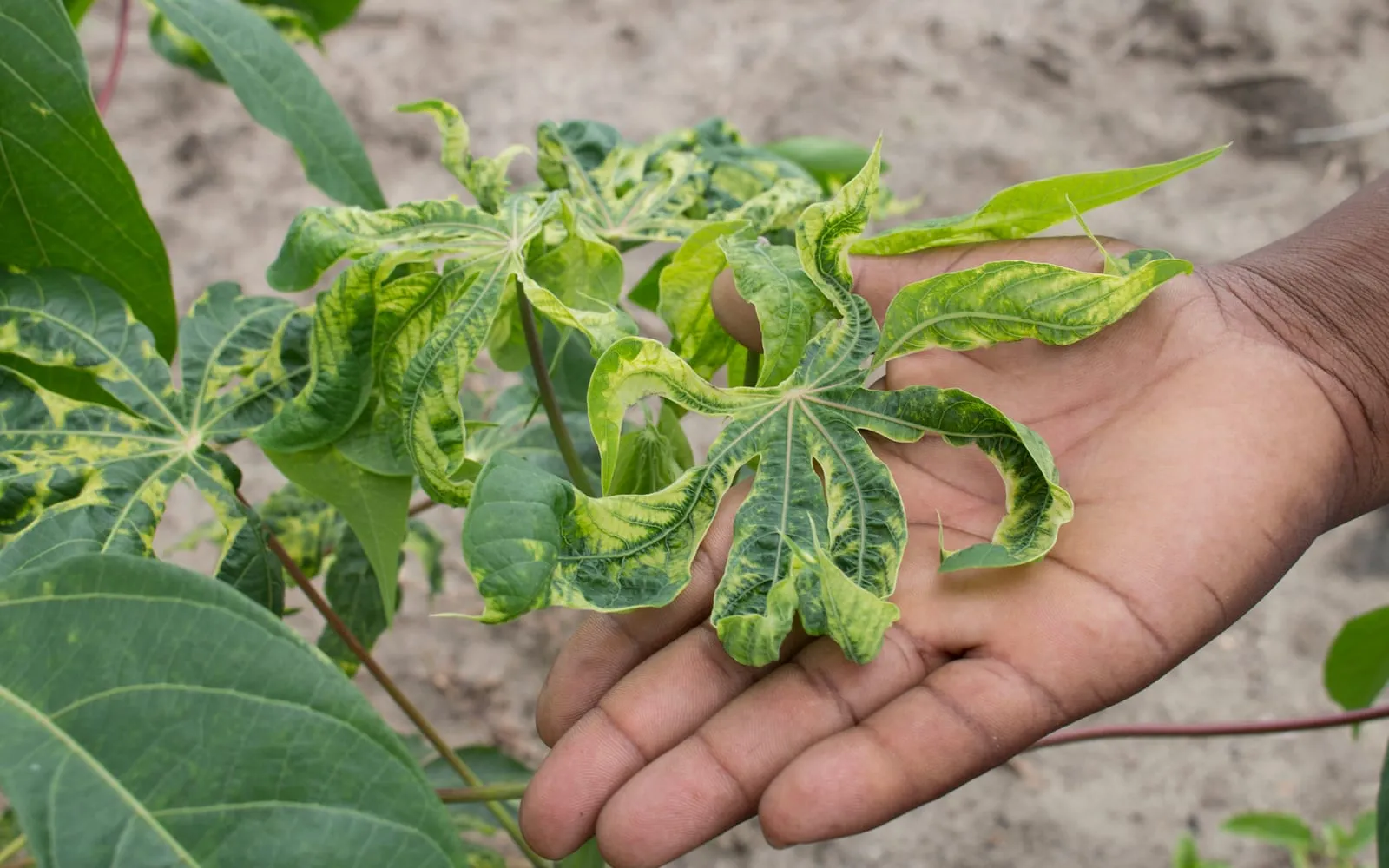
- Leaves puckered, distorted and mottled in a mosaic pattern of yellow-green and normal green
- Leaflets reduced in size and often twisted or curled, giving affected shoots a stunted, malformed look
- Whole plants stunted, with new growth emerging small and mottled from the first leaves
- Yield loss from infected planting material alone commonly exceeding half the crop, since the virus is carried in the cutting used to propagate the next generation
- Symptom severity varying with variety and with which of the several related viruses and their combinations are involved, from mild mottling to severe stunting
- Symptoms present from early growth where infected cuttings were used, rather than developing partway through the season
Before you treat anything
None. This disease affects yield rather than the safety of the harvested root.
What you are looking at
Leaves puckered, twisted and mottled in a patchwork of yellow-green against normal green, on leaflets that are often reduced in size and distorted in shape. New growth from an infected plant emerges small and mottled from the start rather than developing symptoms partway through the season, because the virus most commonly arrives already present in the stem cutting used to plant the crop. Whole plants are visibly stunted, and yield loss from a planting grown entirely from infected cuttings commonly exceeds half the crop.
A crop that outran its worst disease by crossing an ocean
Cassava originated in South America, and one of the more striking facts about its global cultivation is that the disease responsible for the biggest yield losses to the crop worldwide has never established in the hemisphere the plant comes from. At least eleven related geminiviruses cause this disease, seven described from Africa and further species from India and Sri Lanka, all spread by the whitefly Bemisia tabaci and through infected cuttings. Despite cassava being grown at enormous scale across Latin America and much of Southeast Asia, research points to the local whitefly populations in those regions being unable to colonise cassava effectively, unlike the African and South Asian populations that transmit the disease so efficiently.
That freedom is a fact of current distribution rather than a guarantee. A related strain reached Cambodia in the mid-2010s, showing the disease can still extend its range, and Latin American producers treat a suspected finding as a serious biosecurity emergency given how much of the region’s food security rests on a crop that has, so far, escaped this particular problem.
What to do about it
Plant only virus-free, certified cuttings, since an infected parent plant passes the virus directly into everything propagated from it.
Rogue and destroy infected plants as soon as they are identified, rather than leaving them as a source of further spread.
Grow resistant or tolerant varieties bred for the local region where the disease is present.
Space new plantings away from known infected fields where practical, since whiteflies move readily between neighbouring crops.
Report a suspected case anywhere in the Americas, Australia or New Zealand immediately rather than treating it as an ordinary nutrient problem.
What it gets mistaken for
Nutrient deficiencies usually cause more uniform yellowing following a predictable pattern relative to the leaf veins and the plant’s age. This disease’s mottled, puckered pattern combined with distorted leaflets and stunting present from the earliest growth is more specific and does not respond to feeding.
Not established in Central and South America, Australia and New Zealand
Do not prune, spray or otherwise treat a suspected case. Doing so risks spreading an organism the country has kept out, and it disturbs the evidence needed to identify it. Photograph what you can see, leave the plant alone, and contact your national or state plant health authority. The control advice further down this page is written for regions where this problem is already established.
Cassava mosaic disease is caused by a group of at least eleven related geminiviruses, seven described from Africa and further species from India and Sri Lanka, all spread by the whitefly Bemisia tabaci and through infected planting cuttings. Despite cassava being cultivated at huge scale across Latin America and much of Southeast Asia, the disease has never established in the Americas, where the crop originated, and research points to the local whitefly population there being unable to colonise cassava effectively, unlike the African and Asian populations that transmit it so efficiently. A related strain reached Cambodia in the mid-2010s, a reminder that the crop's long-standing freedom from this disease outside Africa and South Asia is a fact of current distribution rather than a fixed rule, and Latin American producers treat a suspected finding as a serious biosecurity emergency for exactly that reason.
What to do, in order
The steps below apply where this problem is already established.
Nothing available to a gardener will cure this once a plant has it. The steps below are about limiting the spread and deciding what to plant in its place.
Start here
Prevention, and the changes that stop the problem returning. Most of these pages should end at this tier.
- Plant only virus-free, certified cassava cuttings
- Because cassava is propagated from stem cuttings rather than seed, an infected parent plant passes the virus directly into every cutting taken from it. Sourcing planting material from a certified, tested clean stock programme rather than saving cuttings from an unknown or previously affected planting is the single most important step available to a grower.
- Rogue and destroy infected plants early
- Removing visibly infected plants as soon as they are identified, rather than leaving them as a source of both further whitefly transmission and potential cutting material, reduces the disease pressure on the rest of a planting and on neighbouring fields.
- Grow resistant or tolerant varieties where available
- Breeding programmes, particularly across East and Southern Africa, have produced cassava varieties with useful field resistance, and planting these where the disease is present substantially reduces both symptom severity and yield loss compared with susceptible local varieties.
Then reach for a barrier
Netting, hand removal and water. Nothing here harms anything except the target.
- Space and isolate new plantings from known infected fields
- Whiteflies move between neighbouring fields, and a new planting started near a heavily infected one is exposed to far more virus-carrying insects early in its growth, when infection does the most damage. Physical distance and, where practical, a barrier crop between fields reduces this exposure.
Then bring in the predators
Encourage what already lives in the garden, and buy predators in where the problem is under glass and nothing will arrive on its own.
- Manage whitefly populations as part of an integrated programme
- Reducing whitefly numbers on a planting lowers the rate of new infection, though insecticide-based control is often uneconomic for the smallholder farmers who grow most of the world's cassava, which is why resistant varieties and clean planting material carry more of the practical weight in most affected regions.
Biological controls are live organisms and their sale and release are regulated country by country. An agent sold freely in one place may be unapproved in another, so buy from a licensed supplier where you live and never import or move one yourself.
Plants affected
Guides that name it among the problems to watch for. The list is the plants it is characteristic of rather than everything it will feed on.