
Edible
Black Cardamom
Amomum subulatum
Also known as Nepal cardamom, Greater cardamom, Badi elaichi
How to grow black cardamom, Amomum subulatum. The smoke-dried Himalayan pod, why it is not a substitute for green cardamom, and growing it under glass.
At a glance
- Difficulty
- Difficult
- Water
- Two or three times a week in summer, weekly in winter
- Light
- Dappled shade
- Temperature
- Hardier than green cardamom, and still damaged below 5 deg C
- Humidity
- High
- Hardiness
- USDA 9-11, RHS H1c, hardy to 5 C
- Type
- Tender evergreen perennial
- Height
- 100-200 cm
- Native to
- the eastern Himalaya
- Best month
- June and August in the Northern Hemisphere, December and February in the Southern Hemisphere
The eastern Himalayan foothills at 800 to 2,000 m, so it takes cooler conditions than true cardamom and a light chill. The capsules are dried over fire, which is where the smoky flavour comes from rather than from the plant.
Hardiness zones describe winter cold alone. Summer heat, humidity, rainfall and the length of the growing season decide as much, so treat the range as the outer limit rather than as a recommendation.
Every month named in this guide is for the temperate Northern Hemisphere. If you garden in the Southern Hemisphere, shift each one by six months, so June becomes December. Closer to the equator the wet and dry seasons matter more than the calendar, and the shift stops being a useful guide.
Not known to be toxic
- Safe to eat
- The pods and seeds
Non-toxic. Black cardamom is a culinary spice used across south Asia and it appears on neither the RHS list of potentially harmful garden plants nor the ASPCA list. The pods are used whole in cooking and removed before serving, since the husk is fibrous rather than harmful. The smoky flavour comes from the drying process over a fire rather than from anything in the plant. As with any spice, the concentrated essential oil is a separate product from the pod.
Sources: RHS potentially harmful garden plants, ASPCA toxic and non-toxic plants
About
Black cardamom is not a large green cardamom, and the two are used differently. It comes from a different genus, the pods are three or four times the size, and the flavour is smoky, resinous and camphorous rather than sweet and floral. It goes into savoury cooking, into biryani and dal and slow-cooked meat, and it will ruin a dessert that wanted the green one.
The smoke is not in the plant. Pods are dried over an open fire in the Himalayan foothills, and that process is what gives the spice its character. Kiln-dried pods sold as black cardamom taste noticeably different.
Growing it outside the tropics is a conservatory project with limited prospects of fruit. The plant is hardier than green cardamom and still tender, and it wants shade, humidity and warmth.
Appearance and character
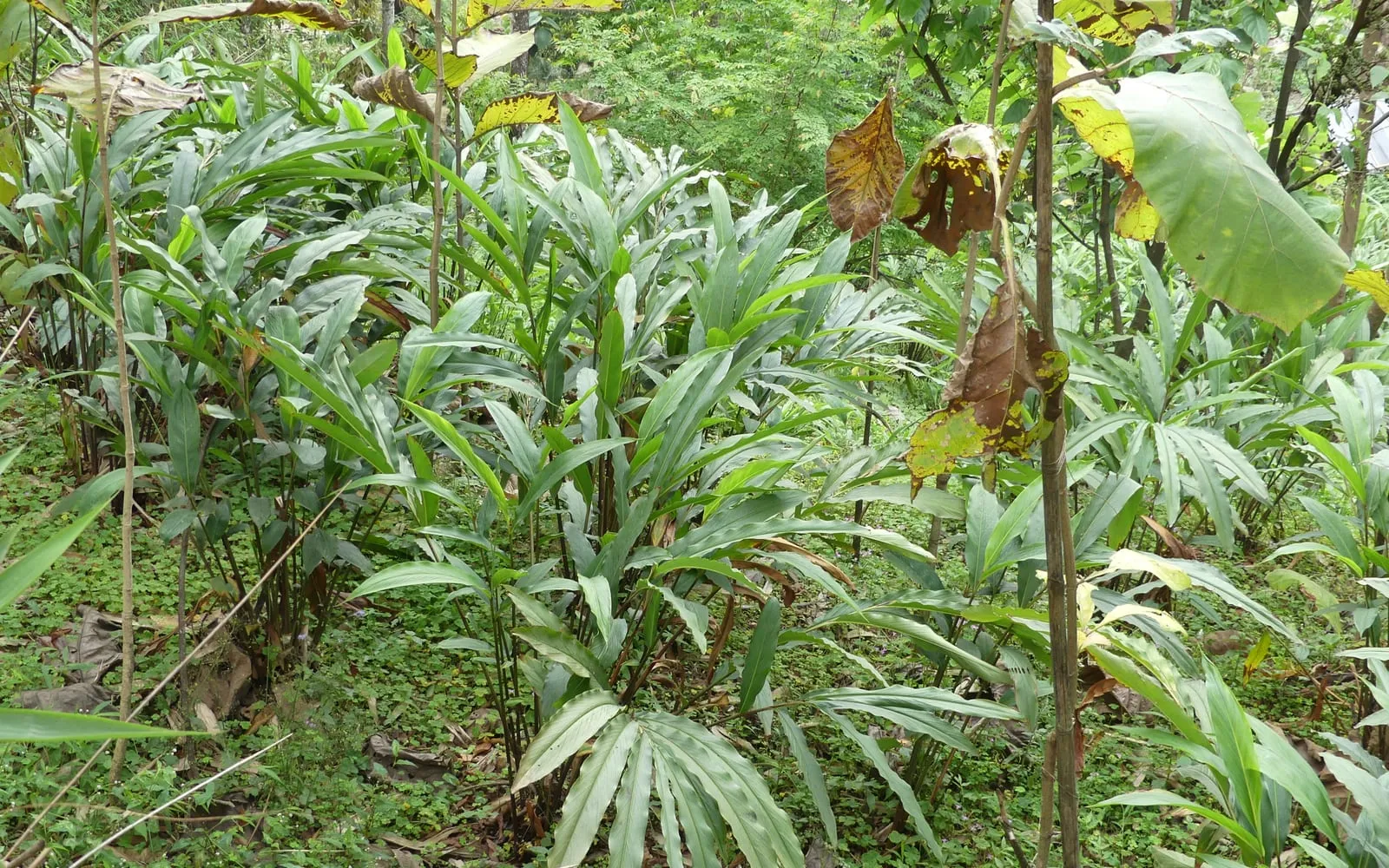
Leafy shoots rising from a creeping rhizome, 1 to 2 m tall, forming a spreading clump.
Leaves are long and lance-shaped, 30 to 60 cm, dark green and smooth, arranged alternately in two ranks up the shoot.
Flower spikes emerge from the base of the plant at ground level, dense and cone-like, with yellow flowers pushing out between overlapping bracts.
Pods are large for a cardamom, 2 to 3 cm long, dark brown, deeply ridged and rough, holding a mass of sticky black seeds.
The scent of the dried pod is smoky and camphorous, and the fresh pod is much milder. The smoke comes from the fire drying.
The plant looks like a smaller, coarser version of green cardamom and is easily mistaken for it before it flowers.
Where it is from
Black cardamom is native to the eastern Himalaya, in Sikkim, Nepal, Bhutan and the hills of north-east India, growing in the shade of forest at 800 to 2,000 metres.
Sikkim is the historic centre of production and still supplies a large share of the crop, with Nepal now the largest producer overall.
It is grown in the shade of alder trees, which fix nitrogen and provide the canopy the plant needs, and the system is an old and stable one.
Drying is done over open wood fires in traditional kilns called bhattis, and the smoke is absorbed into the pods. That step defines the spice.
Its use is entirely savoury in south Asia. It goes into garam masala, biryani, dal, and long-cooked meat dishes, and it is one of the spices in Chinese five-spice in some formulations.
How it grows
Buy a plant or divide a rhizome in spring. Seed is available occasionally and is slow, needing warmth and fresh seed.
Pot into rich humus-rich compost that holds moisture, in a wide pot to accommodate the spreading rhizome.
Grow it under glass in shade. A conservatory or greenhouse with shading suits it, and direct sun scorches the leaves.
Keep it above 10 deg C. It is hardier than green cardamom and it still will not take frost.
Keep the humidity high.
Water regularly in summer and less in winter.
Feed fortnightly through the growing season.
Divide every second or third spring, which is the practical way to increase it.
Flowering needs a mature well-grown clump and rarely happens in a pot. If it does, hand pollinate.
Through the seasons
Winter is survival under glass above 10 deg C, watered weekly and kept humid.
Spring brings new shoots from the rhizome. Divide, repot and start feeding.
Early summer is rapid growth, and the time flower spikes appear at the base on a mature clump.
Midsummer is when pods would develop.
Late summer is when they would ripen.
Autumn is when to reduce watering and stop feeding.
Care difficulty
Difficult, in the same way as green cardamom and with slightly more tolerance of cold.
Warmth is the requirement. Minimum 10 deg C and preferably above 18 deg C for growth.
Humidity matters as much. Dry heated air browns the leaves and brings spider mite.
Shade rather than sun, which reflects its forest understorey origin.
A wide pot and regular division keep the clump vigorous, and a cramped plant stays small.
Flowering outside the tropics is unlikely. The plant is worth growing as a large architectural foliage subject, and anyone hoping for pods should be realistic.
Watering
Water two or three times a week in summer, keeping the compost evenly damp.
Water weekly in winter, without letting it dry out.
Never let it stand in water, since the rhizome rots in cold wet compost.
Use tepid water in winter and rainwater in a hard water area.
Raise the humidity with misting, damp gravel and grouped planting.
Reduce watering from October.
Warning signs, diseases and pests
Brown leaf edges mean dry air.
Yellowing and slow decline usually mean cold.
Spider mite produces fine stippling and webbing in dry heated conditions.
Mealybug sits at the shoot bases as white waxy fluff.
Scale insects appear on the leaves as brown limpets with sticky honeydew.
Soft rot at the rhizome is root rot from cold wet compost.
No flowers in a pot is the usual outcome rather than a fault.
Growing environment
A greenhouse or conservatory with shading. No outdoor option outside the tropics.
Minimum 10 deg C and preferably above 18 deg C.
High humidity year round.
Dappled shade rather than direct sun.
Rich, humus-rich, moisture-retentive compost in a wide pot.
pH from 5.5 to 6.5.
Room to spread. The rhizome runs sideways and a restricted plant stays small.
Feeding
Feed a balanced liquid feed fortnightly from May to August.
Reasonable nitrogen suits it while it is building shoots.
Stop feeding from September and give nothing through winter.
Repot and divide every second or third spring rather than feeding an exhausted pot.
Leaf mould or composted bark in the compost suits a forest plant.
Troubleshooting
Can I use it instead of green cardamom? No. They are different genera with completely different flavours. Green cardamom is sweet and floral and goes into desserts and chai. Black cardamom is smoky and resinous and belongs in savoury cooking.
Why does it taste smoky? Because the pods are dried over open wood fires in the Himalayan foothills. The smoke is absorbed during drying rather than produced by the plant.
Should I use the whole pod? Usually yes. Bruise it and add it whole to the dish, then remove it before serving. Some recipes call for the seeds alone.
It has never flowered. Normal in a pot. It needs a mature clump, consistent warmth, humidity and room for the rhizome.
The leaves went brown at the edges. Dry air. Raise the humidity.
Is it hardy? No, though it is hardier than green cardamom. It suffers below about 5 deg C and dies below 3 deg C.
How do I increase it? Divide the rhizome in spring. That is how most plants change hands.