
Houseplant
Furry Feather
Goeppertia rufibarba
Also known as Velvet Calathea, Calathea rufibarba
How to grow Goeppertia rufibarba, the furry feather calathea. Its wavy leaves with fuzzy purple undersides, and how to stop the edges browning.
At a glance
- Difficulty
- Easy
- Water
- Keep evenly moist; do not let it dry out or sit soggy
- Light
- Bright indirect light to light shade
- Temperature
- Warm, 18 to 27 deg C; keep above 15 deg C
- Humidity
- High, above 60 per cent
- Hardiness
- USDA 10-12, RHS H1b, hardy to 15 C
- Type
- Evergreen rhizomatous perennial
- Height
- 40 to 80 cm
- Native to
- Brazil
A tender Brazilian foliage plant from the humid, shaded forest floor, grown indoors. It has no frost tolerance and needs steady warmth above about 15 deg C, high humidity, and shelter from cold draughts. Dry air and cold both make it decline, and it is more sensitive than most houseplants to the minerals in tap water.
Hardiness zones describe winter cold alone. Summer heat, humidity, rainfall and the length of the growing season decide as much, so treat the range as the outer limit rather than as a recommendation.
Not known to be toxic
Calatheas, now placed in the genus Goeppertia, are not listed as toxic by the ASPCA, which records them as safe for cats and dogs, and no harmful compound is recorded in people. It is one of the safer choices for a home with pets or children, and a chewed leaf would cause no more than the mild upset any foliage might. It is grown entirely for its leaves and poses no poisoning hazard.
Sources: ASPCA toxic and non-toxic plants, RHS potentially harmful garden plants
About
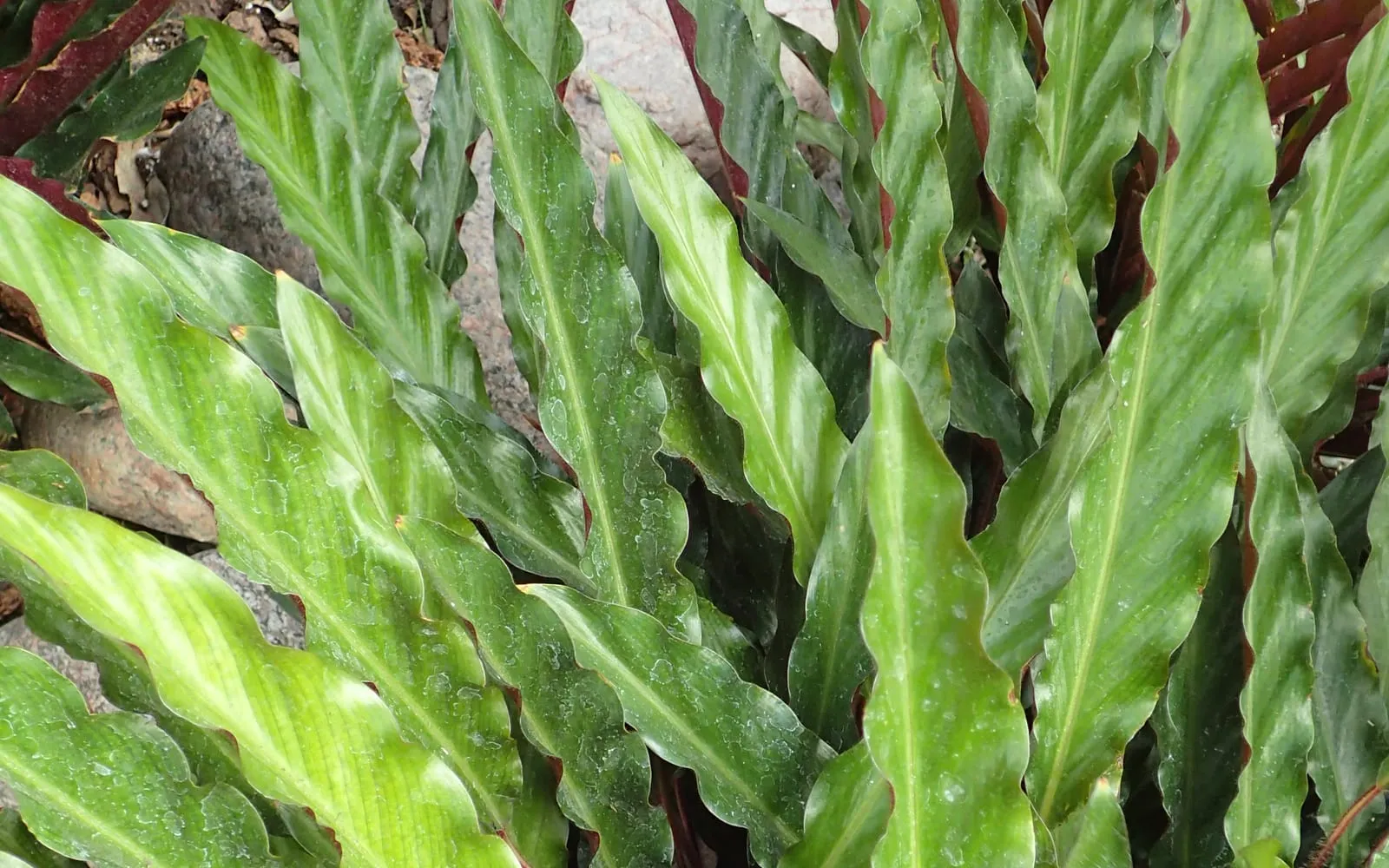
Furry feather calathea is grown for long, wavy-edged leaves that are glossy green above and a rich purple-red beneath, and for the soft fuzz that covers the leaf undersides and stalks. Run a finger along a leaf stem and it feels like velvet, which is where the names furry feather and velvet calathea come from.
It belongs to the prayer plant family and shares that group’s habit of folding its leaves upward at night and lowering them by day. It is a close relative of the true prayer plant and is grown the same way.
It has a reputation for being fussy because of two points. It needs high humidity, and it dislikes the minerals in hard tap water, which brown its leaf edges. Meet those two needs and it is otherwise straightforward.
Appearance and character
Leaves are long and narrow with distinctly wavy margins, glossy mid to dark green on top and flushed deep purple-red underneath, carried upright on slender stalks. The undersides and stalks are covered in a fine, soft fuzz.
The plant is upright and clump-forming, reaching forty to eighty centimetres, taller than most calatheas kept indoors. It spreads by a short, creeping rhizome just under the surface, which produces fresh leaf stalks around the edge of the clump and lets you split it in spring.
At night the leaves fold and rise, showing their purple undersides, and by day they open and lower again, the daily movement that the prayer plant family is known for.
Flowers are small and yellow, held in a short spike, and are incidental. The plant is grown for its leaves.
Where it is from
Goeppertia rufibarba comes from Brazil, from the warm, humid, shaded floor of tropical forest, where the light is filtered, the air is moist and the temperature stays warm and even. It is a plant of constant humidity and gentle light.
It needs warmth, high humidity, filtered light and steady moisture, matching that forest floor, and it is not adapted to cold, drying out or the dissolved minerals in hard tap water, all of which show up as browned or curling leaves.
How it grows
It grows steadily in warmth and humidity, unfurling new leaves from the centre of the clump, and slows in the lower light of winter. Given warm, humid, stable conditions it grows through much of the year.
Pot it in a moist but free-draining, peat-free houseplant mix, and keep the compost evenly moist, never bone dry and never waterlogged. Water with rainwater, filtered or distilled water, since the plant is sensitive to the fluoride and salts in hard tap water.
Keep it warm, humid and out of cold draughts, in bright indirect light or light shade. Direct sun scorches the leaves and fades their colour, while deep shade slows it.
Divide the rhizome in spring to make more plants or to refresh a congested clump, and remove any browned leaves at the base to keep it looking fresh.
Through the seasons
Spring starts renewed growth as light increases, and a strong plant produces several new leaves in quick succession. Divide a congested rhizome now, move it up a pot size, and start feeding again.
Summer is the main growth period, unfurling one long wavy leaf after another in the warmth. Keep it evenly moist and humid and watch for spider mites in dry spells.
Autumn growth slows as light falls. Ease off feeding and keep the humidity up as heating dries the air.
Winter is a slower period in lower light. Keep it warm, humid and evenly moist, and take care not to let it sit cold and wet.
Care difficulty
Easy once its two demands are met, and frustrating when they are not. Given warmth, high humidity, filtered light and clean water it grows well and holds its colour. Most problems trace to dry air, cold, or hard water, which brown and curl the leaves. Grow it somewhere humid and water it with rainwater or filtered water and it is much easier.
Watering
Keep the compost evenly moist through the year, watering when the top centimetre begins to dry but well before the pot goes dry. The long, wavy leaves warn you early when it has run short, curling inward along their length while the velvet stalks droop, and a plant left dry too often sheds its lower leaves. Ease off only slightly in winter, since even in low light it never wants to go bone dry.
Use rainwater, filtered or distilled water instead of hard tap water, since the plant is sensitive to fluoride and dissolved salts, which show as brown leaf edges. Empty any saucer after watering.
Warning signs, diseases and pests
Brown, crisp leaf edges are the most common complaint and usually mean dry air or mineral-heavy tap water, sometimes both. Raise the humidity, switch to rainwater or filtered water, and keep the compost evenly moist.
Spider mites thrive in warm, dry air and stipple the leaves pale with fine webbing. Raise the humidity, wipe the leaves, and treat early, since dry air encourages them quickly in this plant.
Curling or folded leaves that do not relax by day usually mean the plant is too dry, too cold, or both. Check the compost and the temperature and correct them.
Growing environment
Bright, indirect light or light shade suits it, matching the filtered light of the forest floor. Direct sun scorches and fades the leaves, and deep shade thins the plant and dulls its colour.
Humidity is as important as light. Keep it above about 60 per cent if you can, with a humidifier, a pebble tray or a group of plants, and away from radiators and cold draughts that dry or chill the air. A warm, humid bathroom often suits it well.
Give it a moist, free-draining, peat-free mix and warmth above about 15 deg C, and water it with clean water. Those conditions matter more than anything else.
Feeding
Feed monthly through spring and summer with a balanced liquid houseplant feed at half strength. Furry feather grows taller and faster than most calatheas, so it makes use of feeding, but the fine roots still scorch if fertiliser salts collect in the compost and add to the leaf-edge browning the plant is already prone to.
Stop feeding in autumn and winter while growth slows. Flush the pot with clean rainwater every month or two to wash out the salts, which counts for more here because the same minerals that brown the leaf edges come partly from feed left in the mix. Fresh compost supplies enough for the first six weeks or so after repotting.
Troubleshooting
The leaf edges are brown and crisp. Dry air or hard water, or both. Raise the humidity, water with rainwater or filtered water instead of hard tap water, and keep the compost evenly moist. This is the plant’s most common complaint.
The leaves are curling and not opening. Usually too dry or too cold. Check the compost is evenly moist and the room is warm enough, above about 15 deg C, and keep it out of cold draughts.
The colours are fading. Too much light, often direct sun. Move it to bright but indirect light, which keeps the green rich and the purple undersides deep.
Is it safe around pets and children? Yes. Goeppertia species carry no toxin the ASPCA records as harmful to cats or dogs, and none is known in people. The soft fuzz on the undersides sometimes tempts a cat to bat or chew a leaf, but the worst that follows is the mild stomach upset any foliage might cause, as with the true prayer plant.
The leaves are stippled with fine webbing. Spider mites in dry air. Raise the humidity, wipe the leaves top and bottom, and treat early before they spread.
Furry Feather problem guides
Not sure what is wrong? See the common houseplant pests guide.