
Outdoor plant
Texas Coastal Plain Cyclanthera
Cyclanthera dissecta
Also known as Cutleaf Cyclanthera, Wild Cucumber
What cutleaf cyclanthera is, Cyclanthera dissecta, a slender wild climber with finely divided leaves, small exploding fruits and an edible Andean relative.
At a glance
- Difficulty
- Easy
- Water
- Keep the soil moist in dry spells
- Light
- Full sun to light shade
- Temperature
- Frost-tender warm-season annual
- Hardiness
- USDA 8-11, RHS H2, hardy to 2 C
- Type
- Slender annual climber
- Height
- 2 to 4 m of annual growth
- Native to
- The southern United States, Mexico
A warm-climate annual that completes its life in a single growing season and dies at the first frost, surviving from year to year only by seed. It needs a warm summer to grow and fruit, and reseeds itself where the season is long enough. In cooler regions it lasts one summer and is gone, leaving seed behind if the autumn is mild.
Hardiness zones describe winter cold alone. Summer heat, humidity, rainfall and the length of the growing season decide as much, so treat the range as the outer limit rather than as a recommendation.
Not known to be toxic
No poisoning is documented for cutleaf cyclanthera, and its close relative the achocha, Cyclanthera pedata, is a cultivated vegetable eaten across the Andes, so the group as a whole is not a poisonous one. The small fruits of this wild species are not a recognised food and are best left alone rather than eaten, since tender members of the cucumber family can carry bitter cucurbitacins. It poses no hazard to handle or grow.
Sources: RHS potentially harmful garden plants, North Carolina Extension plant toxicity database
About
Cutleaf cyclanthera is a slight, wiry annual climber of the cucumber family, wild across the southern United States and Mexico. It is grown by almost nobody, and this guide explains what it is if you meet it scrambling through rough ground or a hedge in its native range.
Its leaves give it its name, being cut into fine, narrow segments instead of held as a single blade. The whole plant is delicate, with thin stems and small leaves, quite unlike the heavy sprawling vines of the wild gourds.
It belongs to the same genus as achocha, Cyclanthera pedata, a climbing vegetable grown in the Andes for its edible young fruits, so this wild relative is close to a genuine crop even though it is not eaten itself.
Appearance and character
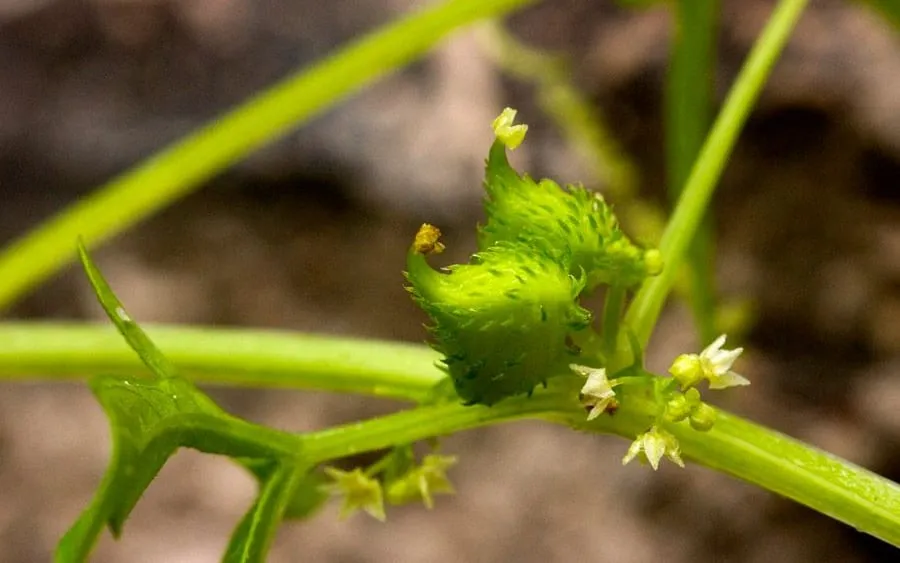
Leaves are deeply divided into several slim, toothed lobes, giving a lacy, cut-apart look that the epithet dissecta describes. They are thin and mid-green, carried along slender stems.
Tendrils grow beside the leaves and coil around any support, letting the light stems climb through other vegetation to a few metres in a good summer.
Flowers are small, greenish white and inconspicuous, with separate male and female flowers on the same plant, opening through the warm months.
Fruits are small, ribbed or slightly spiny pods, only a centimetre or two long, that dry and split open with a flick to fling their few seeds a short distance. This explosive scattering is a trait shared across the genus.
The whole plant is annual, rising from seed each year and dying with the first frost, leaving next year’s plants to come from the seed it has scattered.
Where it is from
Cyclanthera dissecta grows wild in the southern United States, including the Texas coastal plain that gives it one of its names, and south into Mexico. It grows in scrub, thickets, fencerows and disturbed ground in warm country.
It behaves as a warm-season annual there, springing up from seed with the summer rains, climbing through whatever is at hand, fruiting, and dying back as the season ends. It depends on a long, warm growing period and on self-sown seed to return the following year.
How it grows
Seed germinates in the warmth of late spring or early summer, and the seedling climbs quickly on its tendrils through the hot months, flowering and setting its small exploding fruits as it goes. Growth is fast but light.
The first frost kills the plant, ending its single season. Where the autumn stays mild long enough for the fruits to ripen and scatter, seed carries the plant into the following year; where frost comes early, it may not persist.
It is not cultivated as a crop or ornamental, though as a fast, harmless annual climber it does no damage and can be left where it appears. Its edible cousin achocha is the member of the genus grown in gardens.
Through the seasons
Late spring to early summer brings germination and the first climbing growth as the weather warms.
Summer is the main season of climbing, flowering and fruiting, the small pods forming and beginning to dry and split.
Autumn ripens and scatters the last seed, and the first frost then kills the vine.
Winter the plant is gone, present only as scattered seed waiting for the warmth to return.
Care difficulty
There is little to it, since it is a light annual that grows from seed and needs nothing beyond a warm season. It is not vigorous or troublesome, and it is not a plant most people set out to grow. The only real requirement is warmth, and where summers are hot enough it manages on its own.
Watering
Water in dry spells through the growing season to keep the soil from drying out, since as an annual it has no deep storage root and grows best with steady summer moisture. In naturally moist ground or a wet summer it needs no help.
Warning signs, diseases and pests
Aphids may gather on the soft growing tips, as on many climbing annuals, and can be dislodged with water or left to the insects that eat them. They rarely trouble so light a plant for long.
It has few other problems, being a short-lived annual that dies before most diseases build up. It is neither invasive nor damaging, and needs no control.
The fruits are not a food, so there is nothing to harvest or to worry about beyond leaving them to scatter their seed if you want the plant again.
Growing environment
Full sun to light shade suits it, with the warmth of an open, sheltered spot bringing the best growth. It is not a plant for a cold or exposed site.
The soil should be fertile and moisture-retentive yet free-draining, of the kind that suits most summer annuals. It has no special demands beyond warmth and a support to climb.
A hedge, a fence or a wigwam of canes gives it something to climb, and in a warm garden it will cover such a support lightly through summer without swamping it.
Feeding
Little feeding is needed on ordinary fertile soil, where the plant gets enough to complete its short life. On a poor soil, a little balanced feed through summer supports better growth, but heavy feeding is wasted on so brief and light an annual.
Troubleshooting
Is it the same as the achocha I can eat? No, but it is a close relative. Achocha is Cyclanthera pedata, a cultivated Andean vegetable with larger edible young fruits. Cutleaf cyclanthera is a wild species with tiny fruits that are not eaten.
Why do the little fruits burst open? That is how the plant scatters its seed. The ripe pods dry under tension and split suddenly, flinging the seeds a short distance, which is a common trait in the genus.
Will it come back next year? Only from seed, and only where the season is warm enough for the fruits to ripen and scatter before frost. The plant itself dies each autumn, since it is an annual.
Is it invasive? No. It is a light, short-lived annual climber that does no harm and is easily pulled up if unwanted. It does not spread aggressively like the perennial wild gourds.
Can I eat the fruits? Better not. They are not a recognised food, and while the genus is not poisonous, a wild untested fruit is not worth eating when the cultivated achocha exists for that purpose.
Texas Coastal Plain Cyclanthera problem guides
Not sure what is wrong? See the common vegetable pests guide.