
Outdoor plant
Virginia creeper
Parthenocissus quinquefolia
Also known as Five-leaved ivy, American ivy
How to grow Virginia creeper, Parthenocissus quinquefolia. Scarlet autumn colour on a bare wall, whether it damages brickwork, and keeping it out of the gutters.
At a glance
- Difficulty
- Easy
- Water
- Rarely once established
- Light
- Full sun to full shade, and the autumn colour is best in sun
- Temperature
- Fully hardy, to about -35 deg C
- Hardiness
- USDA 3-9, RHS H7, hardy to -35 C
- Type
- Deciduous woody climber, long lived and extremely vigorous
- Height
- 15-20 m
- Native to
- Eastern and central North America, from Canada south to Mexico
- Best month
- October in the Northern Hemisphere, April in the Southern Hemisphere
It is native across eastern and central North America, where it is a woodland plant rather than an introduction, and it is naturalised through Europe, Australia and New Zealand. Adhesive pads let it climb brick and render without support and they leave marks when pulled off. Autumn colour is best in full sun and on poor soil, and a well-fed plant in shade stays green and grows longer.
Hardiness zones describe winter cold alone. Summer heat, humidity, rainfall and the length of the growing season decide as much, so treat the range as the outer limit rather than as a recommendation.
Every month named in this guide is for the temperate Northern Hemisphere. If you garden in the Southern Hemisphere, shift each one by six months, so October becomes April. Closer to the equator the wet and dry seasons matter more than the calendar, and the shift stops being a useful guide.
Toxic if eaten
- Do not eat
- The berries and the sap
- Harm from
- Eating it and handling it
- Affects
- People, cats and dogs
Virginia creeper berries contain oxalate crystals, principally calcium oxalate raphides, and eating them causes burning of the mouth and throat, vomiting, abdominal pain and diarrhoea. Children have been hospitalised after eating them and at least one historic fatality is recorded, which puts this plant above most decorative climbers for concern. The berries are blue-black, held in loose bunches, and look like small grapes, which is the problem, and they ripen in autumn on growth that is often within reach. The sap also contains oxalate crystals and causes skin irritation in some people, so wear gloves when cutting it back. Birds eat the berries in quantity with no ill effect and spread the plant widely. The RHS lists Parthenocissus as harmful if eaten and as a skin irritant, and the ASPCA lists it as toxic to cats and dogs. Where children use the garden, keep the growth cut above head height, which removes the fruit from reach and is the pruning the plant wants anyway.
Sources: RHS potentially harmful garden plants, ASPCA toxic and non-toxic plants
About
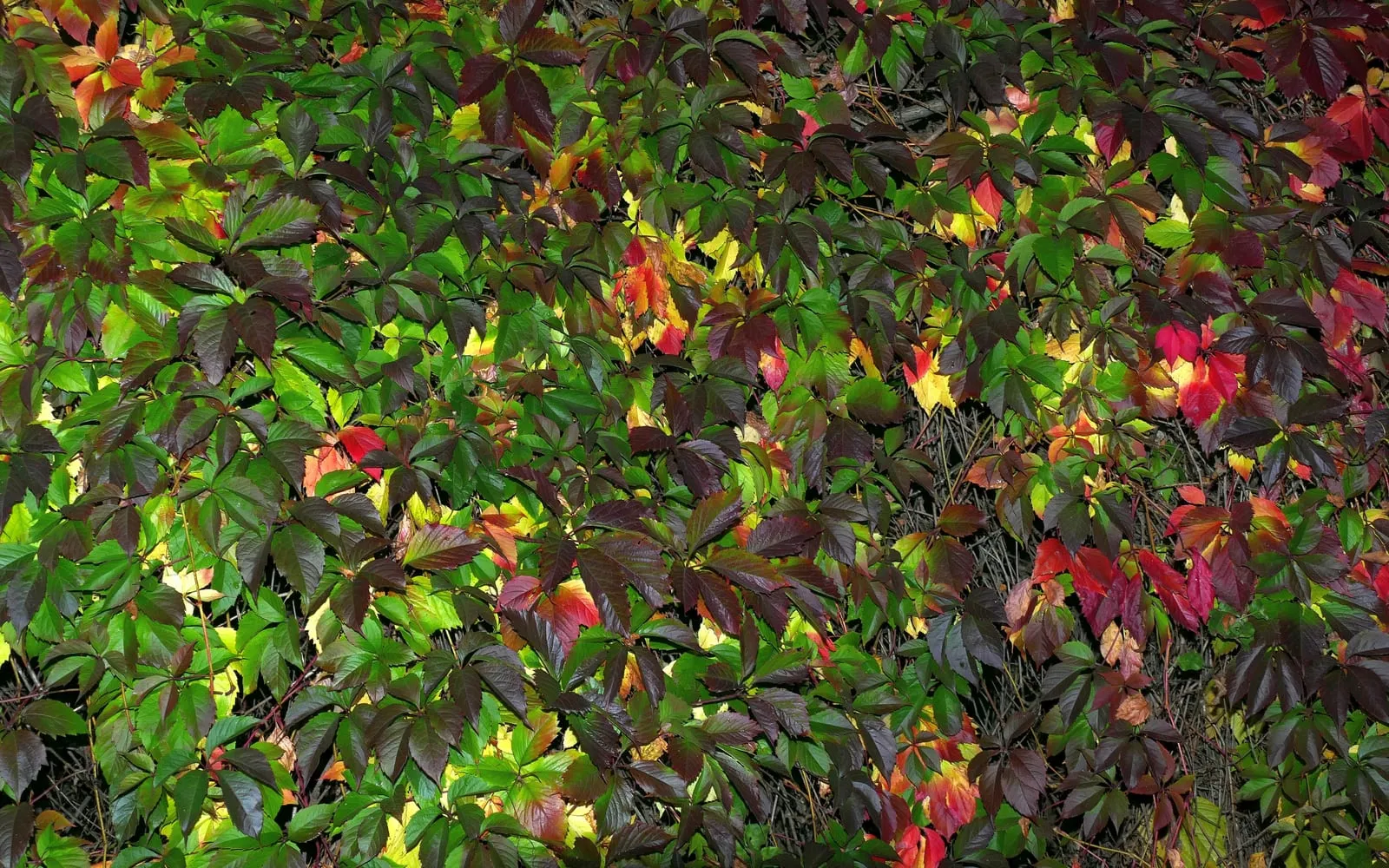
Virginia creeper turns scarlet in October and is the reason anybody plants it.
For eight months of the year it is a plain green sheet of five-fingered leaves on a wall, handsome enough and unremarkable. Then over about two weeks in autumn the whole thing runs through orange to a deep crimson-scarlet that lights up a north-facing house front, holds for a fortnight, and drops.
It is a good plant for a difficult wall. It grows in any soil, in sun or full shade, climbs 15 m with no support of any kind, and needs no training.
The problem is the same thing. It grows several metres a year, it goes under roof tiles, into gutters, around window frames and through air bricks, and once it is up under a slate it lifts it. Planting one on a house means committing to cutting it back every year for as long as it is there.
It climbs by adhesive pads rather than by roots, which matters for the question everybody asks. On sound brickwork and good mortar it does no damage. On soft crumbling mortar or failing render it pulls the surface away when removed.
Boston ivy, Parthenocissus tricuspidata, is the related plant with three-lobed leaves, smaller and slightly better behaved, and it colours just as well.
Appearance and character
A deciduous woody climber reaching 15 to 20 m, self-clinging and extremely vigorous.
Leaves are the identification. Each is divided into five separate leaflets radiating from a single point on a long stalk, each leaflet 5 to 12 cm long, oval, pointed and coarsely toothed. Boston ivy has one three-lobed leaf rather than five leaflets.
Tendrils are branched and each branch ends in a small flattened adhesive pad that grips brick, stone, render, timber and paint.
Flowers open in summer, small, greenish and inconspicuous, and easy to miss.
Berries ripen in autumn in loose bunches, 6 mm across, blue-black with a waxy bloom, on red-pink stalks that stay after the fruit is taken.
Autumn colour is the point of the plant, running from green through orange and red to deep scarlet and crimson over a short period in October.
New growth is often bronze-red in spring.
Stems are woody and thicken with age, and an old plant on a house is a substantial structure.
Where it is from
Eastern and central North America, from Ontario and Quebec south to Florida and Mexico, growing in woodland, on rocky slopes and climbing trees to reach the canopy.
It reached Britain in the early seventeenth century and has been a standard wall plant since the Victorian period.
The genus name means virgin ivy, from Greek, and the reason is disputed. It may record the ability of the flowers to set fruit without fertilisation, or it may be a translation of the older French name.
Parthenocissus tricuspidata, Boston ivy, is the east Asian species and is the plant that covers many American university buildings, giving the Ivy League its name despite not being ivy.
The adhesive pads are a separate evolutionary solution from the aerial roots of true ivy. Each pad secretes an adhesive and hardens onto the surface, gripping without penetrating it.
Birds spread the seed widely and it naturalises in Britain along railways, in hedgerows and on waste ground, though it is not regarded as a serious problem here.
How it grows
Plant in autumn or spring, and think hard about where before you do.
It grows in any soil, in sun or full shade, and it needs no support at all.
Choose the wall carefully. Sound brickwork with good mortar is fine. Soft old lime mortar, crumbling render, painted surfaces you want to keep and anything already failing are not, since removing the plant takes the surface with it.
Keep it away from the roof. This is the practical rule that matters more than any other. Once it reaches the eaves it goes into the gutter, under the tiles and into the roof space.
Plant it 45 cm out from the wall base and lead the first shoots to the wall on a cane. It finds its own way after that.
Water through the first summer, and after that it needs nothing.
Do not feed it. It is vigorous enough already.
Cut it back every year. Late winter is the usual time, and a summer tidy is often needed as well. Take it away from gutters, tiles, window frames, doors and air bricks, and keep the top well below the eaves.
Cut the growth above head height where children use the garden, which removes the berries from reach.
Renovate an overgrown plant by cutting the whole thing back to the main stems in late winter. It regrows without difficulty.
Remove it entirely by cutting the stems at the base and leaving the top growth to die and dry out for a season, which makes the pads brittle and far easier to take off the wall than pulling live growth away.
Choose Boston ivy or Parthenocissus henryana instead for a smaller wall, since both are less rampant.
Through the seasons
Winter is bare, showing the tracery of stems on the wall, and this is the season for cutting it back.
Spring breaks into leaf in April, often bronze-red before greening.
Summer grows very fast, flowers inconspicuously, and needs a tidy to keep it off the roof and out of the windows.
Autumn is the whole reason for the plant, turning scarlet in October before dropping its leaves within a fortnight.
Care difficulty
Easy to grow and demanding to control.
Nothing troubles it. It has no significant pests or diseases, grows in any soil and any aspect, needs no feeding or watering, and climbs without help.
The work is entirely restraint. An annual cut-back is the minimum, and a plant left for three or four years on a house causes real problems in gutters and under tiles.
Removing an established plant from a wall is a substantial job, so decide before before planting one.
Watering
Water through the first summer after planting.
Established Virginia creeper needs no watering in a temperate climate and tolerates drought well, including the dry strip at the foot of a wall.
Mulch a new plant to help it establish, and after that leave it alone.
Avoid feeding and heavy mulching on an established plant, since extra vigour is the last thing it needs.
Warning signs, diseases and pests
Growth in the gutters, under the tiles or around the window frames is the standard problem. Cut it back annually and keep the top below the eaves.
Mortar or render coming away when the plant is pulled off is soft or failing masonry rather than damage caused by the plant. Sound brickwork is unaffected. Cut the stems at the base and let the growth die and dry before removing it.
Poor autumn colour is usually deep shade. It colours best in sun, and a north wall gives a duller display.
Powdery mildew occasionally appears on the leaves in a dry summer and is cosmetic.
Leaf spot and downy mildew both occur and neither matters.
Vine weevil notches on the leaves are cosmetic on an established climber.
Seedlings appearing around the garden is birds spreading the berries.
Blue-black berries within a child’s reach is the safety issue. Cut the growth back above head height.
Growing environment
Full sun to full shade. It grows anywhere, and the autumn colour is better in sun.
Any soil, including chalk, clay, sand and poor made ground.
Fully hardy, tolerant of pollution, wind and coastal conditions.
Allow 10 m or more of wall. This is not a plant for a small space.
It suits a large house wall away from the roof, a boundary wall, an outbuilding, a retaining wall, a bank or a large pergola.
Do not plant it on a small house, on soft lime mortar, on painted render, or anywhere you will not keep on top of the cutting.
Grow Parthenocissus henryana instead for a smaller wall, since it reaches around 10 m, has silver-veined leaves and is less rampant, or Boston ivy for a slightly tidier version of the same effect.
Its wildlife value is fair. The inconspicuous flowers feed bees and hoverflies in summer, birds take the berries in autumn, and the dense growth gives good nesting cover on a wall.
Feeding
None. Feeding a Virginia creeper is working against yourself.
It grows several metres a year on poor soil and extra nitrogen produces more growth to cut off.
Mulch a newly planted one for its first year and then stop.
Poor autumn colour is a light problem rather than a nutrient one.
Troubleshooting
Will it damage my brickwork? Not sound brickwork with good mortar, since it clings by adhesive pads rather than penetrating roots. Soft crumbling mortar and failing render are a different matter, and removing the plant takes the surface with it.
How do I get it off a wall? Cut the stems through at the base and leave the top growth in place for a season. Once it dies and dries the pads become brittle and lift far more easily than live growth.
It is getting into the gutters and under the tiles. The commonest problem with the plant. Cut it back every year in late winter and keep the top well below the eaves, with a summer tidy as well if it is vigorous.
Are the berries poisonous? Yes. They contain oxalate crystals and cause burning of the mouth, vomiting and stomach pain. Children have been hospitalised. Keep the growth cut above head height where children play.
The autumn colour was disappointing. Too much shade. It colours best in full sun, and a north-facing wall gives a duller display.
Is this Virginia creeper or Boston ivy? Count the leaflets. Virginia creeper has five separate leaflets radiating from one point. Boston ivy has a single three-lobed leaf.
Should I feed it? No. It is vigorous enough and feeding gives you more to cut off.
Is there a smaller version? Parthenocissus henryana reaches around 10 m, has silver-veined leaves and is noticeably less rampant, and Boston ivy is a little tidier than Virginia creeper.
When do I prune it? Late winter for the main cut, with a summer tidy to keep it out of gutters and windows.