
Pest
Emerald ash borer
Agrilus planipennis
Also called EAB
A metallic green beetle whose larvae tunnel under the bark in winding galleries, killing an ash tree within two to four years of the first infestation. Native to Asia, it has destroyed tens of millions of ash trees across North America since the 1990s and is spreading west from Moscow through Russia and Ukraine, a second major threat to ash trees compounding ash dieback in the parts of Europe it eventually reaches.
At a glance
- Type
- Pest
- Cause
- Insect
- Severity
- Can kill the plant
- Affects
- Garden plants
- Active
- May to August
- Established in
- Asia and North America
What you are seeing
- Canopy dieback starting at the top of the tree and progressing downward over two to four years
- Small, D-shaped exit holes in the bark, roughly the width of a grain of rice, marking where an adult beetle has emerged
- Winding, S-shaped tunnels packed with fine sawdust-like frass, visible when bark is peeled back from an affected section of trunk or branch
- Vertical splits in the bark over larval galleries, sometimes with woodpecker damage nearby as birds dig for larvae underneath
- Epicormic shoots, clusters of small new growth sprouting from the trunk or major branches, as a stressed tree tries to compensate for canopy loss
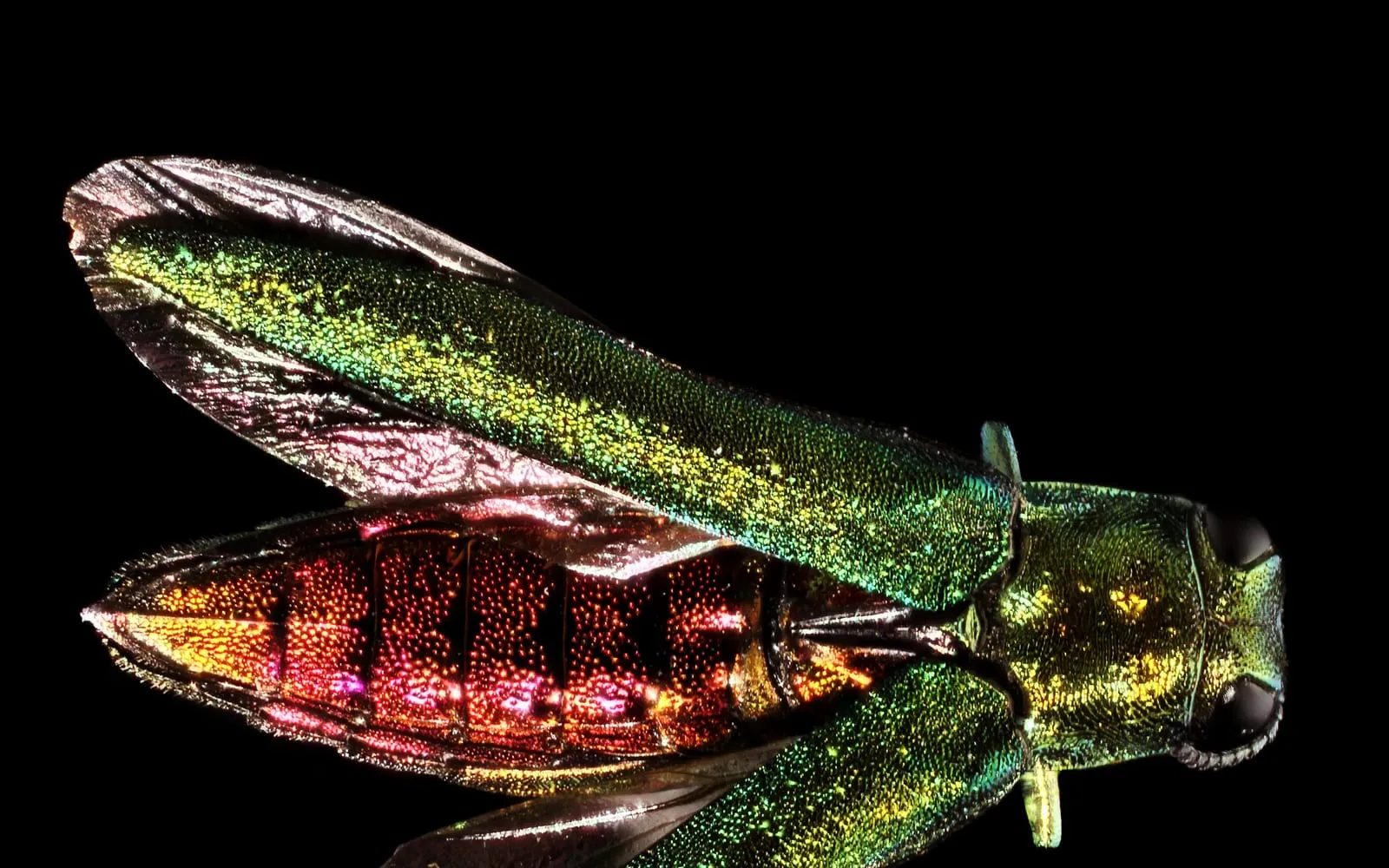
- Slender, metallic emerald-green adult beetles about 8 to 14 mm long, seen on foliage or bark in early summer
Before you treat anything
A dead or dying ash becomes brittle and hazardous quickly. Have a confirmed infested tree assessed and removed by a professional rather than working beneath or around it.
What you are looking at
A canopy that starts thinning and dying back from the top, progressing downward over two to four years. Small D-shaped exit holes, about the width of a grain of rice, appear scattered across the bark, marking where adult beetles have chewed their way out. Peel back bark from an affected section and winding, S-shaped tunnels packed with fine sawdust run beneath it, tracing where larvae fed through a full growing season. Vertical bark splits sometimes appear over these galleries, and woodpeckers are often drawn to the same spots, stripping bark away in patches as they dig for larvae underneath. A stressed tree frequently sprouts clusters of small new growth, called epicormic shoots, directly from the trunk or major branches in a last attempt to compensate.
The adult is a slender, brilliantly metallic emerald-green beetle, 8 to 14 mm long, most often seen on foliage or bark in early summer, though the damage it leaves behind is far more often noticed than the beetle itself.
From a minor Asian pest to North America’s most costly forest insect
Native to eastern Asia, where local ash species carry some natural resistance and this beetle causes only minor damage, it reached North America hidden in wooden shipping material sometime in the 1990s and was first identified near Detroit in 2002. It has since spread across most of the eastern United States and into Canada, killing tens of millions of ash trees and driving costs, in removal and replacement across affected cities alone, into the tens of millions of dollars.
A separate introduction reached Moscow by 2003 and has been spreading through Russia and into Ukraine at up to 41 kilometres a year since, making it one of the faster-moving forest pests on record. It remains confined to the eastern part of the continent for now, and the rest of Europe, including the United Kingdom, is watched closely precisely because of what it has already done in North America. Ash there already faces ash dieback, a separate fungal disease, and the arrival of this beetle on top of that would compound an already serious situation rather than replace it. Australia and New Zealand have never had it and both treat a sighting as an immediate biosecurity matter.
What to do about it
Never move firewood, especially ash, out of an area under quarantine or known to be infested; buy and burn firewood locally.
Check high-value or significant ash trees for D-shaped exit holes and canopy thinning, and set purple prism traps where monitoring programmes recommend them.
Support released parasitoid wasps as the primary long-term control where established. Preventive systemic insecticide injection is a last resort worth discussing with a professional only for an exceptionally valuable individual tree where the beetle is established locally, understanding that treatment needs repeating every two to three years for the tree’s life and does not scale to a woodland or forest.
Report a dying ash with D-shaped exit holes anywhere outside the confirmed range immediately, rather than assuming routine dieback.
Have a confirmed infested tree removed by a professional, since dead and dying ash becomes structurally hazardous quickly.
What it gets mistaken for
Ash dieback is a fungal disease causing blackened leaves, wilting shoot tips and diamond-shaped bark lesions, with none of this beetle’s D-shaped exit holes or winding galleries under the bark. The two can strike the same tree, so a tree showing dieback symptoms is worth checking for both rather than assumed to have only one.
Coral spot produces small orange-pink pustules on wood that is already dead and affects many tree species following existing damage, rather than causing the initial decline this beetle is responsible for.
Not established in Europe, Australia and New Zealand
Do not prune, spray or otherwise treat a suspected case. Doing so risks spreading an organism the country has kept out, and it disturbs the evidence needed to identify it. Photograph what you can see, leave the plant alone, and contact your national or state plant health authority. The control advice further down this page is written for regions where this problem is already established.
Native to eastern Asia, where local ash species have some resistance and the beetle is a minor pest rather than a killer. It reached North America in shipping material in the 1990s, was first identified near Detroit in 2002, and has since spread across most of the eastern United States and into Canada, killing tens of millions of ash trees and costing tens of millions of dollars in removal and replacement. It was found near Moscow in 2003 and has since spread through Russia and into Ukraine at up to 41 kilometres a year, though it remains confined to the eastern part of the continent for now. The rest of Europe, including the United Kingdom, is not yet affected and treats it as a pest of serious concern precisely because of how completely it has devastated ash across North America; Australia and New Zealand have never had it and both treat a sighting as an immediate biosecurity matter.
What to do, in order
The steps below apply where this problem is already established.
Start here
Prevention, and the changes that stop the problem returning. Most of these pages should end at this tier.
- Never move firewood, especially untreated ash, out of a quarantine or infested area
- Firewood is one of the primary ways this beetle has spread within North America far faster than it could fly on its own, since larvae survive concealed inside transported logs. Buying and burning firewood locally, and never carrying it across a quarantine boundary, remains one of the most effective things an individual can do to slow its spread.
- Report suspected symptoms outside the established range
- Given how rapidly this beetle has devastated ash populations wherever it has established, a dying ash showing D-shaped exit holes anywhere outside its confirmed range, including nearly everywhere in western and central Europe, should be reported to the national plant health authority immediately rather than treated as routine dieback.
Then reach for a barrier
Netting, hand removal and water. Nothing here harms anything except the target.
- Monitor with purple prism traps and visual bark inspection
- Purple sticky traps baited with a host-tree lure are the standard early-detection tool in North America, and checking high-value or street trees for D-shaped exit holes and canopy thinning gives earlier warning than waiting for obvious dieback.
Then bring in the predators
Encourage what already lives in the garden, and buy predators in where the problem is under glass and nothing will arrive on its own.
- Support released parasitoid wasps where established
- These wasps attack the beetle's eggs and larvae and are intended as a long-term, landscape-scale suppression tool rather than a rescue for an individual infested tree.Several small Asian parasitoid wasps have been released as classical biological control across parts of North America; not something an individual buys or releases.
Biological controls are live organisms and their sale and release are regulated country by country. An agent sold freely in one place may be unapproved in another, so buy from a licensed supplier where you live and never import or move one yourself.
Plants affected
Guides that name it among the problems to watch for. The list is the plants it is characteristic of rather than everything it will feed on.