
Outdoor plant
Mimosa Tree
Albizia julibrissin
Also known as Silk Tree, Persian Silk Tree
Practical guidance for growing mimosa tree, Albizia julibrissin, including fast growth, pink pompom flowers, folding leaflets, seed pods, mimosa wilt, and self-seeding.
At a glance
- Difficulty
- Easy
- Water
- Regularly for the first two summers, then only in prolonged drought
- Light
- Full sun for the heaviest flowering
- Temperature
- Needs a hot summer to flower well and ripen new wood
- Hardiness
- USDA 6-9, RHS H5, hardy to -20 C
- Type
- Deciduous tree, fast-growing and relatively short-lived
- Height
- 6-9 m
- Native to
- southwestern to eastern Asia
Root hardy well into a cold winter, though a severe one can kill the top growth back to the base, from which it usually resprouts strongly the following spring. Flowering depends more on summer heat than on the winter minimum: a cool, short summer leaves the wood unripened and the following year's flowers sparse.
Hardiness zones describe winter cold alone. Summer heat, humidity, rainfall and the length of the growing season decide as much, so treat the range as the outer limit rather than as a recommendation.
Not known to be toxic
Mimosa tree does not appear on the RHS potentially harmful plants index or the ASPCA toxic plant database. Its flat brown seed pods are not documented as carrying a toxic principle, though like most legume seeds eaten in large quantity they can cause mild stomach upset in a dog or a grazing animal rather than anything more serious. The soft wood and brittle branches are a bigger practical hazard than the plant tissue: a storm can drop a large limb with little warning, which is a structural risk rather than a poisoning one.
Sources: RHS potentially harmful garden plants, ASPCA toxic and non-toxic plants
About
Mimosa tree is a fast-growing deciduous tree grown for its feathery foliage and its clusters of pink, silk-threaded flowers through summer. It establishes quickly from seed and often reaches flowering size within four or five years, a pace few other flowering trees match.
Gardeners plant it for quick shade and for flowers that draw hummingbirds and butterflies through the hottest weeks of summer. It also self-seeds freely in a warm climate, and a mature tree can drop hundreds of seedlings into the surrounding beds and lawn in a single year.
Appearance and character
The leaves are bipinnate, divided twice into rows of small leaflets that give the canopy a soft, fern-like texture. Each leaflet folds shut at night and in heavy rain, a movement driven by pressure changes in cells at its base rather than by growth, and the whole leaf reopens as light returns.
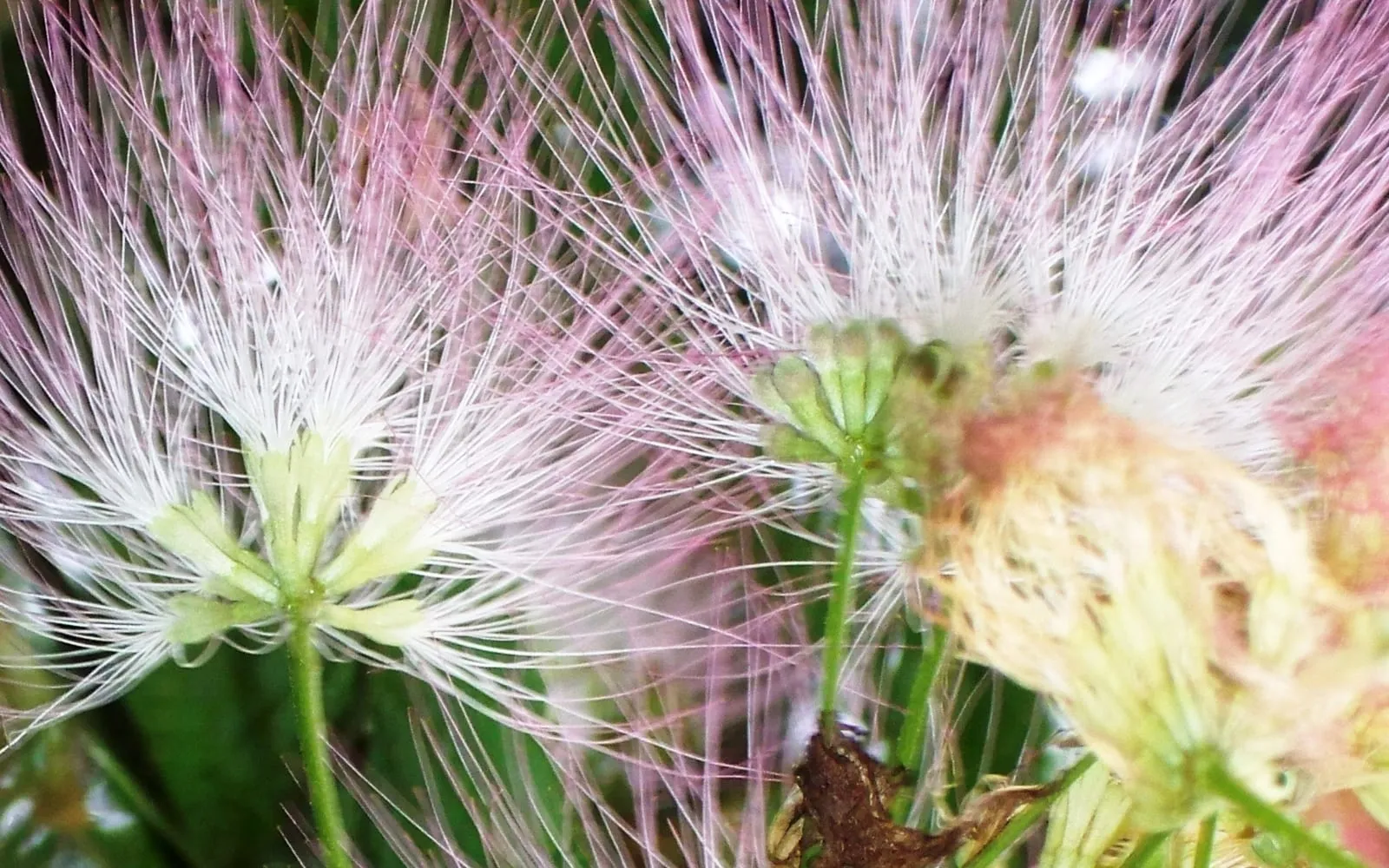
Flowers open from early to late summer in dense pink pompoms, each one made of dozens of long stamens rather than petals, clustered at the branch tips above the foliage. They give way to flat brown seed pods that hang on through winter after the leaves have dropped, rattling in the wind and feeding the tree’s self-seeding habit.
Where it is from
Albizia julibrissin is native across a wide belt of southwestern to eastern Asia, from Iran through the Himalayan foothills to China, Korea and Japan, growing on open slopes and along riverbanks at the woodland edge. That range spans several distinct climates, part of why the species tolerates such a broad spread of soils and summer temperatures in cultivation.
It reached European and American gardens in the eighteenth century for its flowers and its rapid growth, and it has since naturalised widely in warm temperate regions, including much of the southeastern United States, where it is now treated as an invasive weed tree outside gardens.
How it grows
Plant in full sun in any well-drained soil. The species tolerates poor, dry, sandy or compacted ground that would slow most other flowering trees; heavy, waterlogged clay is the one condition it will not forgive.
As a legume, it fixes its own nitrogen through bacteria living in nodules on its roots and rarely needs feeding. Growth in the first few years is rapid, often a metre or more a season, and the wood is correspondingly soft and prone to splitting in storms once the canopy fills out.
Prune while young to establish a strong branch structure. The low, wide forking habit that gives the tree its shade also makes weak crotches likely if left unmanaged. Pull seedlings promptly around the base to stop a single tree turning into a thicket over a few seasons.
Through the seasons
Spring brings the leaves out late, often well after most other trees, unfurling from bare branches over several weeks.
Summer is the flowering season, with the pink pompom flowers opening in flushes from early summer through into early autumn in a hot climate.
Autumn ripens the seed pods as the leaves yellow and drop, usually the earliest deciduous tree in a garden to go bare.
Winter is dormant. The bare, wide-spreading branch structure and the hanging pods carry the interest, and this is the season to cut out any crossing or weak growth.
Care difficulty
Easy once established, and one of the fastest routes to shade and flowers in a new garden. Give it a sunny spot and well-drained soil. It needs no routine feeding, and tolerates heat and drought that would stress a less adaptable tree.
The drawbacks are a relatively short lifespan for a tree, commonly a few decades rather than a century, brittle wood that can shed limbs in a storm, and a self-seeding habit that turns easy establishment into an ongoing job of pulling seedlings in a warm climate.
Watering
Water young trees regularly through their first two summers while the root system spreads, then let an established tree rely on rainfall in all but the most prolonged drought.
Overwatering does more harm than underwatering. A mimosa tree kept consistently moist in heavy soil is far more likely to develop root problems than one left to dry out between waterings.
Warning signs, diseases and pests
Fusarium wilt, often called mimosa wilt, is the most serious threat to the species. It blocks the tree’s water-conducting tissue and causes sudden yellowing and dieback of whole branches, usually fatal once well established. There is no cure, and a wilt-resistant cultivar is worth seeking out where the disease is known locally.
Webworm caterpillars spin loose silken nests among the leaves in summer and skeletonise the foliage inside them. Prune out and destroy affected nests while they are still small.
Scale insects, sometimes called mimosa scale, appear as small waxy bumps along the stems and can build up quickly on a tree already weakened by wilt. Horticultural oil applied during dormancy controls a light infestation.
Root rot follows waterlogged soil, showing as poor growth and dieback spreading from the crown down. Improving drainage is the only real fix.
Growing environment
Full sun brings the heaviest flowering and the sturdiest growth. A tree grown in shade flowers thinly and stretches towards the light.
Almost any well-drained soil suits it, from poor sand to average garden loam, and it tolerates both acid and alkaline ground. Waterlogged or permanently wet soil is the one condition to avoid.
It tolerates coastal wind and salt spray reasonably well, and its tolerance of poor soil and drought makes it a common choice for a difficult site where little else grows quickly.
Feeding
Feeding is rarely necessary. As a legume, the tree hosts nitrogen-fixing bacteria in nodules on its roots and supplies much of its own nitrogen once established.
A struggling young tree in very poor soil can be given a balanced feed in spring, but a mature specimen in ordinary garden soil needs nothing beyond what it makes for itself.
Troubleshooting
Whole branches are wilting and dying in summer. Fusarium wilt is the likely cause, especially if the leaves yellow and drop while the wood beneath the bark shows dark staining when cut. There is no treatment; remove a badly affected tree and avoid replanting a susceptible variety in the same ground.
Seedlings keep coming up everywhere. Mimosa tree self-seeds heavily in a warm climate. Pull seedlings while they are young, and consider removing seed pods before they open if the self-seeding has become a nuisance.
A large limb split off in a storm. The wood is soft and fast grown, and a mature tree can drop a limb in a storm with little warning. Prune a young tree to a strong branch structure to reduce this risk later, and have a damaged mature tree checked for safety.
The leaves fold up in the middle of a sunny day. This is normal nyctinastic movement, triggered by touch, heavy rain or a sudden drop in light rather than by stress, and the leaflets reopen once conditions settle.
Is it considered invasive where I live? In parts of the southeastern United States and some other warm regions it self-seeds aggressively enough to be classed as invasive. Check local guidance before planting it near wild land, and look for a sterile or low-seeding cultivar where one is available.