
Disease
Ash dieback
Hymenoscyphus fraxineus
Also called Chalara, Chalara dieback of ash, Ash decline
Ash dieback causes thinning crowns, diamond-shaped stem lesions and bushy growth from the trunk. Many infected trees persist for years, but trees near roads, paths and buildings need professional assessment.
At a glance
- Type
- Disease
- Cause
- Fungus
- Severity
- Can kill the plant
- Affects
- Garden plants
- Active
- June to October
- Established in
- Europe and Asia
What you are seeing
- Dark brown or orange blotches on the leaflets, spreading along the leaf stalk
- Leaves wilting, blackening and hanging on the tree rather than dropping
- Diamond-shaped lesions on stems and branches, centred where a side shoot joins
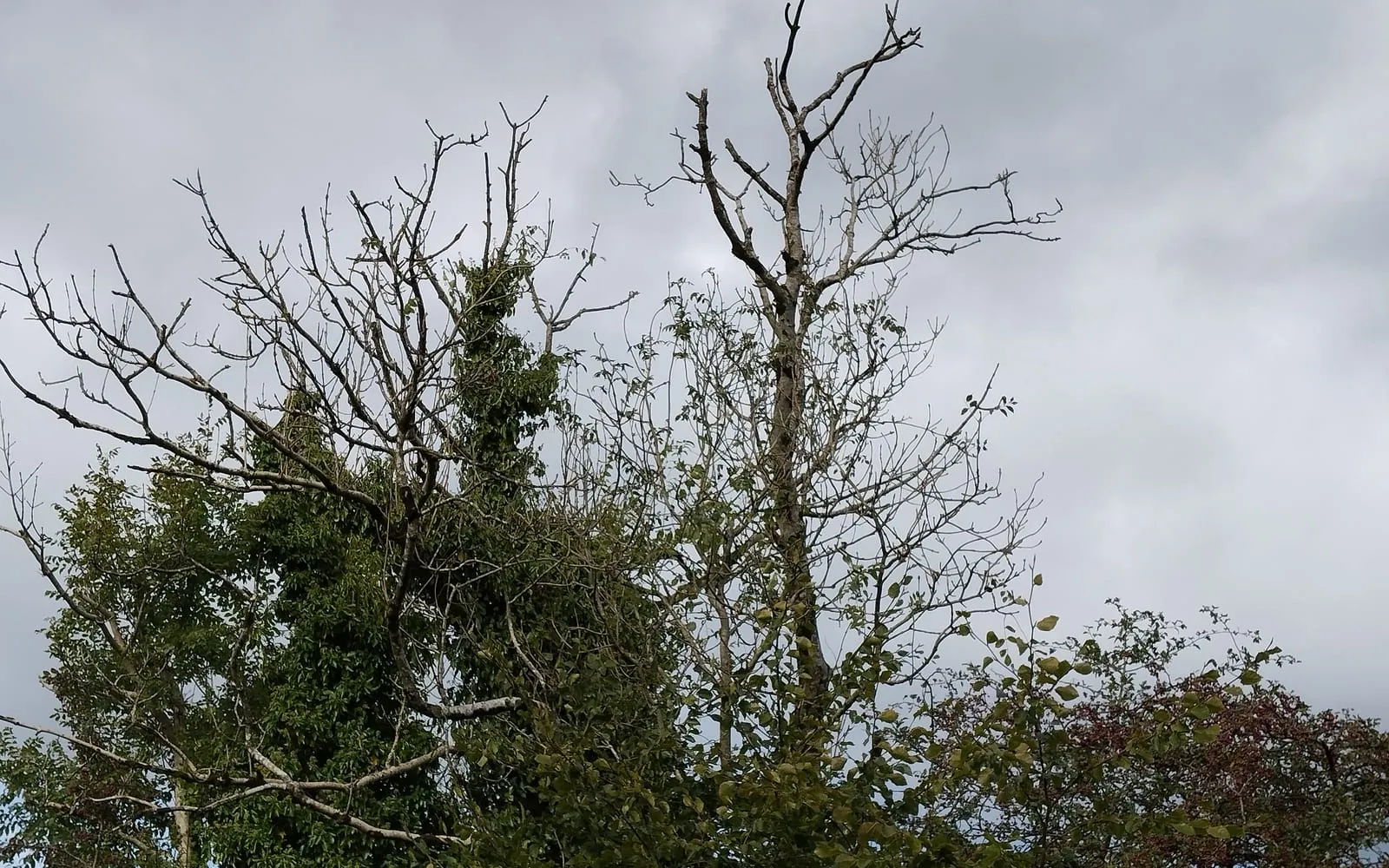
- The crown thinning from the top and the outside inwards, with bare branch ends against the sky
- Bushy clumps of shoots breaking straight out of the trunk and main limbs
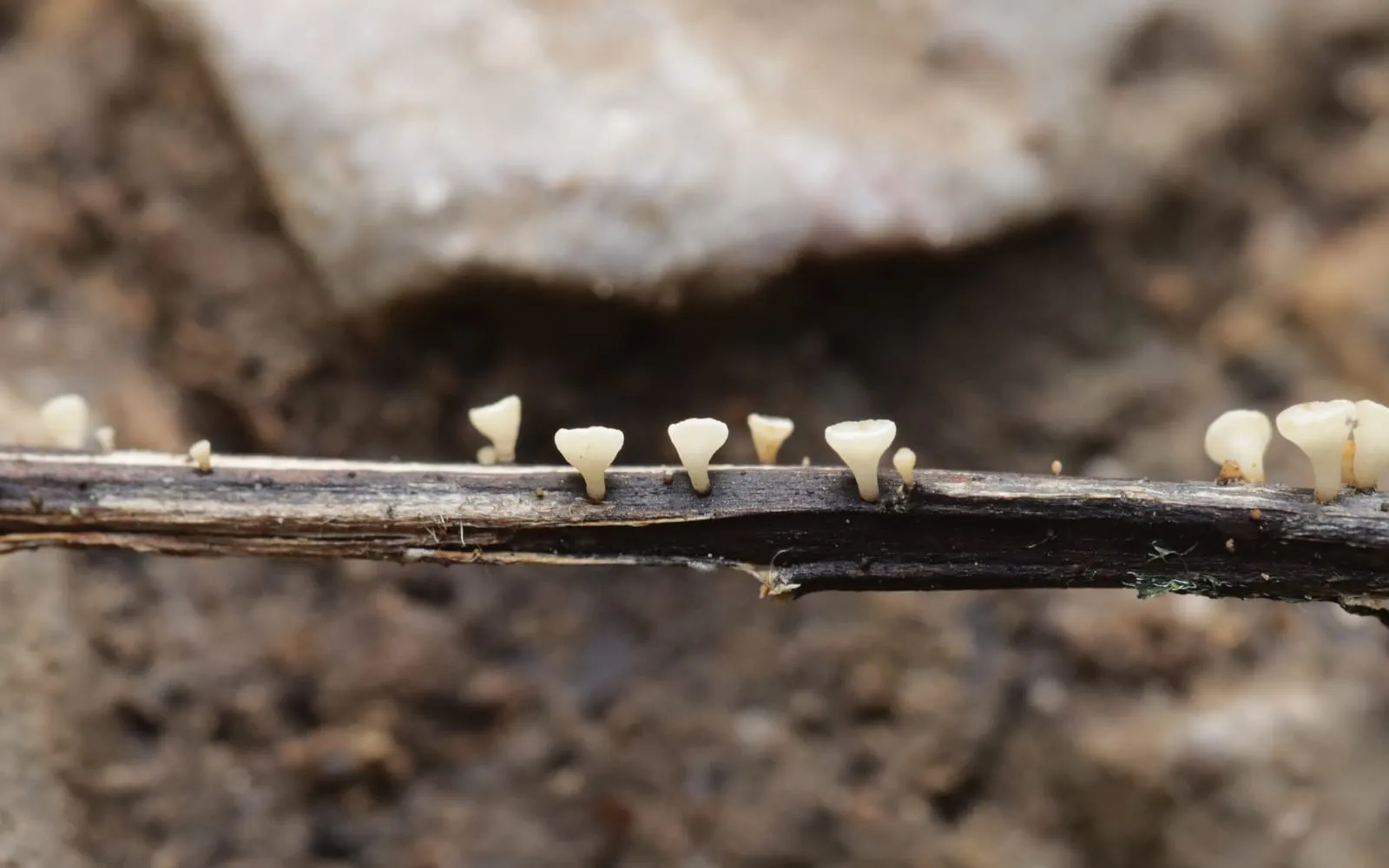
- Small white or cream cup-shaped fungi, a few millimetres across, on last year's blackened leaf stalks lying on the ground
- Saplings and young trees killed outright within a season or two
Before you treat anything
This is the entry on this site where the danger is physical rather than botanical. Ash killed by dieback becomes brittle quickly and sheds limbs without warning, and infected trees have failed at the base in wind. Do not climb one, do not fell one yourself, and keep away from an affected tree in a gale.
What you are looking at
From a distance, an ash with dieback has a thin crown and bare branch tips standing above the foliage, so the outline against the sky looks like antlers. The thinning works from the top and the outside inwards, and it gets worse each year.
Closer to, the leaves carry dark brown or orange blotches that run down into the leaf stalk. Affected leaves wilt, blacken and hang on the tree instead of falling. On the stems, look for lesions shaped like a diamond or a flattened oval, usually centred on the point where a side shoot joins.
A tree that has lost a lot of its crown often produces bushy clumps of shoots straight out of the trunk and the main limbs. That is the tree trying to replace the canopy it has lost, and it is a sign of how far things have gone rather than of recovery.
Underneath, in the litter from last year, look for the fungus itself. Small white or cream cups a few millimetres across stand in rows along blackened ash leaf stalks from July onwards. That is where the spores come from.
Where it came from and where it is going
The fungus is native to east Asia, where it lives harmlessly on a related ash that evolved alongside it. It reached Europe in the 1990s and was found in Britain in 2012, first on imported nursery stock and then in established woodland.
It is now effectively everywhere in Britain. Current expectations are that it will kill most of the ash in Britain, with estimates generally in the range of seventy to eighty-five per cent.
Ash is one of the commonest trees in Britain, so this is a landscape-scale event rather than a garden problem. That said, a great many gardens have an ash in them or next to them, and what to do about that one tree is a fair question with a clear answer.
Do not fell a healthy ash
Somewhere between one and five trees in a hundred carry enough genetic tolerance to survive infection. Those trees are the entire future of ash in Britain, and they look exactly like every other healthy ash right up until the moment their neighbours die and they do not.
Felling ash pre-emptively, or clearing a stand because the disease is in the area, removes the tolerant individuals along with the rest. Several conservation programmes are now working from precisely these survivors.
The exception is safety, and it is a real one. A tree that has lost much of its crown becomes brittle and its root plate weakens, partly because honey fungus moves in on a weakened ash. Affected trees drop limbs and blow over. Anything overhanging a path, a road, a building or a boundary needs looking at by an arborist, and that assessment needs repeating as the disease progresses.
There is no treatment. Nothing available to a gardener, a forester or a commercial grower cures this or slows it.
What to do about it
Watch the tree rather than felling it, unless it is a safety problem.
Get an arborist to assess anything overhanging a path, a road or a building, and have it looked at again each year.
Take out dead and dangerous wood while leaving the living tree standing.
Rake up and bury or cover the fallen leaf stalks under a garden ash, which lowers the spore load immediately around it.
Water the tree in a drought and keep machinery off the roots.
Do not plant a new ash, and do not move ash logs, brash or leaves off the site.
Report a new find through Forest Research’s TreeAlert if you are somewhere the disease has not been recorded.
What it gets mistaken for
Honey fungus kills from the roots up, with white fungal sheets under the bark at ground level and black bootlaces in the soil. It commonly follows dieback into the same tree, so finding it does not rule the other out.
Verticillium wilt takes one branch at a time and stains the wood brown inside, with nothing showing on the outside of the stem.
Drought browns the leaf margins across a whole crown during one hot spell and then stops. Dieback keeps taking branches year after year.
Ash bud moth and various leaf-mining insects damage foliage without producing stem lesions or crown dieback.
Squirrel bark stripping leaves obvious gnaw marks with the wood exposed, usually in a band around a limb.
Not established in North America, Australia and New Zealand
Do not prune, spray or otherwise treat a suspected case. Doing so risks spreading an organism the country has kept out, and it disturbs the evidence needed to identify it. Photograph what you can see, leave the plant alone, and contact your national or state plant health authority. The control advice further down this page is written for regions where this problem is already established.
Hymenoscyphus fraxineus is native to east Asia, where the local ash species live with it, and it reached Europe in the early 1990s. It has since been recorded from Norway to Ukraine and has killed ash on a scale that changed the look of European woodland. North America has escaped it so far and runs active surveillance for it, while losing the same trees to emerald ash borer by a different route. Australia and New Zealand have neither, and little ash to lose.
What to do, in order
The steps below apply where this problem is already established.
Nothing available to a gardener will cure this once a plant has it. The steps below are about limiting the spread and deciding what to plant in its place.
Start here
Prevention, and the changes that stop the problem returning. Most of these pages should end at this tier.
- Leave a healthy-looking ash standing
- A small share of ash trees, somewhere between one and five in a hundred, carry enough tolerance to survive. Those are the trees the species will be rebuilt from, and they are indistinguishable from any other healthy ash until everything around them has died. Felling ash pre-emptively removes exactly the trees worth keeping. Watch and wait.
- Get a professional assessment for any tree over a path or a road
- Dieback weakens the root plate and lets honey fungus in, so an affected ash becomes brittle and prone to dropping limbs or going over altogether. That is a safety question rather than a plant health one. A tree near a house, a road, a footpath or a boundary needs an arborist to look at it, and the risk rises as the disease progresses.
- Do not plant ash
- There is no point putting a young ash into a landscape where the spore load is now universal, and nurseries have largely stopped selling it. Where an ash has been lost, hornbeam, small-leaved lime, field maple, oak and rowan all fill a similar space.
- Deal with the leaf litter under a garden ash
- The fungus fruits on last year's leaf stalks lying on the ground, which is where the summer spores come from. Raking those up and composting them under a covering, or burying them, lowers the local dose. It will not save a tree in open country and it is worth doing for a single tree in a garden.
- Keep the tree in good condition
- Water in drought, keep mowers and strimmers away from the base, and avoid compacting the root area. None of this cures anything, and a tree under no other stress holds on longer, which matters when you are waiting to find out whether it is one of the tolerant ones.
Then reach for a barrier
Netting, hand removal and water. Nothing here harms anything except the target.
- Take out dead and dangerous wood rather than the whole tree
- Removing the deadwood over a path leaves the living tree in place to show what it will do. Get the work done by someone insured and competent, since ash goes brittle as it dies and is unpleasant to climb.
- Do not move ash logs, brash or leaves off the site
- The disease is already everywhere in Britain, and moving material still spreads it to the few areas that have less of it, and moves other pests along with it. Burn or chip it where it stands.
In pictures
Plants affected
Guides that name it among the problems to watch for. The list is the plants it is characteristic of rather than everything it will feed on.