
Outdoor plant
Ground elder
Aegopodium podagraria
Also known as Goutweed, Bishop's weed, Herb Gerard
How to identify and control ground elder, Aegopodium podagraria. The Roman import that never leaves, why forking it spreads it, and the one method that works.
At a glance
- Difficulty
- Difficult
- Water
- Not applicable
- Light
- Full sun to deep shade, and it is at its worst in shade
- Temperature
- Fully hardy, to about -30 deg C
- Hardiness
- USDA 4-9, RHS H7, hardy to -30 C
- Type
- Herbaceous perennial, spreading by shallow white rhizomes
- Height
- 40-100 cm in flower, with foliage at 30 cm
- Native to
- Europe and western Asia, and introduced to Britain by the Romans
- Best month
- May in the Northern Hemisphere, November in the Southern Hemisphere
Shade, drought, poor soil and any winter are all taken, and the rhizome regrows from a fragment, which is the whole difficulty. The Romans are thought to have carried it to Britain as a vegetable and a gout remedy. It has since naturalised across North America, where the variegated form sold in garden centres reverts to the plain green invasive one and it is listed as a noxious weed in several states.
Hardiness zones describe winter cold alone. Summer heat, humidity, rainfall and the length of the growing season decide as much, so treat the range as the outer limit rather than as a recommendation.
Every month named in this guide is for the temperate Northern Hemisphere. If you garden in the Southern Hemisphere, shift each one by six months, so May becomes November. Closer to the equator the wet and dry seasons matter more than the calendar, and the shift stops being a useful guide.
Not known to be toxic
Ground elder is not listed by the RHS as a potentially harmful garden plant and is not recorded by the ASPCA as toxic to cats, dogs or horses. It is edible, and the young spring leaves have been eaten as a pot herb across Europe since at least Roman times, cooked like spinach with a flavour between parsley and celery. The Romans are thought to have brought it to Britain as a food and medicinal plant, and monastic gardens grew it for gout, which is where goutweed and bishop's weed come from. That edibility carries a serious caveat. Ground elder is in Apiaceae, the carrot family, which contains hemlock, hemlock water dropwort and fool's parsley, all of which have killed people who mistook them for something else. Nobody should eat anything from this family without being certain of the identification, and ground elder is best treated as a weed to remove rather than a crop to gather. Where a plant is unlisted by both sources rather than positively assessed, read that as no hazard recorded rather than a hazard ruled out.
Sources: RHS potentially harmful garden plants, ASPCA toxic and non-toxic plants
About
Ground elder is the weed that comes with the house.
It arrived in Britain with the Romans as a vegetable and a gout remedy, was grown in monastery gardens through the middle ages, and escaped everywhere. Most old temperate gardens have it somewhere, and it is a standard feature of a garden that has been left for a few years.
The problem is the rhizome system. White, brittle, running just below the surface, and regenerating from every fragment. A fork through an infested bed breaks it into pieces and each piece becomes a plant, so digging over a border is the fastest way to make it worse.
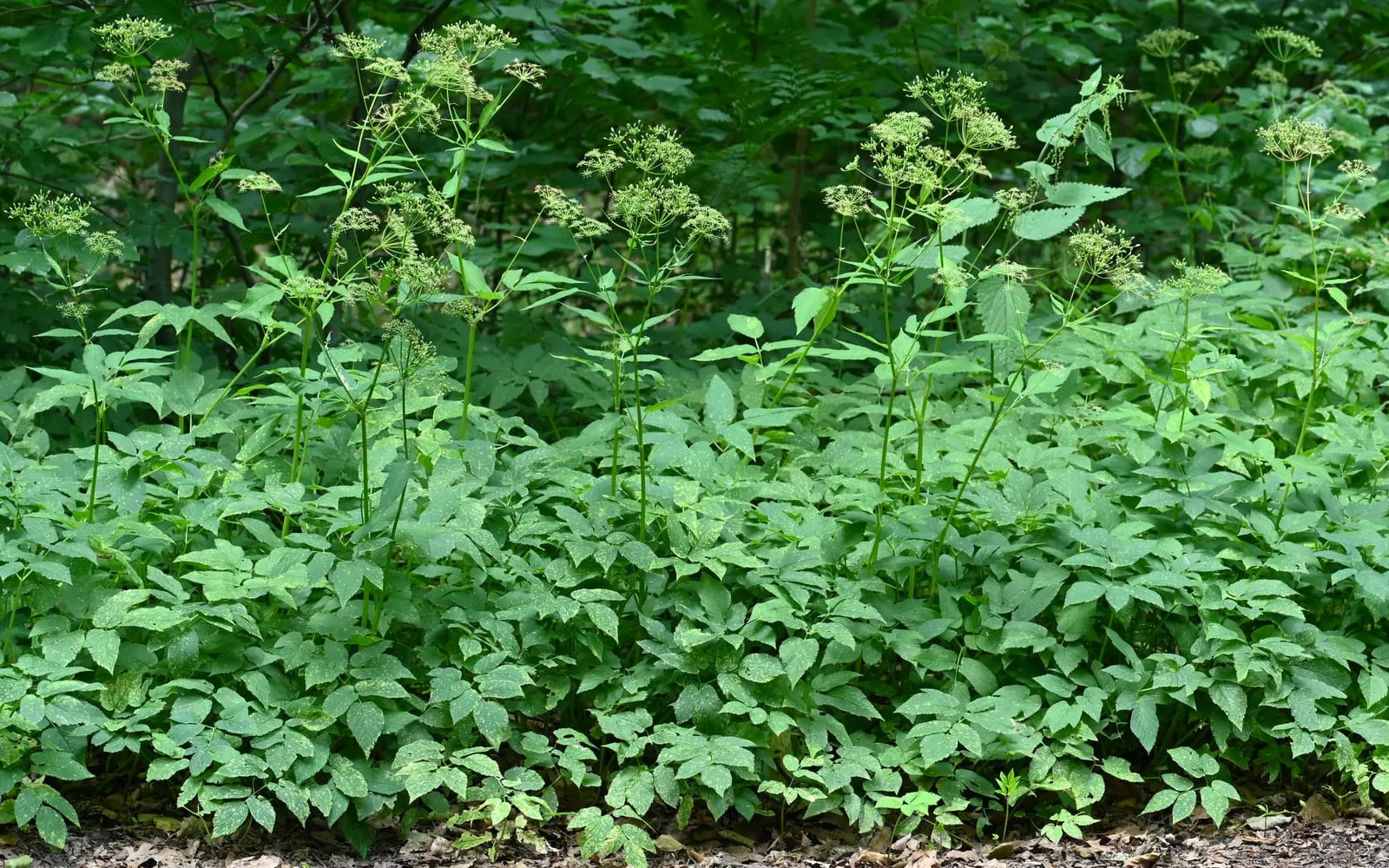
Above ground it makes a dense mat of divided leaves 30 cm deep that excludes everything else, and in May and June it throws flat white umbels on stems to a metre.
It grows in deep shade, which most weeds do not, so the bed under a hedge or beside a north wall where nothing else thrives is exactly where it takes over.
The awkward part is that it grows straight through the crown of a herbaceous plant, and the rhizomes weave through the roots of a hosta or a hardy geranium so that removing one means removing the other.
Appearance and character
A herbaceous perennial with foliage at about 30 cm and flower stems reaching 40 cm to 1 m, dying back in winter and regrowing from the rhizomes.
Leaves are the identification. Each is divided into three groups of three leaflets, so nine in total, on a long grooved stalk with a triangular cross section. Leaflets are oval, 5 to 8 cm long, toothed and pointed, in a fresh bright green.
The leaf shape resembles elder, which is where the name comes from, and the plant is not related to elder at all.
Flowers open in May and June in flat umbels 5 to 10 cm across, made of many small white flowers, held on hollow grooved stems well above the leaves.
Seeds are small, ribbed and elongated, and they spread the plant locally.
Rhizomes are white, brittle, round in section and 3 to 5 mm thick, running horizontally 5 to 15 cm below the surface and branching freely.
The variegated form, Aegopodium podagraria ‘Variegatum’, is sold as ground cover. It is less vigorous and it reverts, and planting it deliberately is a decision to regret later.
Where it is from
Europe and western Asia, growing in woodland, on woodland edges and in hedgerows on moist rich soil.
The Romans are thought to have introduced it to Britain, and it is classed as an archaeophyte, meaning an ancient introduction rather than a native.
Its medieval use was medicinal as much as culinary. It was grown for gout and sciatica, which gives both goutweed and podagraria, from the Latin for gout in the foot.
Herb Gerard records a dedication to St Gerard of Toul, who was invoked against gout.
It is in Apiaceae alongside carrot, parsley, cow parsley, hemlock and hemlock water dropwort, and the family resemblance in the flowers is close enough that identification matters.
It is a serious garden weed across northern Europe and has naturalised in North America, where it is invasive in several states.
The young leaves remain a foraged spring vegetable in parts of Scandinavia and eastern Europe.
How it spreads
By rhizome, overwhelmingly, with seed playing a secondary role.
The rhizomes run horizontally 5 to 15 cm below the surface, branching as they go, and a single plant covers a square metre within a season.
Every fragment regenerates. A piece a centimetre long with a node on it grows into a new plant, which is why cultivation multiplies it.
It grows through the crowns and root systems of herbaceous plants, weaving between the roots so that the two cannot be separated in the ground.
It travels in the rootballs of donated and bought plants, which is how most gardens acquire it. Check every plant coming into the garden.
It travels in imported topsoil, in manure and in compost that has had ground elder roots in it.
It comes under fences and through hedges from neighbouring ground.
Seed spreads it locally, and cutting the flowers before they set reduces new colonies.
Through the seasons
Winter it dies back completely, leaving bare ground, and the rhizomes are at their lowest reserve towards late winter.
Spring shoots appear in March and the mat is dense by April, which is when to start removing it.
Summer flowers in May and June, and this is the period when persistent removal does the most damage to the root reserves.
Autumn the top growth dies down, and late summer into early autumn is the best window for a glyphosate treatment while the leaves are still actively growing.
Control without chemicals
Lift every plant you want to keep, wash the soil off the roots, and pick out every scrap of ground elder rhizome. This is the only reliable way to clear an infested herbaceous border without chemicals, and it is a big job. Bare-root the plants, wash them under a tap, tease out every white fragment, and pot them up or replant into clean ground.
Do this in autumn or early spring when the plants are dormant.
Treat the emptied bed separately. Fork it through carefully by hand, lifting whole rhizomes rather than chopping them, and go over it repeatedly for a season before replanting.
Do not rotavate. It multiplies the plant.
Cover the ground where a bed can be taken out of use. Heavy black polythene or a woven membrane, edges overlapped, left in place for at least a full growing season and better for two. Cardboard and a mulch is not enough on established ground elder.
Remove every leaf as it appears where covering is impossible, week after week, through the growing season. This starves the rhizomes over two or three years and needs real persistence.
Cut the flowers before they seed even if you are doing nothing else.
Bag and bin the rhizomes or burn them. Do not compost them.
Plant dense ground cover once an area is clear. Bare soil lets survivors re-establish unnoticed.
Grow through it where clearance is impossible. Vigorous competitive plants suppress it without eliminating it, and the ones that manage are dealt with below.
Control with glyphosate
Glyphosate is systemic and reaches the rhizomes, and it is the only chemical that does.
Treat in late summer or early autumn while the foliage is green and growing, when the plant is moving reserves down into the rhizomes.
Cut the growth back in midsummer and treat the fresh regrowth, which takes the chemical up more readily than old tough leaves.
Expect to repeat it. Two or three applications over two seasons is normal on an established stand.
Use a gel or a weed wiper to treat ground elder growing among plants you want to keep, painting it onto individual leaves. Any spray drift kills whatever it lands on.
Clear the bed entirely where the infestation is heavy, lifting and washing the plants you want and treating the empty ground, which is far more effective than trying to work around things.
Read and follow the product label. Keep children and pets off treated ground until it has dried, and never let it reach a pond or a watercourse.
Telling it apart
Ground elder has leaves divided into nine leaflets in three groups of three, on a grooved stalk with a triangular cross section, and the flower stems are hollow and grooved.
Cow parsley, Anthriscus sylvestris, has much more finely divided fern-like leaves and grows to 1.5 m in hedgerows.
Hemlock, Conium maculatum, has finely divided leaves, purple blotches on a smooth stem and a foul smell when crushed. It is deadly poisonous.
Hemlock water dropwort, Oenanthe crocata, grows in wet ground, has celery-like leaves and is the most poisonous plant in Britain and Ireland.
The reliable ground elder features are the nine leaflets, the triangular grooved leaf stalk and the dense low mat.
Never eat anything from this family on a tentative identification.
Living with it
Elimination is achievable in a small garden with the lift-and-wash method and a season of follow-up, and it is often unrealistic where it comes in from neighbouring ground.
Suppression is the realistic target in that case. Some plants compete with it well enough to hold their own, and using them where clearance is impossible turns an infestation into ground cover.
The plants that manage are the dense vigorous ones. Geranium macrorrhizum, Euphorbia amygdaloides var. robbiae, Symphytum cultivars, Alchemilla mollis, Brunnera, Vinca, epimedium and the larger hostas all cope, and Geranium macrorrhizum is the best of them.
Avoid planting anything fine, slow or clump-forming into ground elder. It will be swallowed within two seasons.
Keep new ground clean. Check the rootball of every plant that comes into the garden, and be careful about imported topsoil, manure and free plants from other gardens.
Cut the flowers every year even where you are living with it, since it limits the spread to new areas.
Troubleshooting
Why does digging make it worse? Every fragment of rhizome with a node on it grows into a new plant. A fork or a rotavator chops the root system into hundreds of pieces and spreads them through the bed.
How do I clear an infested border? Lift every plant you want to keep in autumn or early spring, wash the soil off the roots under a tap, pick out every white rhizome fragment, and replant into clean ground. Then work the empty bed over by hand and go back over it for a season before replanting.
Can I just cover it? Yes, with heavy black polythene or a woven membrane, edges overlapped, for at least a full growing season and better two. Cardboard and mulch is not enough on an established stand.
When should I spray it? Late summer or early autumn while the leaves are green and growing, when the plant is moving reserves into the rhizomes. Cut it back in midsummer and treat the fresh regrowth.
Can I compost the roots? No. Bag and bin them or burn them. A domestic heap does not get hot enough.
What can I plant that competes with it? Geranium macrorrhizum is the best, along with Euphorbia amygdaloides var. robbiae, comfrey, alchemilla, brunnera, vinca and the larger hostas. None of them eliminates it and they hold their own in it.
Can I eat it? The young spring leaves are edible cooked and were grown as a vegetable here from Roman times. It is in the same family as hemlock and hemlock water dropwort, both of which are lethal, so nobody should eat it without being certain of the identification.
Should I plant the variegated one? No. It is less vigorous than the plain form and it reverts, at which point you have ground elder that you introduced deliberately.
It comes under the fence from next door. Speak to the neighbour, and if that is not possible, sink a vertical barrier 30 cm deep along the boundary and clear whatever gets past it.