
Edible
American pawpaw
Asimina triloba
Also known as Pawpaw, Custard apple, Indiana banana, Prairie banana, Poor man's banana
How to grow American pawpaw, Asimina triloba. The largest fruit native to North America, custard-textured and tropical-tasting, from a tree hardy to -25 deg C.
At a glance
- Difficulty
- Moderate
- Water
- Weekly through summer, and it dislikes drying out
- Light
- Shade for the first two years, then full sun
- Temperature
- Fully hardy to -25 deg C
- Hardiness
- USDA 5-8, RHS H6, hardy to -30 C
- Type
- Deciduous tree, long-lived, suckering into a patch
- Height
- 4-8 m
- Native to
- Eastern North America
- Best month
- September and October in the Northern Hemisphere, March and April in the Southern Hemisphere
Hardy to -30 deg C and yet tropical in every other requirement, needing roughly 400 chill hours and then 2200 growing degree days of summer heat to ripen the fruit. Pollination is the weak point. The flowers smell of carrion and are worked by flies and beetles rather than bees, so two unrelated seedlings and a paintbrush do more than either alone.
Hardiness zones describe winter cold alone. Summer heat, humidity, rainfall and the length of the growing season decide as much, so treat the range as the outer limit rather than as a recommendation.
Every month named in this guide is for the temperate Northern Hemisphere. If you garden in the Southern Hemisphere, shift each one by six months, so September becomes March. Closer to the equator the wet and dry seasons matter more than the calendar, and the shift stops being a useful guide.
Skin irritant
- Safe to eat
- The ripe flesh
- Do not eat
- Seeds, skin, bark and leaves
- Harm from
- Eating it and handling it
- Affects
- People
The ripe flesh is food and has been eaten across eastern North America for centuries. The rest of the plant is chemically defended. Seeds, bark and leaves contain annonacin and related acetogenins, compounds that are neurotoxic and have been studied in connection with an atypical parkinsonism seen where related Annonaceae fruits are eaten heavily. Never eat, crush or grind the seeds, and discard the skin. A minority of people get stomach upset or a contact rash from handling the fruit or foliage, and the leaves have historically been used as an insecticide, which is a fair indication of their chemistry. Neither the RHS nor the ASPCA lists Asimina, which reflects its rarity in gardens rather than a clean bill of health.
Sources: RHS potentially harmful garden plants, ASPCA toxic and non-toxic plants
About
Pawpaw produces the largest edible fruit native to North America and tastes nothing like anything else that will grow in a temperate garden. The flesh is soft custard, somewhere between banana, mango and vanilla.
The tree is hardy to -25 deg C, which surprises people who assume the flavour must come with a tropical constitution. It belongs to a tropical family, Annonaceae, and this species is the one member that pushed north.
Two barriers explain why it is not in every garden. The fruit bruises within days and cannot be shipped, so it never reaches shops. And pollination is difficult, since the flowers are pollinated by carrion flies and beetles rather than bees.
You need two genetically different trees. Seedlings from separate sources or two named varieties will do, and hand-pollination raises the crop considerably.
Appearance and character
A narrow upright tree, often pyramidal, spreading by root suckers into a small thicket if allowed.
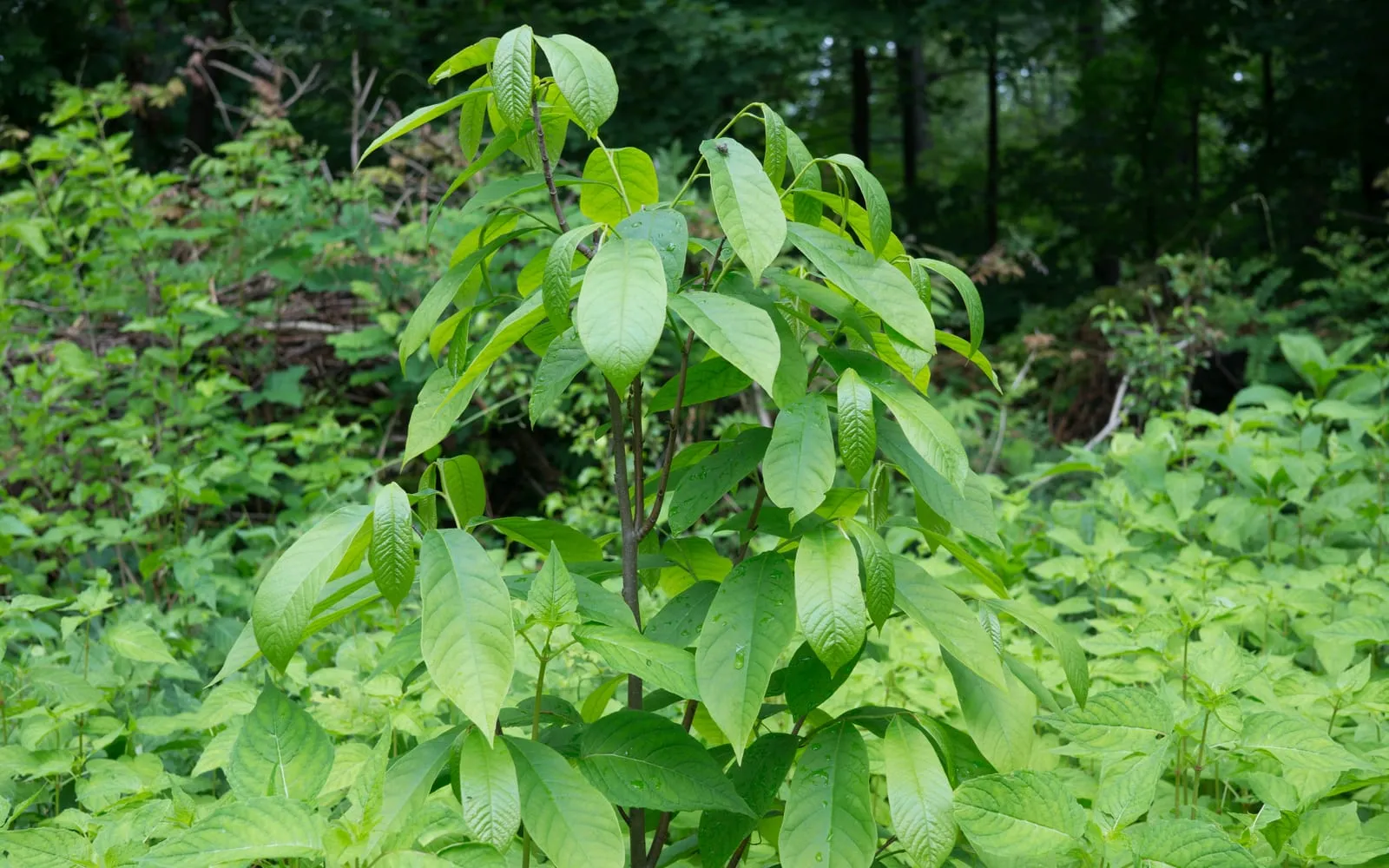
Leaves are very large, 15 to 30 cm, oblong with a pointed tip, drooping downwards which gives the tree a distinctly tropical silhouette. They turn clear yellow in autumn and smell faintly unpleasant when crushed.
Flowers open in April before or with the leaves, 3 to 5 cm across, nodding, with six petals in two whorls, dark maroon-purple and faintly fleshy in texture. They smell of fermenting fruit or carrion, which is what draws their pollinators.
Fruit is an oblong berry 7 to 15 cm long, green ripening to yellow-green with brown blotches, hanging singly or in clusters of two to four.
Inside the flesh is pale yellow custard around two rows of large dark brown seeds.
Where it is from
Asimina triloba is native to the eastern United States and southern Ontario, from New York west to Nebraska and south to Florida.
It grows as an understorey tree in rich bottomland forest and along riverbanks, under a canopy of larger trees, which is why young plants need shade.
Indigenous peoples ate and spread it widely, and the fruit was familiar enough to early settlers that Lewis and Clark recorded living on pawpaws when supplies ran short.
It is the only member of the custard apple family native to a temperate climate, and its relatives are cherimoya, soursop and sweetsop.
Kentucky State University runs the main breeding programme, and varieties such as ‘Sunflower’, ‘Shenandoah’ and ‘Susquehanna’ come from that work.
How it grows
Buy two grafted trees of different named varieties, or two seedlings from unrelated sources. A single tree will not fruit.
Plant in spring rather than autumn, since pawpaw roots are brittle and resent disturbance in cold soil.
Shade young trees for their first two summers. In the wild they germinate under a canopy and full sun scorches them. Shade netting or a temporary screen works.
Move them into full sun from the third year, which is what fruiting requires.
Plant into deep fertile moisture-retentive soil at pH 5.5 to 7, improved with compost.
Hand-pollinate for a reliable crop. Take pollen from a flower whose anthers are shedding with a small brush and transfer it to a flower on the other tree whose stigma is glossy and receptive.
Through the seasons
Flowering comes in April, before the leaves are fully out, and the maroon flowers are easy to miss against bare wood.
Hand-pollinate through the flowering period, which lasts two or three weeks. Flowers are protogynous, meaning the stigma is receptive before that flower’s own pollen sheds, which is the mechanism that forces cross-pollination.
Leaves expand in May and the tree takes on its tropical look through summer.
Fruit swells through summer and ripens in September and October.
Pick when the fruit gives to gentle pressure and the skin lightens, or collect windfalls daily. Ripe pawpaw drops.
Use it within two or three days. It will not keep, and refrigeration only buys another few days.
Care difficulty
Moderate. The tree is hardy, pest-free and undemanding once established.
Establishment is the delicate phase. Young plants need shade for two years, resent root disturbance and dislike drying out.
Pollination is the recurring problem. A tree can flower heavily for years and set nothing, and hand-pollination with a brush is the reliable answer.
The fruit’s refusal to keep changes how you use it. Plan to eat, freeze or pulp the crop within days of picking.
Pests are close to absent, since the foliage is chemically defended and almost nothing eats it.
Watering
Water weekly through summer, 20 litres at a time, particularly in the first four years.
The tree comes from moist bottomland and dislikes drying out. Drought checks growth and causes fruit drop.
Steady moisture through August and September matters while the fruit is sizing.
Mulch generously with compost or leaf mould over a wide area, kept clear of the trunk.
Drainage must still be good. It grows on riverbanks rather than in swamps and will not tolerate standing water.
Warning signs, diseases and pests
Heavy flowering with no fruit set. Poor pollination, which is the usual cause. Hand-pollinate between two genetically distinct trees.
Young leaves scorching and bleaching in the first summers. Too much sun on a juvenile plant. Shade for two years before exposing it.
Large leaves torn and browning. Wind. The foliage is soft and easily damaged, so give the tree shelter.
Growth stalling and fruit dropping in a dry August. Drought. Water heavily and mulch.
Almost no insect damage. Normal, and one of the tree’s advantages. Only the zebra swallowtail caterpillar specialises on it, and that is a North American species.
Suckers coming up around the tree. Natural habit. Remove them, or let them form a patch.
Growing environment
Shade for the first two years, then full sun for the rest of the tree’s life. Getting this sequence right matters more than any other single factor.
Deep fertile moisture-retentive soil at pH 5.5 to 7, with good drainage.
Shelter from wind protects the large soft leaves.
Hardiness to -25 deg C puts it within reach of most temperate gardens, and the tree needs a proper winter chill to flower.
Allow 4 m between trees, and remember two are needed. A pair at the edge of a sheltered lawn or in a woodland-edge planting suits the species well.
Feeding
Feed once in spring with a balanced general fertiliser, or mulch with well-rotted manure.
The tree responds well to organic matter, matching the rich forest floor it grows on naturally.
Mulch annually with compost or leaf mould, which feeds and conserves moisture at the same time.
Avoid pushing nitrogen hard, which produces leafy growth at the expense of fruit.
A container plant needs a balanced liquid feed monthly through summer, though the brittle taproot makes pawpaw a poor long-term container subject.
Troubleshooting
Flowers every spring, never any fruit. Only one tree, two grafts of the same variety, or no pollinator insects. Hand-pollinate between genetically different plants.
Young tree scorching in its first summer. Too much sun. Shade it for two years.
Tree failing after transplanting. Root disturbance, to which pawpaw is very sensitive. Plant in spring from a container and disturb the rootball as little as possible.
Fruit dropping before ripe. Drought in late summer. Water steadily.
Fruit going over within days of picking. Normal. It has no storage life. Freeze the pulp instead.
Stomach upset after eating it. A minority of people react to pawpaw. Discard skin and seeds, and stop eating it if it recurs.
American pawpaw problem guides
Not sure what is wrong? See the common vegetable pests guide.