
Houseplant
Dog Tail Cactus
Deamia testudo
Also known as Deamia testudo, Tortoise Cactus, Selenicereus testudo
How to grow Deamia testudo, the dog tail cactus, a jungle cactus with ribbed stems that clamber over trees by aerial roots and big night flowers.
At a glance
- Difficulty
- Moderate
- Water
- When the top few centimetres of mix have dried
- Light
- Bright indirect light to some direct sun
- Temperature
- Warm; keep above about 10 deg C
- Humidity
- Average to high
- Hardiness
- USDA 10-12, RHS H1c, hardy to 10 C
- Type
- Evergreen climbing epiphytic cactus
- Height
- Stems to 2 m or more, climbing or trailing
- Native to
- Mexico, Central America
A climbing jungle cactus from the warm forests of Mexico and Central America, where it clambers over tree trunks and rocks by clinging aerial roots instead of rooting in dry ground. It needs warmth, bright but filtered light, an open root run and more moisture than a desert cactus, has no frost tolerance and slows below about 10 deg C.
Hardiness zones describe winter cold alone. Summer heat, humidity, rainfall and the length of the growing season decide as much, so treat the range as the outer limit rather than as a recommendation.
Not known to be toxic
A safe plant for a home with pets or children. Deamia, like the other jungle cacti, is not listed as toxic by the ASPCA or the RHS, and no harmful compound is recorded in it. Its ribs carry small spines that can prick, but there is no chemical hazard, so a pet or child that brushed or bit it would meet the spines instead of a poison. Handle it with care for the spines instead of for any toxicity.
Sources: ASPCA toxic and non-toxic plants, RHS potentially harmful garden plants
A clinging climber shaped like a tortoise shell
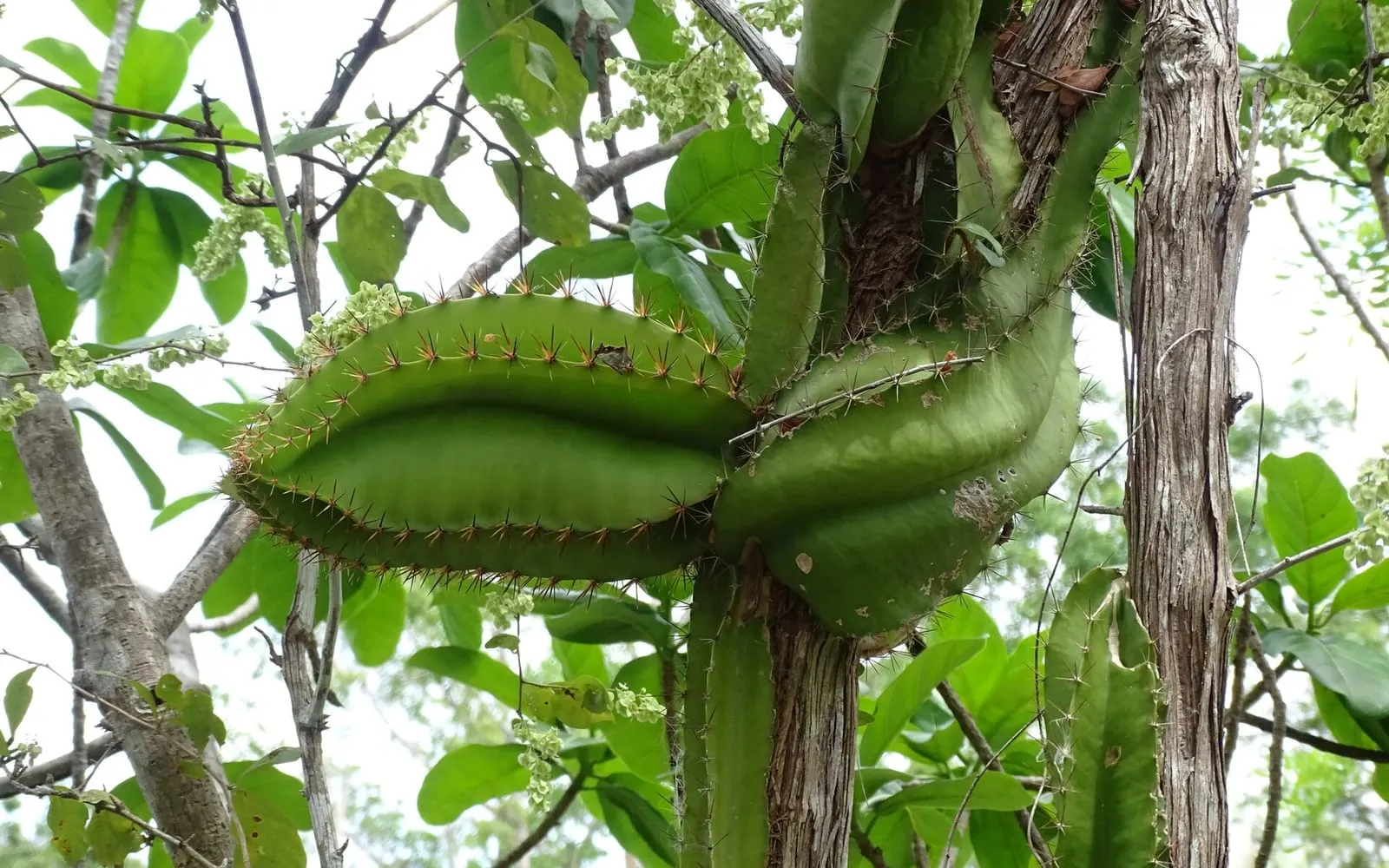
Deamia testudo is a clambering forest cactus with a habit unlike a tidy pot column. Its stems are angular and ribbed, pressing flat against whatever they climb, and along the ribs run rows of aerial roots that grip bark and rock. Where a stem lies against a broad surface, the ribs spread and flatten into a shape said to recall the domed plates of a tortoise shell, which gives the plant its species name testudo and one of its common names. The other, dog tail, comes from the loose, trailing stems that hang where there is nothing to grip. Short spines line the ribs, enough to prick a careless hand.
It grows in the warm forests of Mexico and Central America, climbing tree trunks and scrambling over shaded rock instead of sitting in open, dry ground. Like the other night-flowering jungle cacti, it opens large, pale, funnel-shaped flowers on summer nights, and each flower is gone by morning. Its roots and stems are built for bark, shade and humid air, so it needs more care than the easiest jungle cacti.
Warmth and softened light
Coming from warm forest, it has no defence against cold and should stay above about 10 deg C, kept away from a chilly, wet rootball. Its light needs sit between the two extremes: bright, broken light with perhaps a little soft sun early or late in the day, like a forest edge. Harsh midday sun through glass can scald the flattened stems and leave them scarred, while a dim spot draws them thin, pale and unable to grip well. A well-lit window out of the fiercest glare, or a place in good dappled shade, matches its forest habitat.
Watering a forest climber
Water it more freely than any desert cactus, keeping the mix lightly moist through the growing season without letting it stand wet. Let the top few centimetres dry between waterings, then water again before the plant runs completely dry, since the fine roots and the aerial roots along the stems dislike both drought and a waterlogged pot. Cut back over winter to a cooler, drier rest. It comes from humid forest, so damp air suits it: mist it in warm weather, or group it with other plants to raise the moisture around its stems.
Compost and a surface to grip
Pot it in an open, airy medium that drains fast yet holds a little moisture, such as a loam-based or peat-free compost lightened with orchid bark, perlite and grit. Give it something to fasten on, such as a moss pole, a slab of cork bark or a stout piece of wood, and the aerial roots will take hold and pull the stems upward; without support it trails from a raised pot or a basket instead. Repot in spring once it has outgrown its container, and where it has gripped a support, ease the roots free carefully so you do not tear them.
If you grow it on a removable support, check that the support can be lifted with the plant at repotting time. That avoids breaking the aerial roots later.
Feeding
A dilute balanced feed, or a weak cactus feed, given about once a month through spring and summer, keeps the stems firm and green and supports the buds. Keep it well diluted, because an epiphyte lives on the light nourishment of forest debris instead of rich soil. Stop feeding over the cooler winter rest, and hold off on a freshly potted plant for a few weeks while it settles into the new mix.
Propagation
Cuttings root readily, and the aerial roots already carried on the stems give them a head start. Take a length in warm weather, let the cut dry for a day or two, then set or lay it on a moist, open mix, where it soon anchors and grows. Pressing a cutting against a mossy support speeds the grip and gets a climbing plant going faster. Seed is possible but far slower, and cuttings hold on to the parent’s clambering habit.
Displaying a gripping plant
This cactus is best displayed either on a support or in a hanging container. A slab of cork bark or a chunky moss pole lets the aerial roots grip as they do in the forest, pressing the stems flat and spreading the ribs into the domed, plated look that gives the plant its tortoise name. Grown instead in a hanging basket with nothing to grip, the same plant sends its stems outward and down in loose tails. Either way the plant grips hard, so choose the support before it settles in instead of trying to move a gripped stem later.
Problems
A soft, blackening stem or a mushy base is rot from cold, wet compost, worst through a chilly winter; cut out the damaged tissue, dry the plant off and shift it somewhere warmer and drier. Mealybugs settle as white woolly specks along the ribs and in the areoles; clear them with a swab of dilute alcohol. Thin, pale, weak stems that fail to grip mean too little light. This cactus needs slightly more warmth, humidity and softened light than the toughest jungle kinds.
Why does it cling so tightly? Rows of aerial roots along the ribs grip bark or rock, the way the plant climbs in the forest, so it will fasten hard to any support you give it.
Why is it called the tortoise cactus? Where a stem presses flat against a surface, its ribs spread into a domed, plated shape likened to a tortoise shell, hence the name testudo.
Why is it trickier than some jungle cacti? It needs more warmth, humidity and softened light than the toughest jungle cacti, though it is still straightforward once those needs are met.
Is it safe around pets? It holds no poison; the only caution is the short spines along the ribs, so handle and site it with those in mind.
Dog Tail Cactus problem guides
Not sure what is wrong? See the common houseplant pests guide.