
Houseplant
Tree houseleek
Aeonium arboreum
Also known as Aeonium, Black rose, Irish rose
How to grow aeonium, Aeonium arboreum. The summer dormancy that reverses normal watering, why a flowering rosette dies, and overwintering it outside its own climate.
At a glance
- Difficulty
- Moderate
- Water
- Regular in autumn, winter and spring, and very little in summer
- Light
- Full sun to bright light, with shade from the hottest midday sun
- Temperature
- 10 to 24 deg C, and it is damaged below about 4 deg C
- Hardiness
- USDA 9-11, RHS H2, hardy to 5 C
- Type
- Evergreen succulent, and each rosette dies after flowering
- Height
- 60 cm to 1.5 m
- Native to
- The Canary Islands, Madeira and north-west Africa
- Best month
- August in the Northern Hemisphere, February in the Southern Hemisphere
Canary Islands, on a Mediterranean cycle that runs opposite to most houseplants. Aeoniums grow through the cool wet winter and go dormant in high summer, dropping leaves and closing into tight rosettes, which alarms owners who then water a sleeping plant and rot it. Outdoors year round in USDA 9 and warmer, where the winter stays frost-free.
Hardiness zones describe winter cold alone. Summer heat, humidity, rainfall and the length of the growing season decide as much, so treat the range as the outer limit rather than as a recommendation.
Every month named in this guide is for the temperate Northern Hemisphere. If you garden in the Southern Hemisphere, shift each one by six months, so August becomes February. Closer to the equator the wet and dry seasons matter more than the calendar, and the shift stops being a useful guide.
Harmful if eaten
- Do not eat
- The sap
- Harm from
- Handling it and eating it
- Affects
- People, cats and dogs
Aeonium is in Crassulaceae, the same family as jade plant, sedum, echeveria and kalanchoe. The ASPCA does not list Aeonium specifically, and it does list several of its relatives as toxic to cats and dogs, notably Crassula and Kalanchoe, the latter seriously so because of cardiac glycosides. Aeonium is not known to contain those glycosides. The RHS does not list it among harmful garden plants. The recorded effect from eating aeonium is mild stomach upset, and the sap causes skin irritation in some people, so wear gloves when taking cuttings if you are sensitive. Where a plant is unlisted by both sources rather than positively assessed, read that as no hazard recorded rather than a hazard ruled out, and the family it sits in is a reason for reasonable caution rather than reassurance. Keep it away from an animal that chews plants, and do not confuse it with Kalanchoe, which looks similar to the untrained eye and is genuinely dangerous to pets.
Sources: RHS potentially harmful garden plants, ASPCA toxic and non-toxic plants
About
Aeoniums grow in winter and rest in summer, which is the opposite of almost every other plant in the house.
They come from the Canary Islands, where the summers are hot and dry and the growing season is the mild wet winter. Indoors they follow the same rhythm. Growth runs from autumn through to late spring, and from June to August the plant slows, the rosettes close up and the lower leaves shrivel and drop.
That summer shrivelling looks like drought and it is dormancy. Watering it heavily then is the commonest way an aeonium is rotted.
The other thing that alarms people is flowering. An aeonium rosette that produces a tall conical head of small yellow flowers is at the end of its life, and that rosette dies after seeding. It is monocarpic. On a branched plant only the flowering rosette is lost and the others continue, and on a single unbranched rosette the whole plant goes.
Take cuttings routinely, which root very easily, and the plant is effectively permanent even though the individual rosettes are not.
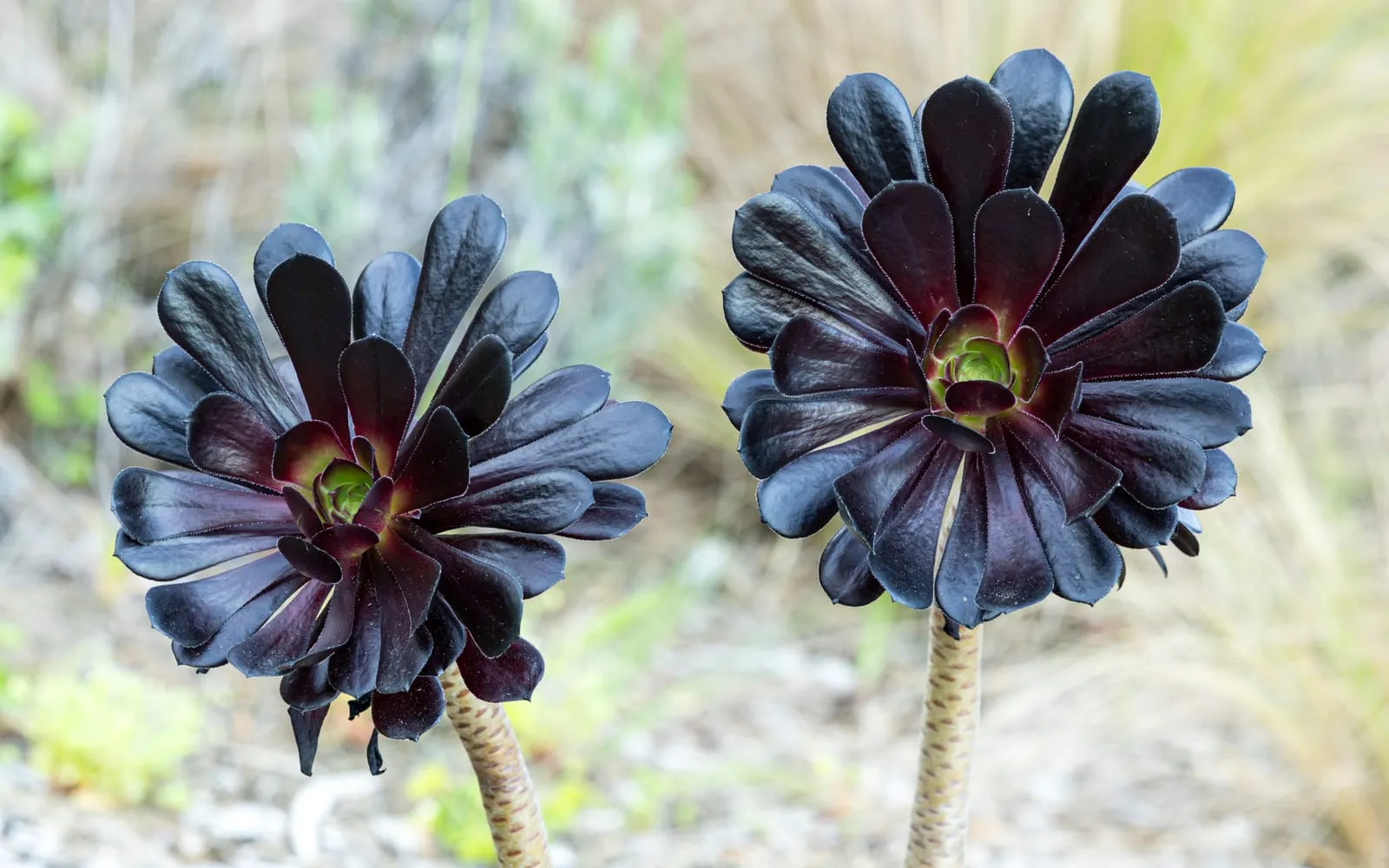
‘Zwartkop’ with its near-black rosettes is the cultivar most people want, and it needs full sun to keep the colour.
Appearance and character
An evergreen succulent reaching 60 cm to 1.5 m, with flat rosettes held at the ends of bare woody stems.
Rosettes are the feature. Flat, symmetrical, 10 to 30 cm across, made of fleshy spoon-shaped leaves arranged in a tight spiral.
Leaf colour runs from mid-green in the species through to near-black in ‘Zwartkop’ and ‘Schwarzkopf’, with variegated, copper and grey-green cultivars available.
Stems are slender, woody, grey-brown and bare below the rosettes, branching as the plant ages.
The bare stem with a rosette on top is the characteristic look and is not a fault.
Flowers appear on mature rosettes in spring, in a tall conical panicle of small starry yellow flowers, and the rosette dies afterwards.
Lower leaves shrivel and drop during summer dormancy, leaving a tighter rosette, and they regrow in autumn.
Aeonium arboreum is the common upright species. Aeonium haworthii branches more freely and Aeonium tabuliforme makes a flat plate-like rosette.
Where it is from
The Canary Islands, Madeira and north-west Africa, growing on cliffs, rocky slopes and dry scrub.
The climate there is Mediterranean, with mild wet winters and hot dry summers, which is exactly the growth cycle the plant follows.
Summer dormancy is an adaptation to that dry season, and it is why aeonium care instructions read backwards compared with most houseplants.
The Canary Islands are the centre of diversity for the genus, with around thirty species, many restricted to single islands, and the group is a much-studied example of adaptive radiation.
Aeonium arboreum ‘Zwartkop’ arose as a sport and was introduced through Dutch nurseries in the twentieth century.
They are in Crassulaceae alongside sedum, sempervivum, echeveria, crassula and kalanchoe, and they use crassulacean acid metabolism, opening their stomata at night to reduce water loss.
Aeoniums are widely grown outdoors in Cornwall, the Isles of Scilly, the Channel Islands and along mild coasts, where they survive the winter and reach substantial size.
How it grows
Grow it in full sun to bright light. Dark-leaved cultivars such as ‘Zwartkop’ need direct sun to hold their colour and go green in shade.
Provide some shade from the hottest midday sun in a conservatory or a south window in summer, which can scorch the rosettes.
Use a gritty free-draining cactus or succulent compost, or a loam-based compost with a third added grit.
Pot into a container only slightly larger than the root ball, with generous drainage.
Water on the reversed cycle. Water regularly from September to May whenever the compost has dried out, and cut back sharply through June, July and August when the plant is dormant, giving only enough to stop the stems shrivelling.
Never let it stand in water at any time.
Feed monthly from September to May with a weak balanced or cactus feed, and not at all in summer.
Keep it above 4 deg C. Aeonium is not frost hardy and a hard frost kills it outright.
Move it outside for the summer in a sheltered position with some shade, which suits it well, and bring it in before the first frost.
Overwinter it indoors in the brightest position you have, in a cool room rather than a warm one, where it will grow through the winter.
Turn the pot regularly, since the rosettes lean towards the light and an unturned plant goes lopsided.
Take cuttings in spring or autumn. Cut a rosette with 5 to 10 cm of stem, let the cut end dry and callus for two or three days, then push it into gritty compost and water sparingly until it roots. This is very easy and is how you keep a plant going.
Behead a leggy plant by cutting the rosette off and rooting it, and the remaining stump usually produces several new shoots.
Cut off a flowering stem once the flowers fade, and accept that the rosette it came from is lost.
Repot every two or three years in spring.
Through the seasons
Winter is the main growing season. Water when the compost dries, feed monthly, and keep it in the brightest cool position available.
Spring continues growing and is when flowering happens on mature rosettes. This is a good time for cuttings and repotting.
Summer is dormancy. Water very sparingly, stop feeding, provide shade from the hottest sun, and expect lower leaves to shrivel and drop.
Autumn starts back into growth from September, and this is when watering and feeding resume.
Care difficulty
Moderate. Aeonium is undemanding and the reversed growth cycle catches everybody out at least once.
Watering it as you would a normal houseplant, heavily in summer and sparingly in winter, is exactly wrong and rots it.
Once the cycle is understood, the plant needs bright light, gritty compost, sparing water and frost protection.
Flowering rosettes dying is inherent rather than a failure, and taking cuttings routinely makes it a non-issue.
Legginess is normal ageing rather than a problem, and beheading and rooting the rosette resets the plant.
Watering
Water on the reversed cycle, which is the single most important thing about the plant.
From September to May, water thoroughly whenever the compost has dried out, letting it drain fully.
From June to August, water very sparingly, giving only enough to stop the stems shrivelling. The plant is dormant and heavy watering rots it.
Never let it stand in a saucer of water at any point.
Check the compost with a finger rather than working to a schedule.
Shrivelled lower leaves in summer are normal dormancy rather than thirst.
Shrivelled stems and a soft base are the two signs to act on, one meaning too little water and the other too much.
Warning signs, diseases and pests
Lower leaves shrivelling and dropping in June and July is normal summer dormancy. Do not respond by watering heavily.
A soft mushy stem base with rosettes collapsing is rot from overwatering, particularly in summer. There is usually no recovery. Take cuttings from any healthy rosettes immediately.
A tall conical spike of yellow flowers is the rosette coming to the end of its life. It is monocarpic and that rosette dies after flowering. Cut the stem off once the flowers fade, and take cuttings from the remaining rosettes.
Dark rosettes turning green is insufficient light. Move it into full sun.
Long bare stretched stems with small rosettes is legginess from poor light. Behead the rosettes and root them, and the stump reshoots.
Brown scorched patches on the rosettes is direct midday sun in a conservatory or against glass. Provide light shade in summer.
Blackened collapsed growth after a cold night is frost. Aeonium is killed outright by it.
White cottony masses in the rosette centres and among the roots is mealybug. Wipe them off with a cotton bud dipped in alcohol, and check the roots when repotting.
A plant that wilts and lifts out with no roots is vine weevil larvae. Use a biological nematode drench.
Growing environment
Full sun to bright light, with some shade from the hottest midday sun in summer. Dark cultivars need direct sun to keep their colour.
A gritty free-draining cactus or succulent compost, in a pot only slightly larger than the root ball with generous drainage.
10 to 24 deg C, and damaged below about 4 deg C. It grows better in a cool bright room over winter than in a warm one.
Low humidity is fine, and it needs no misting.
Allow the rosette spread, up to 30 cm across on a mature plant, and the height of the stems.
It suits a bright windowsill, a conservatory, a porch, a summer patio pot or a sheltered courtyard, and it can live outdoors year-round in Cornwall, the Isles of Scilly and the Channel Islands.
Grow it with other succulents that want the same treatment. Echeveria, sedum, sempervivum, crassula and agave all share the light and the gritty compost, and the summer dormancy is particular to aeonium so its watering differs.
Move it outside for July and August in a sheltered spot with some shade, which suits it far better than a hot windowsill.
Feeding
Feed monthly from September to May with a weak balanced or cactus feed at half strength, which follows the growing season rather than the calendar.
Do not feed from June to August during dormancy.
Do not overfeed. Aeonium grows on thin poor ground in the wild and rich conditions give soft growth.
Repot every two or three years in spring into fresh gritty compost.
Pale weak growth is more often a light problem than a nutrient one.
Troubleshooting
The lower leaves are shrivelling in summer. Normal summer dormancy. Aeoniums come from the Canary Islands and rest through the hot dry season. Water very sparingly through June, July and August, and the leaves regrow in autumn.
When should I water it? Regularly from September to May, whenever the compost has dried, and very little from June to August. This is the reverse of most houseplants and it is the single most important thing to know.
A rosette has produced a tall spike of yellow flowers. That rosette is at the end of its life and will die after flowering. Aeonium is monocarpic. Cut the spike off once the flowers fade and take cuttings from the remaining rosettes.
My black aeonium has gone green. Not enough light. ‘Zwartkop’ needs direct sun to hold its colour.
It has gone leggy with bare stems. Normal ageing, and worse in poor light. Cut the rosettes off with 5 to 10 cm of stem, let them callus for a few days, and root them in gritty compost. The stump usually reshoots.
How do I take cuttings? Cut a rosette with 5 to 10 cm of stem, let the cut end dry and callus for two or three days, then push it into gritty compost and water sparingly. It roots readily.
The base has gone soft. Rot from overwatering, most often in summer. There is usually no recovery. Take cuttings from any healthy rosettes at once.
Can it live outside? Year-round in Cornwall, the Isles of Scilly, the Channel Islands and mild coastal gardens. Elsewhere it goes out for the summer and comes in before the first frost.
Is it safe for pets? The ASPCA neither lists it as toxic nor assesses it as safe. Related plants in the same family, notably kalanchoe, are dangerous to pets, so keep it away from an animal that chews plants.
Tree houseleek problem guides
Not sure what is wrong? See the common houseplant pests guide.