
Houseplant
Ruby Necklace
Othonna capensis
Also known as String of Rubies, Little Pickles, Othonna capensis
How to grow Othonna capensis, the ruby necklace or string of rubies. Its bean-like leaves that redden in sun, its yellow daisies, and how to keep the colour.
At a glance
- Difficulty
- Moderate
- Water
- Once the mix has dried right through
- Light
- Bright light with several hours of direct sun
- Temperature
- Warm; keep above about 7 deg C
- Humidity
- Low
- Hardiness
- USDA 9-11, RHS H2, hardy to 5 C
- Type
- Evergreen trailing succulent
- Height
- Stems trail to 60 cm
- Native to
- South Africa
A trailing succulent from the dry Cape of South Africa, storing water in bean-like leaves on slim purple stems. It needs strong light with direct sun to keep its red colour, sharp drainage and long dry spells, has little frost tolerance and is safest above about 5 deg C. A wet, shaded pot turns it green and rots it.
Hardiness zones describe winter cold alone. Summer heat, humidity, rainfall and the length of the growing season decide as much, so treat the range as the outer limit rather than as a recommendation.
Harmful if eaten
- Do not eat
- Leaves and stems
- Harm from
- Eating it
- Affects
- People, cats and dogs
Neither the ASPCA nor the RHS lists Othonna capensis. It belongs to the same daisy tribe as Senecio, and plants in that tribe, including the string of pearls that the ASPCA lists as toxic to cats and dogs, often carry pyrrolizidine alkaloids, which damage the liver when eaten repeatedly or in quantity. Othonna has been reported to contain them, so treat it as a plant to keep away from chewing pets and children. A single nibble is unlikely to cause more than a stomach upset. Hang it out of reach of cats and dogs, and keep it away from pets that graze on trailing stems.
Sources: ASPCA toxic and non-toxic plants, RHS potentially harmful garden plants
About
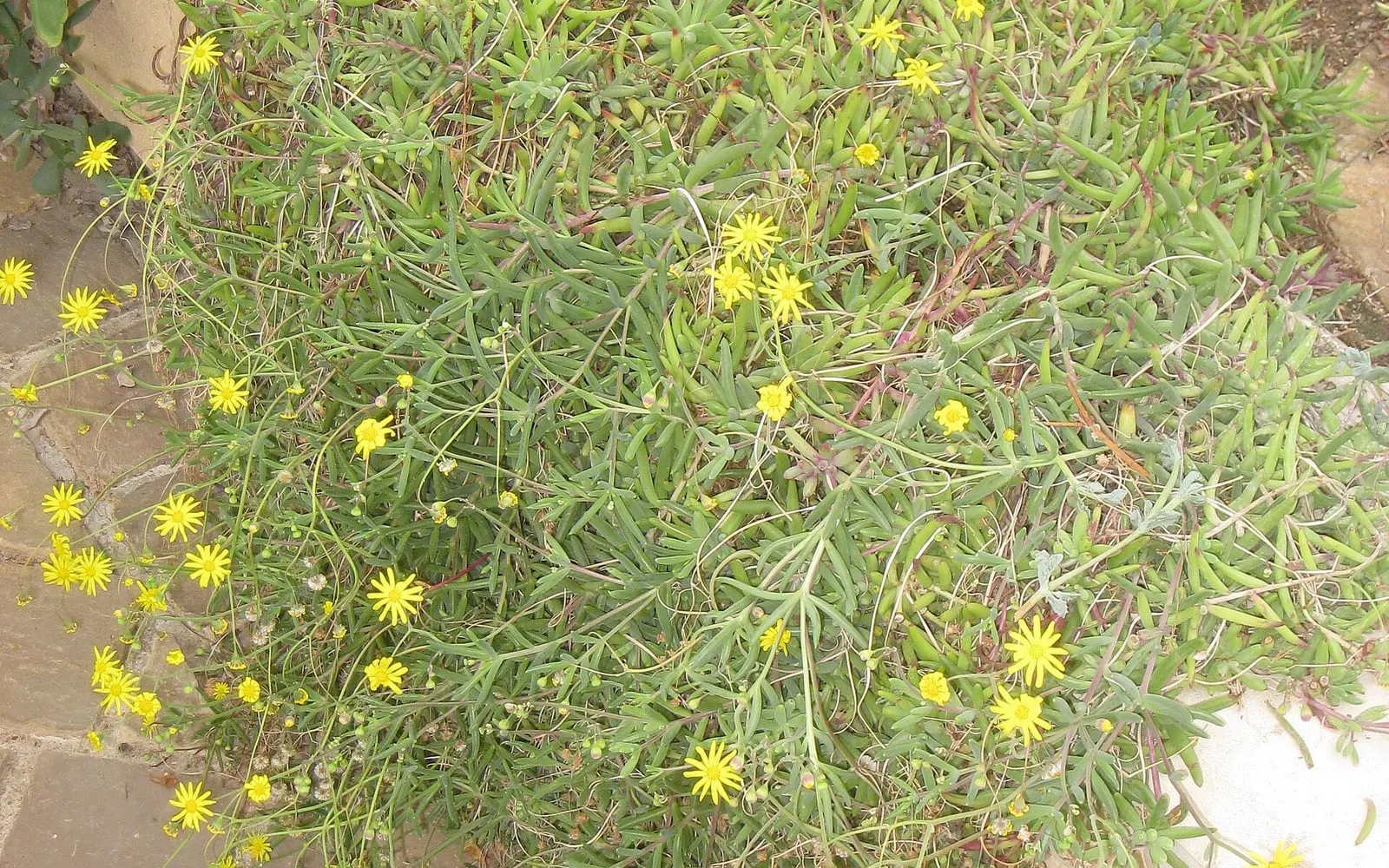
Ruby necklace shows its colour in strong light. Its slim, trailing stems are a deep purple, and along them hang small, bean-shaped leaves that blush from blue-green to a vivid ruby-red when the plant gets enough sun. Add small, bright yellow daisy flowers on thread-like stalks, and a well-lit plant is one of the most colourful trailing succulents there is.
The colour is the main appeal, and it depends on light. In good sun the leaves and stems turn red and purple; in shade they turn plain green and the stems stretch. So this is a plant grown for a bright sill or a sunny hanging spot, not a dim corner.
It comes from the dry Cape of South Africa and wants that reflected in its care: sharp drainage, long dry spells and as much light as you can give it. Like string of pearls it is a trailing succulent for a hanging pot, but where the pearls want protection from harsh midday sun, the ruby necklace wants all the sun it can take to hold its colour.
Appearance and character
The leaves are small, elongated and bean or sausage-shaped, blue-green in shade and turning ruby-red to purple in strong sun, hanging along the stems like beads on a string.
The stems are slim, wiry and a striking deep purple, trailing well over the pot rim and rooting where they touch damp soil, so the plant spreads and fills out readily.
Its flowers are small, bright yellow daisies on fine stalks, opening in sun and closing in dull weather or at night, and appearing generously on a well-lit plant over a long season.
Its colour shifts with the light, so the same plant can look green and leggy in a dark room or red and compact on a sunny sill, which tells you at a glance whether it is getting what it needs.
Where it is from
Othonna capensis is native to the dry, rocky country of the South African Cape, trailing over stones and banks in bright sun, storing water in its bean-like leaves against drought.
Give it strong light with direct sun, sharp drainage and long dry spells. It colours up red only under the sun stress it evolved with. Shade and damp make it turn green, stretch, and eventually rot.
How it grows
It grows quickly for a succulent in warmth and bright light, lengthening its purple stems and flowering over a long season, and slows in the shorter, duller days of winter. Strong light keeps it compact and red; weak light makes it green and lanky.
Grow it in a very free-draining, gritty cactus mix in a hanging pot or a raised pot where the stems can trail. Water only when the mix has dried right through, then soak and drain fully. Its faster growth means it drinks a little more than a slow succulent, but it still wants to dry out between waterings.
Give it the brightest spot you have, with several hours of direct sun, warmth above about 7 deg C, and dry, airy conditions. Pinch back leggy stems to keep it full, and the trimmings root easily.
Propagation is easy. Lay the purple stems on gritty mix and they root at the leaf nodes within weeks; set a handful of cuttings round one pot to bulk it out fast.
Through the seasons
Spring brings fast growth as light returns. Resume watering, pinch back any winter legginess, and take cuttings.
Summer is the main growing and flowering season in strong light. Water when the mix dries fully, feed lightly, and enjoy the reddest colour and the yellow daisies.
Autumn slows growth as light fades. Ease back on watering.
Winter is a near-dry rest. Keep it as bright as possible, cool but frost-free, and water only enough to stop the leaves shrivelling.
Care difficulty
Moderate. It grows and roots easily, but it has two linked demands: strong light to keep its colour and form, and sharp drainage to avoid rot. Deprived of light it turns green and leggy; kept wet it rots. Give it sun and a gritty, dry-side routine and it becomes easy. The colour itself is the best guide to whether it is getting enough light.
Watering
Let the gritty mix dry out completely, then water thoroughly and drain it fully. The bean-shaped leaves store water, so the plant tolerates a dry spell far more easily than a wet one, though its quicker growth means it drinks a shade more freely than a slow succulent through a hard summer.
Cut right back in winter to the odd sip, enough only to keep the leaves from shrivelling. Wrinkled leaves are thirsty and swell again after a drink. A purple stem that turns soft, yellow and see-through has rotted and comes off at once, with firm lengths saved to re-root.
Warning signs, diseases and pests
Green, stretched growth with widely spaced leaves is the most common complaint and almost always means too little light. Move it into direct sun and new growth comes back red, compact and closely leaved.
Wet compost rots the stems and roots, shown by soft, yellowing, see-through stems. Dry the pot out, cut back to firm tissue and re-root the healthy ends. Mealybugs tuck in as white fluff where the bean leaves meet the purple stems; dab them off with dilute alcohol and look the plant over often.
Loss of red colour, with the plant turning plain green, is the same light problem as legginess. It is a light issue, not a disease: give it more sun.
Growing environment
Bright light with several hours of direct sun is essential, both to hold the red and purple colour and to keep the plant compact and flowering. In poor light it turns green, stretches and stops blooming.
Warmth above about 7 deg C and dry, airy conditions suit it. It needs low humidity and dislikes stagnant damp, so a spot with some air movement helps prevent rot.
Hang it in a gritty, free-draining mix where the stems can trail into strong light, on a sunny sill or in a bright window, well away from cold draughts.
Feeding
A dilute cactus feed once or twice over spring and summer is all it takes. Overfeed and the stems grow soft and green, which weakens the ruby-red colour the plant is grown for, so keep the dose light and infrequent.
Give nothing over winter. Fresh gritty mix carries a newly potted plant through its first weeks.
Troubleshooting
It has turned green and gone leggy. Too little light. Move it into direct sun, and new growth comes back red, purple and compact. This is the plant’s main need.
The stems are soft, yellow and see-through. The plant has been overwatered and is rotting. Dry the pot right out, cut every mushy length back to firm purple stem, re-root the sound pieces and water more sparingly from now on.
The leaves have shrivelled. Thirst, after too long dry. A soak plumps them up.
How is it different from string of pearls? The ruby necklace has bean-shaped leaves on purple stems that redden in sun, where string of pearls has round, pea-like beads on green stems. The ruby necklace also wants more direct sun.
Is it safe around pets? Treat it with caution. It is in the daisy tribe that includes Senecio, whose members often carry liver-damaging pyrrolizidine alkaloids, so hang it out of reach of chewing pets and children.
Ruby Necklace problem guides
Not sure what is wrong? See the common houseplant pests guide.