
What is hydroponics? A beginner's guide
Hydroponics means growing plants in a nutrient solution instead of soil. Soil does three jobs for a plant. A hydroponic system has to take over all three, and once it does, plants grow quickly in nothing but water and dissolved feed.
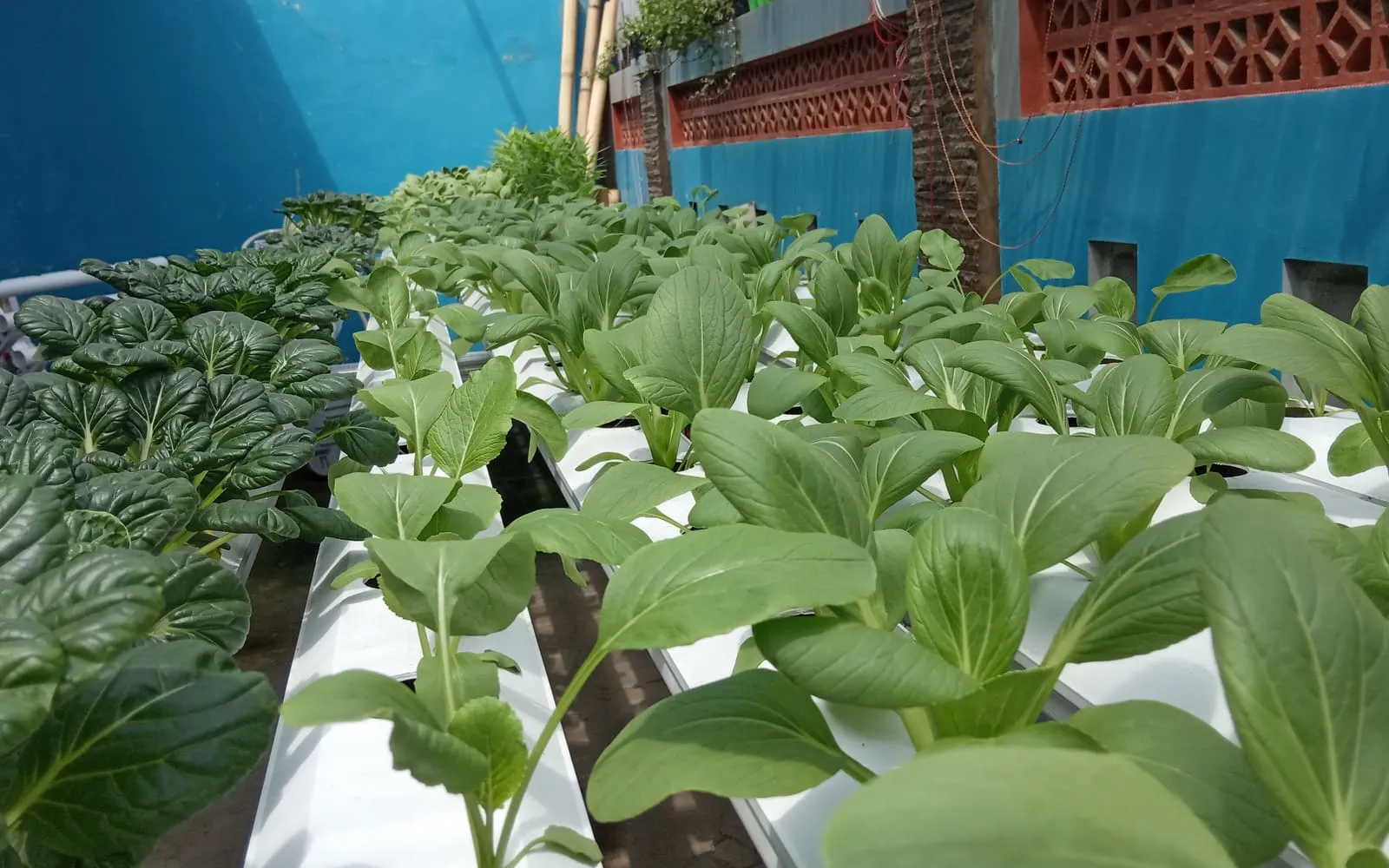
Hydroponics is growing plants without soil. Instead of rooting into the ground, the plant sits with its roots in water that carries dissolved mineral nutrients, or in an inert material like clay pebbles or rockwool kept wet with that same solution. The word comes from the Greek for water and labour.
To see why it works, it helps to know what soil does for a plant. Three things, mostly. It anchors the roots so the plant stands up. It holds a reserve of water and mineral nutrients for the roots to draw on. And, less obviously, it holds air in the gaps between its particles, which the roots need in order to breathe. A hydroponic system supplies all three another way, with no soil involved.
Why grow without soil?
So why bother, when soil is free and plants have managed in it for millions of years? A few reasons.
A plant in a well-run hydroponic system never has to hunt for food or water. Both are delivered to the roots at the right concentration, so more of the plant’s energy goes into growth. Lettuce and other leafy greens can be ready noticeably sooner than the same crop in soil.
It also uses far less water. A recirculating system reuses the same solution instead of letting it drain away into the ground, so it can grow a crop on a fraction of the water an open field needs. That counts for most where water is scarce.
And you can grow where there is no soil worth using. A flat roof, a balcony, a warehouse, a desert research station or the middle of a city all work, because you bring the growing medium with you. Indoors under lights, you can grow all year, whatever the season outside.
What the plant needs
Plants make their own sugars from light, air and water. What they cannot make are the mineral elements, the nitrogen, phosphorus, potassium, calcium, magnesium and the rest, that they use to build proteins, chlorophyll and cell walls. In soil these come from the ground. In hydroponics you supply every one of them, dissolved in the water, as a nutrient solution.
This is the part beginners underestimate. A hydroponic plant depends completely on what you put in the tank. You mainly watch solution strength and pH. Electrical conductivity gives you the strength, because dissolved nutrients carry a current and pure water does not. pH controls whether the roots can take those nutrients up at all. Most crops want a slightly acid solution, around pH 5.5 to 6.5. Let the pH drift and a plant can starve in a tank full of food, because the nutrients are present but locked in a form the roots cannot absorb.
The main systems, simplest first
Systems range from a jar on a windowsill to a computer-controlled greenhouse, but they all solve the same three problems in different ways. Start with the simple ones.
Wick systems are the kitchen-science version, with no pump at all. A wick runs from a reservoir of solution up into the pot, and the growing medium draws the liquid up it like a paper towel dipped in water. A wick can only move so much, so this suits herbs and small leafy plants rather than a thirsty tomato.
Deep water culture hangs the roots straight down into a tank of solution, with an air pump bubbling away to keep the water full of oxygen. It is cheap, simple and fast. For most home growers, this is the sensible first system. The passive version, often called the Kratky method, skips the pump and leaves an air gap above the water that the upper roots breathe from as the level drops.
Ebb and flow floods the roots with solution on a timer, then lets it drain back to the tank. The draining is half the point, because it pulls fresh air down around the roots between floods.
Nutrient film technique, or NFT, runs a thin film of solution down slightly sloping channels, so the lower roots sit in the flow while the rest stay in moist air above it. The channels of leafy greens in the photograph at the top are an NFT setup, and it is the workhorse of commercial salad growing.
Aeroponics goes furthest and mists the bare roots with solution in an enclosed chamber. It gives superb growth and uses the least water of all, but it is fiddly and unforgiving, so it is not where a beginner should begin.
Roots still need air
Remember the third job soil does, holding air for the roots? It is the one a beginner is most likely to get wrong. Roots need oxygen as much as leaves need light. Drop a plant’s roots into still, stagnant water and they suffocate and rot within days, the same root rot that kills an overwatered houseplant. Every system above gets air to the roots somehow. An air pump bubbles the tank, a thin film leaves the upper roots in the open, or a timed flood drains and lets air back in. If a system has gone still and smelly, oxygen is usually what it is short of.
What grows well, and what does not
Fast leafy crops are the easy win. Lettuce, spinach, basil, mint and other herbs grow quickly, stay small and are ready before much can go wrong. Watercress, which grows in moving water in the wild, takes to it with no trouble at all.
Fruiting crops like tomatoes, cucumbers and peppers work well too, but they are taller, hungrier and thirstier, so they need support, a stronger solution and more attention. Root crops such as carrots and potatoes are the poor fit, because there is no soil for the root to swell into and no simple way to hold it steady.
What it is good and bad at
So, is it worth it? That depends on what you want from it.
You get fast, clean, predictable growth in a small space, on very little water, in places where growing in soil is hard or impossible. That is why it supplies salad to cities, herbs to supermarkets, and fresh vegetables to research stations and, yes, the space station.
Against that, the system has to keep working, and you have to keep checking it. There is no reservoir of soil to buffer a mistake. Miss the pH for a week and growth stalls. Lose power to the air pump on a hot afternoon and a deep-water crop can be dead by evening. A disease in the tank reaches every plant through the shared water, which is why cleanliness matters more here than in a border. And running lights and pumps indoors uses electricity, which can cost more than the water it saves.
Getting started
If you want to try it, start small and passive. A single deep-water tub or a Kratky jar with a lettuce or some basil needs no pump and almost no kit, and it teaches you the two numbers you have to watch, pH and solution strength, on a plant you can afford to lose. Get one leafy crop to harvest before you spend money on channels, pumps and lights. Larger systems use the same principles, with more plumbing, monitoring and failure points.
Common questions
- What is hydroponics in simple terms?
- Growing plants without soil. The roots sit in water that carries dissolved mineral nutrients, or in an inert material like clay pebbles kept wet with that solution. Soil normally holds the plant up, feeds it and gives the roots air, and a hydroponic system does all three another way.
- Is hydroponic produce as healthy as soil-grown?
- Yes. A plant builds the same sugars, vitamins and structure whether the minerals come from soil or from a nutrient solution, because it takes them up as the same dissolved ions either way. Taste and nutrition depend far more on the variety, the light and how fresh the crop is than on whether it grew in soil.
- What plants grow best in hydroponics?
- Fast leafy crops and herbs are the easy start, such as lettuce, spinach, basil and watercress. Fruiting crops such as tomatoes, cucumbers and peppers work but need more support, feed and attention. Root crops like carrots and potatoes are a poor fit, because there is no soil for the root to swell into.
- Do you need special nutrients for hydroponics?
- Yes. Ordinary garden fertiliser is not enough, because soil normally supplies several nutrients the water must now carry instead. Hydroponic feeds are made up to provide the full set of elements, and you also watch the solution's strength and its pH, since a wrong pH stops the roots taking the nutrients up.
- What are the main downsides of hydroponics?
- It depends on a working system and on you. There is no soil to buffer a mistake, so a wrong pH, a power cut to the air pump or a disease in the shared water can affect every plant quickly. Setups cost more to buy than a few pots, and running pumps and indoor lights uses electricity that can outweigh the water it saves.
- Is hydroponics cheaper than growing in soil?
- Not usually for a home grower. The water and space savings are real, but the kit, the nutrients and the electricity for pumps and lights add up, so a windowsill of soil pots is cheaper for a bit of salad. Hydroponics earns its place where soil growing is hard, space is tight, or water is scarce.
Sources and further reading
- HydroponicsRoyal Horticultural SocietyThe RHS overview of growing plants on dissolved mineral salts instead of soil.
- Hydroponics: A Brief Guide to Growing Food Without SoilUniversity of Nevada, Reno ExtensionSystems, nutrients and water use, written for the non-commercial grower.
- Growing without soil: getting started with hydroponics at homeUniversity of Illinois ExtensionA practical starting point, including the trade-offs and start-up costs.