
Houseplant
Button Plant
Conophytum calculus
Also known as Conophytum calculus, Marble Buttons, Living Pebble
How to grow Conophytum calculus, the button plant, a tiny living stone with a near-perfect grey-green sphere that grows in winter.
At a glance
- Difficulty
- Moderate
- Water
- Only in the autumn-to-spring growing season, when the mix is dry
- Light
- Bright light with some direct sun
- Temperature
- Warm to cool; keep above about 5 deg C
- Humidity
- Low
- Hardiness
- USDA 9-11, RHS H2, hardy to 4 C
- Type
- Evergreen dwarf succulent, winter-growing
- Height
- Each body 1 to 2 cm across
- Native to
- South Africa
A dwarf living-stone succulent from the arid Namaqualand region of South Africa, where it survives fierce sun and drought as a small sphere among quartz pebbles. It grows through the cool, moist autumn and winter and rests bone-dry through the hot summer, wanting bright light and extremely sharp drainage. It has little frost tolerance, is safest above about 4 deg C, and rots if watered in its summer rest.
Hardiness zones describe winter cold alone. Summer heat, humidity, rainfall and the length of the growing season decide as much, so treat the range as the outer limit rather than as a recommendation.
Not known to be toxic
This is a safe plant to keep around pets and children. Conophytum, one of the mesemb or living-stone group, is not listed as toxic by the ASPCA or the RHS, and no harmful compound is recorded. The tiny bodies are so small and so pebble-like that a pet is unlikely to notice them. A bitten one would cause at most a brief, mild stomach upset.
Sources: ASPCA toxic and non-toxic plants, RHS potentially harmful garden plants
About
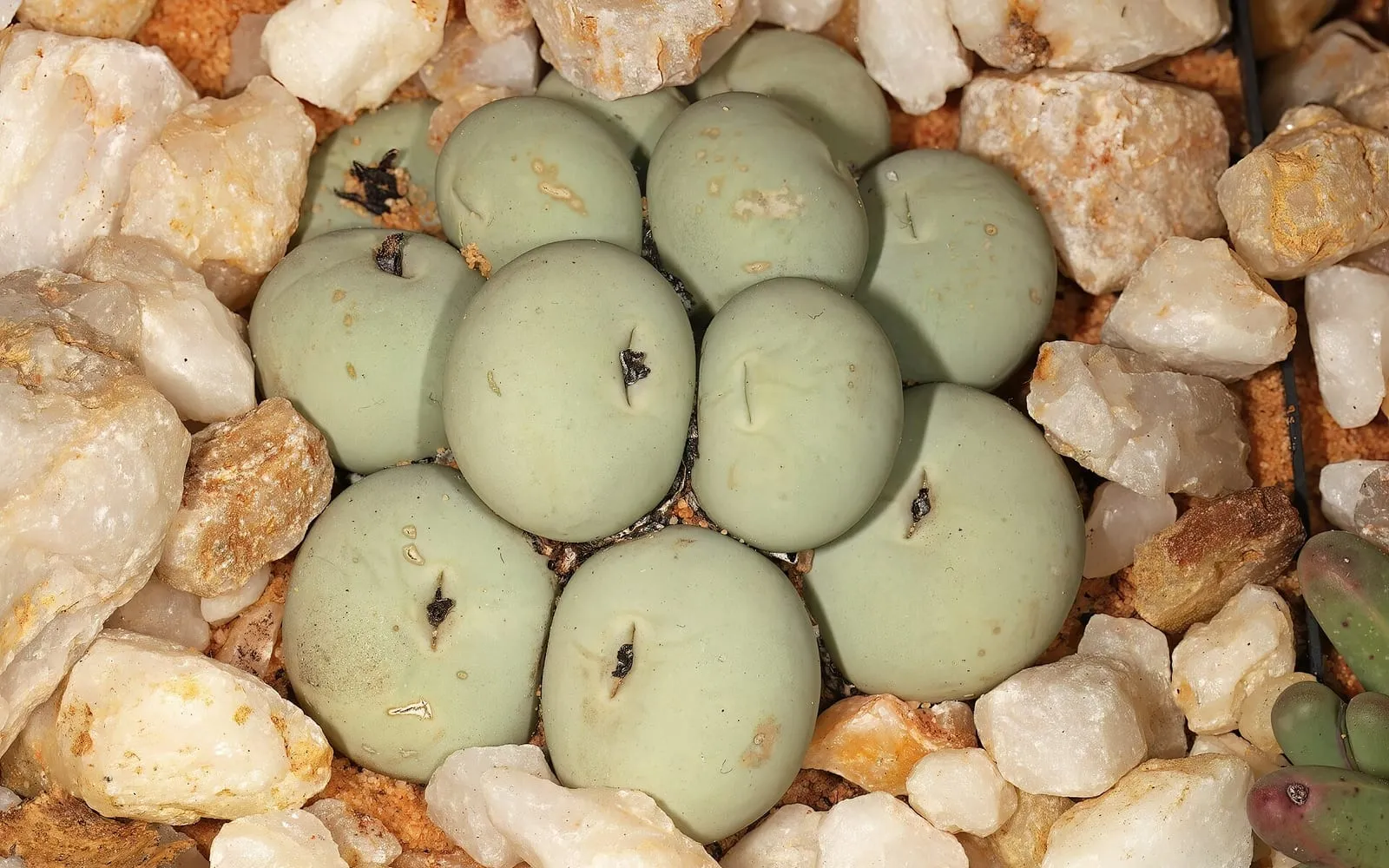
Button plant is a living pebble. Each plant is a single, almost round grey-green sphere, one to two centimetres across, smooth and firm and coloured to match the pale quartz gravel it grows among in the wild. What looks like a rounded body is in fact a single pair of leaves fused into a ball, with a tiny slit at the top for the flower and the next season’s growth. Over time the spheres cluster into neat cushions of marbles.
It belongs to the mesembs, the living stones, and follows their strict seasonal pattern. It grows through the cool, moist autumn, winter and early spring, then rests through the hot, dry summer, when each body dries to a papery sheath that wraps and shields the new one forming inside. That summer skin is normal, and the plant renews itself by shedding it as growth restarts.
The main rule is to match its calendar. Water it in the cool growing season and keep it bone-dry through summer. Water it at the wrong time and it bursts or rots. It is small, slow and undemanding once you know when it grows and when it rests.
Appearance and character
Each body is a smooth, near-spherical fused leaf pair, one to two centimetres across, grey-green to pale bluish, sometimes finely dotted, with a small slit at the top. It looks convincingly like a rounded pebble.
The bodies cluster over time into low cushions of many marbles, as the plant divides and multiplies at the base, so an old plant is a tidy dome of little spheres.
Its flower emerges from the slit at the top, a small daisy-like bloom, often pale yellow and scented at night to draw moths, appearing in autumn as growth restarts.
Through summer dormancy each body dries to a papery, buff sheath that protects the new body forming within, a shrivelled look that is normal.
Where it is from
Conophytum calculus grows in the arid Namaqualand and Richtersveld regions of South Africa, among quartz pebbles on baking, sun-exposed flats, where it survives extreme drought and heat by mimicking the stones around it and shrinking into itself through the dry season.
Give it bright light and extremely sharp, mineral drainage. It grows only in the cool, moist part of the year, and must be kept completely dry through its summer rest. It has no tolerance for rich compost, standing water or summer watering.
How it grows
Its growing season runs through autumn, winter and early spring, when it takes up water, flowers, and forms new bodies. Through summer it is dormant, each body drying to a sheath around the next, and it should be left completely dry then. Most problems come from treating it like a summer-growing succulent.
Grow it in an extremely free-draining, mineral, gritty mix, ideally top-dressed with quartz gravel to match its habitat, in a small pot or pan. Water only in the cool growing season, and only when the mix is dry, giving small amounts instead of soakings.
Give it bright light with some direct sun, keep it warm to cool above about 4 deg C, and above all keep it bone-dry through summer. As growth restarts in autumn, the old papery sheaths split and the fresh bodies emerge; a light watering then helps them through.
Propagate by dividing a clump into rooted pieces at the start of the growing season, or from seed.
Through the seasons
Autumn ends the summer rest and begins the growing season. The old sheaths split, new bodies and flowers emerge, and light watering resumes as the mix dries.
Winter is the main growing season. Give bright light, water sparingly when the mix is dry, and keep it above about 4 deg C.
Spring continues growth as the weather warms, then tapers towards dormancy. Reduce watering as the bodies begin to form their summer sheaths.
Summer is complete dormancy. Give no water at all. Each body dries to a papery sheath around the next; this is normal, and watering now rots or bursts the plant.
Care difficulty
Moderate, and mainly a matter of following its calendar. The plant itself is tiny, slow and tough, but it must be watered only in the cool growing season and kept absolutely dry through its summer rest, which is the reverse of most succulents. Water it in summer and it rots or splits. Keep the compost mineral, drainy and dry at the right time, and it is much easier.
Watering
Water only during the autumn-to-spring growing season, and only when the gritty mix has dried, giving small amounts to keep the bodies plump without soaking them. The plant takes up little at a time.
Give no water at all through the summer dormancy, when each body is drying to its protective sheath. Summer water is the surest way to kill it, bursting the bodies or rotting the roots. Bodies that shrivel to sheaths in summer are resting normally; a body that splits open or goes soft and translucent has been overwatered.
Warning signs, diseases and pests
Water during summer dormancy rots the roots or bursts the bodies. This is the usual serious mistake. Keep it completely dry through summer and water only in the cool growing season. A soft, translucent or split body signals overwatering.
Mealybugs lodge between the clustered bodies as white fluff, well hidden in the crevices; dab them off with dilute alcohol and inspect the cushion closely, since they are easy to miss among the marbles.
Bodies that fail to shed their old sheaths in autumn have usually been too dry for too long or grown too warm; a light watering as growth restarts helps the new bodies emerge.
Growing environment
Bright light with some direct sun keeps the bodies firm, compact and well coloured. In poor light they grow soft, pale and elongated, losing their neat pebble shape. It needs strong light, as in its open habitat.
Warm to cool conditions suit it, above about 4 deg C. It needs low humidity and extremely sharp drainage, and dislikes any stagnant damp. A bright windowsill or a well-ventilated frame suits it.
Grow it in an extremely free-draining, mineral, gritty mix in a small pot or pan, top-dressed with gravel, in bright light. Let the season decide whether you water.
Feeding
Feed little or not at all. At most, give a single very dilute, low-nitrogen feed once in the growing season. Rich feeding forces soft, swollen bodies that split and rot.
Give nothing in summer dormancy. Fresh gritty mix supports a divided or repotted plant through its first season.
Troubleshooting
A body has split open or gone soft and translucent. Overwatering, most often from watering during the summer rest. Keep it completely dry in summer and water only in the cool growing season.
The bodies have shrivelled to papery skins in summer. This is normal summer dormancy. Each dried body is a sheath protecting the new one inside. Do not water; growth and fresh bodies return in autumn.
When do I water it? Only in the cool growing season, autumn through spring, and only when the mix is dry. Give none at all through summer. This reversed calendar is the main thing to get right.
There is white fluff between the bodies. Mealybugs hiding in the crevices. Dab them off with dilute alcohol and check the cushion closely, since they are easily missed.
Is it safe around pets? Yes. Conophytum is not listed as toxic, and the bodies are so small and pebble-like that pets rarely notice them.
Button Plant problem guides
Not sure what is wrong? See the common houseplant pests guide.