
Edible
Arnica
Arnica montana
Also known as Mountain tobacco, Leopard's bane, Wolf's bane
How to grow arnica, Arnica montana. The acid-soil mountain daisy, why it fails in ordinary garden ground, and the reason it is never taken by mouth.
At a glance
- Difficulty
- Difficult
- Water
- In dry weather. It wants moisture without richness
- Light
- Full sun
- Temperature
- Fully hardy. It is a mountain plant
- Hardiness
- USDA 4-8, RHS H7, hardy to -25 C
- Type
- Hardy herbaceous perennial
- Height
- 20-60 cm
- Native to
- the mountains of Europe
- Best month
- June and July in the Northern Hemisphere, December and January in the Southern Hemisphere
Poor acid low-nutrient mountain pasture is the requirement, and that is why it defeats most gardeners, since ordinary fertile soil kills it within a season. Cold is no obstacle at all. Wild populations have collapsed across Europe as pasture has been fertilised, and several countries now protect it.
Hardiness zones describe winter cold alone. Summer heat, humidity, rainfall and the length of the growing season decide as much, so treat the range as the outer limit rather than as a recommendation.
Every month named in this guide is for the temperate Northern Hemisphere. If you garden in the Southern Hemisphere, shift each one by six months, so June becomes December. Closer to the equator the wet and dry seasons matter more than the calendar, and the shift stops being a useful guide.
Toxic if eaten
- Do not eat
- The whole plant, and the flowers most of all
- Harm from
- Eating it and handling it
- Affects
- People, cats, dogs and horses
Arnica is used externally in creams and gels for bruises and it is not taken by mouth. The reason is helenalin and related sesquiterpene lactones, which are toxic when swallowed: ingestion causes vomiting, abdominal pain, and in larger quantities cardiac effects, and fatal cases are recorded in the older literature. Homoeopathic arnica preparations are diluted to the point of containing effectively none of the plant and are a separate matter entirely from the herb. Applied to skin, arnica causes contact dermatitis in a proportion of people and should not be used on broken skin. The ASPCA lists arnica as toxic to dogs, cats and horses. In a garden the plant is not a hazard to walk past, and it is not a plant to eat, brew or give to an animal.
Sources: ASPCA (Arnica, Arnica montana), RHS potentially harmful garden plants
About
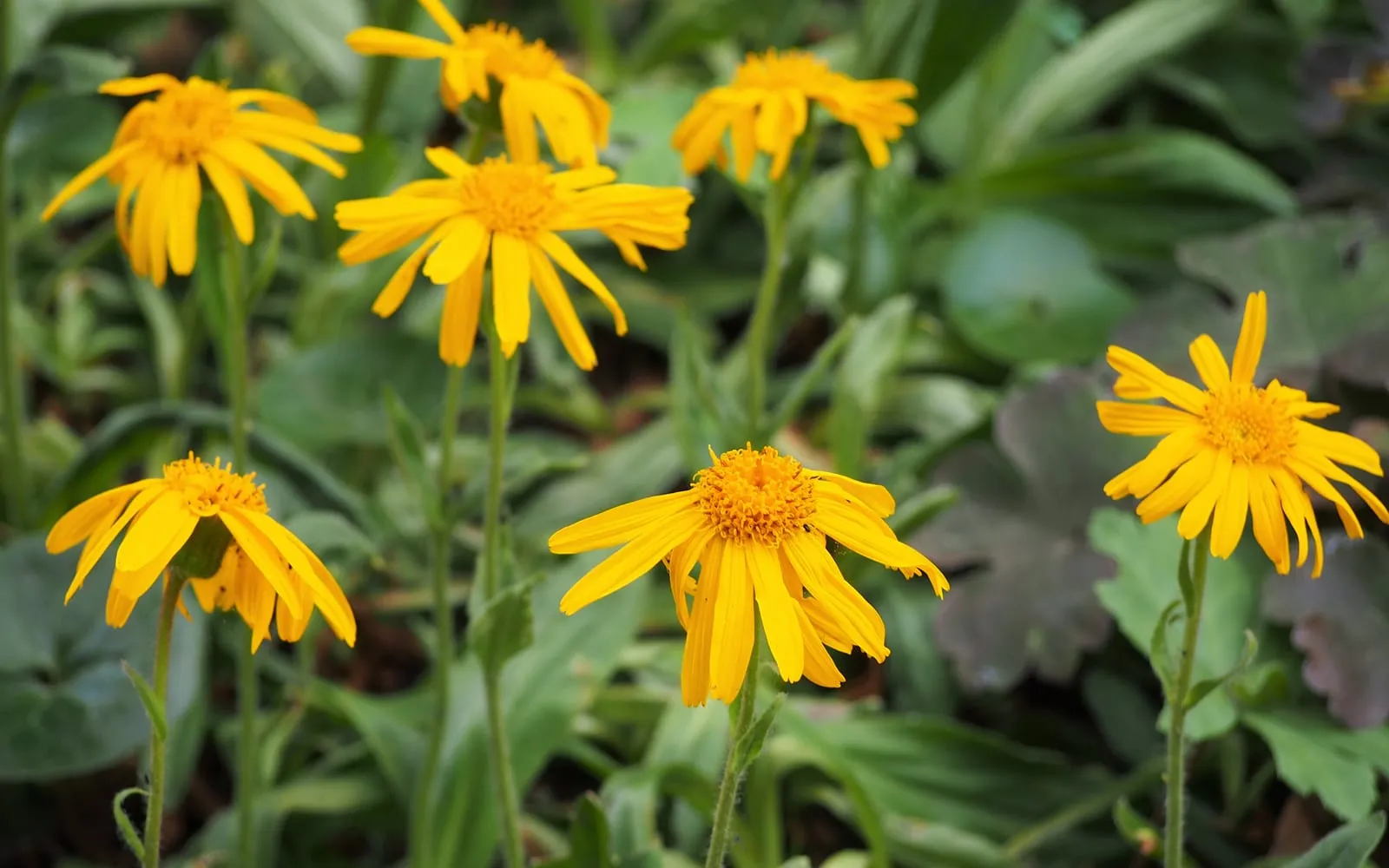
Arnica is a mountain daisy from the acid upland pastures of continental Europe, and the plant behind the bruise creams sold in every chemist. Golden-orange flowers on upright stems above a flat rosette of hairy leaves, flowering in June and July.
Growing it in a temperate garden is difficult for a specific reason. Arnica needs acid, poor, low-nutrient soil, and it is actively suppressed by fertility. In ordinary garden ground it is outcompeted within a season or two, and on chalk it dies outright.
The same requirement explains its decline in the wild. Agricultural improvement of upland pasture, and nitrogen deposition from the air, have removed arnica from much of its European range, and it is protected in several countries.
Appearance and character
A flat basal rosette of oval leaves, 5 to 15 cm long, bright green, hairy and prominently veined, pressed close to the ground.
Flowering stems rise 20 to 60 cm, unbranched or with one or two side branches, hairy and sticky, carrying one or two pairs of small opposite leaves.
The opposite stem leaves separate arnica from most similar mountain daisies, which carry theirs alternately.
Flowers are large golden-orange daisies, 5 to 8 cm across, with slightly ragged and uneven ray petals that give the head a windblown look even in still air.
The whole plant is aromatic and slightly sticky to the touch.
Seed carries a dirty white pappus and disperses on the wind.
Where it is from
Arnica is native to the mountains of Europe, from Scandinavia and the Baltic south through the Alps, Pyrenees, Carpathians and Balkans, growing on acid upland pasture, heath and open woodland between about 500 and 2,500 metres.
It is not native to Britain, and it will not grow anywhere without the acid low-nutrient conditions it depends on.
Its medicinal use in Europe goes back to at least the sixteenth century for bruises, sprains and muscular pain, applied to the skin rather than taken internally.
Its decline is a documented conservation problem. Improved upland pasture, lime application and atmospheric nitrogen deposition all favour the grasses that outcompete it, and arnica is protected in Germany, and listed in the EU Habitats Directive.
Wild harvesting has added to the pressure, and cultivated crops in eastern Europe now supply a growing share of the herbal trade.
How it grows
Sow fresh seed in autumn or early spring. Germination is slow and uneven, and seed loses viability quickly, so use fresh seed and sow plenty.
Sow on the surface of an acid, low-nutrient compost, since the seed needs light. Ericaceous compost mixed with sharp sand is a reasonable substitute for its natural soil.
Keep the pot outdoors. A period of cold improves germination.
Grow seedlings on in ericaceous compost and plant out at 30 cm.
Choose an acid, poor, sandy, sunny position. This is the single condition that decides success, and there is no way around it on chalk or on a rich border.
Use rainwater. Tap water in hard water areas raises the pH and the plant responds badly.
Do not feed it and do not lime the ground. Fertility is what removes arnica from a site.
Divide established plants in spring every few years, which is easier than raising new ones from seed.
Deadhead to prolong flowering, or leave the heads for seed.
Through the seasons
Winter is a flat rosette or bare ground, and the plant is entirely hardy.
Spring brings new leaves and the flowering stems from May. Divide now if needed, and watch for slugs.
Early summer is flowering, in June and July, and the flowers last for weeks.
Midsummer ripens seed on undeadheaded plants. Collect it fresh and sow it straight away.
Autumn is when the rosette settles down for winter. Keep the crown clear of fallen leaves and standing water.
Care difficulty
Difficult, and the difficulty is soil chemistry rather than anything a gardener does.
Arnica needs acid, poor, low-nutrient ground. On neutral or alkaline soil it fails, and on a fertile bed it is outgrown by everything around it within a season or two. A raised bed of ericaceous compost and sharp sand is the practical answer for most gardens.
Hard tap water gradually raises the pH around the roots. Use rainwater.
Germination is slow and unreliable, and the seed does not keep. Buy fresh, sow plenty and be patient.
Slugs concentrate on the emerging rosette and can kill a young plant.
Winter wet rots the crown, so drainage has to be sharp even though the plant wants summer moisture.
Given all of that, it is a plant for someone who wants it specifically rather than a general herb garden addition.
Watering
Water with rainwater. Tap water in a hard water area raises the pH around the roots and arnica will not tolerate it.
Water in dry weather through the summer. The plant wants moisture, and what it cannot have is richness.
Water moderately rather than heavily, and never let it sit wet in winter.
Keep the crown dry over winter, which means drainage rather than reduced watering.
A container of ericaceous compost with sharp sand works well and lets you control the water and the pH, and it needs watering two or three times a week in summer.
Warning signs, diseases and pests
Root and crown rot in wet winter ground kills established plants. Improve drainage without removing the summer moisture.
Slugs graze the young rosette and will destroy a seedling. Protect young plants.
Aphids gather on flower stems and rarely need action.
A plant that declines steadily over two seasons in a normal border is being outcompeted and starved of the conditions it needs. Move it to a raised acid bed.
Yellowing between the veins means the soil is too alkaline. Use rainwater and ericaceous compost, or move the plant.
Seed that fails to germinate is usually stale. It does not keep.
Weak leggy growth means too much shade.
Growing environment
Full sun. It grows in open mountain pasture and needs the light.
Acid soil, around pH 4.5 to 6. This is not negotiable, and on chalk the plant will not grow at all.
Poor, sandy, low-nutrient ground. Fertility is what removes arnica from a site, in a garden and in the wild.
A raised bed filled with ericaceous compost and sharp sand, or a large container of the same, is the reliable option in an ordinary garden.
It is fully hardy anywhere in its range and does better in a cool wet region than in a hot dry one.
An acid heath or moorland-style planting suits it, alongside heathers and other acid-ground plants that want the same treatment.
Feeding
None, and this is one plant where feeding is actively harmful rather than merely unnecessary.
Arnica is adapted to nutrient-poor ground and it is outcompeted wherever fertility rises. Nitrogen deposition from the air is one of the documented causes of its decline across Europe.
Do not lime the soil under any circumstances.
Do not mulch with compost or manure. Sharp sand or grit is the right surface dressing.
Refresh a container with fresh ericaceous compost every second year rather than feeding it.
Troubleshooting
It died within a year. Almost certainly the soil. Arnica needs acid, poor, low-nutrient ground and it will not survive on neutral or alkaline soil or in a fertile border. Grow it in a raised bed of ericaceous compost and sharp sand.
Can I take it internally? No. Arnica contains helenalin and related compounds that are toxic when swallowed, and it is used externally only. Homoeopathic preparations are so dilute as to be a separate matter.
Is it safe around pets? The ASPCA lists it as toxic to cats, dogs and horses if eaten. Walking past it is not a risk, and it is not a plant to let an animal graze.
Nothing germinated. Arnica seed is short-lived and germinates slowly and unevenly. Use fresh seed, sow on the surface, and keep the pot outdoors over winter.
It got smaller each year. Outcompeted. Arnica loses to anything more vigorous on fertile ground. Give it a bed of its own.
Is it the same as leopard’s bane? The name is shared with Doronicum, a yellow-flowered spring daisy that is a different and much easier plant. Arnica is the orange one with opposite stem leaves.
Can I use tap water? Not in a hard water area. It raises the pH around the roots. Use rainwater.