
Outdoor plant
Northern Maidenhair Fern
Adiantum pedatum
Also known as Five-finger fern
How to grow northern maidenhair fern, Adiantum pedatum, in shade. Its wiry black stalks, hardiness compared with houseplant maidenhairs, and dry-shade limits.
At a glance
- Difficulty
- Difficult
- Water
- Constantly moist soil, never allowed to dry out
- Light
- Partial to full shade
- Hardiness
- USDA 3-8, RHS H7, hardy to -30 C
- Type
- Deciduous perennial fern
- Height
- 30-60 cm
- Native to
- North America, East Asia
Reliably hardy through severe winters, dying back completely to the rhizome and re-emerging each spring across a wide swathe of the northern temperate world. Cold is rarely the limiting factor for this fern; dry soil and hot, dry summer air cause the most trouble, and it performs noticeably worse in a warm, exposed summer climate than a sheltered woodland one.
Hardiness zones describe winter cold alone. Summer heat, humidity, rainfall and the length of the growing season decide as much, so treat the range as the outer limit rather than as a recommendation.
Not known to be toxic
Northern maidenhair fern has no toxicity listing from the RHS or the ASPCA and is considered safe around pets and children. It has no documented history of poisoning, and the fine, delicate fronds are not something anything is likely to eat in any quantity.
Source: RHS
About
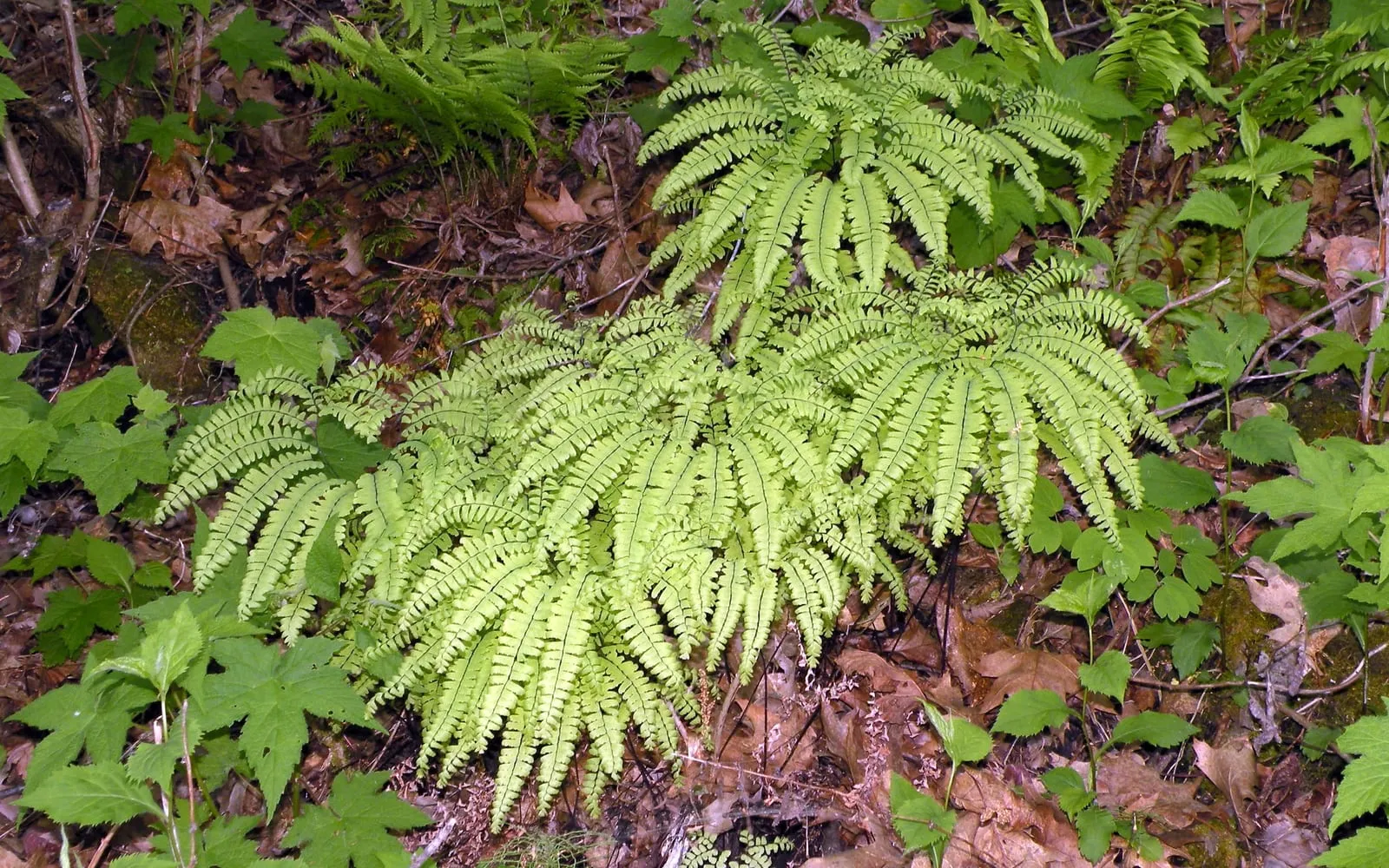
The northern maidenhair fern brings the delicate, fan-shaped fronds usually associated with tender houseplant maidenhairs into a fully hardy garden plant, capable of surviving winters far colder than any windowsill species in the same genus could tolerate. Wiry black stalks branch in a distinctive forked, horseshoe pattern, each branch holding a row of small, fan-shaped leaflets that give the whole frond a light, airy character unlike almost any other hardy fern.
It occurs naturally on two continents separated by an ocean, found across much of temperate North America and, in a closely related form some botanists treat as the same species, across parts of East Asia, a distribution pattern shared by a number of other plant groups with an ancient, once-continuous range.
Appearance and character
Fronds arise on slender, glossy black-brown stalks that fork near the top into two curving branches, each one holding a single row of small, fan-shaped leaflets along its outer edge, an arrangement that gives the whole frond a distinctive horseshoe or open-hand silhouette. New growth unfurls a soft pinkish-bronze before settling into a fresh light green.
The overall effect is markedly more delicate and finely textured than most hardy garden ferns, closer in appearance to the tender maidenhairs commonly grown as houseplants, though this species is fully deciduous, dying back completely each winter rather than persisting year round the way an indoor maidenhair would in a heated room.
Where it is from
Rich, moist deciduous woodland across much of temperate North America and, in related forms, parts of East Asia, typically on neutral to slightly alkaline soil over limestone or similarly base-rich rock, often on shaded slopes or streambanks.
That woodland floor origin, with reliable shade, leaf litter and steady moisture, is much more specific than the conditions many other hardy ferns tolerate, which is why this species has a reputation among gardeners as one of the more particular hardy ferns to keep looking its best over several years.
How it grows
A deciduous perennial spreading slowly by a creeping rhizome just below the soil surface, sending up new fronds each spring from growing points along its length. Growth is unhurried, and a young division can take a couple of seasons to build up the dense, well-furnished clump the species is prized for.
Because the rhizome creeps rather than staying in one fixed crown, an established planting gradually widens over the years, though at nothing like the pace of an aggressively invasive spreading fern.
Through the seasons
Spring: New fronds appear from the creeping rhizome. They are pink-bronze at first and usually emerge later than many other hardy ferns.
Summer fronds reach full size and their characteristic light green. Consistent watering through summer is the single most important task for this species.
Autumn fronds begin to yellow and die back with the shortening days and cooling temperatures.
Winter: The rhizome is fully dormant and hardy, needing no protection, though a mulch helps retain the moisture the rhizome benefits from even while dormant.
Care difficulty
Difficult relative to most other hardy garden ferns, not because any single requirement is extreme but because several specific conditions all need to be met together: reliable shade, humus-rich and slightly alkaline soil, and soil moisture that never lapses for long through a whole growing season. A spot that gets even one of these wrong tends to produce a plant that survives without ever looking its best.
Watering
Consistently moist soil is essential throughout the growing season, and this species is noticeably less tolerant of drying out than many other hardy ferns. A dry spell that a scaly male fern or soft shield fern would shrug off can scorch and collapse the fronds of a maidenhair within days.
A generous, well-maintained mulch of leaf mould around the rhizome, renewed each spring, does a great deal to buffer soil moisture through short dry periods and is close to essential for growing this species well over several years.
Warning signs, diseases and pests
Slugs and snails graze the tender new fronds as they unfurl in spring, and because the fronds are so delicate, even light grazing shows up clearly as notched or torn leaflets. Protecting new growth at this vulnerable stage matters more for this species than for tougher, coarser-leaved ferns.
Scorched, collapsed fronds in summer almost always indicate the soil has dried out, and recovery depends on how long the dry spell lasted; a fern caught early and watered promptly often produces a fresh flush of fronds within a few weeks, while a rhizome left dry for an extended period can be killed outright.
Poor, sparse growth on soil that is otherwise reasonably moist can indicate soil that has become too acidic for this lime-loving species, particularly where the surrounding planting favours acid-loving shrubs like rhododendron. A light application of garden lime can help correct this over a season or two.
Growing environment
Partial to full shade suits it best, ideally the dappled light found beneath deciduous trees rather than the deep, dry shade close to a wall or evergreen hedge. Neutral to slightly alkaline soil, enriched generously with leaf mould or garden compost, gives the best results, and this is one of relatively few common garden ferns that actively prefers some lime in the soil rather than tolerating or avoiding it.
Feeding
An annual mulch of leaf mould or garden compost around the rhizome each spring supplies most of what this fern needs, feeding it gently while also helping to hold moisture in the soil through the growing season. Heavier feeding is rarely necessary and can encourage soft, weak growth more prone to collapsing in dry weather.
Troubleshooting
Fronds have scorched and collapsed in summer. Almost always dry soil. Water thoroughly and promptly, and mulch generously to prevent a repeat; recovery depends on how long the dry spell lasted before it was noticed.
New fronds are notched or torn as they unfurl. Check for slugs and snails, which find the tender new growth of this species particularly appealing, and protect vulnerable young fronds until they toughen up.
Growth is sparse despite apparently moist, shaded soil. Consider whether the soil has become too acidic for this lime-preferring fern, especially near acid-loving shrubs, and try a light application of garden lime.
The clump has failed to establish after a full season. Check the planting depth and soil preparation; this species often struggles in soil that has not been generously enriched with leaf mould or similar organic matter before planting.